
Casino dice games in Australia: craps, Sic Bo, and the legal gap around them
A casino dice game is not one thing. The phrase covers craps — the English-language casino classic — alongside Sic Bo, Dice Duel, Nutz, and the live dealer variants offshore operators stream to Australian screens. What separates them is not whether dice are rolled, but who rolls them, how the bets are priced, and where the game is being played. In Australia, that last question matters more than the others: online casino is prohibited under the Interactive Gambling Act 2001, and no Australian licence exists for any of these games on the internet. Every dice game an Australian player finds online comes from an offshore operator, outside Australian consumer protection, and potentially one ACMA blocking order away from disappearing.
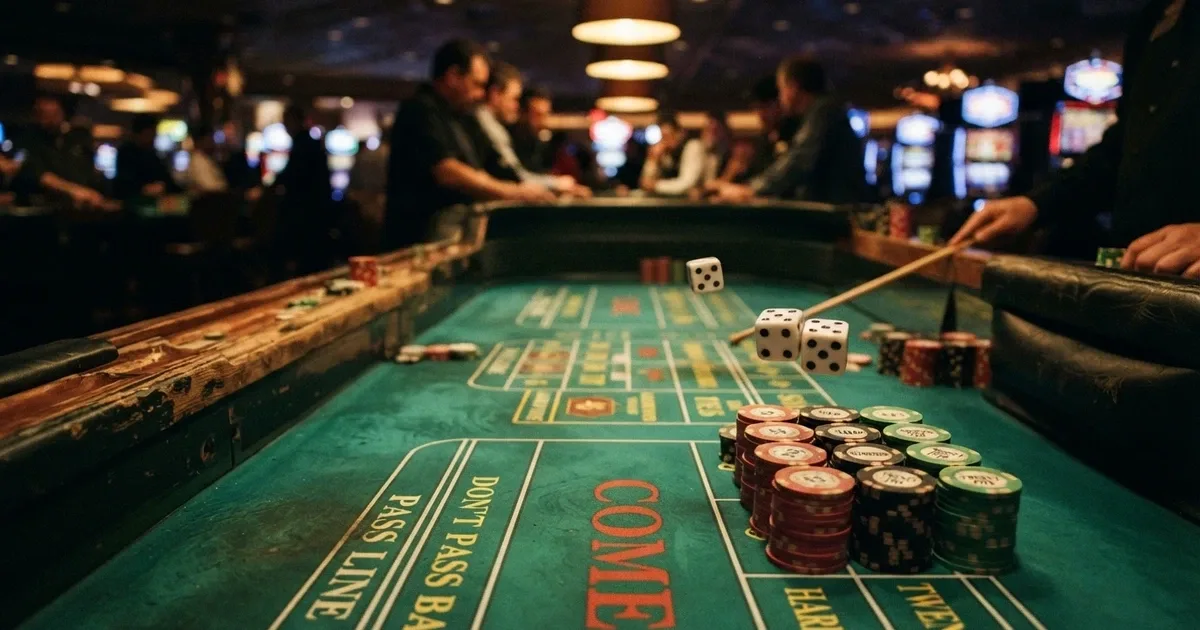
This page covers what the dice games actually are, where Australian players can and cannot play them, what the house edge on each bet looks like in 2026, and what an offshore sign-up costs the person making it. Current as of 22 November 2026 and cross-checked against the ACMA register, the VGCCC rules database, and Curaçao Gaming Control Board licence records.
Table of Contents
- What a casino dice game actually is — and what it isn’t
- The dice games Australian casinos actually run
- Why the rules matter more than your luck in a dice game
- Playing dice online from Australia — the real picture
- The offshore operators Australians reach for dice games
- Why online casino dice is prohibited in Australia
- Responsible gambling: the safety net most Australian players never use
- Frequently asked questions
- The dice decision every Australian player has to make in 2026
What a casino dice game actually is — and what it isn’t
A casino dice game is any wagering game played in a casino where the outcome is determined wholly or primarily by the roll of one or more dice, and where the bet is placed against the house rather than against other players. That definition pulls in five things a reader who searched “casino dice game” will recognise by name: craps, Sic Bo, Dice Duel, Nutz, and the live dealer variants (Lightning Dice, Super Sic Bo, Evolution Craps Live). It also pulls in a long tail of street and carnival games — hazard, chuck-a-luck, bank craps — that most players will not meet in a commercial casino.
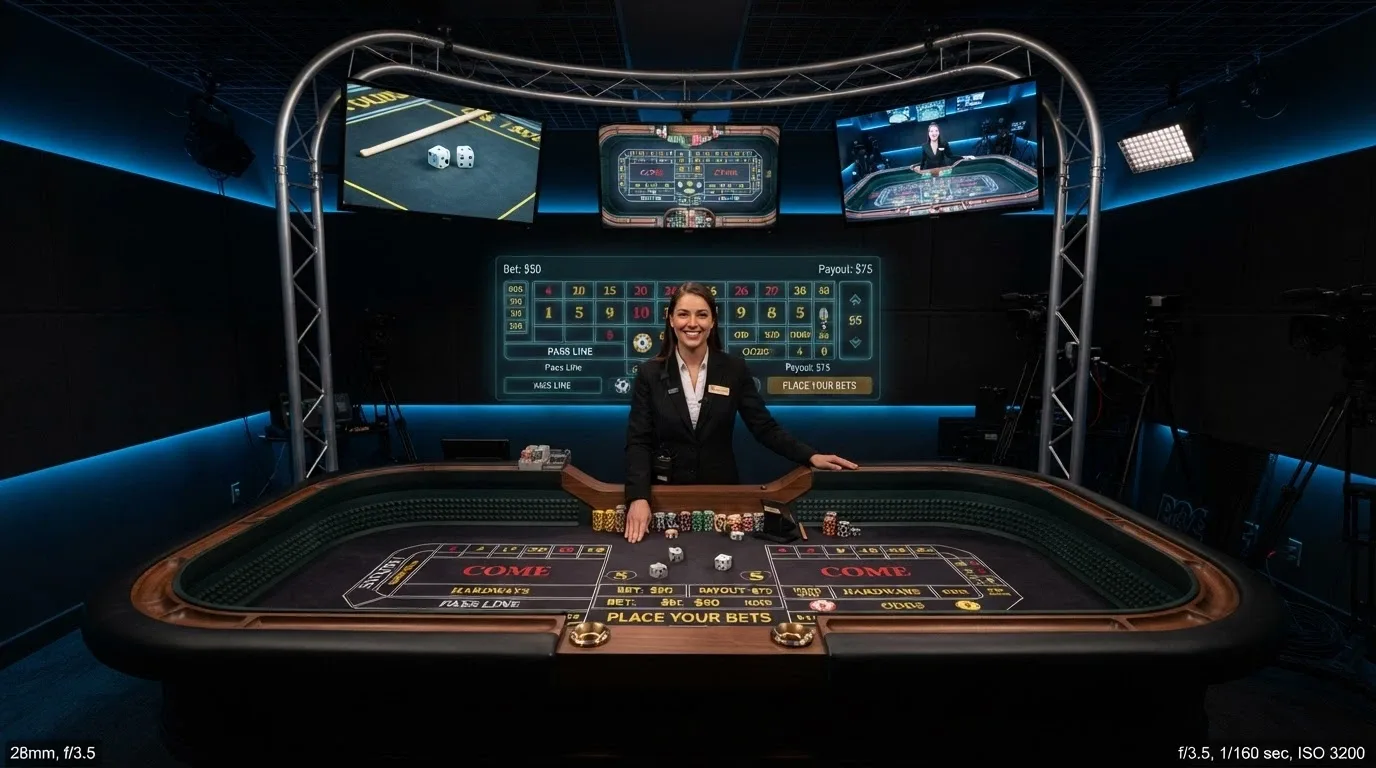
What it does not include is anything important to draw the line against. A slot machine with dice symbols on the reels is not a dice game; the outcome is governed by an RNG, not by dice. A board game played with dice pieces is not a dice game in the casino sense; the dice are a tool, not the wager. A sports betting market on the total number of goals or the number of corners in a football match is not a dice game; the dice never appear. The line is sharper than it looks: it runs from the roll itself.
Three terms every reader should recognise, because they cover almost every dice game a person will meet in a real-money setting. Craps is the American-style game where two dice are rolled on a table layout, the shooter picks up the dice and throws, and the rest of the table bets on the outcome. Pass Line carries a 1.41% house edge — the lowest single-bet edge on the table — and the Odds bet layered behind it carries 0%, which is why craps is the most mathematically generous dice game in any casino. Sic Bo is the three-dice game that originated in Asia and is now the most widely available dice product offshore operators stream. A tumbler shakes three dice, the result is read electronically, and the betting grid is dense enough that some bets pay 180:1 for a specific triple. Dice Duel is a Crown Melbourne exclusive using two dice — one gold, one red — with nine betting options, and Nutz is a five-dice Yahtzee-style game with a 10.63% house edge on the main bet. These two are land-based Australian exclusives that do not exist anywhere online.
The dice games every casino visitor should recognise
Craps is the world’s most recognised casino dice game. It is the dominant game in any North American casino floor and it carries the deepest betting vocabulary of any dice title. Sic Bo is the Asian counterpart and has become the most common dice product in offshore live dealer lobbies, because the mechanic — three dice, a tumbler, an electronic result reader — translates to a streaming studio with very little adaptation. The third category is house-backed dice games that no overseas casino carries: Dice Duel and Nutz, both Crown Melbourne exclusives, with rule sets designed for the Australian floor rather than imported from an international provider. The difference between craps and Sic Bo comes down to who rolls the dice: in craps, the shooter is a player at the table, and the rest of the table bets on whether that player wins or loses. In Sic Bo, the dice are rolled by the machine, and every bet on the layout is a bet against the house on the same roll.
Why “casino dice game” usually means craps
The search term lands on craps for a reason that is not arbitrary. Most English-language search volume for “casino dice game” is craps-shaped — people asking how to play, what the bets pay, what the shooter does. Sic Bo pulls its own search volume, but it is dwarfed by craps in any English-language market, and the land-based and offshore affiliate content reflects that: more pages cover craps rules than Sic Bo rules, more craps strategy guides exist, and the house edge figures that circulate online are almost always craps house edges. Other dice games exist — Dice Duel, Nutz, the live dealer variants — but the head term has craps at its core, and a reader looking at this page is most likely a craps-curious reader who is also asking what else is out there.
The dice games Australian casinos actually run
Land-based, the Australian dice market is narrower than the offshore one. Crown Melbourne runs Sic Bo, Dice Duel, and Nutz on its main gaming floor. The Star in Sydney runs Sic Bo with a tumbler-based three-dice mechanic, paying 180:1 on a specific triple, 31:1 on any triple, and 1:1 on Big/Small. Crown Perth’s table game page carries the same Sic Bo product as Melbourne. The Star does not run Dice Duel or Nutz. No other Australian land-based casino has a published dice table. Craps — the dominant game in any North American casino — does not appear on a Crown or Star gaming floor in any standard form, because Australian regulators have not approved a craps layout under the VGCCC or the NSW Independent Casino Commission.
The Victorian Gambling and Casino Control Commission updated Crown Melbourne’s casino game rules on 1 May 2026, including changes to Sic Bo bet naming conventions that operators must follow. That update is the most recent dice-specific regulatory change in the country. Crown’s Dice Duel layout — gold and red dice on a felt with nine betting positions — is approved under those rules. Nutz is approved as a five-dice Yahtzee-style game with a 10.63% house edge on the main bet.
Online, the picture inverts. Australian-facing offshore operators run craps, Sic Bo, Lightning Dice, Super Sic Bo, Dice City, Mega Sic Bac, and Evolution Craps Live — but every one of them is doing so without an Australian licence, in breach of the IGA, and outside the reach of Australian consumer protection. The product is prohibited to provide. Australian players access it because the offshore operators will accept Australian customers and the ACMA cannot block every site on the day the player signs up.
Craps — the world’s most famous dice game, live at Australian tables
Craps is the headline dice game in any English-language casino, and the one most readers will picture when they search the term. The mechanic is straightforward: a shooter rolls two dice on the come-out roll, and the rest of the table bets on the outcome. A 7 or 11 on the come-out wins for Pass Line bettors; a 2, 3 or 12 loses. Any other number — 4, 5, 6, 8, 9 or 10 — becomes the point, and the shooter rolls again until they either hit the point (Pass Line wins) or roll a 7 (Pass Line loses). The Don’t Pass bar runs the same mechanic in reverse.
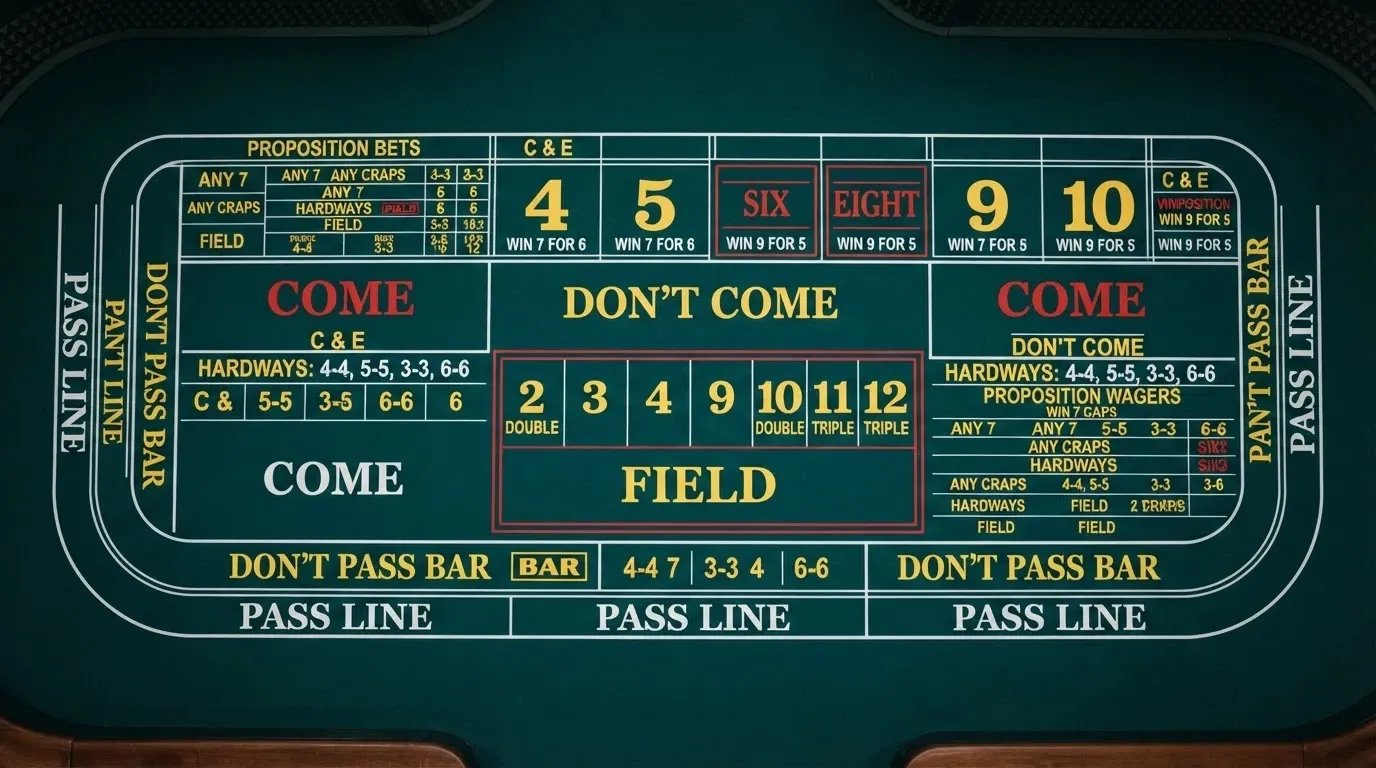
The Pass Line carries a 1.41% house edge, and Don’t Pass carries 1.36% — the lowest single-bet edge on any table game outside blackjack with perfect basic strategy. The Odds bet, placed behind a Pass or Don’t Pass bet after a point is established, pays at true mathematical odds with 0% house edge, and adding 3-4-5x Odds behind a Pass Line bet drops the combined house edge to approximately 0.37%. That is the closest a casino game gets to fair odds, and it is the reason craps is mathematically the best dice game on a casino floor.
Australian players will not find a craps table on a Crown or Star floor in standard form. The offshore online craps landscape is the only place an Australian player encounters the game, and that means a Curaçao-licensed operator with an Evolution or Pragmatic Play live dealer studio streaming from Eastern Europe or the Philippines. The craps bonus contribution rate at these casinos typically sits at just 5% of wagering — a structural penalty that means a craps player clearing a bonus has to wager twenty times the bonus amount to clear it on craps alone, compared to a slots player.
Sic Bo — the three-dice game with 180:1 potential
Sic Bo is the most universally available dice game on offshore online casino lobbies. The mechanic: a tumbler shakes three dice, the result is displayed, and the betting grid runs from 1:1 on Big/Small (a total of 4–10 or 11–17, with triples losing) to 180:1 on a specific triple (e.g. all three dice showing 4). Any triple pays 31:1. The Star in Sydney publishes these exact payouts in its Sic Bo rules PDF, and offshore online Sic Bo tables run the same payout structure under the same mathematical probabilities.
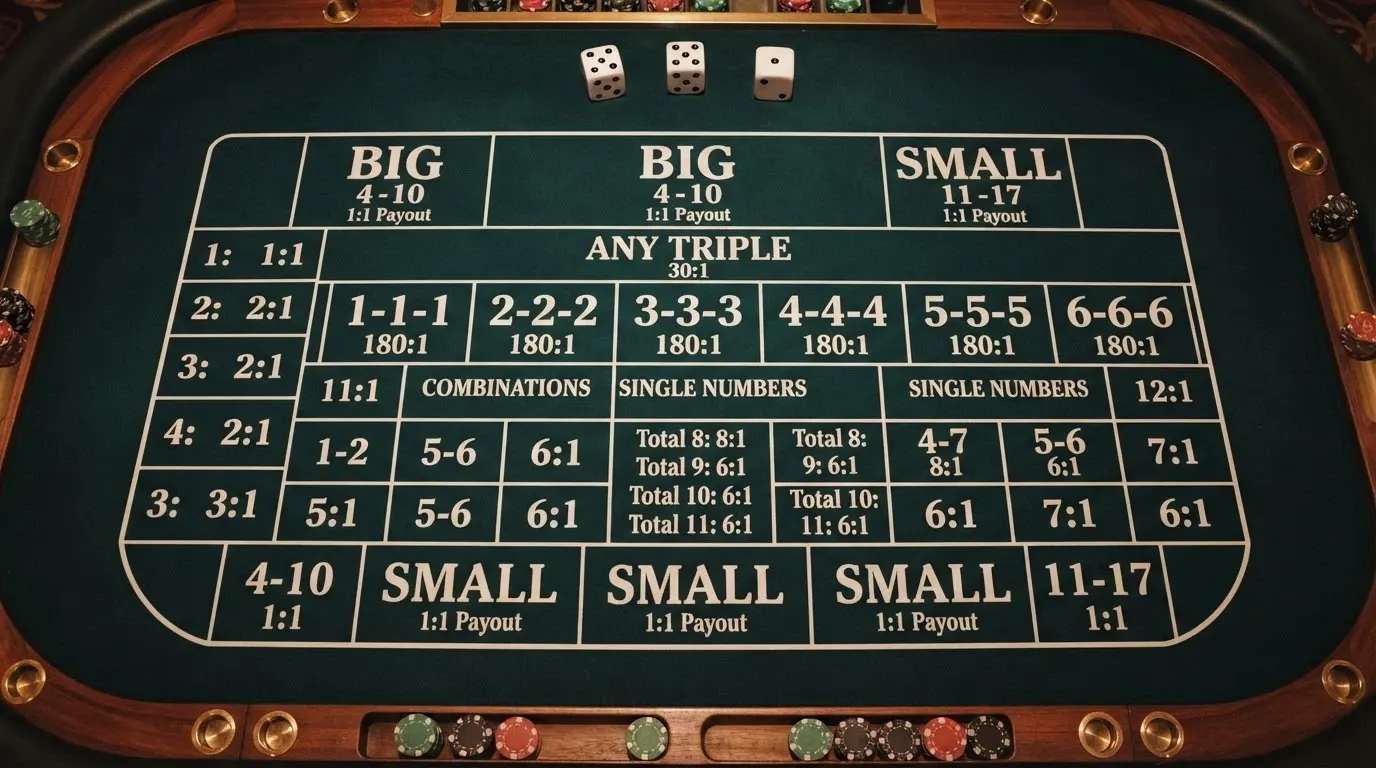
Evolution’s Super Sic Bo runs an RTP range of 95.02% to 97.22% depending on the bet, with a maximum payout of 1000x through random multipliers. SkyCrown carries Sic Bo by BGaming at 97.22% RTP, which sits at the top of the Sic Bo range. The VGCCC updated Sic Bo bet naming at Crown Melbourne on 1 May 2026, so an Australian land-based Sic Bo player in 2026 is reading a slightly different layout from what was on the felt in 2024.
Sic Bo’s edge profile is steeper than craps. Big/Small is the safest bet and the closest to fair, but the triple bets at 180:1 carry a house edge over 16% — worse than any craps proposition bet on the worst end of the layout. The lesson is the same one craps teaches: bet selection is the lever the player controls, and the bets with the highest payouts are the bets with the worst expected value.
Dice Duel and Nutz — the Australian exclusives you will not find anywhere else
Two dice games exist on Australian floors that no overseas casino carries. Dice Duel runs at Crown Melbourne only: two dice, one gold and one red, with nine betting options. The colour bets pay 1:1 — gold wins, red wins. A tie pays 4:1, except a tie on 6, which pays 8:1. The game is approved under VGCCC rules and is not available at The Star or Crown Perth in published form, nor at any offshore operator.
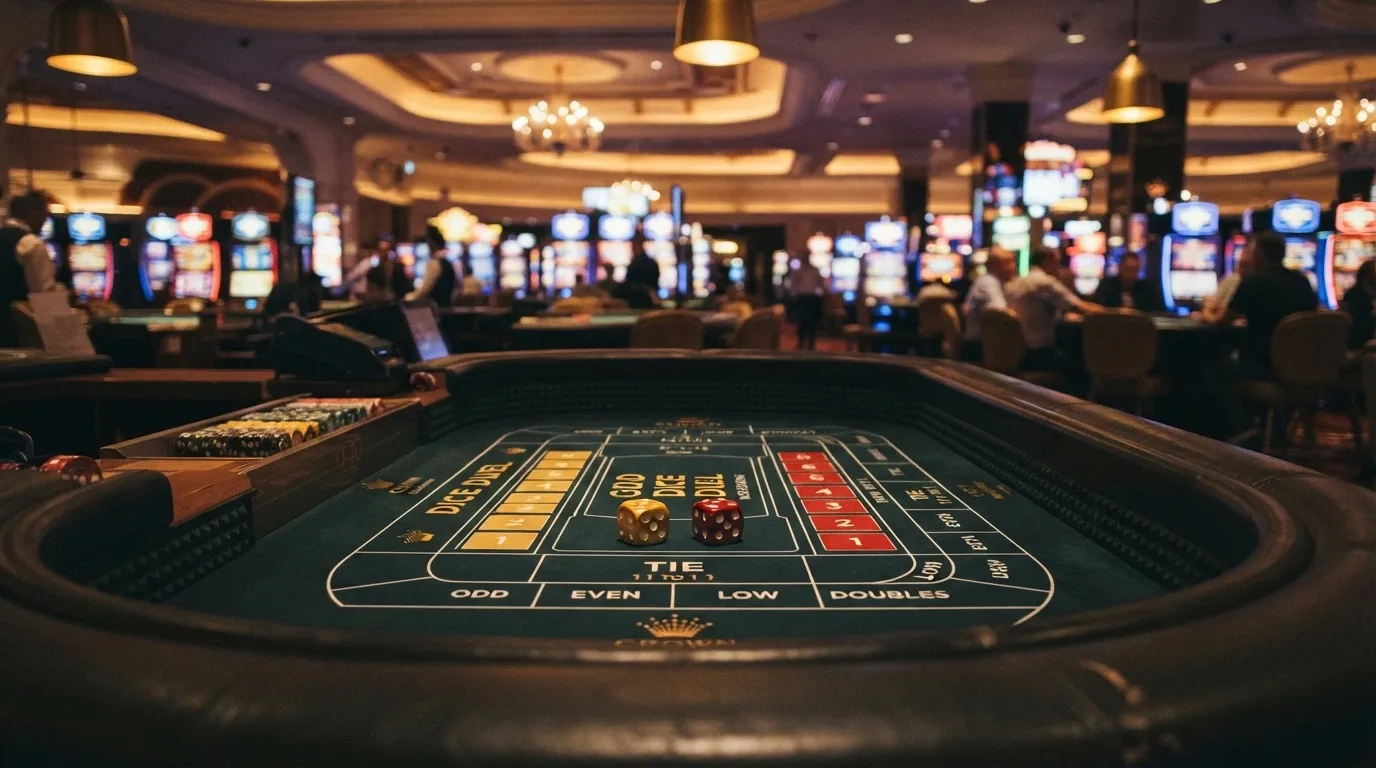
Nutz is the second Crown exclusive. Five six-sided dice are rolled, and the main Nutz bet pays on a Yahtzee-style pattern at a house edge of 10.63%. Wizard of Odds has run the math on Nutz and the main bet is, by craps standards, a punishing proposition — but it is a game an Australian player cannot replicate anywhere else online. Online casino is prohibited under the IGA, and even if it were not, the Dice Duel and Nutz layouts are VGCCC-approved for the Crown floor and have not been licensed to any offshore provider.
Live dealer dice — the streaming experience offshore operators sell
The live dealer dice product is what an Australian player sees advertised when they search for online craps or Sic Bo from an Australian IP address. Evolution Craps Live carries an RTP range of 83.33% to 99.17% depending on the bet placed — the best bets (Don’t Pass, Don’t Come) yield 99.17%, which is below craps land-based because the streaming studio adds a margin. The minimum bet sits at $0.50 and the maximum at $5,000 per round. Evolution Super Sic Bo runs the same range, 95.02% to 97.22% with random multipliers up to 1000x. Pragmatic Play’s Dice City carries a 96.57% RTP with a maximum 10,000x win, released 10 July 2025. Lightning Dice sits at 96.03% to 96.21% with the same 1000x multiplier ceiling. Mega Sic Bac — Pragmatic Play Live’s hybrid — runs a 98.26% RTP (a 1.74% house edge), with multipliers up to 1000x.
The structural difference from RNG dice: live dealer dice has a real human presenter rolling real dice, the outcome is verified by sensors and read by OCR, and the betting interface is overlaid on the streamed video. The maths are the same as the land-based versions. The risk profile is different — the operator running the stream holds no Australian licence, no ACMA jurisdiction applies, and the ACMA can block the URL the player reached the studio through at any time.
Why the rules matter more than your luck in a dice game
Dice is the most mathematically legible game on a casino floor. Every bet carries a published house edge, the edge is fixed at the table layout, and no amount of betting system, dice control or “hot shooter” mythology moves it. Pass Line at 1.41% will pay 1.41% less than true odds across millions of rolls. Any Seven at 16.67% will pay 16.67% less across millions of rolls. The numbers are not negotiable, and they are not subject to momentum.
The players who lose the fastest are the ones who bet the worst edge on the layout. Proposition bets in the centre of a craps table — Any Seven, the hardways, the hops — pay 16% to 33% less than fair odds, and they look exciting because the payouts are 4:1, 30:1 or higher. A Place bet on 4 or 10 carries a 6.67% house edge, which is more than four times the Pass Line edge and a direct subtraction from the player’s bankroll over the same number of decisions. Knowing which bets to skip cuts the house edge by more than half across a session, because the craps layout is designed to make the centre look like the centre of the action.
Craps bets ranked from safest to riskiest
| Bet Type | House Edge | Payout | Best For |
|---|---|---|---|
| Odds bet (behind Pass/Don’t Pass) | 0.00% | True odds | Players who have established a point |
| Don’t Pass | 1.36% | 1:1 | Players who bet against the shooter |
| Pass Line | 1.41% | 1:1 | The standard entry bet |
| Don’t Come / Come | 1.36% / 1.41% | 1:1 | Same edge as the line bets, usable mid-roll |
| Place 6 or 8 | 1.52% | 7:6 | Players with a point established who want to spread |
| Place 5 or 9 | 4.00% | 7:5 | Mid-range place bets, ordinary for craps |
| Place 4 or 10 | 6.67% | 9:5 | Worth skipping at this edge |
| Any Seven (proposition) | 16.67% | 4:1 | Skip — the worst single-roll bet on the layout |
The Odds bet is the only zero-edge play in any casino, anywhere, and pairing it with Pass Line cuts the combined edge to approximately 0.37% with 3-4-5x odds. That is the closest a casino game gets to break-even for the player, and it is the bet experienced craps players stack their money behind.
Sic Bo — the bets worth making and the ones to skip
Sic Bo’s betting grid looks like a stock ticker — dozens of numbers, dozens of payouts — and the house edge gradient runs from gentle at the edges to brutal in the middle. Big/Small (total of 4–10 or 11–17, losing on any triple) pays 1:1 and sits at the low end of the edge profile, the closest Sic Bo comes to a fair bet. Odd/Even runs the same edge profile. Specific doubles (e.g. a double-3) pay higher and carry a moderate edge. Specific triples — the bet that all three dice land on a chosen number — pay 180:1 and carry a house edge in the high teens, the worst edge on the Sic Bo grid. Any triple pays 31:1 and sits between Big/Small and the specific triple.
The same rule applies as in craps: the highest payouts are the worst expected value. Big/Small and Odd/Even will lose the player the least over a session of comparable wagering. The triple bets will empty a bankroll fastest, because each dollar wagered returns less than 84 cents on average across enough rolls.
The one strategy shift that actually changes the odds
There is no craps strategy that beats a fixed house edge. No dice-control technique moves the shooter from random distribution to controlled distribution in any mathematically verified way. No progression system — Martingale, Fibonacci, Paroli — overcomes the negative expected value, because each decision on the layout is independent and the house edge applies to each decision equally. Bankroll management is damage control, not a winning strategy. The only thing the player controls is bet selection.
The Odds bet is the lever. Layered behind a Pass Line or Don’t Pass bet, it carries 0% house edge and pays true mathematical odds. A player who backs the line with full 3-4-5x Odds has cut their combined edge to 0.37% — the lowest the casino offers on any dice game. Anything beyond that is presentation. The bets in the centre of the layout look like the centre of the action. They are the centre of the house’s margin.
Playing dice online from Australia — the real picture
Online casino is prohibited in Australia. Section 15 of the Interactive Gambling Act 2001 makes it an offence for any provider to offer an online casino game — including any dice game — to a person physically in Australia. No Australian casino licence exists for online dice because the product is banned outright. The ACMA has had 1,564 illegal gambling websites blocked by Australian ISPs since November 2019, and more than 225 illegal services have withdrawn from the Australian market. In Q4 2025 alone, the ACMA completed 69 investigations into online gambling providers — 38 of them for providing a prohibited interactive gambling service — and blocked 133 sites. The site an Australian player uses can join that list at any time.
The credit card and cryptocurrency ban for online wagering came into force on 11 June 2024. Any Australian-facing casino that still accepts a credit card deposit or a Bitcoin transfer is operating outside Australian rules, and the deposit method itself is a tell. The 2026 reform, commencing 1 January 2027, gives banks and payment providers express authority to block transactions to illegal gambling operators — a change that will reach into the payment rails, not just the website URL.
Australian players access craps through offshore operators because local sites do not offer the game online. The offshore landscape is Curaçao-dominant — Stake, SkyCrown, RocketPlay, Bizzo, Fair Go, Royal Reels, WinSpirit — with some operators carrying a second licence from the Kahnawake Gaming Commission. None of them holds an Australian casino licence because no such licence exists.
The expected cost of a welcome bonus, in expected-loss terms, illustrates the gap between the marketing and the maths. SkyCrown’s headline package is up to A$8,000 + 400 free spins at 40x wagering. Assuming the player takes the full bonus and wagers only the bonus amount on BGaming’s Sic Bo at 97.22% RTP, the required turnover is A$8,000 × 40 = A$320,000, and the expected loss is A$320,000 × (1 − 0.9722) = A$8,896 — a figure that exceeds the bonus itself. The expected loss is an estimate, not a guaranteed outcome; the player could win, the player could lose more, but across millions of wagers the offer costs the player more than it pays. The “bonus” is the price of entry, not a gift.
The legal reality every Australian player needs before they deposit
The player is not prosecuted under the IGA. The statute targets the provider, not the customer. No Australian has been charged with placing an online dice bet at an offshore casino. That is the one protection the law provides, and it is the only one.
There is no Australian consumer protection on any offshore platform. BetStop does not reach Curaçao-licensed casinos — the exclusion register binds Australian-licensed wagering services only, and an offshore operator is not connected. A self-excluded Australian can still deposit and play at an offshore casino, and the casino has no obligation to enforce the exclusion. There is no Australian complaints body that can recover withheld winnings from an offshore operator. ACMA can block the site at any time, and the block does not return the player’s balance. A blocked site mid-session is a frozen balance with no Australian recourse.
Free-play dice games — the risk-free way to learn the table
Demo mode is available at most offshore casinos without a deposit. Craps and Sic Bo can be played in practice mode against the same RNG or the same live studio interface that the real-money version uses. For a player learning the craps layout — the come-out roll, the point, the Odds bet stacking — demo mode is the safest way to build the muscle memory before any real-money decision.
Demo mode does not make offshore play legal, and it does not make it safe. The casino is the same offshore operator whether the player is wagering real money or play money, and any balance the player eventually loads will be on the same prohibited product under the same offshore licence. The demo is a rules-learning tool, not a regulated Australian product.
The offshore operators Australians reach for dice games
Every operator on this page is offshore-licensed. None holds an Australian casino licence because no such licence exists. The product is prohibited to provide. What follows is not a licensed-operator ranking — it is an honest map of where Australian players actually go when they search for online dice games, labelled for what they are.
| Operator | Licence / Regulator | Welcome Bonus | Wagering | Game Library |
|---|---|---|---|---|
| Stake | Curaçao OGL/2024/1451/0918 (LOK) | No deposit match; rakeback and weekly boosts | — | Stake Originals Dice + Evolution live suite |
| SkyCrown | Curaçao (specific licence not confirmed this run) | Up to A$8,000 + 400 free spins | 40x (bonus + FS) | 7,200+ games, Sic Bo BGaming 97.22% RTP |
| RocketPlay | Curaçao OGL/2024/1307/0748 | 100% up to A$200 + 50 free spins | Not independently confirmed | 5,000+ games, 100+ providers |
| Royal Reels | Curaçao | AU$10 no deposit after phone verification | 31x average | 5,400+ pokies from 40+ providers |
| Bizzo Casino | Curaçao 8048/JAZ2017-067 + Kahnawake | Up to AU$7,750 + 175 free spins | 40x | 3,000+ games, 70+ providers |
| Fair Go | Curaçao eGaming | A$1,000 across 5 deposits (100% to A$200 each) | 30x–40x | 280 RTG games |
| WinSpirit | Curaçao Antillephone N.V. | Up to 400 EUR + 100 free spins | 40x on bonus portion | Not independently confirmed |
| Rainbet | Not confirmed this run | Not confirmed | Not confirmed | Not confirmed |
| Scream Casino | Not confirmed this run | Not confirmed | Not confirmed | Not confirmed |
| Rocket Casino | Not confirmed this run | Not confirmed | Not confirmed | Not confirmed |
Three operators (Rainbet, Scream Casino, Rocket Casino) appear in market-share tables for Australian-facing offshore casinos, but detailed information regarding their licence status, operator entity, domain, game providers, dice game availability and bonus terms is not available. They are listed for completeness — readers should treat them as unverified rather than recommended.
Stake — proprietary dice with a 1% edge
Stake built its own dice game rather than renting a studio product, and the result is the simplest house edge on this page. Stake Originals Dice carries a flat 1.00% house edge on every roll, with the win chance adjustable from 0.01% to 98% and the outcome verified through HMAC-SHA256 provably fair seed verification — the player can confirm the roll was not manipulated after the bet is placed. The licence is Curaçao OGL/2024/1451/0918 under the LOK framework, the operator is Medium Rare N.V., and the company was founded in 2017 by Australian entrepreneurs Ed Craven and Bijan Tehrani.
There is no traditional deposit-match welcome bonus. Stake runs a rakeback structure and weekly boosts instead, with bonus codes issued through its promo system. For a player who wants the simplest mathematical proposition in dice — flat 1% on every roll, no live dealer variance, provably verifiable — Stake’s in-house dice is the closest the offshore market gets to a clean product. The edge profile is plain: 1% across every wager, no promotional load on top.
SkyCrown — the biggest welcome package on the list
SkyCrown’s headline is the largest in the featured set: a 4-tier welcome package up to A$8,000 + 400 free spins, with 40x wagering on both the bonus money and the free spin winnings. The game library runs to 7,200+ titles from 12+ providers, and the Sic Bo product is BGaming’s version at 97.22% RTP — at the top of the Sic Bo range. SkyCrown is Curaçao-facing and operates under that regulator.
The cost of the bonus is the expected-loss calculation in the section above. A$320,000 in required turnover on a 97.22% RTP game produces an A$8,896 expected loss — greater than the headline bonus itself. SkyCrown’s library is wide and the Sic Bo RTP is honest; the bonus is the part of the offer that costs the player more than it pays.
RocketPlay — Evolution live casino suite for dice players
RocketPlay is a live-dealer dice destination. The library runs to 5,000+ games from 100+ providers, with Evolution and Pragmatic Play Live carrying the live dice products. The licence is Curaçao OGL/2024/1307/0748, the operator is Scores55 Tech B.V., and the welcome bonus is 100% up to A$200 + 50 free spins. The specific wagering multiple for this operator is not publicly disclosed.
For a player who wants Evolution Craps Live, Super Sic Bo, or Lightning Dice under one roof, RocketPlay’s Evolution coverage is the relevant feature. The A$200 welcome is modest against the 5,000+ game library, and the operator’s smaller bonus means a lower expected-loss load if the player takes it.
Royal Reels — the AU$10 no-deposit entry point
Royal Reels carries one of the rare no-deposit bonuses in the offshore market: AU$10 credited after phone verification, with an average 31x wagering requirement across bonuses. The game library runs to 5,400+ pokies from 40+ providers, the operator is Digibrite SRL since 2021, and the licence is Curaçao. Three of the bonuses carry maximum cashout caps, though the specific cap amounts were not confirmed in this run.
Dice-specific game availability for Royal Reels is not publicly confirmed. The library is pokies-heavy by count, and the operator’s primary product positioning is slots rather than table games. A player looking specifically for craps or Sic Bo should confirm the dice product exists on the live lobby before depositing, because the pokies count does not tell them whether a dice table is running.
Bizzo Casino — dual-licenced with PayID support
Bizzo holds a dual licence — Curaçao 8048/JAZ2017-067 and the Kahnawake Gaming Commission — making it one of the more thoroughly licensed operators in the featured set. The welcome is a 4-deposit package up to AU$7,750 + 175 free spins at 40x wagering, with a maximum bet of AU$6.50 during wagering. The game library runs to 3,000+ titles from 70+ providers, AUD is accepted natively, PayID is supported alongside 22+ cryptocurrencies.
For an Australian player who wants an AUD balance and PayID deposit without crypto conversion, Bizzo is the operator whose payment infrastructure matches Australian banking natively. The dual licence is a stronger verification footprint than a single Curaçao licence, though neither grants the operator the right to offer online casino to a person in Australia.
Fair Go — RTG-only with a five-deposit welcome
Fair Go runs on RealTime Gaming exclusively — 280 games, all RTG. The welcome is a 5-tier package totalling A$1,000, structured as 100% up to A$200 on each of the first five deposits. The licence is Curaçao eGaming under Deckmedia N.V., the minimum withdrawal is A$100, and wire transfer fees run A$50. Wagering sits at 30x–40x depending on the bonus.
RTG is a US-facing software house from the early 2000s, and its portfolio does not centre on dice. Dice-specific titles were not independently verified for Fair Go in this run. The operator is an option for an AUD-native deposit and a small, predictable bonus structure, but a dice player should confirm the live lobby carries the titles they want before committing to the five-deposit welcome.
WinSpirit — Curaçao Antillephone with a EUR-denominated bonus
WinSpirit holds a Curaçao Antillephone N.V. licence under Complete Technologies N.V. The welcome runs to 400 EUR + 100 free spins at 40x wagering on the bonus portion. The EUR denomination is the relevant feature for an AUD player — the bonus is priced in euros and converts at the deposit-time FX rate, with no guarantee the conversion favours the player.
Information regarding dice game availability, provider list and game count for WinSpirit is not publicly confirmed. The licence is verified at the regulator level (Antillephone is a recognised Curaçao sub-licence), but the rest of the operator profile is unverified.
Rainbet — limited data, included for completeness
Rainbet appears in operator market-share data for Australian-facing offshore casinos. This run did not confirm a Curaçao or other licence, did not confirm the operating entity, did not confirm the domain, did not confirm game providers, did not confirm the dice game catalogue, and did not confirm bonus terms. The operator is listed because it appears in the market data, but no recommendation can be drawn from the absence of confirmed specifications.
Scream Casino — limited data, included for completeness
Scream Casino appears in the same operator market-share tables. License, operating entity, domain, providers, dice games and bonus terms are not publicly confirmed for this operator. The listing reflects market presence, not verified product offering.
Rocket Casino — limited data, included for completeness
Rocket Casino appears in the same market-share data. Licence, operator, domain, providers, dice games and bonus terms were not confirmed this run. As with Rainbet and Scream Casino, the listing reflects market presence, not verified offering.
Why online casino dice is prohibited in Australia
The Interactive Gambling Act 2001 makes it an offence for any provider to offer an online casino game — including any dice game — to a person physically in Australia. There is no carve-out for craps, Sic Bo, live dealer dice, or any variant. The product is prohibited. The statute does not leave a grey area; the prohibition is plain, and the ACMA enforces it.
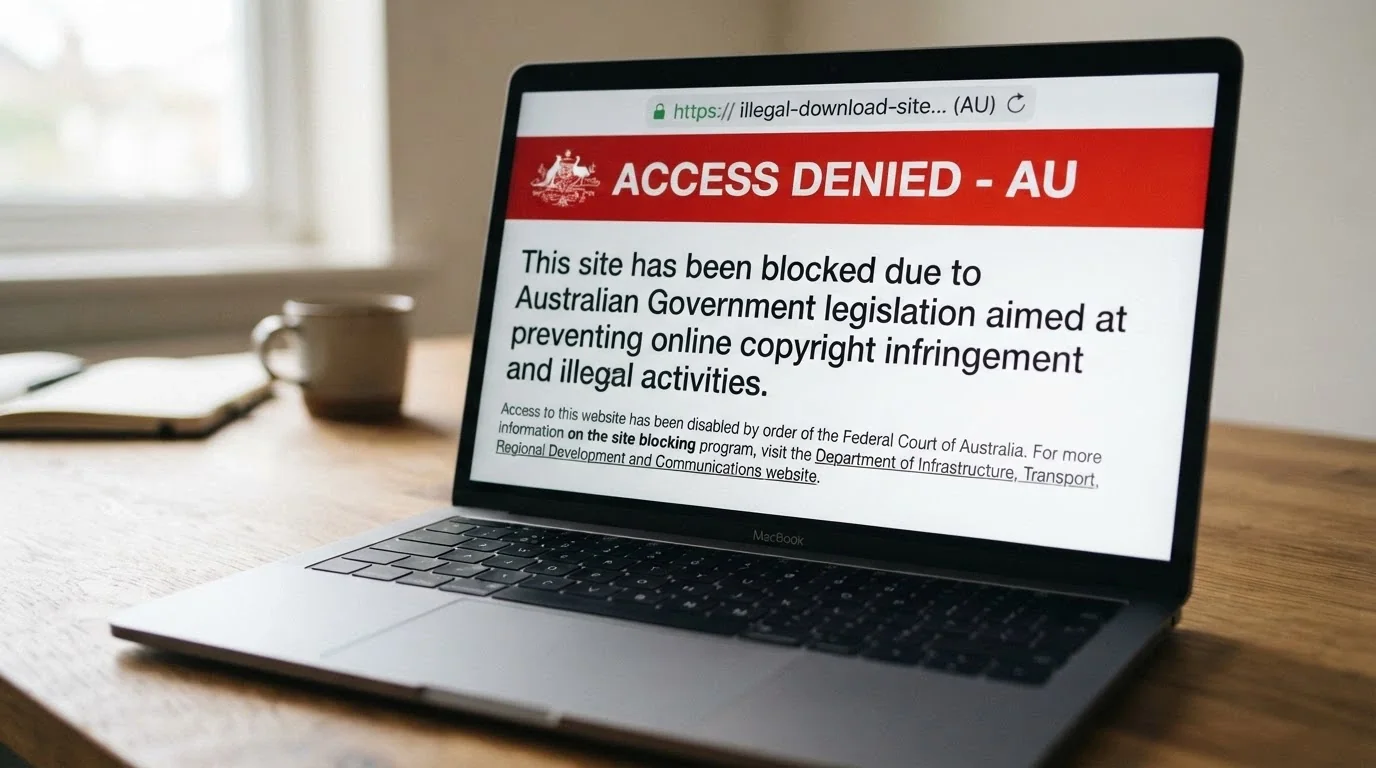
Section 15 of the IGA is the operative provision. Online casino games, online pokies and in-play sports betting are all prohibited interactive gambling services. Pre-event wagering on races and sport is permitted and state-licensed. Lotteries and keno are permitted and state-licensed. The minimum age for any commercial gambling activity in Australia is 18. The 2026 reform — the Interactive Gambling Amendment (Gambling Reform) Bill 2026, passed 19 August 2026 — strengthens the framework, with Schedules 1–4 commencing 1 January 2027.
The Interactive Gambling Act — what it actually bans
The IGA prohibits online casino games, online pokies, and in-play betting on a sporting event once it has started. Wagering on races and sport placed before the event begins is permitted, through operators licensed by a state or territory — predominantly the Northern Territory Racing and Wagering Commission. Lotteries and keno are permitted and state-licensed. The player is not the target of prosecution; the statute targets the provider, and the ACMA’s enforcement actions have all been against operators, not customers.
How the ACMA enforces the prohibition
The ACMA’s enforcement is operational, not theoretical. 1,564 illegal gambling and affiliate websites have been blocked by Australian ISPs since November 2019, and more than 225 illegal services have withdrawn from the Australian market since enforcement was strengthened in 2017. In Q4 2025 alone, the ACMA completed 69 investigations — 38 for providing a prohibited interactive gambling service, 26 for providing an unlicensed regulated interactive gambling service, and 5 for advertising prohibited or unlicensed services. 133 sites were blocked in that quarter, the majority being casino-style services offering blackjack, roulette, poker and slots.
The ACMA can block a site at any time. The block does not return the player’s balance. A player mid-session at an offshore casino that joins the blocked list loses access mid-hand, and the funds that were on the site are now on a site the Australian internet cannot reach. That is the operational cost of the prohibition, and it falls on the player, not the operator.
The 2026 reform and what changes from January 2027
The Interactive Gambling Amendment (Gambling Reform) Bill 2026 passed Parliament on 19 August 2026. The measures — Schedules 1 through 4 — commence 1 January 2027. From that date, wagering advertising is capped at three ads per hour between 6:00 am and 8:30 pm. A live-sport advertising blackout runs from 15 minutes before to 5 minutes after a live event. Athletes, celebrities and influencers are barred from promoting wagering. Direct marketing of inducements is prohibited for 14 days after a customer signs up and for three months after a person deregisters from BetStop.
The most consequential change for an offshore player is the payment-blocking authority. From 1 January 2027, banks and payment providers gain express authority to block transactions to illegal gambling operators. The ACMA’s existing power to block URLs is reinforced by a parallel power to block the payment rail itself. A bank can decline a transaction from a customer to an offshore casino. The reach extends past the URL into the financial infrastructure the casino depends on.
What Australian players actually risk when they play offshore
The player is not prosecuted. That is the one protection the law provides. Everything else is exposure.
There is no Australian consumer protection on any offshore platform. No Australian complaints body can recover withheld winnings. BetStop does not reach Curaçao-licensed casinos — a self-excluded Australian can still deposit at an offshore operator, and the offshore operator has no obligation to honour the exclusion. The ACMA can block the site at any time, and a blocked site can carry a player’s balance with it. Credit card and crypto deposits at an Australian-facing casino are a tell that the operator is outside Australian rules — those payment methods have been banned for online wagering since 11 June 2024.
Responsible gambling: the safety net most Australian players never use
The responsible gambling infrastructure exists. The reach is incomplete, and the usage rate is low. BetStop’s offshore blind spot is the single largest gap. The harm statistics put Australia near the top of any country’s gambling harm league table.
BetStop — the self-exclusion register 73.5% of adults do not know exists
BetStop is the National Self-Exclusion Register, live since August 2023. One registration excludes a person from every Australian-licensed online and phone wagering service. As of 31 December 2025, 54,859 people had registered, and 35,135 had active exclusions. 77% of registrants report a better overall quality of life after self-excluding. 79% report improved mental health. 69% report better personal relationships. The outcomes are real.
The reach is partial. BetStop binds Australian-licensed wagering services only — an offshore casino is not connected and will keep taking a self-excluded person’s money. Awareness is the second gap. Only 33.5% of wagerers are aware BetStop exists, and only 26.5% of Australian adults overall know about the register. The infrastructure is built; three-quarters of the population it is built for has never heard of it.
How big Australia’s gambling harm problem actually is
The numbers are large and they are recent. 15.1% of the Australian adult population — an estimated 3.32 million people — are experiencing some level of gambling harm, either from their own gambling or from someone else’s. 13.0% of the population — an estimated 2,857,000 people — are experiencing gambling harm from their own gambling behaviours. 1.97 million Australian adults are classified as having at-risk or problem gambling, and 1.38 million are affected by another person’s gambling. Risky gambling rose from 13.7% in 2024 to 19.4% in January 2025 — more than five percentage points in twelve months. 56.1% of individuals who gambled mainly participated online in the past twelve months.
The gap between harm and response is the story. An estimated five million wagerers nationwide includes 400,000 high-risk gamblers, but only 30,000 individuals have active exclusions through BetStop — about 7.5% of those experiencing severe gambling harms. Dr Sakata of the Australian Gambling Research Centre has framed the gap plainly: the infrastructure exists, and the people who need it most are the least likely to be inside it.
Practical steps every dice player can take today
Register with BetStop at betstop.gov.au — one registration, every Australian-licensed service excluded. Set a deposit limit on every account before playing, and request the activity statement to see the real cost. Call 1800 858 858 — the National Gambling Helpline, free, confidential, staffed 24/7. Visit gamblinghelponline.org.au for online chat and counselling. Use the take-a-break feature where available.
The helpline is staffed by people whose job is to listen, and the volume of calls reflects the demand. The infrastructure is built, and the first call is free.
Frequently asked questions
What separates craps from Sic Bo at the table?
In craps, the shooter is a player who rolls the dice, and the rest of the table bets on the outcome of that roll. In Sic Bo, the dice are rolled by a machine or tumbler, and players bet against the house’s fixed odds on every single roll of the machine.
Can an Australian player get in legal trouble for playing online craps?
The Interactive Gambling Act 2001 targets the service providers, not the customers. While providing online casino games to Australians is illegal, there is no provision under the Act to prosecute an individual player for placing a bet at an offshore casino. The law focuses on stopping the providers from offering the service.
Are offshore casino sites safe for Australians playing dice games?
Offshore sites lack Australian consumer protection. They are not covered by the BetStop exclusion register, meaning self-excluded players can still deposit. Furthermore, if the ACMA blocks a site while you have funds on it, you have no local recourse to recover your balance, leaving your money potentially frozen with no Australian support.
Which casino dice game gives you the lowest house edge?
Craps offers the most mathematically generous edge. The Pass Line bet carries a 1.41% house edge, and the Odds bet, which can be layered behind it, carries 0%. Combining these with 3-4-5x Odds reduces the total house edge to approximately 0.37%, making craps the statistically best game for a player on the casino floor.
Do live dealer craps tables accept Australian players?
Yes, many offshore operators accept Australian players and offer Evolution or Pragmatic Play live dealer craps studios. However, these services are illegal under the Interactive Gambling Act 2001. While the operator will accept your registration, they are doing so without an Australian licence and outside the reach of Australian consumer protection laws.
Why does not Australia license online casinos the way the UK does?
Australia’s legislative framework, defined by the Interactive Gambling Act 2001, explicitly prohibits online casino services to protect players from gambling harms. Unlike the UK’s regulated model, the IGA maintains a strict ban on online casinos, allowing only state-licensed pre-event sports wagering, lotteries, and keno to operate legally within the Australian consumer protection framework.
Operators were drawn from Australian-facing offshore casino market-share data and from operator profiles with confirmed dice-game availability. Each operator was checked against the ACMA register for blocking activity and against official Curaçao licence records where accessible. The evaluation considered licence verifiability, dice-game catalogue (craps, Sic Bo, live dealer variants), bonus terms transparency, AUD and PayID support, and the absence of any Australian consumer protection framework applying to offshore operators.
No operator on this page holds an Australian casino licence, because no such licence exists for the product any of them offer. The selection is a map of the offshore landscape Australians actually reach, not a licensed-operator ranking. Where research could not confirm a specification — a licence number, a wagering multiple, a game count — the operator’s profile states that explicitly rather than substituting an estimate.
The dice decision every Australian player has to make in 2026
Land-based dice at Crown Melbourne and The Star is legal, regulated and consumer-protected. The Star’s Sic Bo runs 1:1 on Big/Small, 31:1 on any triple, 180:1 on the specific triple. Crown’s Dice Duel and Nutz are not available anywhere else. The limitation is variety — these are the only two Australian venues with published dice tables, and craps in its standard form is not on either floor.
Offshore online dice offers every variant — craps, Sic Bo, Lightning Dice, Super Sic Bo, Mega Sic Bac, Dice City, and the proprietary dice at Stake. The trade is protection for access. The site can be blocked. The balance can be stranded. The wagering requirement on the welcome bonus can cost the player more than the bonus itself — SkyCrown’s A$8,000 + 400 free spins headline produces an A$8,896 expected loss on its own Sic Bo product, which is more than the bonus pays. The credit card and crypto ban means the payment method itself is a tell, and from 1 January 2027 the bank has express authority to block the transaction.
Free-play demo mode lets a player learn the craps layout and the Sic Bo grid without risking a dollar, but it does not make offshore play legal and it does not make it safe. BetStop is the only self-exclusion register an Australian can use, and it does not reach offshore casinos.
The decision turns on what the player values more. Access to every variant and live dealer streaming, or Australian consumer protection and BetStop coverage. There is no operator that offers both, because the product one side offers is prohibited in the country the other side protects. A player making the choice in 2026 is choosing between them, not choosing between casinos.