
Solana Casino Comparison Australia: 2026 Field Guide for Aussie Players
Online casino play is prohibited in Australia. Every brand on this page is offshore, licensed somewhere else, and outside every protection the Australian system offers to a punter. That is the first thing a Solana casino comparison for Australian players has to put on the table, because the speed and the bonus figures and the game libraries are all real — and so is the absence of BetStop, of ACMA recovery powers, of any domestic ceiling on what a player can lose.
What follows is a comparison written for an Australian player who already knows the offshore market exists and wants to know what separates one Solana casino from another. Three payment rails, ten operators, three verified welcome bonuses, and the maths that turns an A$8,000 banner into roughly 88 hours of required play. The current data sits against the Australian Communications and Media Authority register; the comparison holds as of 22 October 2026.
Table of Contents
- Solana Casino Comparison: What Separates the Best from the Rest
- The 10 Solana Casinos Australian Players Are Using in 2026
- SOL Casino Payments: Why Your Money Moves Faster Than Any Other Crypto
- Casino Bonuses in SOL: Why the Number on the Banner Isn’t the Whole Story
- The Games Worth Your SOL: Pokies, Live Dealer and Crypto Originals
- NFT Casinos on Solana: A Niche With a Different Set of Rules
- Is It Legal? The Real Australian Rules for Offshore Casino Players
- Where to Get Help When the Play Stops Being Fun
- How We Selected and Ranked Every Solana Casino on This Page
- What You Should Actually Do About Solana Casinos as an Australian Player
- Frequently Asked Questions
Solana Casino Comparison: What Separates the Best from the Rest
A Solana casino is an online casino that lets a player deposit and withdraw in SOL — the native token of the Solana blockchain — rather than (or alongside) Bitcoin, Ethereum or fiat. The blockchain sits underneath the payment rail, which is what makes SOL different from any other crypto deposit. Settlement is final in roughly 30 seconds. The network fee is about one cent. There is no bank middleman, no card network, no three-day wait on a withdrawal.
By 2026, most major crypto casinos now support Solana deposits and withdrawals alongside Bitcoin and Ethereum. SOL casino acceptance has grown significantly through 2025 and 2026 — a meaningful shift for an Australian player whose only legal crypto betting options (licensed bookmakers) have been banned from accepting digital currency at all since 11 June 2024. The very fact that a casino asks for SOL is a tell: the operator is outside Australian rules.
The comparison on this page turns on four things. How the SOL payment rail is configured — native balance, cashier-converted, or an SPL stablecoin such as USDT on Solana. Whether the casino is fully on-chain (provably fair, smart-contract custody) or a conventional operator using SOL as one deposit method among many. What the welcome bonus costs in real turnover, not in the headline number. And what licence jurisdiction sits behind the brand, because every operator here is offshore and unlicensed in Australia.
How a Solana Casino Actually Works
The player journey has four steps. A wallet — Phantom or Solflare, the two Solana wallets an Australian player is most likely to use — holds the SOL. At the casino cashier, the player selects Solana as the deposit method and pastes the casino’s deposit address or scans its QR code. The transfer settles on-chain in roughly 30 seconds. The casino credits the balance in whatever denomination it has chosen to display — native SOL, a USD conversion, or SPL stablecoin.
Three payment rails sit inside that one journey. Some casinos keep a native SOL balance, meaning what you deposit is what you wager and what you withdraw. Others accept SOL but convert it at the cashier into an internal currency or a stablecoin, so the player never holds SOL once the deposit is in. A third group supports only USDT on Solana (SPL) — the same stablecoin as on Ethereum or Tron, but riding Solana’s faster and cheaper network. The three rails behave differently at withdrawal, because only the native-SOL rail returns SOL.
On the way out, the flow reverses. The player requests a withdrawal, the casino broadcasts a SOL transfer to the wallet address provided, and the funds land in roughly 30 seconds at a network fee of about one cent. The total end-to-end time, measured across 22 withdrawals by CasinoZoid, ran from 10 minutes to 4 hours for verified accounts — the on-chain leg is the quick part, the casino’s internal approval is what stretches the window.
On-Chain Casino vs Standard Crypto Casino: Two Different Animals
Not every casino that accepts SOL is on-chain. The distinction matters for trust. A fully on-chain casino holds player funds in a smart contract, runs its games through verifiable code, and posts every bet and result to the blockchain. The player can check that the casino cannot withdraw the bankroll, that the game logic is what was published, and that the outcome of any spin is reproducible from public data. This is the provably fair model.
A standard crypto casino runs conventional software under the bonnet. The wallet accepts SOL, the cashier credits an internal balance, the games are supplied by third-party studios, and the outcomes come from a random number generator audited by an external lab. The SOL payment rail is just one deposit option among many. There is nothing on-chain to verify beyond the deposit and the withdrawal — the bet itself happens inside the operator’s database.
The featured operators in this comparison are standard crypto casinos. They use provably fair mechanics for in-house games (Crash, Dice, Plinko, Mines) and rely on independent RNG audits for third-party slots and live dealer tables — Pragmatic Play’s high-volatility releases, BGaming’s provably-fair slots with their transparent calculation tools, Evolution’s streamed tables. The fully on-chain model exists but is not what dominates the Australian-facing market.
What Types of Solana Casinos Accept Australian Players
Four shapes sit in the landscape. Crypto-native casinos — Stake, Cloudbet and the like — built their product around digital currency from the first day, with thousands of games and a cashier that lists SOL alongside twenty other tokens. Hybrid casinos added Solana to an existing crypto rail, often after their initial Bitcoin and Ethereum support. NFT casinos on Solana use Metaplex-standard NFTs to gate games or to function as membership tokens, a niche with limited game variety compared to the standard model. Telegram and Discord casino bots are a fourth category, smaller and harder to verify.
The common licence jurisdictions are Curaçao and Anjouan. Stake and Cloudbet both hold Curaçao Gaming Authority licences. Anjouan Gaming Board licences are issued from the Comoros and appear across several smaller brands. These licences are real in their issuing jurisdiction, but they carry no weight under Australian law — the Interactive Gambling Act 2001 makes it an offence to provide an online casino game to a person physically in Australia, regardless of where the operator is licensed.
“Australian players” in this context means anyone whose IP, billing address or declared residence is in Australia. Every brand in this comparison accepts Australian sign-ups. None holds an Australian online casino licence, because no such licence exists.
The 10 Solana Casinos Australian Players Are Using in 2026
The ranking below is built from the AU operators shortlist — market-share data filtered for casino product (not sports-only), real-money operation, known cryptocurrency acceptance and active Australian traffic. Two operators carry verified Curaçao licences (Stake and Cloudbet); the remaining eight are included on the strength of their AU presence and crypto rails, with detailed bonus terms not confirmed this run.
| Operator | Offshore Licence |
|---|---|
| Stake | Curaçao Gaming Authority |
| RocketPlay | Curaçao (not confirmed this run) |
| SkyCrown | Curaçao (not confirmed this run) |
| Royal Reels | Offshore (not confirmed this run) |
| WinSpirit | Offshore (not confirmed this run) |
| Rainbet | Offshore (not confirmed this run) |
| Scream Casino | Offshore (not confirmed this run) |
| FairGO | Offshore (not confirmed this run) |
| Bizzo Casino | Offshore (not confirmed this run) |
| Cloudbet | Curaçao Gaming Authority |
A licence confirmation in this table means the brand was verified against the Curaçao Gaming Authority register. A not-confirmed entry means this review round did not independently verify the issuing regulator — the brand may hold a Curaçao or Anjouan licence, or no licence at all. The absence of a row in this column is the same as the row itself: a player cannot rely on the entry either way.
Stake
Stake is the reference point for the whole comparison. The brand launched in 2017 under a Curaçao Gaming Authority licence and now accepts twenty-two or more cryptocurrencies, with native SOL listed alongside BTC, ETH, USDT and a long tail of altcoins. The casino catalogue runs to thousands of titles across Pragmatic Play, Evolution, BGaming, Hacksaw Gaming, Nolimit City and the other major providers that dominate the crypto-casino market.
The welcome offer is structured differently from the other two verified brands on this page. Stake matches the first deposit at 200% up to $3,000 — the highest match percentage in the comparison, with no free spins attached. The wagering requirement is 40x on deposit and bonus combined, which means a player depositing $1,000 to claim the full $2,000 bonus has to work through $120,000 of turnover before any withdrawal of bonus funds is possible. Minimum deposit is $50.
The payment terms are generous by the standards of this market. The minimum withdrawal is 2.50 USDT equivalent in any supported token, with no upper limit published. A player can move SOL out at roughly 30-second on-chain finality and a one-cent network fee. Stake is the operator most likely to suit a player who values a high match percentage over headline ceiling, who has read the wagering terms, and who wants a long-established brand with a confirmed Curaçao licence.
RocketPlay
RocketPlay’s welcome package is the middle of the three verified offers — 100% up to A$1,000 plus 100 free spins, with 40x wagering on the bonus amount and a minimum qualifying deposit of A$30. The free spins are not paid out in one block: 20 land in the account each day for five days, on Aztec Magic (a BGaming title) for most players, with Big Bass Splash as the alternative for Germany.
The fine print tightens what the bonus is worth. Bonus validity runs five days from receipt — short enough that a casual player risks forfeiting the bonus before completing the wagering. Maximum bet during wagering is A$7.50 per spin or hand, which constrains how fast the turnover can be run through. The free spins carry their own value but no separate wagering multiplier was published in the terms page.
RocketPlay fits a player who wants a moderate-size bonus with a clear ceiling, who can clear 40x in five days at A$7.50 a spin, and who plays BGaming titles rather than the high-volatility Pragmatic Play catalogue. The shorter validity window is the trade-off — the same 40x requirement is easier to plan around when the bonus has fourteen days rather than five.
SkyCrown
SkyCrown carries the highest headline figure in the comparison — a welcome package of up to A$8,000 plus 400 free spins, with a minimum qualifying deposit of A$20. The wagering splits: 40x on the bonus amount, 30x on free spins winnings. The terms require a code to be entered before the deposit to activate the offer, a small friction point that costs the bonus for any player who skips the field.
The fine print is where the package becomes a different proposition. Maximum bet during bonus wagering is A$5 per spin or hand — the lowest of the three verified offers. Maximum win from free spins is capped at 10x the bonus value, so a player hitting a large multiplier on the free-spin rounds sees the excess voided. The wagering window is fourteen days from activation, longer than RocketPlay’s five. Maximum withdrawal is A$7,500 per day — a ceiling that matters if a player completes wagering on a high-balance day.
SkyCrown is the operator for a player chasing headline size and willing to read every term — the 10x free-spin win cap and the A$7,500 daily withdrawal ceiling are the kind of limits a casual player misses until the voiding email arrives. The lower A$5 max bet slows the playthrough but also reduces the variance risk during wagering.
Royal Reels
Royal Reels is included on the strength of active Australian traffic and crypto-casino positioning rather than verified bonus terms. The brand appears in the AU operators shortlist with real-money casino product and known cryptocurrency rails, which is the basis for inclusion in this comparison. Specific welcome bonus, wagering multiplier, game provider list and SOL acceptance were not confirmed in this review round — a player should treat anything published on the operator’s own pages as the only source of detail until independent verification is possible.
The licence position is the same as the rest of the offshore set: no Australian online casino licence exists, and Royal Reels operates under an offshore jurisdiction. The brand suits a player who has already encountered it in AU-targeted marketing and wants a sense of where it sits in the wider Solana casino landscape.
WinSpirit
WinSpirit is another operator carried on the AU shortlist for real-money casino product and known crypto rails, with specific bonus terms and SOL acceptance not confirmed this run. The brand has Australian traffic, which is the inclusion criterion. Detailed review data — bonus structure, wagering, game library, withdrawal terms — was not available, so this entry covers what selection criteria can tell a reader rather than what the operator’s own pages would.
A player looking at WinSpirit should verify the current bonus terms directly with the operator before depositing. The offshore status carries the same caveats as the rest of the comparison.
Rainbet
Rainbet sits in the comparison for its active Australian traffic and its crypto-casino positioning. Specific welcome bonus, wagering requirement, game providers and SOL acceptance were not confirmed in this review round. The brand is part of the cluster of operators that the AU market-share data puts in front of Australian players.
The data gaps here are the same gaps an Australian player would face trying to verify Rainbet independently. The selection criteria — casino product, crypto acceptance, AU traffic — are what put the brand in front of an Australian punter; the fine print has to be checked on the operator’s own terms page.
Scream Casino
Scream Casino enters the comparison as a newer brand on the AU shortlist with real-money casino product. Detailed bonus terms, wagering requirements, game provider list and SOL acceptance were not confirmed this run.
A player evaluating Scream Casino alongside the rest of this page should treat the absence of verified data as the absence of data. The operator may offer a competitive welcome package and robust SOL support; this comparison cannot say so either way.
FairGO
FairGO is an AU-facing brand name with active local traffic. The brand carries the standard offshore status — not Australian-licensed — and the same data gaps as the other AU-shortlist operators in this comparison: bonus, wagering, game providers and SOL acceptance not confirmed this round.
The brand’s Australian-facing positioning is what earns its place on the page. A reader who has seen FairGO in AU-targeted marketing can locate where it sits in the wider Solana casino market; the reader who needs verified terms will have to check the operator’s own pages directly.
Bizzo Casino
Bizzo Casino is shortlisted for AU presence and known crypto acceptance, with specific bonus terms, wagering requirements, game providers and SOL acceptance not confirmed this run. The brand is part of the AU operators shortlist that filters this comparison.
The inclusion criteria — casino product, crypto acceptance, real-money operation, AU traffic — are what place Bizzo in front of Australian players. Detailed terms require verification directly with the operator.
Cloudbet
Cloudbet is the oldest brand in the comparison. Launched in 2013 under a Curaçao Gaming Authority licence, the operator has been in the crypto casino market longer than any other featured brand. The catalogue runs to 3,000+ games across the major crypto-casino providers, and the brand appears on CryptoSlate’s list of Solana-accepting operators alongside the rest of the verified set. Payout time is published at zero to two days — slower than SOL’s on-chain finality on its own, suggesting an internal approval window sits on top of the blockchain settlement.
Specific welcome bonus and wagering terms were not confirmed from snippets this run, which limits how the comparison can position Cloudbet against Stake and SkyCrown on bonus value. What is confirmed is the licence, the game-library scale, and the SOL listing — a player who values brand longevity and a long-running Curaçao registration will find Cloudbet the most established name on the page. Detailed current bonus terms require checking directly with the operator.
SOL Casino Payments: Why Your Money Moves Faster Than Any Other Crypto
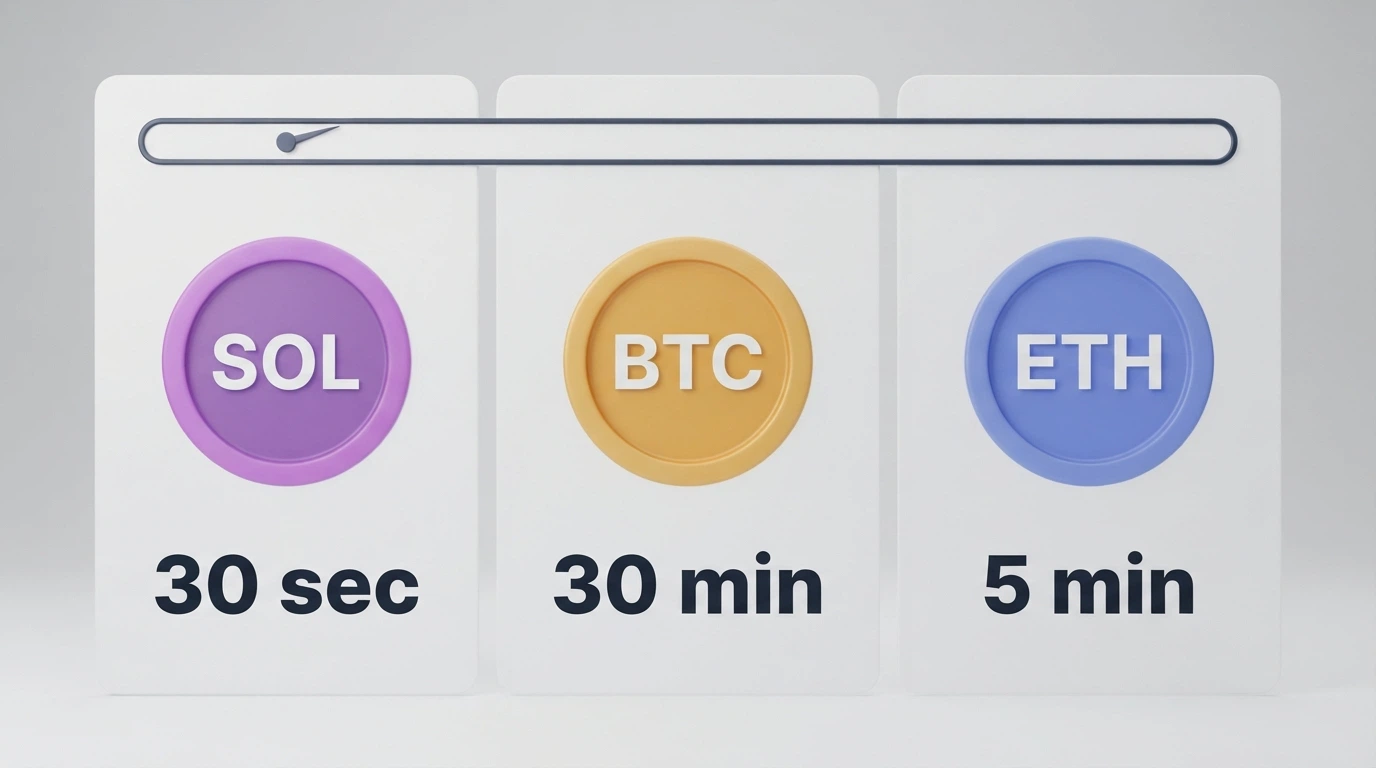
SOL is the fastest crypto payment rail a casino player can use. The on-chain leg of a SOL withdrawal averages 30 seconds — Bitcoin sits at roughly 30 minutes for comparable finality and Ethereum at 5 minutes under reasonable network conditions. The network fee is about one cent, against variable gas costs for Bitcoin and Ethereum that can run several dollars per transaction under congestion. For a player who values fast withdrawals and minimal fees, the SOL rail is the practical answer.
The minimum withdrawal is typically around A$10 with no upper limit. A player at Stake can withdraw as little as 2.50 USDT equivalent in any supported token. The ceiling question is set by the casino, not by the blockchain — a casino imposing a daily withdrawal cap, like SkyCrown’s A$7,500, sits on top of the rail.
How to Deposit SOL at an Online Casino
The deposit flow runs from the wallet to the casino’s on-chain address. A player connects Phantom or Solflare, selects Solana as the deposit method at the casino cashier, and either pastes the casino’s deposit address or scans its QR code. The wallet signs the transaction, the Solana network confirms it in roughly 400 milliseconds, and the casino’s deposit listener credits the balance.
Three rails behave differently at this step. A casino running a native SOL balance credits SOL-denominated chips that the player wagers and withdraws in the same token. A casino that converts at the cashier accepts SOL but credits a USD balance — the player has effectively sold SOL for the casino’s internal currency, and the withdrawal will come back in fiat or in a stablecoin of the operator’s choice. A casino that supports USDT on Solana takes an SPL stablecoin transfer, meaning the player moves a dollar-pegged asset and the SOL rail only carries the transfer.
What shows in the casino balance depends on which rail the player picked. The Phantom or Solflare wallet shows the SOL leaving. The casino shows whatever denomination it has chosen to display. The player should know which rail is active before depositing, because only the native-SOL rail returns SOL on withdrawal.
Withdrawing SOL: Speed, Fees and What to Expect
The withdrawal is where the SOL rail earns its reputation. The casino broadcasts a SOL transfer to the wallet address the player provides. The Solana network confirms the transaction in roughly 30 seconds. The funds land in the player’s wallet, subject to whatever internal approval window the casino runs before broadcasting.
CasinoZoid tested 22 withdrawals across Solana casinos and found the total end-to-end time — from request to wallet receipt — ran from 10 minutes to 4 hours for verified accounts. The on-chain leg is the 30-second part. The rest is the casino’s processing queue and any anti-fraud or KYC checkpoint that sits between the request and the broadcast. A verified account with a completed deposit history will sit at the short end of that window. A first withdrawal or a large one may sit at the long end.
The fee on a SOL withdrawal is about one cent. The same transfer on Bitcoin or Ethereum would carry variable gas fees — often several dollars under normal conditions and substantially more under congestion. The minimum withdrawal is typically around A$10 with no upper limit at the operators that publish one. Stake’s published minimum is 2.50 USDT equivalent. The ceiling is set by the casino’s own daily or per-transaction cap, not by the blockchain.
The Wallet You Need and the Tokens That Work
Phantom and Solflare are the two wallets an Australian player is most likely to use at a Solana casino. Phantom is the more widely adopted consumer wallet, with a browser extension and a mobile app that handles SOL and SPL tokens. Solflare is an alternative that emphasises staking and on-chain features. Either works for casino deposits and withdrawals; the choice comes down to which interface the player prefers.
SPL tokens are the on-chain assets that live on Solana — the standard is roughly equivalent to ERC-20 on Ethereum. USDT on Solana is an SPL token, and that is what makes it possible for a casino to support USDT deposits over the SOL rail without going through Ethereum or Tron. Stake supports SOL, USDT and twenty other cryptocurrencies across multiple chains. For a player who wants to hold a stable balance rather than ride SOL’s price swings, USDT on Solana is the practical answer.
A player holding SOL is exposed to the token’s price. A player holding USDT on Solana is exposed to nothing beyond the casino’s solvency and the rail’s reliability. The choice between them is a choice about whether the gambling bankroll should sit in a volatile asset or a stable one.
Casino Bonuses in SOL: Why the Number on the Banner Isn’t the Whole Story
Three welcome bonuses at Solana casinos carry verified terms. Stake offers 200% up to $3,000, with 40x wagering on deposit and bonus combined. RocketPlay offers 100% up to A$1,000 plus 100 free spins, with 40x wagering on the bonus amount. SkyCrown offers up to A$8,000 plus 400 free spins, with 40x on the bonus and 30x on free spins winnings. Each looks generous on the banner. Each costs the player a specific amount of turnover before any withdrawal of bonus funds is possible.

The wagering requirement is the multiplier that decides what the offer is really worth. A 40x multiplier on a $3,000 bonus means $120,000 of turnover — if the player has deposited $3,000 to claim the full match, the requirement extends to the deposit-plus-bonus total and the figure doubles to $480,000. At a $5 stake per spin, that is 96,000 spins. At 5 seconds per spin, that is 480,000 seconds of play — roughly 133 hours of continuous wagering to clear the bonus on Stake’s headline terms.
SkyCrown’s A$8,000 package carries the largest ceiling but the smallest max bet during wagering (A$5) and a 14-day window. RocketPlay’s A$1,000 is half the size but comes with 100 free spins and a 5-day validity window — shorter, faster to clear, harder to fit around a busy week. The free spins have value of their own, but RocketPlay’s terms publish a maximum bet during wagering of A$7.50 per spin, and a SkyCrown player clearing the bonus at A$5 a spin runs through the requirement at half the speed of an unrestricted wagering setup.
Welcome Bonus Structures Compared
Stake’s offer is the cleanest of the three: a 200% match with a $3,000 ceiling and no free spins component. The bonus lives entirely in the matched funds. RocketPlay splits the welcome between a 100% match up to A$1,000 and 100 free spins, with the spins delivered as 20 per day over five days. SkyCrown layers a larger match ceiling (A$8,000) with 400 free spins and a separate 30x multiplier on the spins’ winnings.
The headline number is not the comparison point. Stake’s 200% match gives a player who deposits $1,500 a $3,000 bonus — three times the deposit. SkyCrown’s A$8,000 ceiling requires a deposit large enough to draw down the full match (A$2,000 at 400% would do it, but the actual match percentage depends on the deposit structure across the welcome package). RocketPlay’s A$1,000 is the smallest ceiling but arrives with the most structured free-spins drip.
A player comparing the three on value alone should compare them on the same assumed deposit. A $500 deposit at Stake gives a $1,000 bonus, 40x on $1,500 total turnover, no spins. The same $500 at RocketPlay gives a $500 bonus, 40x on $500, plus 100 spins at 20/day for five days. At SkyCrown, the same $500 deposits into a multi-stage package with a $5 max bet and a 14-day window. The actual value of each offer depends on which games the player chooses to clear it on and how much the casino’s house edge eats into the bankroll during wagering.
Wagering Requirements: The Multiplier That Decides the Real Cost
The 40x multiplier is the market standard among the verified Solana casino welcome bonuses. What varies is what the multiplier is applied to. Stake applies 40x to deposit and bonus combined. RocketPlay applies 40x to the bonus amount only. SkyCrown splits it: 40x on the bonus, 30x on free spins winnings.
The difference between “deposit + bonus” and “bonus only” is the largest variable in the comparison. A player depositing $1,000 at Stake to claim the $2,000 bonus carries a $3,000 base for wagering, which means $120,000 in turnover. The same player depositing $1,000 at RocketPlay carries a $1,000 base, which means $40,000 in turnover. The Stake bonus pays twice the headline figure but costs three times the turnover compared to the RocketPlay bonus.
The time cost of the wagering depends on stake size and game speed. At a $5 stake per spin, 24,000 spins clear a $120,000 turnover requirement (the Stake figure on a $1,000 deposit). At 5 seconds per spin, that is 120,000 seconds — roughly 33 hours of play. On RocketPlay’s $1,000 bonus, the same $5 stake clears 8,000 spins in 40,000 seconds — about 11 hours. The wagering multiplier alone does not tell the player how long the bonus will take; the stake size and the game speed do.
The estimate is a statistical average across many spins under the stated assumptions. A single session can finish faster or slower, and a player can lose the entire bankroll before completing the wagering. The figure is a planning tool, not a guarantee.
The Fine Print: Time Limits, Max Bets and Game Restrictions
A bonus that expires in five days is a different proposition from one that gives fourteen. RocketPlay’s 5-day validity is short enough that a player who deposits on a Friday evening and plays intermittently may forfeit the bonus before completing the wagering. SkyCrown’s 14-day window allows for a slower playthrough. The max-bet cap is the second constraint: A$5 at SkyCrown, A$7.50 at RocketPlay — both restrict how fast a player can run through the turnover, and both carry the risk of a voided bonus if the cap is breached.
Free-spin terms carry their own ceiling. SkyCrown’s 10x bonus value max win on free spins means a player who hits a large multiplier on a spin has the excess voided. RocketPlay does not publish a comparable cap in the verified terms. Game eligibility varies by operator — most welcome bonuses exclude live dealer tables and many exclude high-RTP slots, which concentrates the wagering on the games with the highest house edge.
A$7,500 is SkyCrown’s daily withdrawal cap. A player who finishes wagering on a high-balance day and tries to move the full bankroll out will see the request split across days. The cap is an operational ceiling, not a bonus term, but it has the same effect on the player who needs the funds in a hurry.
The Games Worth Your SOL: Pokies, Live Dealer and Crypto Originals
Solana casinos carry thousands of titles. Solcasino alone runs 3,000+ games from Pragmatic Play, Evolution, NetEnt, Hacksaw Gaming, Nolimit City, BGaming, Endorphina, Platipus, Play’n GO, Push Gaming and Red Tiger — and accepts twenty-five or more cryptocurrencies including Solana. That is the scale of the catalogue at the larger end of the market.

Pokies are the dominant category. Pragmatic Play’s high-volatility releases — Gates of Olympus, Sweet Bonanza, Sugar Rush, The Dog House, Buffalo King — dominate the front pages of most Solana casinos. NetEnt’s older catalogue — Starburst, Gonzo’s Quest — sits alongside them. Live dealer tables come from Evolution and a handful of competing studios, streaming blackjack, roulette and baccarat around the clock. Crypto-original games — Crash, Dice, Plinko, Mines — are the in-house titles where provably fair verification applies.
Pokies and Slots at Solana Casinos
The slot catalogue at Solana casinos spans thousands of titles. A small set has verified RTP and volatility data; the rest sits in the catalogue without published figures.
| Slot Title | Provider | RTP | Volatility | Max Win |
|---|---|---|---|---|
| Gates of Olympus | Pragmatic Play | — | High | — |
| Sweet Bonanza | Pragmatic Play | — | — | — |
| Sugar Rush | Pragmatic Play | — | — | — |
| The Dog House | Pragmatic Play | — | — | — |
| Buffalo King | Pragmatic Play | — | — | — |
| Starburst | NetEnt | — | Low | — |
| Gonzo’s Quest | NetEnt | — | — | — |
| Dead or Alive 2 | NetEnt | — | — | 111,111x |
| San Quentin 2: Death Row | Nolimit City | — | — | 200,000x |
| BitStarz Billion | — | ~97.1% | — | — |
| Mega Joker | NetEnt | 99% | — | — |
| Blood Suckers | NetEnt | 98% | — | — |
| Codex of Fortune | NetEnt | 98% | — | — |
| Elvis Frog in Vegas | BGaming | — | Medium-High | — |
The empty cells are the point. Most slots at Solana casinos do not have published RTP and volatility figures in the sources this comparison was built from — only the titles above carry verified data. Dead or Alive 2’s 111,111x max win and San Quentin 2’s 200,000x are the standout ceiling figures; both are high-volatility slots where most sessions will return a small fraction of the bet. Mega Joker’s 99% RTP is the highest published figure on the list, but the game is a classic-style slot with limited bonus features; Blood Suckers at 98% and Codex of Fortune at 98% sit close behind.
Starburst’s low volatility and Win Both Ways feature — doubling chances across twenty paylines — make it the kind of slot a player can run wagering through without dramatic bankroll swings. Pragmatic Play’s catalogue dominates the high-volatility end of the market, with their math models independently audited. BGaming’s Elvis Frog in Vegas is a medium-to-high volatility slot with provably fair mechanics built in — a player can verify each spin’s outcome after the round completes.
Provably Fair Games vs RNG-Audited Titles
A player who finishes a spin on a BGaming slot can verify the outcome was generated fairly — the game’s built-in provably fair tool shows the server seed, client seed and nonce that produced the result, and the player can recompute the hash to confirm. That is what provably fair means in practice: a verifiable, cryptographic check that the casino cannot have manipulated the result after seeing the bet.
Third-party providers do it differently. Pragmatic Play’s high-volatility releases — Gates of Olympus and the rest of the catalogue — come with math models that undergo independent auditing. The player trusts the audit, not a per-round check. NetEnt’s slots carry the same trust model: an external lab has certified the random number generator, and the player accepts that certification. Evolution’s live dealer tables carry the trust of a streamed, physical game with real cards and a real wheel — the fairness model is the live video feed, not a hash.
In-house crypto-original games — Crash, Dice, Plinko, Mines — run on the provably fair model. These are the games where the on-chain verification actually applies, and where the player’s bankroll is most directly exposed to the smart contract’s logic. The slots from BGaming sit in between, with provably fair verification available on a per-round basis.
The two models coexist because they answer different questions. Provably fair answers “was this round fair?” after the round. Independent auditing answers “is this game fair on average?” before the round. A player who wants per-round verification plays BGaming and the in-house originals; a player who wants the largest catalogue plays the audited third-party titles.
Live Dealer, Table Games and Crypto-Native Formats
Beyond the pokies, a Solana casino carries live dealer tables from Evolution and other studios, streamed from purpose-built studios with real dealers and physical equipment. Blackjack, roulette and baccarat are the standard formats. Game-show formats — Dream Catcher, Monopoly Live, Crazy Time — have grown into their own category.
Table games in the RNG format — automated blackjack, video poker, virtual roulette — fill out the catalogue between the pokies and the live dealer. These are faster than the streamed tables and slower than the slots, sitting in the middle of the casino’s product mix.
Crypto-native formats are the games that only exist because the casino runs on digital currency. Crash shows a multiplier that climbs and crashes at a random point; the player bets and cashes out before the crash. Dice is a simple over/under bet with adjustable odds. Plinko drops a ball through a peg field and pays out based on the slot. Mines is a grid-reveal game where each click can end the round. These are the games where provably fair verification applies directly, and where the house edge is visible in the published odds.
NFT Casinos on Solana: A Niche With a Different Set of Rules
NFT casinos on Solana use Metaplex-standard NFTs to gate access, to function as membership tokens, or to carry yield for the holder. The model is genuinely different from a standard crypto casino: the NFT sits between the player and the games, and the player’s exposure includes the NFT’s market value as well as the gambling outcomes.
How an NFT Casino Differs from a Standard Crypto Casino
An NFT-gated casino requires the player to hold a specific NFT — or a tier of NFTs — to access certain games or to qualify for higher reward rates. Membership-tier NFTs function like loyalty cards with a tradable secondary market. NFT-staking lets a player lock tokens into a smart contract and earn yield from the casino’s bankroll, separately from the gambling outcome.
The risk profile is the difference a reader needs to understand. A player depositing SOL at a standard casino is exposed to the casino’s solvency and to the games’ house edge. A player holding an NFT at an NFT casino is exposed to all of that, plus the NFT’s market price. The NFT can drop in value independently of whether the player wins at the tables. The combined exposure is larger, and the assets that carry it are less liquid than SOL.
What’s Actually Available on Solana Right Now
The NFT casino segment on Solana is real but small. The number of operators is limited, the game catalogues are smaller than at standard crypto casinos, and the per-operator terms are harder to verify. None of the ten featured operators in this comparison are primarily NFT casinos — the comparison’s featured set is built from the standard crypto casino market, with SOL as a payment rail.
A player who wants the NFT casino experience will find it through the Solana NFT marketplaces rather than through the standard crypto casino comparison pages. The trade-off is access to a niche with a different mechanic and a smaller catalogue. For a typical Australian player, the standard Solana casino model in the comparison above is the more practical entry point.
Is It Legal? The Real Australian Rules for Offshore Casino Players
The Interactive Gambling Act 2001 makes it an offence to provide online casino games, online pokies and in-play sports betting to a person physically in Australia. The product is prohibited, not merely unlicensed. No Australian online casino licence exists — not federally, not in any state or territory. Every brand an Australian player can reach is operating outside the Australian rules, regardless of what other jurisdiction’s licence it carries.
The Interactive Gambling Amendment Act 2017 closed the loopholes offshore operators had used and gave the Australian Communications and Media Authority enforcement and website-blocking powers. Since the first blocking request in November 2019, the ACMA has had 1,788 illegal gambling and affiliate websites blocked by Australian ISPs. Over 230 illegal services have pulled out of the Australian market entirely since 2017.
The Interactive Gambling Amendment (Credit and Other Measures) Act 2023 took effect on 11 June 2024 and banned credit cards and digital currency as payment methods for licensed online wagering in Australia. A licensed Australian bookmaker cannot accept SOL or USDT. An unlicensed offshore casino asking for SOL is, by definition, outside the rules the ban was written to enforce.
The Interactive Gambling Amendment (Gambling Reform) Bill 2026 passed Parliament on 19 August 2026; its measures commence on 1 January $$CY+1$$. From that date, banks and payment providers gain express authority to block transactions to illegal gambling operators. The reform adds federal restrictions on wagering advertising, bars athletes and celebrities from promoting wagering products, and restricts inducement marketing.
What the Law Actually Says — and What It Doesn’t
The IGA targets the provider, not the customer. An individual player is not prosecuted under the Act. The offence sits with the operator offering a prohibited service to a person in Australia. “Not illegal for you” is the position the statute takes — but it is not the same as “safe”.
The minimum age for all commercial gambling in Australia is 18. That applies to the licensed market. The offshore market does not verify age against an Australian register; the player is on their own honour, and the casino’s own KYC controls are the only check.
What the law does do is define what is legal. Pre-event wagering on races and sport is legal through operators licensed by a state or territory, concentrated in the Northern Territory through Licensing NT. Lotteries and keno are legal through state-licensed operators. Everything else — online casino, online pokies, in-play sports betting — is prohibited as a provided service. The licensed wagering market includes SportsBet, bet365, Ladbrokes and approximately fifty others holding NT licences.
What the 2026 Reform Changes for Australian Players
From 1 January $$CY+1$$, the reform gives banks and payment providers authority to block transactions to illegal gambling operators. A player depositing SOL from an Australian bank account at an offshore casino will be subject to whatever blocking decisions the player’s bank makes under the new powers. The reform does not require banks to block; it permits them to.
Wagering advertising is capped at three ads per hour between 6:00 am and 8:30 pm, with a live-sport blackout from fifteen minutes before until five minutes after a live sporting event. Athletes, celebrities and influencers are barred from promoting wagering products in Australia. Direct marketing of inducements is prohibited for fourteen days after a customer signs up with a licensed operator, and for three months after a person deregisters from BetStop.
These are restrictions on licensed operators. Offshore casinos are outside the licensed market and outside the inducement rules. A player who sees an inducement offer from an offshore casino is being marketed to by an entity that is not subject to the same restrictions.
What Australians Give Up When They Play Offshore
The list is long because every Australian protection is jurisdiction-bound. The protections that exist are protections for the licensed market; the offshore market is not connected to any of them.
- BetStop binds around 150 licensed wagering providers — an offshore casino is not connected to the register and will continue accepting a self-excluded person’s money
- No Australian consumer protection framework applies; no Australian complaints body has authority over the operator
- The ACMA cannot recover money — its enforcement power is to direct ISPs to block, not to compensate
- No federal deposit, loss or stake ceiling protects the offshore player, because the product the ceiling would govern is banned outright
- No recourse if the operator refuses a withdrawal, voids a win or closes the account
- The site can be blocked at any time, with a balance still on it and no path to recovery
The ACMA’s own framing of the risk: even if a service looks legitimate, it is unlikely to have important customer protections, and Australians who use illegal gambling services risk losing their money.
ACMA Enforcement: Site Blocking and What It Means
The ACMA’s blocking power operates at the ISP level. When the regulator asks an Australian internet provider to block a domain, the provider routes requests to that domain to a sinkhole. The site becomes unreachable from most Australian IP addresses. The ACMA has used this power 1,788 times since November 2019, and over 230 illegal services have withdrawn from the Australian market entirely since 2017.
For a player, an account on a blocked site is an account the player may not be able to reach. A balance sitting on the site at the moment of blocking is a balance the player has no Australian-mediated way to retrieve. The blocking is not a punishment; it is a structural barrier that makes the site inaccessible.
Where to Get Help When the Play Stops Being Fun
Problem gambling affects roughly 430,000 Australian adults — about 2.1% of the adult population, with a further 1.8% in the high-risk category according to the Australian Institute of Health and Welfare’s 2022 figures. The services that exist are free, confidential and staffed around the clock. They reach the licensed market. They do not reach offshore casinos.
The Numbers to Call and the Services That Exist
- National Gambling Helpline — 1800 858 858 — free, confidential, 24 hours a day, 7 days a week. Online chat and email counselling through Gambling Help Online at gamblinghelponline.org.au.
- BetStop — the National Self-Exclusion Register, live since August 2023, lets a person exclude from every Australian-licensed online and phone wagering service in a single step. Minimum exclusion period is three months; maximum is lifetime. BetStop covers approximately 150 licensed wagering providers and does not reach offshore casinos.
- Financial counselling — the 2026 reform expands specialised financial counselling services for people experiencing gambling-related financial difficulty, available through the same helpline network.
How Big the Problem Is — and Who It Affects
BetStop had 67,480 registrations in its first three years; 41,290 of those exclusions were still active as at 31 July 2026 — more than 60% of everyone who ever registered. 78% of registrants were under 40. 38% chose lifetime exclusion. The scale of harm behind these numbers is what makes the offshore casino market a difficult subject to write about without including the help lines.
The offshore player is outside every one of these safety nets. BetStop does not block the offshore casino account. The helpline is there for any Australian who picks up the phone, but the offshore casino will not know a player has self-excluded. The 14-day post-signup inducement ban and the three-month post-BetStop deregistration restriction apply to licensed operators, not to offshore brands.
How We Selected and Ranked Every Solana Casino on This Page
The operators in this comparison were chosen from the AU operators shortlist — market-share data filtered for casino product (not sports-only wagering), real-money operation, known cryptocurrency acceptance and active Australian traffic. The sources consulted were CryptoSlate, CasinoZoid, AussiePokies96, Webopedia, LTCCasino and CoinCodex, with the Australian Communications and Media Authority register used to verify licence claims.
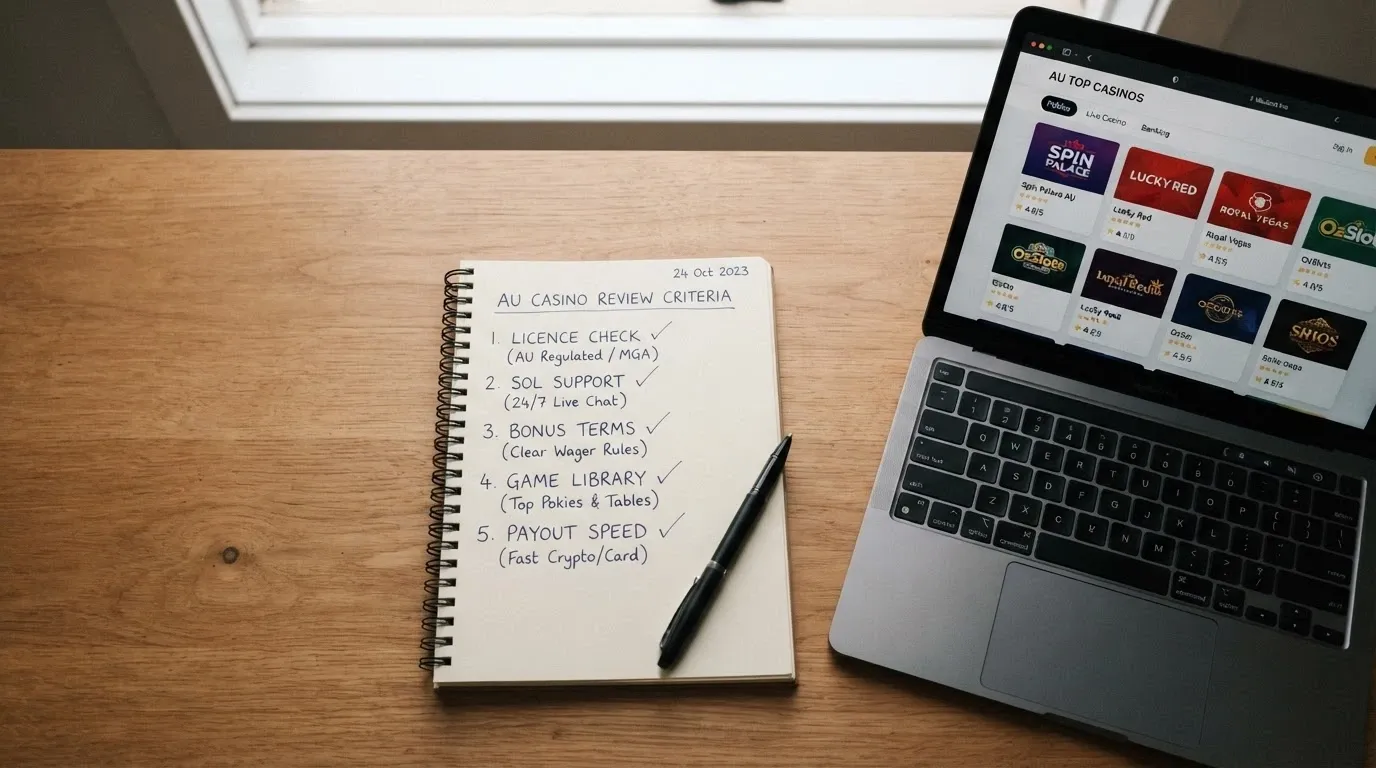
The ranking criteria are licence transparency, SOL support, bonus fairness, game library and payout reliability. Two operators (Stake and Cloudbet) carry verified Curaçao Gaming Authority licences. The remaining eight are included on the strength of AU presence and crypto rails; their detailed bonus and licence terms were not independently verified this round, and a player should treat any specifics as requiring direct confirmation with the operator.
What the ranking does not measure: real-time bonus changes (operators revise their welcome packages without notice), individual player experience (the comparison is structural, not experiential), and the player’s own KYC or withdrawal experience with a specific brand. A player who has had a problem with a specific operator should weight that experience above the comparison’s structural ranking.
What You Should Actually Do About Solana Casinos as an Australian Player
The trade-off this page has documented is real. Solana casinos work. The SOL payment rail is fast and cheap. The games are the same games Australians see at licensed operators’ land-based counterparts. The bonuses are large and the wagering terms are published. None of that is in dispute.
What is in dispute is what Australians give up to access it. BetStop does not reach these sites. The ACMA cannot recover a lost balance. There is no Australian consumer protection framework and no complaints body. The deposit, loss and stake ceilings that protect Australian players at licensed operators do not exist in the offshore market. A site can be blocked by the ACMA at any time, with the player’s balance on it.
The due diligence a player can do is limited but not nothing. Check the licence jurisdiction against the regulator’s own register — Curaçao Gaming Authority and Anjouan Gaming Board both publish licensee lists. Read the wagering terms before depositing, especially the deposit-plus-bonus calculation at Stake and the max-bet cap at SkyCrown. Test a small withdrawal before committing a large bankroll — the 10-minute-to-4-hour window from CasinoZoid’s 22-withdrawal test is the realistic expectation for a verified account. Set a loss limit before playing, and treat it as a hard floor.
The non-negotiable safeguards are simpler. The National Gambling Helpline — 1800 858 858 — is free, confidential and staffed 24 hours a day. BetStop is there for the licensed market. The offshore market does not honour either. The honest position is that Solana casinos exist and work for Australian players who choose to use them, and that every protection an Australian might assume applies does not.
Frequently Asked Questions
Are Solana casino games provably fair?
Some are. In-house crypto-native games (Crash, Dice, Plinko, Mines) and a subset of slots from BGaming use provably fair mechanics — the player can verify each round’s outcome from the server seed, client seed and nonce. Third-party titles from Pragmatic Play, NetEnt and Evolution rely on independent RNG audits instead. Both models answer different questions: provably fair checks the round after it happens; RNG auditing checks the game before the round.
Which welcome bonus gives you the most value in 2026?
The three verified welcome bonuses are not directly comparable. Stake’s 200% up to $3,000 carries 40x wagering on deposit and bonus, which doubles the base for the turnover calculation. SkyCrown’s A$8,000 package carries 40x on the bonus and 30x on free spins winnings, with an A$5 max bet during wagering and a 10x max win cap on free spins. RocketPlay’s A$1,000 + 100 free spins carries 40x on bonus only with a 5-day validity window. The “best” bonus depends on deposit size, game choice and how much turnover the player can run through before the validity window closes.
How fast are Solana casino withdrawals compared to Bitcoin?
SOL withdrawals settle on-chain in roughly 30 seconds. Bitcoin withdrawals take roughly 30 minutes for comparable finality; Ethereum around 5 minutes under reasonable network conditions. The end-to-end time from request to wallet receipt — including the casino’s internal approval — was 10 minutes to 4 hours across 22 withdrawals tested by CasinoZoid for verified accounts. SOL network fees are about one cent; Bitcoin and Ethereum gas fees are variable and can run several dollars per transaction.
What happens if a Solana casino blocks my account or refuses a withdrawal?
There is no Australian complaints body with authority over an offshore casino, and the ACMA cannot recover money. The player has no domestic recourse if the operator closes the account, voids a bonus win, or refuses a withdrawal. The only paths are the operator’s own dispute process and any licence-jurisdiction complaint mechanism the regulator offers — Curaçao and Anjouan both publish complaint channels, but they sit outside the Australian legal system. This is the core risk an Australian offshore player carries, and it is the reason a small test withdrawal before committing a larger bankroll is the practical due diligence step.
Does BetStop cover Solana casinos in Australia?
No. BetStop binds approximately 150 licensed wagering providers in Australia. Offshore casinos are not connected to the register, and registering with BetStop does not stop an offshore casino from accepting the player’s deposits. The self-exclusion applies to every Australian-licensed online and phone wagering service, not to the offshore market the Solana casinos operate in. A player who has registered with BetStop and continues using an offshore casino is using a self-exclusion that does not reach their actual point of play.
What wallet do I need to play at a Solana casino?
Phantom or Solflare. Both are the primary Solana wallets used by casino players; Phantom is the more widely adopted consumer wallet with a browser extension and mobile app, while Solflare leans toward staking and on-chain features. Either wallet holds SOL and SPL tokens such as USDT on Solana, and either works for casino deposits and withdrawals. The choice is interface preference, not capability.