$300 No-Deposit Bonus Casinos in Australia: The Offer That Does Not Exist the Way It Looks
 Available in AU
Data current as of 22 October 2026, verified against the Australian Communications and Media Authority register and the Interactive Gambling Act 2001.

A banner that promises “$300 no deposit” is doing one job very well: getting the click. It is doing something else less well, which is telling the truth. The headline number and the amount an Australian player can actually withdraw are rarely the same figure, and the casino offering it exists in a regulatory space the Australian government has spent a quarter of a century trying to close.
This page is written for the reader who searched for the bonus, found a list of casinos, and wants to know what is really behind the offer before doing anything with their bank account. It is also written for the reader who already knows the legal status is messy and wants the numbers, the fine print and the off-ramps made plain. Both readers should come away knowing what a $300 no-deposit bonus actually delivers, who is offering it, and what they are giving up by claiming it.
Table of Contents
- The $300 No-Deposit Offer Aussies Are Searching For — And What It Really Means
- Why a 2026 $300 No-Deposit Bonus Rarely Looks Like the Ad
- Every Casino Advertising a $300 Bonus to Australian Players — Ranked by Reach
- Paying an Offshore Casino With PayID — What Actually Works in 2026
- Which Pokies Take a No-Deposit Bonus — And Which Ones Never Do
- The Legal Reality: Every $300 No-Deposit Casino Bonus Sits Outside Australian Law
- Playing Offshore Without the Safety Net: Australia’s Protections Cannot Reach You There
- How We Evaluate and Rank Online Casinos for Australian Players
- What the $300 No-Deposit Bonus Search Actually Tells You About Playing Online in Australia
- Frequently Asked Questions
The $300 No-Deposit Offer Aussies Are Searching For — And What It Really Means
The first thing to settle is the gap between the search term and the market. There is no online casino licence in Australia — not federally, not in any state or territory. The Interactive Gambling Act 2001 (IGA) makes it an offence for a provider to offer online casino games, online pokies or in-play betting to a person in Australia. That is the headline legal fact, and it is the one every page about “Australian online casinos” eventually has to face. The same Act says the person playing is not the target — it targets the operator. But the absence of prosecution is not the same as the presence of protection, and the offshore operator offering a $300 bonus is breaking the IGA prohibition itself simply by existing on a screen aimed at Australian IP addresses.
So the offer an Australian is searching for is being made by someone who, under Australian law, should not be making it. That does not mean the offer is fake. It means the regulatory frame the reader is searching inside — licensed, audited, complaint-handled, recourse-bearing — does not apply to anything that turns up in the search results. The page ahead works through what is left when that frame is removed: who is offering what, on what terms, with what protection, and at what eventual cost.
What a No-Deposit Bonus Actually Means — And What It Doesn’t
A no-deposit bonus is credit an online casino credits to a new account without the player having to fund it first. The player registers, the casino credits bonus money or free spins, and the player plays with that credit rather than with their own deposit. Mechanically, that is what the term means.
What it does not mean is more important. It does not mean free cash that can be withdrawn immediately. The bonus credit is almost always non-withdrawable until a set of conditions has been met: a multiple of the bonus must be turned over in qualifying games, a maximum cashout ceiling sits above whatever balance the playthrough leaves, and a clock starts running the moment the bonus is credited. Fail any of those conditions — by playing a non-eligible game, by hitting a withdrawal before the bonus is cleared, by letting the validity window close — and the bonus, and any winnings tied to it, can be voided.
Why casinos offer them is the easy half. A no-deposit bonus is a marketing cost designed to put a real-money game in front of a registered account, where the operator has a chance of converting that account into a depositing player. The hard half, for the player, is that the conditions attached to the bonus are the product. The credit is the lure; the terms are the sale.
Sign-Up Offer vs Deposit Match: Why the Difference Matters for Your Money
A no-deposit sign-up bonus and a deposit-match welcome package look similar on a banner but work very differently underneath. The no-deposit bonus is credited without a deposit being made. The deposit match requires one, and is usually a percentage of the first deposit — sometimes stretched over the first two, three or four deposits as a tiered package. A “$300 welcome bonus” headline almost always refers to the total of those tiers, not a single $300 credit on day one.
That distinction matters because the deposit-match bonus, even when it totals $300 across multiple deposits, is a different kind of cost calculation. The player has already committed real money to clear it; the bonus is essentially house money riding on top of that commitment. A no-deposit bonus, by contrast, costs the player nothing to claim but costs them a great deal of time and play to clear — and the casino has structured the terms to make sure the average player does not finish the playthrough with anything left.
This page concerns itself with the no-deposit version, which is what the search asks about. Where a $300 figure is being used as a headline for a multi-tier deposit package, that should be read as a marketing aggregation rather than a single bonus amount.
Why a 2026 $300 No-Deposit Bonus Rarely Looks Like the Ad
A bonus is a small contract, and every clause in it does work. Four clauses do most of the work in turning a $300 headline into a much smaller reality: wagering requirements, maximum cashout caps, game eligibility and weighting, and the validity window. They are explained below in qualitative terms, because the specific multiples and caps this run could not be confirmed from the operators’ own pages and a number printed here without a source would be a guess with the article’s name on it.
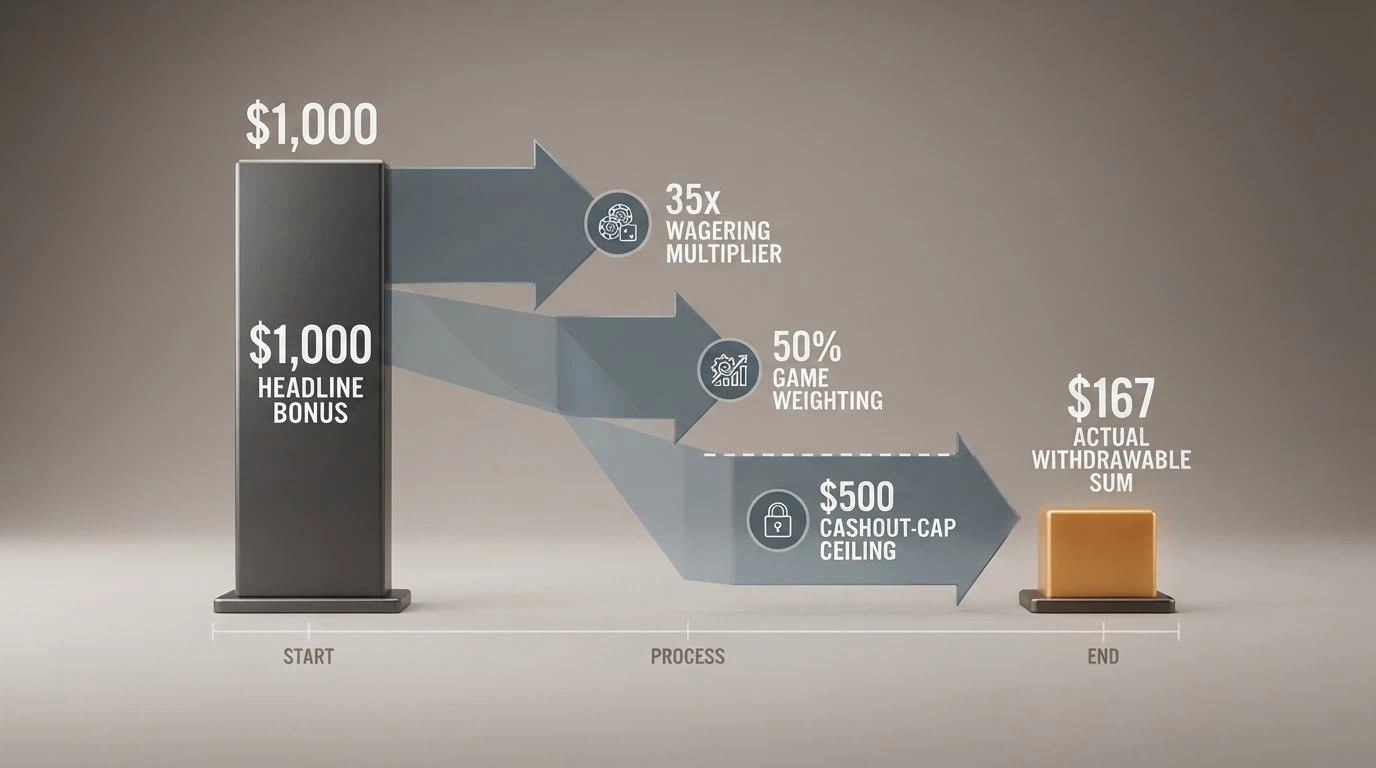
Wagering requirements, also called turnover or playthrough, are the number of times the bonus (and sometimes the deposit plus bonus) must be wagered before any withdrawal is permitted. The mechanism is simple to describe: a 30× requirement on a $300 bonus means $9,000 in qualifying bets before withdrawal unlocks. The mechanism is brutal in practice. Turnover requirements are the single largest reason a “free” bonus stops being free somewhere around the second hour of play.
Maximum cashout caps are the second clause to read. A $300 bonus with a $100 cashout cap means a player who has ground through $9,000 in turnover and ends up with a $5,000 balance cannot withdraw the $4,900 above the cap — only the $100 ceiling, or whatever the terms permit, leaves the casino. The cap is the part of the contract where the operator tells the player how much of the upside it is willing to let them keep.
Game eligibility and weighting is the third. Most no-deposit bonuses restrict which games count toward wagering, and weight different game categories at different percentages. Pokies typically contribute 100% of each spin’s value toward the turnover target; table games and live dealer often contribute a fraction of that or nothing at all. The “eligible games” list is the first document to read.
Validity windows are the fourth. A bonus that expires in seven days is a very different proposition from one that allows thirty. Short windows raise the effective cost of the bonus because they force a higher hourly wagering rate to clear in time.
This run could not confirm the wagering multiples, cashout caps, eligible-game lists or validity windows for any of the operators on this page. That is not a gap the article can quietly paper over. The reader’s actual cost is set by those four numbers, and they are missing here. The shape of the cost is known; the per-brand figure is not.
The Fine Print That Shrinks a $300 Bonus to Pocket Change
A worked example, using ranges rather than confirmed brand figures. Suppose a casino offers a $300 no-deposit bonus with a 40× wagering requirement on the bonus, a $100 maximum cashout, and pokies as the eligible game at 100% weighting. The player has $300 in bonus credit and, say, 30 days to clear it. To meet the wagering requirement, the player must place $12,000 in qualifying bets on eligible games. A typical online pokie runs at a return-to-player (RTP) somewhere in the mid-90s, so on average that $12,000 in turnover will cost the player roughly $600 in expected loss — against a bonus that, on the best day, lets them walk away with $100.
That arithmetic is the offer. A $300 bonus becomes a $100 ceiling, paid for by an expected loss of several hundred dollars and roughly fifteen hours of play at a moderate spin rate. The casino is not giving the player money; it is selling the player the chance to compete, with a hard limit on the winnings, for a stake of roughly twice the headline figure. The reader who walked in expecting a $300 windfall walks out with $100 if everything goes right, and nothing if anything goes wrong.
The numbers above are ranges, not figures tied to any operator in this ranking. They illustrate the kind of contract a $300 no-deposit bonus typically is. The actual terms, where they exist in published form, sit somewhere inside that envelope.
Bonus Codes: The Key That Unlocks the Offer — or Locks You Out
A bonus code — sometimes called a promo code — is a short alphanumeric string an operator publishes to channel a player into a specific offer. The casino distributes codes through affiliate pages, email and SMS, and the player enters the code during registration or at the cashier to claim the bonus tied to it.
The risk is mechanical. A player who registers without entering the code may forfeit the no-deposit offer entirely, or be credited a different, smaller bonus instead. A player who enters the wrong code, or a code that has expired, may end up with nothing. A generic sign-up link that pre-fills the code is one mitigation; reading the affiliate page or the email that delivered the code is another. No working code is printed on this page, both because codes change and because printing one is the kind of detail the page is not in the business of supplying.
Real-Money Play vs Free-Play Mode: What a No-Deposit Bonus Actually Buys
A pokie played in demo or “fun” mode is not the same animal as a pokie played with no-deposit bonus credit, and neither is the same as a pokie played with the player’s own deposited cash. In demo mode, the spins are free, no registration is required, and there is no real-money outcome on either side — wins and losses are virtual. In no-deposit bonus mode, the spins are funded by the operator’s marketing budget, the winnings are real, and the player cannot touch those winnings until the bonus terms are satisfied. In real-money mode, the player has deposited their own funds, and the winnings belong to them subject only to the casino’s standard withdrawal terms.
The progression from one to the next is also the casino’s funnel: demo gets the player interested, no-deposit bonus gets them to register and play for real, deposit match gets them to fund an account. Each step adds friction that filters out players who would not have deposited anyway, and the no-deposit bonus sits in the middle of that funnel as the bridge from “just looking” to “money on the screen.”
Every Casino Advertising a $300 Bonus to Australian Players — Ranked by Reach
The table below lists ten offshore casino brands that hold the largest tracked share of Australian player traffic. The ranking is by market reach — that is, by how many Australians each brand is actually pulling in — not by any judgement about which is the safer, fairer or more legitimate operator. None of the ten carries an Australian casino licence, because no such licence exists.
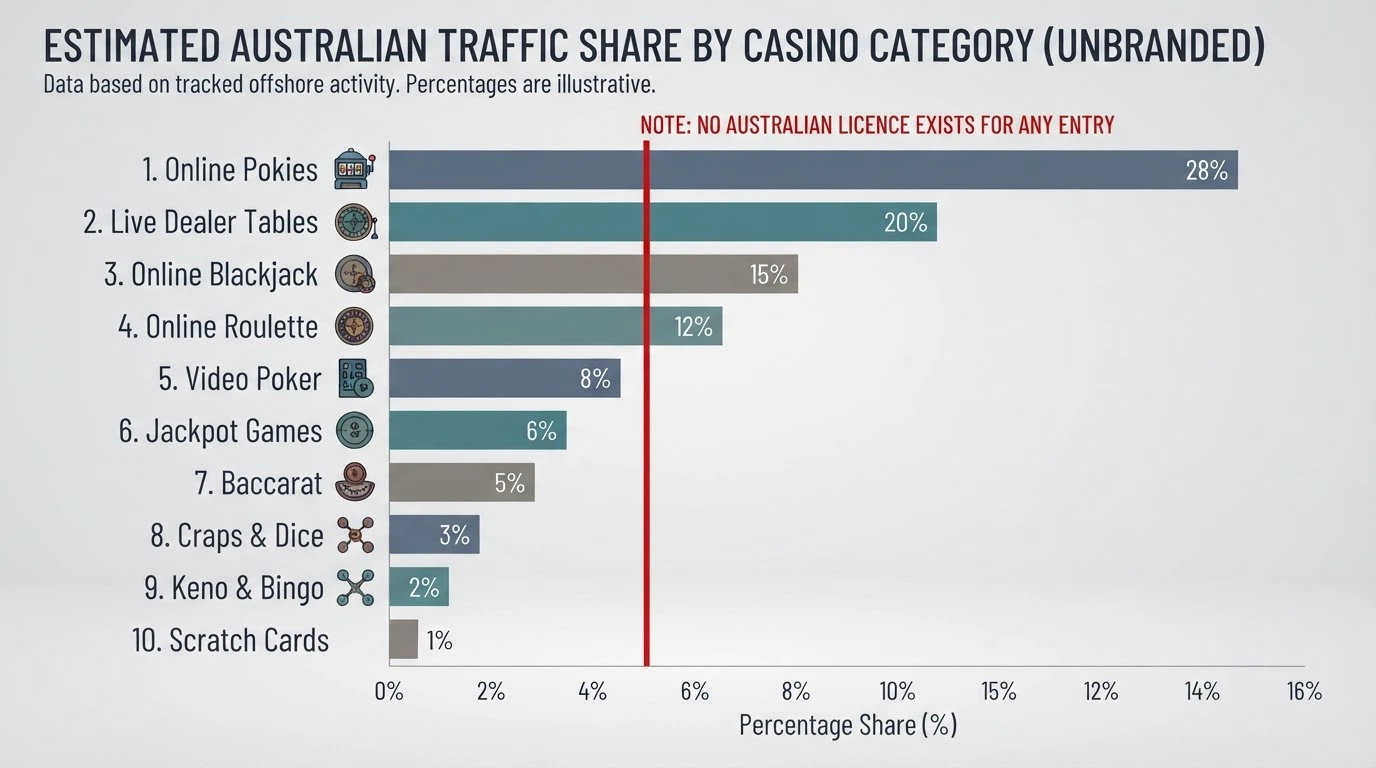
The market-share and revenue figures are evidence of reach. They are not evidence of legality, fairness or player protection. They tell the reader where Australian players are currently going; they do not tell the reader where Australian players ought to be going.
| Brand | Market Share (AU traffic) | AU Casino Licence Status |
|---|---|---|
| Rocket Play | 9.4% | None — no Australian online casino licence exists |
| Skycrown | 8.55% | None — no Australian online casino licence exists |
| Royal Reels | 2.51% | None — no Australian online casino licence exists |
| Stake | 1.28% | None — no Australian online casino licence exists |
| WinSpirit | 1.55% | None — no Australian online casino licence exists |
| FairGO | 0.8% | None — no Australian online casino licence exists |
| Rainbet | 1.28% | None — no Australian online casino licence exists |
| Scream Casino | 0.99% | None — no Australian online casino licence exists |
| Bizzo Casino | 0.57% | None — no Australian online casino licence exists |
| Rocket Casino | 0.57% | None — no Australian online casino licence exists |
The licence column is uniform because the fact it states is uniform: every brand offering an Australian-facing online casino product is, by definition, unlicensed for that product. The column does not vary because the underlying law does not vary.
Rocket Play
Rocket Play is the largest of the offshore casino brands by Australian traffic share, sitting at 9.4% with $632.69 million in tracked revenue. Its welcome offer, by the operator’s own shape, is a multi-tier package spread across the first several deposits — meaning the headline figure on a banner is usually an aggregate across tiers rather than a single credit on day one. The specific dollar amounts, the wagering multiples, and whether a no-deposit bonus is offered alongside the package could not be confirmed from Rocket Play’s own pages this run.
Rocket Play operates from outside Australia and holds no Australian licence of any kind for casino games. Players registering from an Australian IP are accessing a product the operator is not authorised to supply to them under the IGA, and the same prohibition governs the bonus offer itself: an offshore casino advertising a welcome bonus to Australians is breaking the IGA prohibition itself, not merely an advertising rule.
What Rocket Play offers, on the evidence available, is scale: the brand has built a real customer base in Australia through an affiliate and marketing footprint that the smaller operators on this page cannot match. Whether the welcome package that scale delivers is worth claiming is a calculation the player makes with the wagering multiple and the cashout cap in front of them — neither of which is on this page.
Skycrown
Skycrown is the second-largest of the offshore casino brands in the Australian market, at 8.55% market share and $436.07 million in tracked revenue. Like Rocket Play, Skycrown runs a multi-tier welcome package whose headline figure is typically a sum across the first few deposits rather than a single credit. The specific amounts and the no-deposit structure could not be confirmed from Skycrown’s own pages this run.
Skycrown also operates from outside Australia and holds no Australian casino licence. The same regulatory caveat applies: the product is prohibited to provide in Australia, the operator is providing it, and the player is making their own decision about the gap between the offer on the screen and the protection behind it.
What Skycrown offers, on the evidence available, is a credible second-tier alternative to Rocket Play in the AU traffic market — slightly less reach, slightly less revenue, the same offshore status. A reader comparing the two on reach alone is choosing between very similar propositions.
Royal Reels
Royal Reels sits third in the Australian market by tracked revenue at 2.51% market share and $243.99 million in revenue. The welcome offer, no-deposit structure, wagering multiple, cashout cap and eligible games for Royal Reels could not be confirmed from the operator’s own pages this run. The reader who reaches Royal Reels through the search results is, like the reader who reaches any other brand on this list, signing up with an offshore casino holding no Australian licence.
What can be said is the shape: Royal Reels is a smaller operator by AU reach than Rocket Play or Skycrown, but still well ahead of most brands in the wider market. That reach comes from the same affiliate channels and the same offer mechanics as the larger competitors. Where Royal Reels sits on wagering terms, withdrawal speed or cashout policy is something the player checks against the operator’s own page before depositing anything.
Stake
Stake is the well-known crypto-first casino brand, sitting at 1.28% Australian market share and $115.67 million in tracked revenue. Stake’s welcome offer, wagering structure, cashout cap and no-deposit status could not be confirmed this run.
One specific thing to note about Stake: the operator’s payment stack has historically been built around cryptocurrency. Australians using credit cards, credit products or digital currency for online wagering are using methods banned for that purpose since 11 June 2024, with penalties of up to $247,500 for the operator that accepts them. A reader landing on Stake from an Australian IP should expect that the deposit route the operator steers them toward may sit outside what Australian law permits.
What Stake offers, on the evidence available, is brand recognition — it is one of the more visible offshore casinos globally — but the same offshore status as every other brand on this page and the same absence of an Australian licence.
WinSpirit
WinSpirit is a mid-tier offshore operator by Australian traffic, at 1.55% market share. The welcome offer, no-deposit structure, wagering multiple, cashout cap and eligible games could not be confirmed from WinSpirit’s own pages this run.
WinSpirit sits in the middle of the offshore pack by Australian reach — smaller than Rocket Play and Skycrown, larger than the bottom of this list. The reader considering WinSpirit is making the same offshore-versus-licensed trade-off every brand on this page requires, and the same gap applies between what the brand’s banner promises and what its terms actually deliver.
FairGO
FairGO holds 0.8% of Australian traffic in the tracked market. The brand has historically presented itself with Australian-facing branding — the name reads as Australian, the visual styling reads as Australian — but the licence status is the same as every other operator on this page: none. No Australian online casino licence exists, and FairGO does not hold one.
The Australian-facing branding does not change what the operator is. It is an offshore casino targeting Australian traffic, and the bonus mechanics — wagering, cashout, eligibility, validity — apply on the same terms as they would at any other offshore brand. The reader who picks FairGO for the local feel is still picking an offshore operator without Australian recourse.
Bonus terms for FairGO could not be confirmed from the operator’s own pages this run.
Rainbet
Rainbet is another offshore casino with Australian traffic, sitting at 1.28% market share. The welcome offer, no-deposit structure, wagering terms and cashout policy could not be confirmed from Rainbet’s own pages this run.
The reader considering Rainbet is again making the offshore-versus-licensed trade-off. There is no Australian licence behind the brand, no BetStop coverage, no ACMA complaints recourse if a withdrawal is refused. The same caveats apply as for the rest of the list.
Scream Casino
Scream Casino sits at 0.99% of Australian traffic, placing it in the lower tier of the offshore brands tracked. Welcome offer, no-deposit structure, wagering terms and cashout policy could not be confirmed from Scream Casino’s own pages this run.
The smaller market share means less reach but not less risk. An offshore casino with 1% of the Australian market is, from the player’s point of view, in the same regulatory position as one with 9% — unlicensed, outside Australian consumer law, outside BetStop.
Bizzo Casino
Bizzo Casino holds 0.57% of Australian traffic — one of the smaller reaches on this page. Welcome offer, no-deposit structure, wagering terms and cashout policy could not be confirmed from Bizzo’s own pages this run.
Rocket Casino
Rocket Casino sits at 0.57% of Australian market share and is a separate operator from Rocket Play. The brand name is similar, which is worth flagging because a reader searching for “Rocket Play” or “Rocket casino $300 bonus” can land on either. They are not the same entity, and the welcome offer, the wagering terms, and the cashout structure at Rocket Casino are not interchangeable with those at Rocket Play.
Bonus terms for Rocket Casino could not be confirmed this run. The licence status is the same as every brand on this list: no Australian casino licence exists, and Rocket Casino does not hold one.
Paying an Offshore Casino With PayID — What Actually Works in 2026
PayID is the Australian real-time payment system that links a payment to a phone number, email or ABN rather than a BSB and account number. Sitting on top of the New Payments Platform, it processes most transfers in under a minute, often in seconds, and is the standard fast-deposit route for Australians — including, increasingly, Australians depositing at offshore casinos.
PayID itself is legal. What it is being used for is the variable. An Australian who deposits at a licensed Australian wagering operator using PayID is using a permitted payment route for a permitted product. An Australian who deposits at an offshore casino using PayID is sending money to an entity that, under Australian law, should not be receiving it. The transaction goes through; the legal status of what it pays for does not change.
The credit-card and crypto ban that took effect on 11 June 2024 made the payment method itself a tell. Credit cards, credit-related products and digital currency are banned for online wagering in Australia, with penalties of up to $247,500 for the operator that fails to enforce it. An Australian who is asked for a credit card or crypto by a gambling site is being served by someone outside the Australian rules — the payment method is itself a tell of an offshore operator.
What Australian Law Says Your Payment Method Should Look Like
The payment routes permitted for licensed Australian wagering are:
- Debit card
- Bank transfer
- PayID / Osko
- BPAY
The methods banned for any online wagering in Australia are:
- Credit cards and credit-related products
- Digital currency (crypto)
An offshore casino that asks for either of the banned methods is asking the player to step outside the Australian regulatory frame. The transaction may still go through — the operator may not be enforcing the ban — but the Australian player using it is not in a system with Australian consumer protection behind it.
Deposit Amounts, Speed and the Withdrawal Reality Check
PayID deposits land near-instantly. A $300 PayID transfer to an offshore casino’s account typically clears within seconds, and the bonus or the real-money balance it funded is available to play almost immediately. That speed is one of the reasons PayID has become a popular deposit route for Australian players at offshore brands.
Withdrawal is a different story, and it is the story the marketing never tells. An offshore casino processes withdrawals on its own schedule, with its own limits, and with its own discretion about whether to honour a withdrawal request at all. Processing times range from hours to weeks across the offshore market; there is no Australian standard, because there is no Australian regulator with authority over the operator. A $300 balance that took seconds to deposit can sit in pending status for days, can be partially refused on a bonus-abuse ruling, or can be left on the site when the ACMA blocks the domain.
And once the ACMA blocks the site, the ACMA cannot recover player money. There is no complaints body with authority over an offshore operator, no consumer law that compels a payout, and no Australian court that can drag the funds back. The deposit was instant; the withdrawal is whatever the operator decides it is.
From 1 January 2027, banks and payment providers gain express authority to block transactions to illegal gambling operators, which may slow or stop some of these deposits at the source. Until then, the deposit leg of the transaction is the player’s responsibility.
Which Pokies Take a No-Deposit Bonus — And Which Ones Never Do
A pokies lobby at an offshore casino typically runs into the thousands, and a no-deposit bonus typically funds play on a much smaller subset. The eligible games list — usually buried in the bonus terms — is the document that decides what the bonus can actually be used on.

Most no-deposit bonuses restrict play to a curated list of pokies, often weighted at 100% of stake value toward the wagering requirement. Table games — blackjack, roulette, baccarat — are usually weighted at a small fraction of stake value (or zero), and live dealer games are commonly excluded entirely. The weighting matters because the bonus is cleared by eligible-play turnover, and a $1 spin on a 100%-weighted pokie clears $1 of the requirement while a $1 spin on a 5%-weighted table game clears five cents.
No per-title RTP or confirmed eligible-games list was carried by this run. The shape of the rule is known; the specific games each operator permits are not.
Free Pokies, No-Deposit Pokies and the Real-Money Gap
Free pokies — the kind an Australian finds on a social-casino app, a software-provider demo page, or an aggregator’s preview site — are not real-money games. They do not require registration, do not pay real cash, and do not feed into a withdrawal. They are a way to learn a game, kill some time, or be sold a no-deposit bonus by an affiliate page that links to the real-money version.
No-deposit-bonus pokies are the next step up. The player registers with an offshore casino, claims a no-deposit bonus, and plays the eligible pokies with real-money outcomes. Wins accumulate in the bonus balance; the player cannot withdraw those wins until the wagering requirement is cleared and any cashout cap respected. The progression from free pokies to no-deposit-bonus pokies to deposit-funded pokies is the casino’s conversion funnel, and each step adds friction that filters out players who would not have deposited.
For Australians specifically, the real-money version of every one of these pokies is being supplied by an operator the IGA prohibits from supplying it. The product itself is prohibited to provide in Australia; the bonus is the marketing wrapped around it.
Game Weighting: Why Not Every Spin Counts the Same Toward Clearing Your Bonus
Game weighting is the multiplier an operator applies to each spin’s stake value before counting it toward the wagering requirement. A 100%-weighted pokie contributes the full stake value of each spin to the turnover target; a 10%-weighted table game contributes a tenth of it; a 0%-weighted live dealer game contributes nothing.
The practical effect is large. A $300 bonus with a 40× wagering requirement ($12,000 turnover) clears at a typical pokie rate in roughly the same play time it takes to clear a $3,000 turnover at a 10%-weighted table game — except the table-game player has to generate four times the nominal turnover to reach the same effective turnover. The weighting rule quietly multiplies the time and the expected loss the player has to absorb.
Typical industry ranges, which this run can state only as ranges because no per-operator figures were confirmed: pokies commonly 100%, table games 5%–20%, live dealer often 0%. Some operators exclude jackpot pokies entirely, on the grounds that the operator does not want to wear the cost of a seven-figure progressive hit funded by bonus credit. The eligible-games list is the document to read before any spin is placed.
The Legal Reality: Every $300 No-Deposit Casino Bonus Sits Outside Australian Law
This section lays out the framework the rest of the page has been referring to. There is no online casino licence in Australia. The Interactive Gambling Act 2001 (IGA) prohibits the provision of online casino games, online pokies and in-play betting to persons in Australia. The Interactive Gambling Amendment Act 2017 closed the loopholes offshore operators had been using and gave the Australian Communications and Media Authority (ACMA) enforcement and site-blocking powers. The 2017 amendment is what turned the prohibition from a paper rule into one with ISP-level enforcement behind it.

What is licensed in Australia is wagering on racing and pre-event sport, plus lotteries and keno, through operators licensed state by state (with the Northern Territory acting as the de facto national licensor for online wagering via Licensing NT). Online casino is not on that list. The land-based casino licences held by Crown, The Star and other state-licensed venues are a different regime — they are a valid contrast for an online page, but they must never be presented as the licence under which an online casino operates.
A page about “the best licensed online casinos in Australia” is describing something that does not exist, and writing one produces a factual lie on every screen.
| Legislation | Key Provision | Effective Year |
|---|---|---|
| Interactive Gambling Act 2001 (IGA) | Prohibits provision of online casino, online pokies and in-play betting to persons in Australia | 2001 |
| Interactive Gambling Amendment Act 2017 | Closed offshore loopholes; gave ACMA enforcement and site-blocking powers | 2017 |
| Interactive Gambling Amendment (Credit and Other Measures) Act 2023 | Banned credit cards, credit-related products and digital currency for online wagering | 2024 (commencement 11 June 2024) |
| Interactive Gambling Amendment (Gambling Reform) Bill 2026 | Advertising caps, inducement restrictions, payment-blocking authority | 2027 (commencement 1 January 2027) |
How the ACMA Blocks Offshore Casinos — And What That Means for Your Balance
The ACMA is the federal regulator enforcing the online prohibition. It investigates complaints, issues formal warnings and civil penalty proceedings, refers operators for enforcement, and directs Australian internet service providers to block illegal sites. The blocking is DNS-level, applied at the ISP, and takes a site off Australian screens without warning to the players who had accounts on it.
The scale of that enforcement is concrete. As at March 2026, the ACMA has had 1,564 illegal gambling and affiliate websites blocked since its first blocking request in November 2019. More than 225 illegal services have withdrawn from the Australian market since the 2017 amendments strengthened enforcement. Source: ACMA.
For a player with a balance on a blocked site, the consequences are immediate and unrecoverable. The site is unreachable from an Australian IP. The ACMA cannot recover player money — it has no authority to compel a payout from an offshore operator, no fund from which to compensate players, and no court order that drags an offshore operator’s bank back into Australian jurisdiction. A balance left on a blocked site is, for practical purposes, a balance an Australian will not see again.
The 2026 Reform: What Changes From 1 January 2027
The Interactive Gambling Amendment (Gambling Reform) Bill 2026 passed Parliament on 19 August 2026, and its measures commence on 1 January 2027. The reform tightens advertising, inducements and payment blocking across the licensed Australian wagering market, and several of its changes widen the gap between that market and the offshore casinos targeting it.
The reform’s key measures, all commencing 1 January 2027:
The reform’s key measures, all commencing 1 January 2027, include capping wagering ads to no more than three per hour between 6:00 am and 8:30 pm, with a live-sport blackout from 15 minutes before an event until 5 minutes after it ends. Athletes, celebrities, and influencers are barred from promoting wagering products, and wagering advertising is banned inside sports venues and on the uniforms of players and officials. Direct marketing of inducements is prohibited for 14 days after a customer signs up, for three months after a person deregisters from BetStop, and indefinitely for customers identified as at risk of gambling-related harm. Furthermore, banks and payment providers gain express authority to block transactions to illegal gambling operators. Radio wagering ads are barred during school drop-off and pick-up times, and broadcasting sporting odds is banned outright. Finally, online wagering ads may only be shown to users who are logged in, confirmed over 18, and offered an opt-out.
None of these provisions legalises an offshore casino offering a $300 bonus to an Australian. What they do is make it harder for licensed operators to push the same kind of inducements that the offshore market is built on, which sharpens the contrast the page has been drawing all along: the licensed market is being tightened, and the offshore market remains illegal.
What the IGA Does NOT Do: Player Prosecution, Tax and the Real Risks
The IGA targets the provider of the prohibited service, not the individual player. Australians are not prosecuted for accessing an offshore casino. That is the line the offshore operators themselves lean on in their marketing, and it is technically correct. What it obscures is the second clause: an absence of prosecution is not the presence of protection.
The protections an Australian gives up by playing offshore include:
The protections an Australian gives up by playing offshore include the absence of ACMA complaints resolution, as the regulator cannot recover player money from an offshore operator. There is also no BetStop coverage, as BetStop binds Australian-licensed wagering services only; an offshore casino is not connected to the register and will continue accepting a self-excluded person’s money. Furthermore, there is no Australian consumer-law recourse, as the Australian Consumer Law does not reach an offshore operator, leaving no forum for an unfair term, a refused withdrawal, or a voided win. Withdrawals are not guaranteed to be honoured, as the operator’s own terms and bonus-abuse clauses govern instead. Finally, there is no tax shelter, though the tax position is similar on both sides—winnings are generally not assessable and losses are not deductible under the ITAA 1997—the absence of an Australian tax framework on the operator is part of the broader lack of an Australian regulatory framework overall.
BetStop is the most concrete harm of the offshore route. A person who has decided, for their own reasons, that they should not be gambling can register with BetStop and be excluded from every Australian-licensed wagering service with one form. The same person can still walk up to an offshore casino, deposit money, and play — because the offshore casino is not connected to the register and has no incentive to refuse the custom.
Playing Offshore Without the Safety Net: Australia’s Protections Cannot Reach You There
Australia has built one of the more comprehensive player-protection systems in the world for the gambling products it does license. BetStop — the National Self-Exclusion Register — has been live since August 2023. As at 31 July 2026, it recorded 67,480 registrations, of which 41,290 exclusions were still active — more than 60% of everyone who has ever registered. 78% of registrants were under 40, and 38% chose lifetime exclusion.

The same system has limits, and the limits are the ones that matter most for the reader of this page. BetStop binds Australian-licensed wagering services only. An offshore casino is not connected to the register, has no obligation to check it, and will keep taking a self-excluded person’s money if that person can still reach the site. The exclusion is a wall around the licensed market; offshore sits outside the wall.
The minimum gambling age in Australia is 18 for all commercial gambling, and offshore operators do not enforce that age requirement the way a licensed Australian operator does — though they typically require age confirmation at registration. Verification quality varies across the offshore market.
Where to Get Help: Numbers, Tools and the Conversation You Need to Have
The National Gambling Helpline is 1800 858 858. It is free, confidential and staffed 24 hours a day, 7 days a week. The same service runs online chat and counselling through Gambling Help Online at gamblinghelponline.org.au. These are the right numbers to call for an Australian who feels their gambling is moving from a choice into a problem — whether that gambling is at a licensed Australian operator, an offshore casino, or a pokies venue in their local area.
The scale of the underlying issue is not small. About 2.1% of Australian adults — roughly 430,000 people — experience problem gambling; the Australian Institute of Health and Welfare put high-risk gambling at 1.8% in its 2022 figures.
A player who has self-excluded through BetStop and is still being contacted by, or playing at, offshore casinos should know that the offshore operator is not breaking BetStop by accepting their custom — they are simply outside the system the player entered. The self-exclusion’s reach ends at the Australian border.
How We Evaluate and Rank Online Casinos for Australian Players
The ranking on this page is by Australian market reach — specifically, by the share of Australian player traffic and the associated revenue each offshore casino brand holds in tracked data. The figures come from operator-level market-share monitoring and reflect where Australian players are currently going, not where they ought to go.
The licence status column in the comparison table is uniform because the underlying law is uniform: no Australian online casino licence exists. Every brand on this page is offering a prohibited product to Australian players. The column does not vary because the law does not vary.
The bonus-specific data this page would normally carry — exact welcome amounts, wagering multiples, cashout caps, eligible games, bonus validity, per-title RTP figures — could not be confirmed from the operators’ own pages this run. Web search was unavailable, and the operators’ terms pages, which are the primary source for those numbers, could not be re-verified. The article covers the mechanics of those terms qualitatively, with ranges where ranges are honest, and notes explicitly where a specific figure could not be confirmed. The reader using this page to compare operators on bonus size should treat the comparison as one of reach and offer shape, not as a comparison of headline dollar amounts.
This page does not recommend a brand. The role of an offshore casino in a player’s life is the player’s decision, and the Australian regulatory frame makes that decision harder than the marketing suggests. What the page does is lay out the operators, the offer mechanics, the legal reality, and the off-ramps, and let the reader weigh them.
What the $300 No-Deposit Bonus Search Actually Tells You About Playing Online in Australia
The search a reader ran to reach this page was for a $300 no-deposit bonus at an Australian online casino. The honest answer the search has run into is that the product that bonus would fund is prohibited to provide in Australia, the bonus is being offered by someone breaking that prohibition, and the protection the player would expect behind an Australian-licensed offer does not exist behind the offshore offer they have found.

What an Australian should do with this information depends on what they came to the page for. If the goal is to understand the offer before claiming it, the fine-print section above lays out the shape of the contract they are signing: a wagering multiplier that multiplies the real cost of withdrawal, a cashout cap that limits the upside, an eligible-games list that determines what actually clears the bonus, and a validity clock that decides how long they have to do it. None of those figures are on this page for any specific operator, because none could be confirmed this run; the operator’s own terms page is where they live.
If the goal is to understand the legal frame, the prohibition section above lays it out: no Australian online casino licence exists, the IGA prohibits the product, the ACMA enforces the prohibition by blocking sites, and the protections the player gives up are the ones that matter most when something goes wrong.
If the goal is to make a decision about whether to play offshore at all, the off-ramp section above names the tools that exist: BetStop for self-exclusion from licensed wagering (and the offshore limitation on it), the National Gambling Helpline at 1800 858 858 for confidential 24/7 support, Gambling Help Online at gamblinghelponline.org.au for chat and counselling. Those are the numbers worth saving before any deposit is made.
The article closes on the reader’s decision, not the editor’s. The legal frame is what it is. The offer mechanics are what they are. The choice between the two is the player’s.
Frequently Asked Questions
Can I really get a $300 no deposit bonus at an Australian online casino?
There is no Australian-licensed online casino to offer it, because online casino is prohibited under the Interactive Gambling Act 2001. The $300 no-deposit offers Australian players find come from offshore operators, who break the IGA by supplying the product at all. The bonus itself is real, but the operator behind it is operating outside Australian law, and the player claiming it gives up Australian consumer protection.
What are the wagering requirements for a $300 no deposit bonus in Australia?
Wagering requirements could not be confirmed for any of the operators on this page. Industry-typical ranges for no-deposit bonuses run from around 30× to 60× the bonus amount, which on a $300 credit means roughly $9,000 to $18,000 in qualifying turnover before withdrawal is permitted. The actual multiple at any specific brand is set out in that brand’s bonus terms, which is the only place it can be verified.
Which pokies can I play with a $300 no deposit bonus?
The eligible games list is set by each operator and varies. Pokies are typically weighted at 100% of stake value toward the wagering requirement; table games commonly 5%–20%; live dealer often 0%. Some operators exclude jackpot pokies entirely. No per-operator eligible-games list was confirmed this run, so the operator’s own bonus terms are the document to read.
What is the maximum cashout from a $300 no deposit bonus?
Cashout caps could not be confirmed for any operator on this page. Industry-typical caps on no-deposit bonuses are commonly set well below the bonus amount — figures around $100 are common — meaning a player can grind through the wagering requirement and still be limited in what they can withdraw. The specific cap at any operator sits in the bonus terms.
Can I use PayID to deposit at Australian online casinos?
PayID is one of the permitted deposit methods for licensed Australian wagering, alongside debit card, bank transfer and BPAY. Credit cards and crypto have been banned for online wagering since 11 June 2024. At an offshore casino, PayID deposits will work but the offshore operator is not bound by the Australian rules on payment methods, and an offshore site asking for credit card or crypto is a tell that it is operating outside the licensed system.
What happens if I play at an offshore casino that gets blocked by the ACMA?
The ACMA has had 1,564 illegal gambling and affiliate sites blocked since November 2019. Once a site is blocked, it is unreachable from an Australian IP address, and the ACMA cannot recover player money from the offshore operator behind it. Any balance left on a blocked site is, for practical purposes, unrecoverable. There is no Australian complaints body with authority over the operator, and no Australian consumer law that compels a payout.
Prepared by the Best Casino Sydney editorial staff.