
Online Casinos with High Cashback Bonuses for Australian Players
Online casino is prohibited in Australia under the Interactive Gambling Act 2001. There is no licence for it — not federally, not in any state or territory. Every casino an Australian player can actually deposit at is offshore, unlicensed in Australia, and operating under rules the Australian Communications and Media Authority (ACMA) does not enforce. That is the starting point, not a footnote.

From there the cashback question narrows quickly: which of these offshore sites pays cashback honestly, treats the player as more than a deposit source, and does not trap the rebate behind impossible wagering? That is what this page sets out to answer. The offshore reality and the legal limits sit at the top because they shape every comparison that follows.
Verified as of 16 October 2026 against the ACMA register and the operators’ own published terms.
Table of Contents
- Why Cashback Is the Bonus Australian Players Actually Keep
- How Your Cashback Is Actually Calculated
- Daily, Weekly or VIP: Which Cashback Cadence Pays Most
- Highest-Cashback Offshore Casinos Accessible to Australians
- Crypto Cashback and the Australian Payment Ban
- The Legal Reality for Australian Casino Players
- Responsible Gambling: Tools That Actually Work
- How We Evaluate Cashback Casinos
- Is a High-Cashback Offshore Casino Worth the Risk?
- Frequently Asked Questions
Why Cashback Is the Bonus Australian Players Actually Keep
Cashback is the only bonus category where the player and the house end up looking at the same number. A welcome bonus pays on the way in, on a deposit the player would have made anyway. Free spins pay on games the operator chose. Cashback is paid after the session, on what the player actually lost, and that one feature inverts the usual incentive structure underneath the offer.
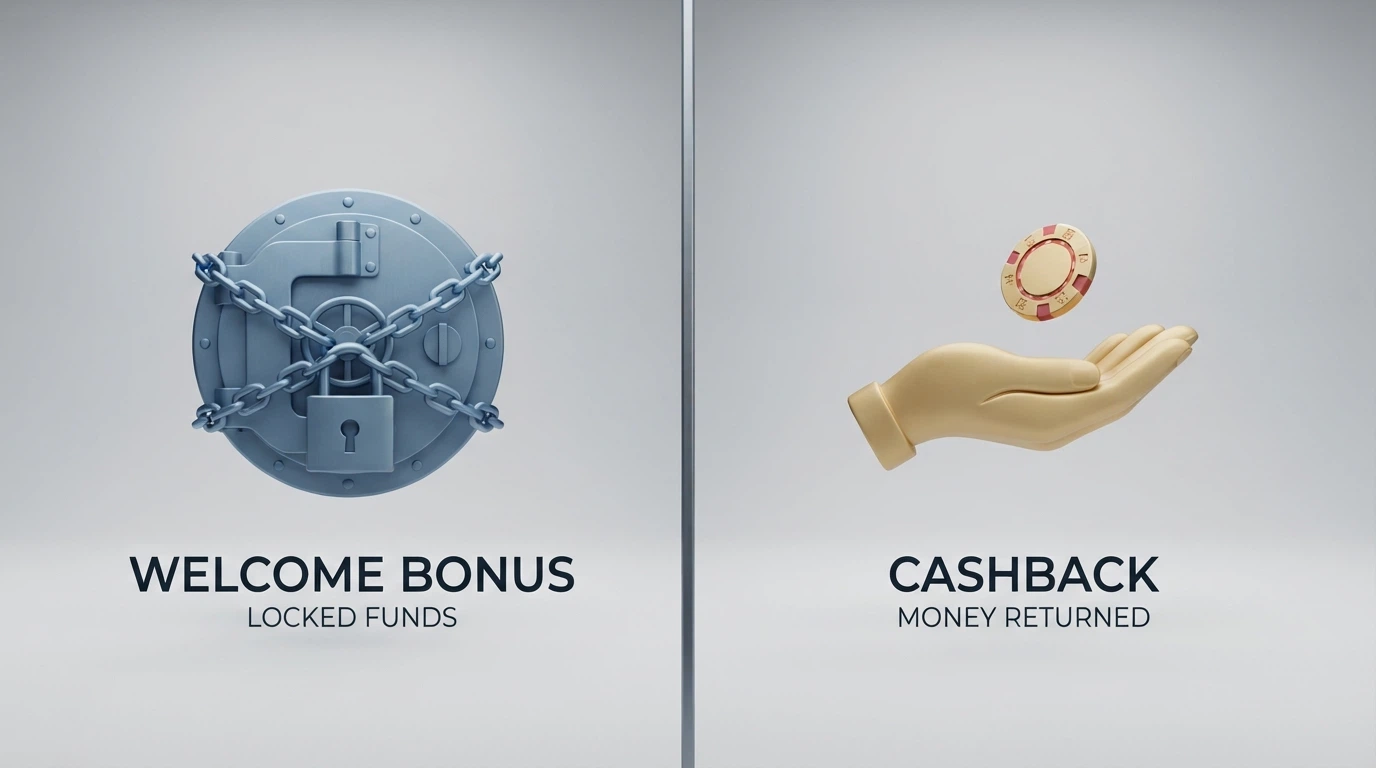
What a Cashback Bonus Is and How It Differs from Other Offers
A cashback bonus is a rebate on net losses over a defined period. The player loses A$1,000 across the week, the casino pays back a percentage — typically 10% to 20% — at the end of that period. There is no deposit match, no spin allocation, no prize from a tournament the player never entered. The rebate exists because the player’s losses created it.
The mechanical difference matters more than the headline number. Welcome bonuses credit up front and lock the bonus amount behind a wagering multiplier, often 30x to 50x of the bonus, before the player can touch the original deposit. Free spins lock the spin winnings behind a similar condition, and the cap sits on a per-spin value. A 10% cashback paid in real cash, on a 1x or 0x wagering basis, sits closer to actual money than either of those. The promotional pages do not always make that distinction clear. They should.
The other distinction is who the offer rewards. A welcome bonus pays the player who signs up and deposits. A cashback offer pays the player who keeps playing — week after week, through losing sessions, with no guarantee of return. That shifts value toward regulars and away from one-off bonus hunters, which is exactly what most Australian-facing operators want.
The Cashback Rate Landscape at Australian-Facing Casinos
Headline rates in this market cluster in a tight band: 5% to 30%, with the most common range 10% to 20% on weekly net losses. Anything outside that band is either a marketing trick — a “100% daily cashback” that disappears on the first withdrawal — or a top-tier VIP perk reserved for players whose losses justify the offer.
The percentage on its own misleads. A 25% cashback with a 10x rollover is worth less than a 10% cashback credited in real cash with no wagering, because the wagering requirement eats roughly two thirds of the stated value through expected house-edge losses. The arithmetic is worked through in the wagering section below, but the headline rule is the one any sharp player already knows: read the small print before celebrating the big number.
Mobile and Real-Money Cashback Play
Cashback works the same way on mobile as it does on desktop — the calculation runs on the backend, the player does not need to do anything different. The distinction that actually matters is between real-money play and demo play. Cashback applies to real-money net losses only. A player who spins for fun in demo mode, wins a few thousand in pretend money, then switches to real and loses A$200 will see the cashback calculated on the A$200, not on the combined activity.
The offshore casinos serving Australia are built for instant browser play on mobile, no app download required. That is operationally convenient. The convenience does not change what the player is doing: depositing real money into an offshore account that has no Australian regulatory oversight.
How Your Cashback Is Actually Calculated
A cashback percentage is a multiplier on a number that has to be calculated first. The number is net loss, and the calculation is consistent enough across operators to learn once. The conditions attached to the percentage — wagering, caps, eligible games — change everything about what the rebate is actually worth.
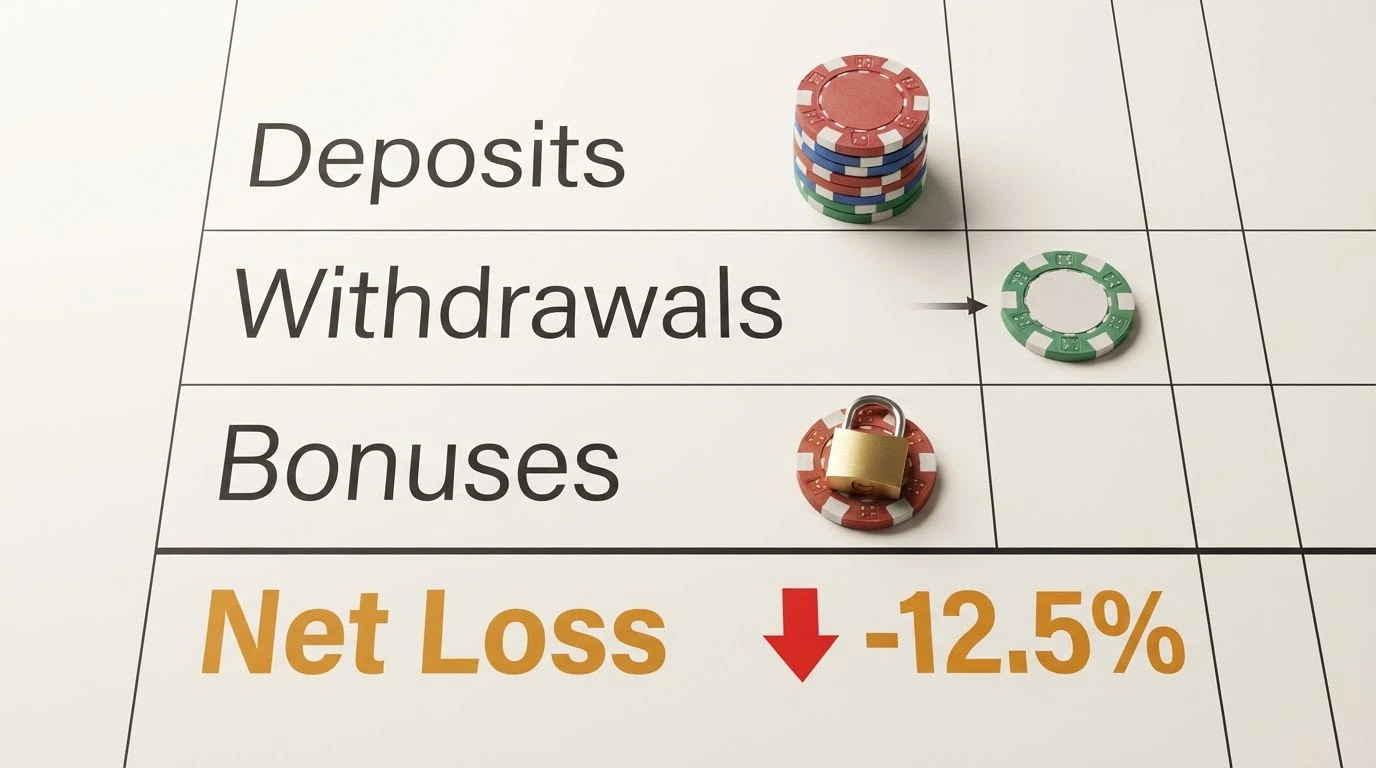
The Net-Loss Formula Explained
The formula used across the offshore cashback market is simple:
Net Loss = Deposits − Withdrawals − Bonuses
That figure is then multiplied by the cashback percentage to arrive at the rebate. Three points are worth holding onto.
Bonuses are subtracted because they are house money, not player losses. A player who deposits A$1,000, claims a A$200 welcome bonus, plays, withdraws A$300, and ends the period with A$500 in remaining bonus funds has a net loss of A$200 — not A$700. The bonus is excluded. Withdrawals are subtracted because money taken out is no longer at risk. A player who deposits A$1,000, withdraws A$400, then loses A$300 has net losses of A$300 for the period — not A$1,000 in deposits. Most operators calculate net loss over a fixed window — usually a calendar week — and reset the calculation at the end of that period. Unclaimed cashback rarely rolls over.
A worked illustration: a player deposits A$1,000 on Monday, withdraws A$200 on Wednesday, has no bonus active, and ends Sunday with a balance of A$400. Net loss is A$1,000 − A$200 − A$400 = A$400. At 10% cashback, the rebate is A$40. Verifiable against the player’s own transaction history at most operators.
Real Cash vs Bonus Funds: Why It Matters More Than the Rate
Two players receive the same cashback percentage at the same casino. One gets paid in real cash, withdrawable immediately. The other gets paid in bonus funds, locked behind a 10x wagering multiplier. The first player has a rebate worth A$100. The second has a rebate that, after expected house-edge losses clearing the wagering, is worth roughly a third of that figure.
That is the gap the marketing department does not advertise. Cashback paid as real cash with zero wagering is worth face value. Cashback paid as bonus funds with a 10x rollover is worth about a third of that, after the player runs the bonus through the games to clear the condition. The percentage on the offer page is the same. The wallet feels very different.
This single variable — real cash or bonus funds — is also the most important comparison point between operators. A 15% cashback paid in real cash beats a 25% cashback paid in bonus funds with 10x wagering. The first leaves the player ahead of the marketing claim. The second requires the player to put back roughly A$170 of the A$250 rebate before any of it can be withdrawn.
Wagering Requirements on Cashback
Wagering on cashback is normally lighter than on a deposit bonus, but the spread is wide. A 1x requirement is the gold standard: the player wagers the cashback amount once, then withdraws. A 3x requirement is the upper bound most experienced players will accept without thinking. Anything above 5x on a cashback offer is the kind of small print that needs to be read three times.
The featured set in this ranking covers the range. SkyCrown’s Diamond tier runs at 1x wagering, effectively making the cashback real money for the highest-tier player. SkyCrown’s Gold and Platinum tiers sit at 3x, with Platinum lifting the cap to A$2,500. SkyCrown’s Bronze and Silver tiers run at 5x, which is steep but typical for entry-level VIP. RocketPlay holds 5x across its cashback tiers, with the weekly cap at A$7,500. Fair Go Casino runs 10x on its 25% weekly cashback, the heaviest wagering in the featured set.
The arithmetic behind those multipliers matters more than the numbers themselves. Consider SkyCrown’s Gold tier at 10% weekly, A$1,000 cap, 3x wagering, played on a high-RTP slot like Gates of Olympus — an RTP of 96.50%, which leaves a house edge of 3.5%. A player who hits the cap receives A$100 in cashback. Clearing it requires A$300 in turnover. Expected loss on that A$300, calculated as turnover multiplied by the house edge, comes to A$300 × 0.035 = A$10.50. So the player trades about A$10.50 of expected play to convert A$100 of cashback into withdrawable cash. Running the same A$100 cashback at Fair Go’s 10x wagering requires A$1,000 in turnover, with an expected loss of A$35.
Game Contribution Rates and Eligible Play
Cashback wagering clears fastest on slots. Across the market, slots contribute 100% of every dollar wagered toward the requirement. Table games — blackjack, roulette, baccarat — typically contribute 10% to 20%, and at some operators they are excluded entirely. Live dealer games are treated as a separate category, often with contribution rates as low as 5%.
RocketPlay’s structure is a clean illustration. Slots count fully, live games count at 5%. A player clearing a RocketPlay cashback on live blackjack has to run twenty times the effective turnover to clear the same bonus. That does not show up in the cashback percentage. It shows up in the time it takes to withdraw, and in the extra house edge absorbed along the way.
The practical consequence is straightforward. A player who lives on table games should weight wagering-heavy offers less heavily than the headline suggests, and should look for cashback credited in real cash instead. The slots-first player is on the right side of the contribution table by default.
Caps and Ceilings: When the Headline Rate Stops Applying
A cashback percentage is multiplied by net losses. A cap is multiplied by the same number. Past the cap, the percentage stops mattering entirely.
The clearest illustration: a 10% weekly cashback capped at A$500 covers A$5,000 in net losses before the cap bites. The same 10% rate, paid daily instead of weekly, capped at A$100, covers only A$1,000 in net losses per day. Both offers advertise 10%. The effective ceiling is five times higher on the weekly version.
Caps also vary by tier within a single operator. SkyCrown’s ladder runs from A$250 at Bronze to A$5,000 at Diamond — a twenty-fold spread. RocketPlay’s weekly cap sits at A$7,500, the largest in the featured set, but is reachable only by VIP Level 4 players and above. Fair Go does not publish a hard cap in the same terms.
The cap also tells the reader who the offer was designed for. A A$100 weekly cap is sized for casual play. A A$2,500 weekly cap implies the operator expects A$25,000 in weekly net losses from the player using it. The cap is not just a number. It is a hint about who the operator had in mind.
Daily, Weekly or VIP: Which Cashback Cadence Pays Most
The cadence of a cashback offer changes its real-world value. Daily cashback pays more often but at lower rates; weekly cashback is the industry standard because it balances operator cost with player value; monthly and VIP cashback pay the highest rates but require the heaviest losses to qualify. Live cashback has its own category. The right rhythm depends on how the player actually plays.
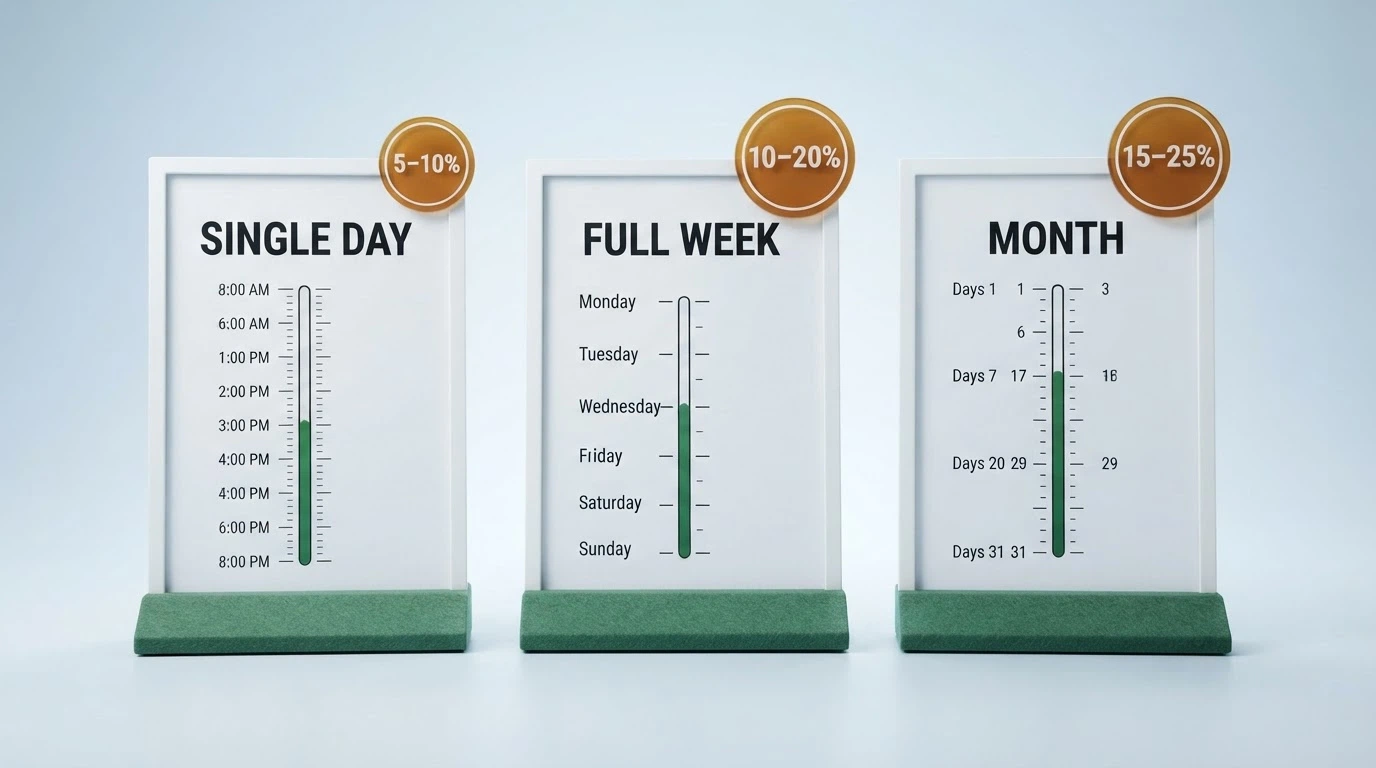
| Cashback type | Typical rate | Typical wagering | Typical cap | Best for |
|---|---|---|---|---|
| Daily | 5–10% | 1x–3x | Modest (A$100–A$300) | High-frequency players who want fast recovery |
| Weekly | 10–20% | 1x–5x | Mid to high (A$250–A$7,500) | Regular players; the industry default |
| Monthly / VIP | 15–25% | 1x–5x | High (A$1,000–A$5,000+) | High-volume players with losses to support the rate |
| Live dealer | 3–10% | Effective 10x–20x via low contribution | Modest | Live-only players accepting the math |
Daily Cashback: Low Rates, Fast Turnover
Daily cashback programs typically pay 5% to 10% on the previous day’s net losses. The lower percentage reflects the operator’s cost — paying out every day means more total payout over the same losing run than paying once a week. The trade for the player is speed: the money lands overnight, the bankroll stabilises faster, and a bad day does not bleed into the next session.
A 10% daily cashback capped at A$100 caps out at A$1,000 in net losses per day — meaningful for a casual player, restrictive for anyone playing at higher stakes. The cap is the design choice that keeps these offers modest.
1xSlots runs a daily cadence at the top of its VIP ladder, paying 5% to 11% on net losses with zero wagering. That structure is the closest thing to daily cashback that pays in real cash at the higher tiers, and it is the reference point the rest of the market is benchmarked against.
Weekly Cashback: The Industry Standard
Weekly is the default cadence across the featured operator set, and it is the cadence most Australian-facing cashback comparison pages use as their baseline. Typical weekly rates run 10% to 20%, with Thursday or Friday as the common credit day so the operator’s books close on Sunday and the payout processes before the weekend.
SkyCrown pays weekly at 5% to 15% across its five-tier VIP ladder. RocketPlay pays weekly at 3% to 10% from VIP Level 4 upward, credited every Thursday. Fair Go pays weekly at 25% on net losses, but with the 10x wagering that makes the headline harder to convert into withdrawable cash.
Winz, not in the featured operator set, runs a flat 20% weekly with 0x rollover — uncapped, no wagering, paid in real cash. It is the benchmark the rest of the market is measured against, and a useful reference for what the top of the market looks like when the operator chooses not to extract a second margin through wagering.
Monthly and VIP-Tier Cashback: Higher Rates, Bigger Commitment
Monthly cashback and VIP-tier cashback pay the highest rates, generally 15% to 25% on net losses, and they sit at the top of every operator ladder. The qualification cost is the size of the bankroll and the size of the losses. A monthly cashback structure only delivers value to a player whose losses over the period are large enough to make the rate meaningful.
SkyCrown’s VIP ladder is the clearest illustration. Bronze starts at 5% with a A$250 cap and 5x wagering. Diamond finishes at 15%, a A$5,000 cap, and 1x wagering. Each step up the ladder moves two variables in the player’s favour — higher rate, larger cap, lower wagering — at the cost of staying active at a level that requires significant and sustained losses to reach.
1xSlots, outside the featured set, runs an eight-tier ladder from 5% to 11% at the Diamond tier with 0x wagering, paid daily. The top tiers are effectively rakeback rather than cashback — paid as real cash on every bet, not on net losses after the fact.
The trade at the high end of VIP cashback is the same trade as at the low end, just larger. A 15% rate on A$30,000 in monthly losses delivers A$4,500. A 5% rate on A$300 in weekly losses delivers A$15. The relevant comparison is the dollar figure, not the percentage.
Live Casino Cashback
Live dealer cashback exists at a smaller set of operators and runs under different rules from the main cashback ladder. Lower rates, higher effective wagering through low game contribution, and separate eligibility. A “3% live cashback” headline often translates into an effective 20x in slot-equivalent terms once game contribution is factored in.
RocketPlay runs a live cashback at 3% to 5% with a minimum A$150 loss and a A$1,500 cap. The 1x wagering reads cleanly on paper, but live games contribute only 5% toward clearing — that is the equivalent of 20x in effective turnover on a slot equivalent. The 3% headline is harder to convert than the main 10% on slots at the same operator.
Winz, the recurring benchmark, runs 20% weekly cashback on all categories including live dealer at every VIP tier. ZetCasino, similarly outside the featured set, runs a 10% live cashback up to A$225. The player who plays live dealer needs to read the contribution table before assuming the headline percentage applies to live play.
No-Deposit and Instant Cashback
No operator in the featured set currently offers a true no-deposit cashback bonus. The closest analogues are instant or automatic crediting — the rebate lands in the player’s account without a manual claim — but only after a deposit, a minimum loss, or another qualifying activity has been met.
SkyCrown’s cashback is deposit-triggered. RocketPlay requires a minimum A$50 weekly in/out difference. Fair Go requires net losses without an active bonus, requested through customer support. Each operator gates the rebate behind some form of real-money activity.
The honest reading: cashback by definition is paid on what the player lost, which means a deposit has happened first. A no-deposit cashback offer in the strict sense — a rebate on losses incurred without ever funding the account — does not exist as a permanent product at any of the featured operators. What marketing pages sometimes call no-deposit cashback is usually a small fixed bonus credited on signup, with the cashback structure sitting separately behind a real-money threshold.
Highest-Cashback Offshore Casinos Accessible to Australians
Every operator on this page is offshore. None holds an Australian licence, because none can. The ranking below compares cashback value within that constraint — rates, wagering, caps, cadence — and treats offshore status as a fixed feature of every entry rather than a per-operator variable.
| Operator | Offshore licence | Cashback rate | Welcome offer |
|---|---|---|---|
| SkyCrown | Curacao | 5–15% weekly (VIP-tiered) | Multi-tier up to A$8,000 + 400 free spins |
| RocketPlay | Curacao | 3–10% weekly (from VIP Level 4) | Deposit match + free spins |
| Fair Go Casino | Curacao eGaming (Deckmedia N.V.) | 25% weekly | 100% up to A$200 × 5 deposits |
| WinSpirit | Curacao | Regular offers | 200% bonus + 25 free spins |
| Bizzo Casino | Curacao | Terms not published | Daily slot races + tournaments |
| Royal Reels | Licence not confirmed | Terms not published | Not confirmed |
| Rocket Casino | Licence not confirmed | Terms not published | Not confirmed |
| Rainbet | Curacao (likely) | Rakeback 5–20% (VIP-tiered) | Up to 250% + 60 free spins |
| Scream Casino | Licence not confirmed | Terms not published | Not confirmed |
| Stake | Curacao | Terms not published | Crypto-focused, varies |
The cells marked “not confirmed” reflect what each operator has publicly published at the time of review. The ranking below ranks what can be ranked, and notes the rest without filling the gaps.
SkyCrown
SkyCrown runs the deepest VIP cashback ladder in the featured set. Five tiers, from Bronze at 5% / A$250 cap / 5x wagering up to Diamond at 15% / A$5,000 cap / 1x wagering. The Diamond tier is the genuine outlier — 1x wagering on cashback is essentially real money with a single confirmation click, and the A$5,000 cap implies the operator is comfortable paying that figure weekly.
The Gold tier at 10% / A$1,000 cap / 3x wagering is where most active players will land, and it is the tier where the cashback becomes a meaningful part of the bankroll. At 3x wagering on Gates of Olympus (96.50% RTP), the expected cost of clearing the A$100 weekly cap is about A$10.50 — roughly a tenth of the rebate’s face value. That is a workable trade.
Offshore status: Licensed in Curacao; the operator does not hold an Australian licence, as none is available for offshore casinos.
Verdict: the best ladder in the featured set for a player who climbs it. Casual players will only ever see Bronze and Silver, where the 5x wagering eats most of the value.
RocketPlay
RocketPlay’s cashback activates from VIP Level 4 (Lava) and runs 3% to 10% weekly on the player’s net in/out difference, with a A$50 minimum, 5x wagering, and an A$7,500 cap. The Thursday credit date is consistent with the weekly norm.
The headline figure — A$7,500 weekly cap — is the largest in the featured set, but the qualifier is significant. The cashback is not available at the default VIP level. A casual player who deposits and plays without climbing to Level 4 will not see a cent of weekly cashback, which makes RocketPlay a poor fit for low-stakes players regardless of how the marketing reads.
Offshore status: Curacao-licensed; this operator does not hold an Australian licence, as none is available for offshore casinos.
Verdict: high ceiling for the player who reaches VIP Level 4, invisible to everyone else.
Fair Go Casino
Fair Go publishes the highest cashback percentage in the featured set: 25% weekly on net losses, paid as bonus funds with a 10x wagering requirement. The catch is in the small print.
At 10x wagering, a player who earns A$250 in weekly cashback needs A$2,500 in turnover to clear it. At Gates of Olympus RTP, the expected cost of that turnover is around A$87.50 — a third of the rebate. Compare that to SkyCrown Gold, where clearing A$100 in cashback costs roughly A$10.50. The Fair Go headline is two and a half times the SkyCrown rate. The clearing cost is more than eight times higher. That gap is what the 25% number does not tell a reader.
The library is RealTime Gaming only — about 280 games, smaller than the multi-provider sites. AUD is supported natively, alongside Bitcoin, Ethereum and Litecoin for players who prefer crypto. The welcome package is 100% up to A$200 across five deposits at 30x deposit plus bonus (effectively 60x on the bonus value alone). Fair Go operates under a Curacao eGaming licence managed by Deckmedia N.V.
Offshore status applies: Curacao eGaming licensed, no Australian licence possible.
Verdict: the highest headline, the heaviest clearing cost. Pays best for the player who runs the bonus through high-RTP games and never lets the wagering deadline bite.
WinSpirit
WinSpirit runs a 200% welcome bonus plus 25 free spins at 40x wagering on promotions, with a Curacao licence and a Trustpilot score of 4.6 out of 5. The welcome package is on the heavier side; the headline value is real.
Offshore status: Curacao-licensed; no Australian licence available.
Verdict: customer-service reputation is real, cashback terms aren’t published. A reader who weights Trustpilot over hard cashback numbers.
Bizzo Casino
Bizzo runs a heavily gamified product. Daily slot races, table-game tournaments, live dealer, a real-time Hall of Fame tracker showing the biggest winners, and a Free Spin Mondays promotion. The brand positions itself on engagement and frequency, not on a single headline cashback percentage.
Offshore status: Operating offshore with a Curacao licence; no Australian licence is held.
Verdict: built for the player who wants daily tournament action. The cashback story is not on the page yet.
Royal Reels
No confirmed licence, no published cashback rate, no published terms beyond the brand’s general marketing surface.
Offshore status applies: licence not confirmed, no Australian licence possible.
Verdict: an Australian-facing brand with sparse published information. The ranking cannot place it above operators with public cashback terms.
Rocket Casino
No published cashback rate, no confirmed licence, no publicly verifiable terms. The brand name carries recognition, but the cashback comparison requires the kind of detail that isn’t currently published.
Offshore status applies: licence not confirmed, no Australian licence possible.
Verdict: the name is familiar, the cashback details are not. Until the operator publishes terms, this page cannot rank it.
Rainbet
Rainbet runs a rakeback model rather than a traditional cashback structure. Seven VIP tiers from Bronze at 5% to Infernal Diamond at approximately 20%, claimable every 15 minutes, paid as real cash with 0x wagering. The model is closer to a commission rebate than a loss rebate — the player earns a percentage of every bet, not a percentage of net losses over a period.
The headline numbers are real, but two issues matter for the Australian reader. First, Rainbet is explicitly restricted in Australia per the operator’s own terms and conditions. An Australian player may find their account blocked or withdrawals refused at the operator’s discretion. First, reaching the higher rakeback tiers requires substantial wagering volume — the Infernal Diamond level is unreachable for any normal player.
The welcome offer runs up to 250% plus 60 free spins across three deposits, with a choice between a Wager Lock path (40x wagering) and a No Wager Lock path that releases bonus funds gradually as the player wagers. The 20% rakeback boost for the first 72 hours is a short-window sweetener.
Offshore status applies: AU-restricted per own T&Cs, no Australian licence possible.
Verdict: real-cash rakeback is genuinely valuable. The Australian player block makes the offer unreachable for most readers.
Scream Casino
No published rate, cadence, cap, or wagering requirement. The brand exists in comparison pages but the cashback data does not.
Offshore status applies: licence not confirmed, no Australian licence possible.
Verdict: a smaller offshore brand with no published cashback terms. Cannot be ranked on the criteria this page uses.
Stake
Stake is the largest crypto-first casino name in the offshore segment. Curacao-licensed, large game library, sportsbook alongside casino. The brand is widely known among Australian-facing offshore players.
Offshore status: Licence: Curacao; no Australian licence is held, as none is obtainable for this offshore service.
Verdict: a major crypto brand with cashback details not currently published for this market.
Crypto Cashback and the Australian Payment Ban
Crypto cashback casinos exist and they exist for a reason: lower operator costs, faster settlement, and a player base that values the anonymity the rail provides. The reason this matters for an Australian reader is that crypto deposits for online wagering have been banned in Australia since 11 June 2024, under the Interactive Gambling Amendment (Credit and Other Measures) Act 2023. Penalties for accepting crypto from Australian customers run to A$247,500 for the operator.
Why Crypto Casinos Offer Cashback
The offshore crypto casino segment competes on cashback and rakeback because their cost base is lower than fiat-heavy competitors. No card processing fees, no chargeback exposure, faster settlement cycles. The cashback rate is a marketing lever the operator can pull further on crypto rails than on fiat rails.
For an Australian player, though, the relevant point is different. A casino that accepts crypto deposits from Australia is, by definition, not an Australian-licensed operator. Australian-licensed wagering services cannot legally accept crypto for online gambling. The payment method is itself a signal that the operator sits outside the Australian regulatory framework.
The brands in the featured set that accept crypto — Fair Go with Bitcoin, Ethereum and Litecoin, Stake as a crypto-first platform — are doing so because they are offshore, not licensed in Australia, and operating under rules the ACMA does not enforce. The credit-card and crypto payment ban is not a feature of an Australian law that fails to apply to offshore operators. It is a feature of an Australian law that proves these operators sit outside it.
From 1 January 2027, banks and payment providers gain express authority to block transactions to illegal gambling operators. The crypto route will not be a workaround at that point. It will be an additional risk factor, with the bank-side block sitting alongside the offshore status.
The Legal Reality for Australian Casino Players
This is the section that no affiliate listicle carries and that every reader on this page needs to read before depositing. Online casino is prohibited in Australia. The law that prohibits it is over twenty years old. The reform that strengthens it passed in 2026.

What the Interactive Gambling Act Actually Prohibits
The Interactive Gambling Act 2001, strengthened by amendments in 2017, prohibits the provision of online casino games, online pokies, and in-play sports betting to people in Australia. There is no federal licence for online casino, no state or territory licence for online casino, and no path for any operator in the featured set to obtain one. The IGA targets the provider, not the player — Australian residents who use these services are not personally prosecuted — but the prohibition on the supply side is comprehensive.
The Australian Communications and Media Authority (ACMA) enforces the prohibition. Since its first blocking request in November 2019, ACMA has had 1,564 illegal gambling and affiliate websites blocked by Australian ISPs, and more than 225 illegal services have voluntarily withdrawn from the Australian market since the 2017 strengthening. ACMA’s own statement is direct: the Interactive Gambling Act 2001 makes it illegal for gambling providers to offer some online services to people in Australia.
What is licensed in Australia is pre-event sports and race wagering, lotteries, and keno, through operators licensed by a state or territory. The Northern Territory, through Licensing NT, is the de facto national wagering licensor — Sportsbet, bet365, Ladbrokes and a long tail of bookmakers hold NT licences for terms of up to 20 years. None of these licenses an online casino product.
Offshore Casinos: What Australian Players Lose
Playing at an offshore casino means the player gives up every consumer protection the Australian framework is built around. No ACMA recourse for lost funds. No BetStop coverage. No Australian Financial Complaints Authority dispute pathway. No guarantee of a withdrawal when the player wins. No minimum age verification standard that the Australian regulator enforces.
The site can also be blocked at any time. ACMA’s blocking regime is DNS-level, applied to Australian ISPs, and the operator has no notice before the block goes live. A player with a balance in the account when the site is blocked has limited recourse. The dollar value is real; the path to recovering it is not.
Operators can change terms unilaterally. A 25% cashback rate published today can be revised to 10% next week, or removed entirely, without prior notice. Australian consumer law does not reach the operator. The only protection the player has is the operator’s reputation and the player’s own willingness to walk away when the terms change.
The 2026 Gambling Reform and What Changes on 1 January 2027
The Interactive Gambling Amendment (Gambling Reform) Bill 2026 passed Parliament on 19 August 2026. The measures commence on 1 January 2027. The reform is the biggest overhaul of Australian gambling law in a generation and changes the offshore landscape in three concrete ways.
First, advertising is restricted. From 1 January 2027, wagering advertising is capped at three ads per hour between 6:00 am and 8:30 pm. A blackout runs from 15 minutes before to 5 minutes after a live sporting event. Radio ads are banned during school commute times. Broadcasting sporting odds is prohibited outright. Online wagering ads are restricted to logged-in, over-18 users who have not opted out. No wagering advertising in sports venues or on uniforms. No athlete, celebrity, or influencer endorsements.
The rollout phases over three years. Phase 1 covers news, current affairs, and radio during school commute hours. Phase 2 covers live sport broadcasts and stadia. Phase 3 completes the prohibition. The AdStop opt-out register is not expected to be operational by commencement.
Second, inducement marketing is banned. From 1 January 2027, operators cannot market inducements to a customer for 14 days after sign-up, for three months after BetStop deregistration, and indefinitely for customers identified as at risk of gambling-related harm. The 14-day cooling-off period applies to all new sign-ups; the three-month restriction follows anyone who has deregistered from self-exclusion.
Third, payment-side enforcement gets sharper. From 1 January 2027, banks and payment providers gain express authority to block transactions to illegal gambling operators. The credit-card and crypto ban that commenced on 11 June 2024 covered the payment method; the 2027 reform covers the transaction itself.
Payment Bans, Bank Blocking and What They Mean for Deposits
Credit cards, credit-related products and digital currency (crypto) are banned as payment for online wagering in Australia since 11 June 2024, under the Interactive Gambling Amendment (Credit and Other Measures) Act 2023. Penalties for non-compliance are up to A$247,500. Legal deposit routes for licensed wagering are debit cards, bank transfer, PayID/Osko, and BPAY.
An Australian being asked for a credit card or crypto deposit by a gambling site is being served by someone operating outside the Australian rules. The deposit method is a tell.
From 1 January 2027, banks and payment providers can refuse or block transactions to illegal operators. That includes the offshore casinos in the featured set. A player whose bank decides to block a transaction may find the deposit fails without explanation. The bank-side block does not depend on the player’s consent and does not require a court order.
The implications cut in both directions. The Australian framework’s protection only applies to licensed operators. The payment ban and the bank-side block make it harder to fund unlicensed operators. The combination is the regulatory system doing what it was designed to do — push players toward the licensed market and out of the offshore one.
Responsible Gambling: Tools That Actually Work
The Australian framework offers the player the strongest set of consumer-protection tools in the global gambling market. They do not reach offshore casinos. That is the gap this section makes explicit.

BetStop and Why It Does Not Cover Offshore Casinos
BetStop is the National Self-Exclusion Register, live since August 2023. One registration excludes a person from every Australian-licensed online and phone wagering service — sports, racing, and the licensed casino products that exist in some state-regulated forms. As at 31 July 2026, BetStop has recorded 67,480 registrations, with 41,290 exclusions still active — more than 60% of everyone who ever signed up. 78% of registrants are under 40. 38% chose lifetime exclusion.
BetStop is the strongest single tool Australia offers a player who wants to stop. It is also the clearest example of the offshore gap. BetStop binds only Australian-licensed services. An offshore casino is not connected to the register and will keep accepting a self-excluded person’s money. A player who has registered with BetStop, then opens an account at an offshore casino, has removed the Australian protection while leaving the gambling behaviour in place.
For the offshore reader, this is the most concrete harm of the route: the strongest self-exclusion tool the country offers does not reach the operator the reader is using.
Deposit Limits, Self-Exclusion and Where to Get Help
The Australian National Consumer Protection Framework for Online Wagering includes ten measures: no line of credit, strong identity and age verification, restricted incentives, easy account closing, deposit limits, monthly activity statements, consistent risk messaging, trained staff, and a National Self-Exclusion Register. These apply to licensed operators. They do not apply to the offshore set.
The supports available to any Australian player, regardless of where they gamble:
- The National Gambling Helpline is 1800 858 858 — free, confidential, staffed 24 hours a day, 7 days a week, with online chat and counselling through Gambling Help Online at gamblinghelponline.org.au.
- BetStop, the National Self-Exclusion Register, is at betstop.gov.au — one registration excludes from every Australian-licensed online and phone wagering service.
- About 2.1% of Australian adults — roughly 430,000 people — experience problem gambling, and the Australian Institute of Health and Welfare put high-risk gambling at 1.8% in 2022. The numbers describe a population-level problem the offshore route does nothing to address.
How We Evaluate Cashback Casinos
The ranking rests on a published methodology. Every operator was checked against the official Australian licence register — none holds an Australian online casino licence, because none can. The cross-check against the ACMA register confirms offshore status across the featured set.
Sources used for the operator figures: the operators’ own published terms pages, ACMA enforcement data and public statements, and independent casino-data platforms plus affiliate-review publications that publish operator-specific terms. Where the operators’ own pages and the third-party sources disagreed, the operators’ own terms took precedence.
The evaluation criteria, in order of weight: cashback rate, wagering requirement, real-cash versus bonus-funds status of the rebate, cap, cadence, game contribution rates, licence transparency, and Australian accessibility. Where an operator did not publish a specific figure, the page records the absence rather than estimating one. The “not confirmed at review” entries in the operator table and write-ups are not gaps in the research. They are the research reporting what is and isn’t published.
The ranking is descriptive. It compares offers on their published terms. It does not endorse any operator as a place to play and does not recommend that any Australian reader deposit at any of the operators above.
Is a High-Cashback Offshore Casino Worth the Risk?
The cashback arithmetic on this page favours a specific kind of player — one with a real bankroll, regular play, and a tolerance for offshore counterparty risk. For that player, the difference between SkyCrown Diamond at 15% / 1x and a flat 5% with 10x wagering is meaningful, and the kind of arithmetic that justifies the offshore route. The cashback terms are real. The rates are real. The wagering requirements are real.

The other side of the comparison is what the player gives up. No ACMA recourse if the operator disappears with the balance. No BetStop coverage, so the strongest self-exclusion tool Australia offers does not reach the site. No withdrawal guarantee — the operator can revise terms, slow payouts, or change the bonus structure at any time. From 1 January 2027, banks can block the deposit transaction itself. The site can be DNS-blocked at any time, with money still in the account. Crypto deposits are illegal for Australian-licensed operators and remain a risk-flag for the offshore set.
The decision this page supports the reader in making is not which offshore casino has the best cashback percentage. That answer is on the table above. The harder decision is whether the offshore route makes sense for the reader at all, given what is on the other side of the percentage. The legal reality in this country is that licensed online casino does not exist. The reform in 2026 tightens the noose on the offshore market rather than loosening it. The cashback is a real number. The protection that number sits inside is not.
Frequently Asked Questions
How does a cashback bonus work at an online casino in Australia?
A cashback bonus is a percentage rebate on net losses over a defined period, usually weekly. The operator calculates your net loss as deposits minus withdrawals minus bonuses, then applies the cashback percentage to that figure. The rebate is paid either as real cash or as bonus funds with a wagering requirement.
How is net loss calculated for a cashback bonus — is it based on deposits or actual losses?
Net loss is calculated on actual losses, not on deposits. The standard formula is deposits minus withdrawals minus bonuses. Withdrawals are subtracted because money taken out is no longer at risk. Bonuses are subtracted because they are house money, not player loss.
What is the difference between daily, weekly and monthly cashback cycles?
Daily cashback pays more often at lower rates, usually 5% to 10% on the previous day’s net losses. Weekly cashback is the industry standard at 10% to 20%. Monthly cashback pays the highest rates, 15% to 25%, but requires the largest losses to qualify.
Can I use PayID or crypto to deposit at offshore cashback casinos from Australia?
PayID availability depends on the offshore operator. Crypto is a different question: credit cards, credit-related products and crypto have been banned as payment for online wagering in Australia since 11 June 2024. Any casino accepting crypto from Australia is, by definition, not an Australian-licensed operator.
What should I look for in the fine print before claiming a casino cashback offer?
The three numbers that decide the real value: the wagering multiplier (1x is the gold standard, 3x is the upper bound most players accept, anything above 5x on cashback is questionable); whether the cashback is paid in real cash or bonus funds; and the cap (the dollar amount that determines the maximum weekly or monthly payout). The headline percentage is the least important of the four figures.