
How Offshore Reload Bonuses Actually Work for Australian Players in 2026
Every reload bonus reviewed on this page is an offer from an offshore casino. The Interactive Gambling Act 2001 makes it an offence to provide online casino products — pokies, table games, live dealer — to a person in Australia, and no Australian licence exists for any of it. The IGA targets the provider, not the player, which is why the offers keep arriving and why Australians keep claiming them. What follows is a guide to those offers: which ones carry the most value, what the wagering actually costs in time, and what protection an Australian player gives up the moment they open an account.

Data current as of 16 October 2026 and verified against the ACMA register and the Interactive Gambling Act 2001.
Table of Contents
- The Law That Bans What You’re Reading About
- What a Reload Bonus Is (and Why It’s Not Your Welcome Offer)
- The Reload Offers That Actually Matter for Australian Players
- The 10 Offshore Casinos Australians Use for Reload Bonuses
- Why Your Reload Bonus Favours the Pokies
- The Full Legal Picture: What the IGA Prohibits, Permits and Protects
- Responsible Gambling: What Reload Bonuses Do to Your Play
- How We Evaluated These Reload Casinos
- What Your Reload Bonus Strategy Should Actually Look Like
- Frequently Asked Questions
The Law That Bans What You’re Reading About
Reload bonuses are an offer the Interactive Gambling Act 2001 prohibits the provider from making. Every reload bonus on this page is an offshore product, served by a casino with no Australian licence, and governed by whatever terms the operator chooses to set. The Act’s plain effect is to make the offer illegal to provide — and legal to claim, because the statute targets the provider, not the person at the other end. That contradiction is the first thing a player weighing a reload bonus should hold in mind, and it is the frame every other section of this page sits inside.
What the Interactive Gambling Act Actually Bans
The Interactive Gambling Act 2001 is the federal statute that governs interactive (online) gambling in Australia. The Act prohibits the provision of online casino games — roulette, blackjack, poker, craps and online pokies — and in-play sports betting to customers physically present in Australia. The Australian Communications and Media Authority (ACMA) is the federal regulator that enforces it. There is no carve-out for a state or territory licence: no state or territory can issue one, because the product is banned at the federal level.
The Act has been strengthened twice since 2017. The Interactive Gambling Amendment Act 2017 closed the loopholes offshore operators had been using to argue their services sat outside Australian law, and it gave ACMA its blocking and enforcement powers. Since the first ISP-level block in November 2019, ACMA has had more than 1,564 illegal gambling and affiliate websites blocked, and more than 225 illegal services have withdrawn from the Australian market since 2017. The enforcement is real, ongoing and growing. As ACMA states plainly, “providing a prohibited interactive gambling service to a person in Australia is illegal, and the ACMA pursues it.”
What the IGA does not do is name the player. The Act creates an offence for the provider; it does not create one for the person who opens an account and claims a bonus. That is the gap every reload offer on this page lives inside. The provider is breaking Australian law; the player is not prosecuted for using the service. The Act’s framing is deliberate — Australia treats gambling harm as a public-health problem to manage, not a crime to punish the individual for.
Every Reload Bonus on This Page Is Offshore
Every one of the ten operators reviewed below is an offshore casino without an Australian licence. SkyCrown, RocketPlay, WinSpirit, Fair Go, Stake, AzurSlot, Bizzo Casino, Royal Reels, Scream Casino and Rocket Casino all sit outside the IGA’s licensable perimeter. They are licensed in Curaçao or other offshore jurisdictions (licensing details often remain unconfirmed via the regulator’s own registers), and they accept Australian customers through their offshore platforms. None of them is Australian-legal for casino gambling.
ACMA can block any of these sites at any time. The blocking is DNS-level: Australian ISPs redirect the domain to a notice page, and the casino disappears from Australian connections. A player with an open balance at the time of a block can find their funds held by an offshore entity with no Australian consumer-law route to recover them. This has happened to more than 1,500 sites since 2019.
BetStop, the National Self-Exclusion Register, does not reach them. BetStop binds around 150 Australian-licensed wagering providers — sports books and racing operators, which is the only form of interactive gambling Australia permits online. An offshore casino accepting reload deposits from a self-excluded Australian is not breaking any rule BetStop enforces, because the operator is not on the register to begin with. The self-exclusion tool a player assumes covers the Australian market does not cover the market this page is about.
From 1 January 2027, banks and payment providers gain express authority to block transactions to illegal gambling operators. The transaction is the one route Australian regulators can reach directly. A blocked payment at the bank will not return the balance already on an offshore site, but it will stop the next deposit. That structural change is worth holding in mind now, before the year turns.
What a Reload Bonus Is (and Why It’s Not Your Welcome Offer)
A reload bonus is a deposit match offered to an existing customer, on a repeat deposit, after the welcome package has been spent. It is the casino’s way of asking a player to come back and top up — the second, third and fourth time onwards, rather than the first. The structure mirrors a welcome bonus: deposit, get a percentage matched in bonus funds, meet a wagering requirement, withdraw. The numbers, the eligibility and the rhythm are all different.
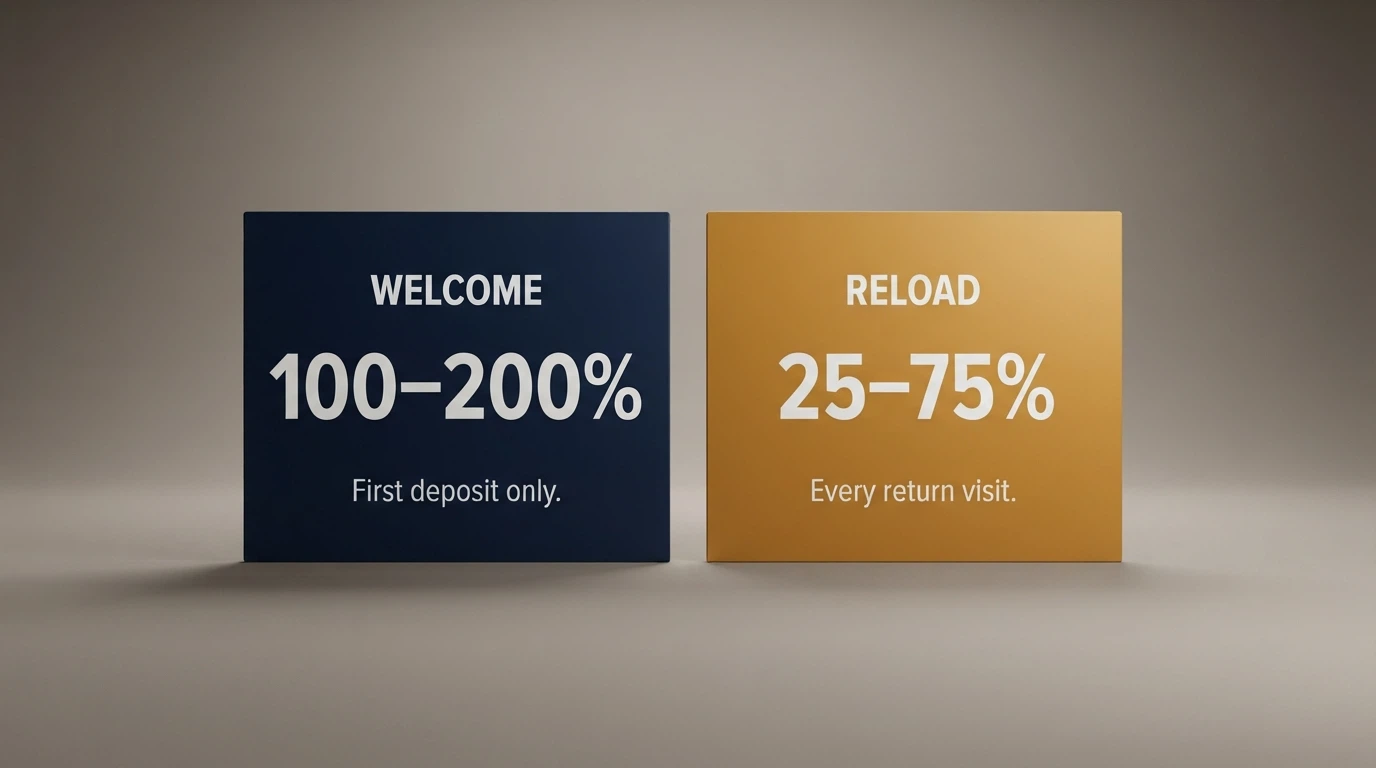
Welcome bonuses at Australian-accessible casinos in 2026 typically match between 100% and 200% of the first deposit, often with hundreds of free spins attached. The value is high because the operator is buying a new customer. Reload bonuses match between 25% and 75%, with smaller free-spin bundles and shorter expiry windows. The value is lower because the customer is already in the door.
A reload bonus is also recurring. A welcome bonus fires once, on the first deposit (sometimes spread across four deposits, in tiered packages). A reload bonus can fire every Tuesday, every Friday, every weekend, or once a month. The shape of the offer reflects the shape of the player’s habit: a frequent small-deposit player meets a different reload calendar than a monthly high-roller.
How a Reload Bonus Actually Works
The mechanics from deposit to withdrawal run in a fixed order. The player deposits real AUD, and the operator credits a percentage of that deposit as bonus funds. The two balances sit in separate pots: cash balance and bonus balance. The player then wagers the bonus amount a fixed number of times on eligible games, and only after the wagering requirement is met can the bonus balance be withdrawn. Most reloads cap the maximum cashout from the bonus at a fixed multiple of the bonus value, regardless of how the wagering ran.
A worked example: a player deposits A$200, claims a 50% reload, and gets A$100 in bonus funds. If the wagering requirement is 35x on the bonus, the player must wager A$100 × 35 = A$3,500 before the bonus balance becomes withdrawable. The player can withdraw their original A$200 cash deposit at any time, but withdrawing before clearing the bonus forfeits the bonus and any winnings from it. The max bet during wagering is typically capped at A$5 per spin — the range across the reviewed set runs from A$2 to A$8, with A$5 the most common figure.
The bonus expires if the wagering is not completed in time. A weekend reload might give 72 hours. A monthly reload might give seven days. A daily boost might give 24 hours. The expiry window is the operator’s way of forcing the player to clear the bonus quickly — and of recovering the bonus if the player does not. The maths is unforgiving if a player runs out of time with the wagering half-done: the remaining bonus, and any winnings tied to it, are forfeit.
Five Ways a Reload Bonus Is Not Your Welcome Offer
- The match percentage is lower. A welcome bonus matches 100–200% of the first deposit; a reload matches 25–75%. The casino is paying for a new customer on the welcome, and paying for a return visit on the reload. The two are not the same proposition.
- The wagering is slightly lower, not because the offer is softer. Reload wagering runs 30–40x on the bonus, versus 30–50x on welcome offers. The narrower band is not generosity — it is the operator’s way of making the offer look comparable at a smaller bonus amount.
- Eligibility is existing-player only. New accounts can claim a welcome; they cannot claim a reload. The reload is reserved for players who have already deposited, often at least once, and the offer is the operator’s way of pulling that player back.
- The cadence is recurring, not once-off. A welcome bonus is a single package (sometimes spread across four deposits, but a single offer in the marketing). A reload bonus is a calendar: Tuesday free spins, Friday cashback, weekend match, monthly power-up. The reload is built for return visits.
- The bonus caps are smaller. A welcome package at SkyCrown runs to A$8,000 plus 400 free spins across four deposits. The biggest reload in the reviewed set is SkyCrown’s high-roller reload at A$2,500, and most reloads cap between A$300 and A$1,000. The headline numbers are quieter, and the maths on what a smaller bonus actually costs in time is the part to read.
What a Reload Bonus Is Worth in 2026
The numbers across the Australian-accessible market in 2026 fall in a clear range. Weekend reloads commonly match 50–75% of the deposit up to a cap of around A$1,000. Midweek reloads sit at 40–60% with similar caps. Monthly power-up reloads, where they exist, run to 75% up to around A$750. Daily boost offers — short-window, evening-only reloads — are the smallest at 10–25% up to around A$100.
The difference between the 25% floor and the 75% ceiling is the gap between a midweek nudge and a weekend draw. The 50% mark is the median offer. The biggest reload caps in the reviewed set are SkyCrown’s high-roller reload at 50% up to A$2,500 and WinSpirit’s weekend reload at 50% up to A$1,000. Most reloads in the set sit between 25% and 75% on a cap of A$300 to A$500.
The percentage is not the only number that matters. A 75% match up to A$300 means a maximum bonus of A$225 on a A$300 deposit that has to clear 35x wagering, which is A$7,875 of turnover, before it can be withdrawn. A 50% match up to A$1,000 means a maximum bonus of A$500 on a A$1,000 deposit, but the same 35x wagering is A$17,500 of turnover. The higher match percentage gives less bonus money; the higher cap gives more. The two are not the same shape, and the player who chases the percentage can end up with the smaller bonus.
Who Gets a Reload Bonus and How Often
Reload bonuses are an existing-player product. A new account gets the welcome package; only after the first deposit and the welcome terms have played out does the reload calendar open up. Some reloads require an opt-in — a button click in the cashier, an entry at deposit, a marketing email link. Others credit automatically on a qualifying deposit. The mechanic varies by operator, and the terms are the place to check before depositing.
Minimum deposit thresholds apply. SkyCrown sets a A$30 minimum for most reloads, climbing to A$500 for the high-roller reload. AzurSlot sets A$30 for the weekend reload. WinSpirit’s 10% Daily Boost requires the deposit to land between 6pm and 9pm AEST to qualify. The threshold is the operator’s way of filtering for the players the offer is built around, and the players outside that filter do not see the offer even when it is on the page.
The refresh cycle determines how often a player can claim. Some reloads are weekly — WinSpirit’s 100 free spins every Tuesday, AzurSlot’s 5–10% cashback every Monday. Some are weekend-only — SkyCrown’s 100% up to A$300 Sunday reload, AzurSlot’s 40% up to A$500 weekend. Some are monthly — SkyCrown’s 75% up to A$750 Monthly Power-Up. The shape of the calendar tells the player what the operator expects them to deposit and when.
The Reload Offers That Actually Matter for Australian Players
Not every reload bonus is built the same. The Australian-accessible market in 2026 carries a handful of distinct offer types, each with its own match percentage, wagering multiple, validity window and catch. The differences look cosmetic on a marketing page. They are not. The reload type determines how much a player has to deposit, how long they have to clear the bonus, and whether they are playing with bonus funds or real cash.
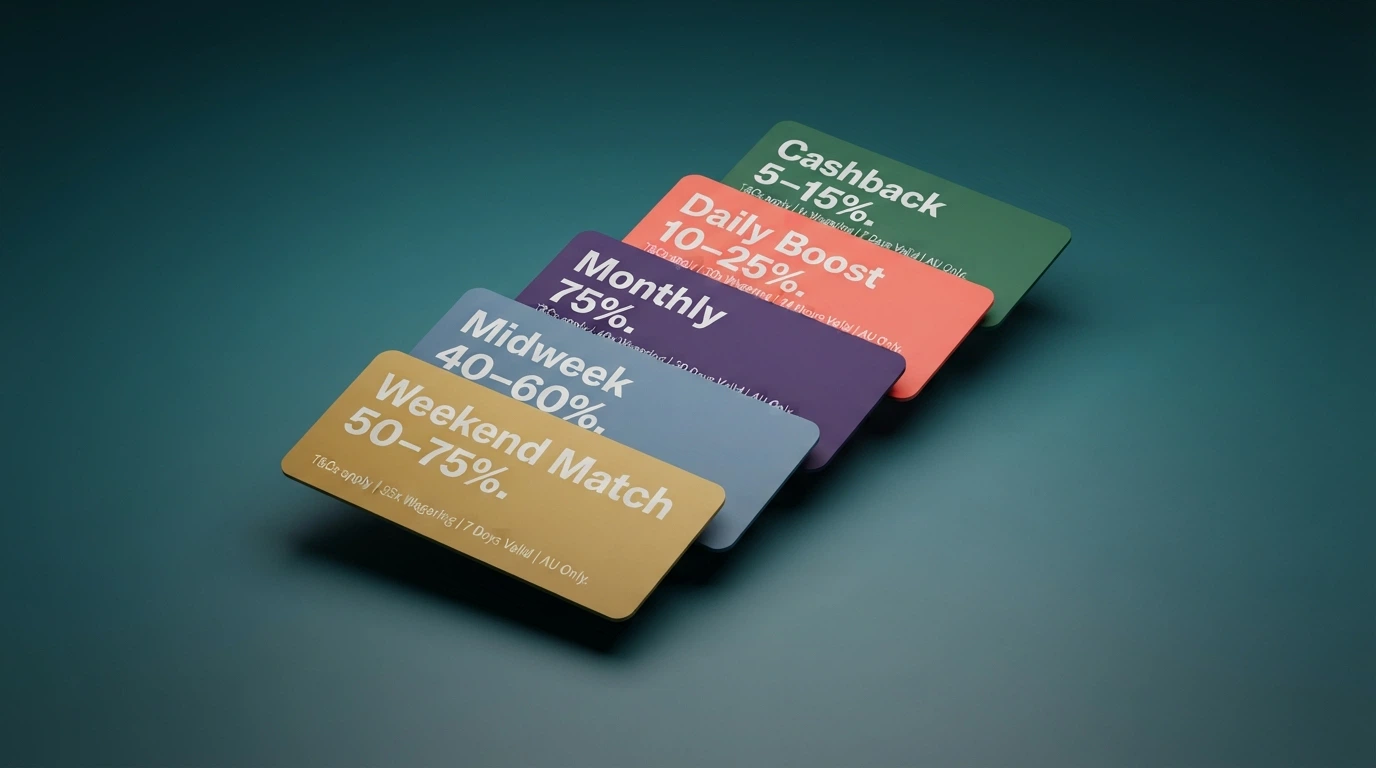
The reload-type comparison below summarises the main categories. The cells use Australian dollar figures and wagering multiples from operators accessible to Australian players in 2026; the no-data marker (—) is used where the market does not produce a single representative figure for the cell.
| Reload Type | Typical Match | Wagering Requirement | Typical Validity | Key Caveat |
|---|---|---|---|---|
| Weekend Match | 50–75% | 35–40x | 3–7 days | Max bet A$5; some Sunday-only |
| Midweek Reload | 40–60% | 30–40x | 3–7 days | Smaller match; minimum deposit applies |
| Monthly Power-Up | 75% | 35x | 5–7 days | Higher cap; rarer in the calendar |
| Daily Boost | 10–25% | 20x | 24 hours | Tiny time window (3–6 hours); low cap |
| Cashback | 5–15% of net losses | 10–15x | 7 days | Refund on net loss, not deposit |
| Crypto/PayID Boost | 50% → 75% (boosted) | 35–40x | 3–7 days | Restricted payment method |
| No-Deposit Reload | Free spins (rare) | 40–60x | 24–48 hours | Very rare; usually welcome only |
The numbers in the table are the operator-published midpoints, not a single operator’s terms. A weekend reload at the 75% ceiling, for example, is the SkyCrown Sunday offer; a 50% weekend reload is closer to the WinSpirit structure. The whole table sits on the assumption that the reader will read the terms on the specific operator before claiming. The numbers above are the shape, not the binding offer.
Weekend vs Midweek vs Monthly: When the Value Peaks
The peak reload value in the Australian-accessible market sits on the weekend. A weekend reload — Friday evening through Sunday night, in most calendars — is the operator’s main draw for a returning player. Match percentages climb to 50–75% with caps of A$1,000 in many cases. SkyCrown’s weekend reload runs to 100% up to A$300 plus 50 free spins on Sundays, with a three-day expiry and 40x wagering on the bonus. WinSpirit’s weekend offer runs to 50% up to A$1,000 Saturday and Sunday.
Midweek reloads are smaller. A 40–60% match up to a few hundred dollars is the typical shape, with wagering in the same 30–40x range. The midweek offer is the operator’s way of keeping a player active between weekend peaks, and the lower match reflects that the operator is filling a gap in the calendar rather than competing with a rival’s weekend push. The midweek offer is the one to claim if the player is depositing anyway; it is rarely the one to chase.
Monthly power-ups are the largest caps. SkyCrown’s Monthly Power-Up runs 75% up to A$750 — a higher match than the weekend reload, on a longer cycle. The trade-off is frequency: a player who deposits only at the start of the month gets the high-cap offer once; a player who deposits weekly never builds up to the trigger. The monthly reload rewards commitment, not volume.
Timing the deposit to the cycle is the part of the strategy that costs nothing. A player who can defer a deposit from Wednesday to Sunday gets the weekend reload, not the midweek one. A player who can defer from late in the month to the first week gets the monthly power-up. The deposit amount and the bonus amount stay the same; the bonus the player keeps is the one tied to the better offer.
The Near-Mythical No-Deposit Reload
Reload bonuses, by definition, are tied to a deposit. A reload is the operator paying the player to top up an account that has already gone through a welcome offer. A no-deposit reload is, in marketing terms, the operator paying the player to do nothing — and that is why the offer barely exists in the reload category.
Fair Go Casino runs periodic no-deposit free spin offers, usually on a featured pokie and usually with a tight expiry window. These offers are not reloads in the structural sense; they are marketing promotions dressed up in reload language. A no-deposit free spin offer might cap winnings at A$180 and run a 60x wagering on whatever the spins return, which means the player is funding the wagering requirement with no bonus to clear it against. The offers exist. They are not a category.
The vast majority of reloads require a deposit. A reload built around “claim without depositing” is, almost by definition, a different product — a free spin bundle, a cashback credit, a tournament entry. The reload calendar in the reviewed set is built around deposits, and a player looking for a no-deposit offer is looking outside the reload category entirely. The most useful framing: a no-deposit reload is something to claim if it appears in the promotions tab, not something to wait for. Patience is the wrong strategy; reading the terms on the deposit-based offer is the right one.
Reload Match vs Cashback: The Maths That Decides
A reload match is a percentage of the deposit, paid as bonus funds that have to clear wagering. A cashback is a percentage of net losses, paid as bonus funds that have to clear lower wagering. The two offers look like the same shape — bonus money, with a multiplier attached — and they settle into very different value depending on whether the session wins or loses.
A reload match rewards the act of depositing. A player who deposits A$200, claims a 50% reload, and gets A$100 in bonus funds is being paid A$100 to top up. The bonus is theirs whether they win or lose, and the wagering is what determines how much of it they can actually withdraw. WinSpirit’s 25% reload up to A$200 runs at 20x wagering; their 15% cashback up to A$500 runs at 15x wagering. The reload is a bigger match, on a bigger multiple. The cashback is a smaller match, on a smaller multiple.
The maths that decides between them is the session result. A player who wins on the reload walk-away has claimed A$100 of bonus on a 20x turnover of A$2,000 — a bet that paid off because the session ran hot. A player who loses on the reload walk-away has lost A$200 and earned A$100 of bonus that has to clear A$2,000 of wagering to be withdrawable. A player who claims a 15% cashback on a A$500 net loss gets A$75 in bonus at 15x — A$1,125 of wagering, much less, on money that was already lost. The cashback favours the losing player. The reload match favours the depositing one.
AzurSlot pairs the weekend reload at 40% up to A$500 with a 5–10% weekly cashback on net losses at 10x wagering. The structure is the operator’s way of rewarding both ends of the session cycle. A player running hot should be weighing the reload. A player running cold should be reading the cashback terms, because the cashback is the offer that pays the player who has already lost. The reload match and the cashback are not interchangeable, and the player who treats them as interchangeable is treating the offer as a marketing line rather than a betting product.
Why PayID and Crypto Deposits Get You a Bigger Reload
Some operators run a boosted reload for players depositing via crypto or PayID. The standard 50% weekend reload becomes a 75% reload for players funding the account through a lower-cost payment method. The mechanism is straightforward: a credit card transaction costs the operator a percentage in processing fees; a PayID or crypto transfer costs a fraction of that, and the operator passes part of the saving back to the player as a bigger match.
The crypto and PayID boost is a tell, not a sign of generosity. Credit cards, credit-related products and digital currency are banned as payment for online wagering in Australia under legislation that took effect on 11 June 2024. The ban applies to operators licensed in Australia. Offshore casinos accepting Australian customers have not been bound by it, which is why credit card and crypto deposits still work at the operators reviewed on this page. The payment-method tell cuts both ways: a credit card deposit that succeeds at an offshore casino is also a sign that the operator is operating outside Australian rules, and a player who notices the tell is the player who can choose whether to use the deposit method at all.
PayID is the legal route and the most common one in the reviewed set. PayID and Osko are real-time bank transfers operated by the New Payments Platform, and they sit in the small set of payment methods that work both at licensed Australian wagering operators and at offshore casinos. The PayID boost is the cleanest version of the offer: a higher match on a deposit method that is legal in Australia and faster than a debit card. The crypto boost is the same logic, on a payment method Australia has chosen to disallow for licensed wagering, and the choice to take it is the player’s.
The Terms That Bite Hardest for Australian Players
Six terms do most of the work in a reload bonus, and a player who reads them first is several hundred dollars ahead of a player who reads them after depositing.
Wagering formula. The requirement is expressed as a multiple — 30x, 35x, 40x, 45x — and applies either to the bonus alone or to the deposit plus the bonus. RocketPlay’s 40x applies to the bonus amount only, which is the cleaner structure. Fair Go’s 30x applies to deposit plus bonus, which doubles the effective multiplier. A 30x on deposit plus bonus is, in practice, closer to 60x on the bonus alone. The formula in the terms decides the actual turnover, and the actual turnover decides how long the bonus takes to clear.
Max bet cap. A$5 per spin is the most common cap during wagering, with the reviewed range running from A$2 to A$8. The cap is per spin, regardless of game type. A spin at A$5 that does not contribute 100% to wagering still counts against the cap, and the cap is the operator’s way of stopping a player from clearing the bonus on a single large bet.
Bonus expiry. A weekend reload might give three days. A monthly reload might give five to seven days. A daily boost might give 24 hours. The window is short by design, and a player who runs out of time on the bonus has funded the wagering out of their own deposit only to forfeit the remainder.
Game contribution. Pokies contribute 100% to wagering. Table games contribute 10–20%. Live casino is usually excluded. The contribution is what determines which games the wagering can be cleared on, and the pokies are the only path the contribution table leaves open in any reasonable time.
Sticky vs non-sticky bonus structure. A non-sticky bonus lets the player play with real AUD cash first, and withdraw any winnings from the real balance before touching the bonus. A sticky bonus locks the deposit and the bonus together, and the player has to clear wagering before any withdrawal. Non-sticky is the player-friendly structure, and it is the rarer one in the market.
Max cashout from free spins. Free spin winnings are typically capped at A$50–A$100, regardless of how much the spins actually return. The cap is the operator’s way of capping the upside of a free-spin bonus, and it can take a four-figure spin win down to a two-figure payout. The cap is the ceiling on the offer’s actual return.
What a A$1,000 Reload Bonus Actually Costs in Time
Take the top of the weekend range: a A$1,000 bonus at 35x wagering with a A$5 max bet. The required turnover is A$1,000 multiplied by 35, which is A$35,000. At A$5 a spin, that works out to 7,000 spins. At five seconds per spin — a conservative average for an online pokie with the autoplay running — 7,000 spins is just over 9.7 hours of continuous play to clear the bonus.
The number is a statistical estimate: an average over many spins, not a guaranteed outcome for any individual player. Pokies return roughly 96% of turnover in the long run, which means a chunk of that 9.7 hours is funded by the bonus money itself rather than by the player’s deposit. A player who clears the bonus is, on average, recovering part of the bonus from the wagering and forfeiting part of it to the house edge. The point of the maths is to give a player a real number for what “clearing the bonus” costs in time and turnover, not to promise what the bonus will be worth at the end.
Three inputs change the result, and each one moves the time materially. A 40x reload at the same A$1,000 bonus and A$5 max bet works out to A$40,000 turnover, 8,000 spins, around 11.1 hours. A A$3 max bet — within the reviewed range — pushes the same A$35,000 turnover to 11,667 spins and about 16.2 hours. A A$750 monthly power-up at 35x works out to A$26,250 turnover, 5,250 spins, around 7.3 hours. The numbers move with the bonus cap, the wagering multiple, and the max bet cap, and each of those three is something the player can read in the terms before depositing.
A A$1,000 reload at 35x and A$5 a spin is a ten-hour commitment to clear. A player who treats it as a thirty-minute session is not clearing the bonus; the player is funding the wagering requirement out of subsequent deposits until the balance runs out or the bonus expires. The time figure is the real cost of the offer, and the offer’s headline match percentage hides it.
The 10 Offshore Casinos Australians Use for Reload Bonuses
The ten operators below are ranked by how well their reload calendar serves an Australian player, not by market share or welcome-package size. Every one of them is an offshore casino with no Australian licence; every one of them is illegal for the provider to offer to Australians under the Interactive Gambling Act 2001; and the protections that follow from an Australian licence — BetStop, dispute resolution, deposit guarantees, federal advertising rules — do not apply at any of them. The table below is a snapshot of the offers, not a recommendation to use them.

The cells in the operator comparison use the no-data marker (—) where reload-specific terms were not publicly listed; cells with figures are drawn from operator terms pages and reputable review sources verified within the last twelve months.
| Operator | Legal Status in Australia | Reload Type | Best Reload Offer | Wagering on Reload |
|---|---|---|---|---|
| SkyCrown | Offshore, no Australian licence | Weekend + Monthly + High-roller | Weekend 100% up to A$300 + 50 FS | 40x |
| RocketPlay | Offshore, no Australian licence | Weekly (Friday + Sunday) | Friday 50% up to A$600 | 40x (bonus only) |
| WinSpirit | Offshore, no Australian licence | Weekend + Daily + Cashback | Weekend 50% up to A$1,000 Sat–Sun | 30x |
| Fair Go | Offshore, no Australian licence | Daily/Weekly + Free spins | 25–75% (varies) | 30x (deposit + bonus) |
| AzurSlot | Offshore, no Australian licence | Weekend + Cashback | Weekend 40% up to A$500 | 45x |
| Stake | Offshore, no Australian licence | Daily race + Weekly raffle | A$100,000 daily prize pool | — |
| Bizzo Casino | Offshore, no Australian licence | — | — | — |
| Royal Reels | Offshore, no Australian licence | — | — | — |
| Scream Casino | Offshore, no Australian licence | — | — | — |
| Rocket Casino | Offshore, no Australian licence | Weekend (terms unconfirmed) | Triple Weekend Reload (terms unconfirmed) | — |
The five terms covered earlier in the section on what bites hardest — wagering formula, max bet, expiry, game contribution, sticky/non-sticky structure, free spin cashout cap — are the ones to verify against the operator’s own terms page once an offer is on the table. The comparison is the shape of the offers, not the binding contract.
SkyCrown
SkyCrown runs the densest reload calendar in the reviewed set. The headline welcome package is A$8,000 plus 400 free spins across four deposits, but the reloads are where a returning player meets the brand. The weekend reload runs 100% up to A$300 plus 50 free spins on Sundays, with 40x wagering on the bonus and 30x on the free spin winnings, a three-day expiry from credit, and a A$5 max bet during wagering. The Monthly Power-Up runs 75% up to A$750 — a higher match than the weekend reload, with a longer window and a deeper cap. The high-roller reload runs 50% up to A$2,500 from a A$500 minimum deposit, with a A$10 max bet during wagering. The mid-tier reload — the standard calendar entry — runs 50% up to A$500.
The reload structure is tiered, which is both its strength and its weakness. A player depositing A$200 on a Sunday gets A$200 in bonus at the 40x wagering band, with 50 free spins on top. The same player depositing A$2,000 on a Sunday gets A$2,000 in bonus funds, but on the same 40x wagering and the same three-day expiry — a ten-hour commitment to clear, on a 7,000-spin turnover. The high-roller reload is the only SkyCrown offer with a relaxed A$10 max bet during wagering, and it is the only one suited to a player moving real money through the bonus.
SkyCrown is licensed in Curaçao (details subject to verification). The brand is offshore, the offers are generous, and the four-tier reload calendar is the most reload-heavy in the set. The numbers move with the deposit size, and a player who reads the tier table before choosing the offer will keep more of the bonus. The 40x on the weekend reload and the three-day expiry are the constraints; the 50 free spins on Sundays are the part that actually pays the player who runs hot. At 40x on a Sunday-only, three-day window, the offer is not generous — the four-tier reload calendar is.
WinSpirit
WinSpirit runs the most frequent reload calendar of any operator in the reviewed set. The weekend reload runs 50% up to A$1,000 on Saturday and Sunday. The 100 free spins fire every Tuesday. The 15% cashback up to A$500 credits every Friday. The 30% reload fires on Sundays. The 10% Daily Boost reload — 6pm to 9pm AEST — runs at 20x wagering, with a 24-hour validity from credit. The welcome bonus is up to A$2,000 plus 100 free spins.
The wagering on the standard reload is 20x on the bonus, with cashback at 15x and welcome at 30x. The Daily Boost is the cheapest in the set on the multiplier, and the 24-hour window is the cleanest part of the calendar to claim — a player who logs in at 6:01pm AEST and plays for an hour has the bonus spent. The 30% Sunday reload is the calendar’s middle band, with 20x on the bonus. None of the reloads in the WinSpirit calendar are the highest in the set. None of them are the lowest. The volume is the offer.
WinSpirit is a Curaçao-based offshore operator (details subject to verification). WinSpirit publishes a terms page and a bonus calendar, both of which are accessible to Australian players without restriction, and the wagering figures and validity windows in this write-up are drawn from those pages. The reload calendar is the strongest in the set by volume, the licence record is the part to read closely, and a player who values a daily reload over a monthly one will find the calendar built for them.
RocketPlay
RocketPlay applies wagering to the bonus amount only, not the deposit plus the bonus. That is the cleanest structure in the reviewed set, and it cuts the effective turnover in half against any operator running a deposit-plus-bonus formula. The Friday reload runs 50% up to A$600, with 40x wagering on the bonus alone. The Sunday reload is reported as having no win cap, which is a rarer structure in the set. The welcome package runs 100% up to A$1,000 plus 100 free spins on the first deposit, and 200% up to A$1,000 on the second deposit (minimum A$75 to clear the second tier).
The max bet during wagering is A$5, the most common cap in the set. The Friday reload is the one to compare to midweek offers at other operators, and the wagering structure is the part that makes the comparison favourable. A 50% reload up to A$600 with 40x on the bonus alone is a A$240 bonus on a A$480 deposit, with A$9,600 of turnover to clear — a 1,920-spin wagering commitment at A$5 a spin, just over 2.7 hours of continuous play. The same offer at a 40x deposit-plus-bonus operator would require A$28,800 of turnover on the bonus, 5,760 spins, around 8 hours of play. The wagering formula is the single biggest cost driver in the set, and RocketPlay’s structure is the cheapest one on the page.
RocketPlay is licensed in Curaçao under Dama N.V. (details subject to verification). The Friday reload is the calendar’s main offer, the Sunday reload is the bonus-without-cap feature, and the bonus-only wagering structure is the reason a player comparing reloads on formula alone should weigh RocketPlay first.
Fair Go
Fair Go is the RTG-powered pokies operator in the reviewed set. The welcome package runs 100% up to A$200 on each of the first five deposits — a total of A$1,000 plus 50 free spins — with 30x wagering on deposit plus bonus. The reload calendar is built around daily and weekly reload offers, free spin bundles on featured pokies, and seasonal campaigns. Match percentages on the reloads run between 25% and 75%, depending on the calendar slot. No-deposit free spin offers run periodically; these are capped at A$180 maximum cashout and carry higher wagering.
The RTG catalogue is a constraint as much as a feature. Fair Go’s reloads are designed to be cleared on RTG pokies, with table games contributing only 10–20% to wagering. A player who plans to spend their reload on blackjack or roulette will clear the wagering five to ten times slower than a player on the pokies, and the calendar is built around the assumption that the player is on the pokies. The 30x on deposit plus bonus is a steeper structure than the bonus-only formulas elsewhere, and the effective turnover is closer to 60x on the bonus.
Fair Go’s licensing details are frequently unavailable via public registers. The brand positions itself around the Australian punter, the RTG catalogue is a known quantity, and the reload calendar is dense. The 30x deposit-plus-bonus formula is the constraint to weigh, and the pokies-only assumption is the part of the calendar that decides whether the offer is a fit. Players who live in the pokies will find the value compounds; players who split time between pokies and tables will see the effective wagering compound against them. The sticky 30x on deposit plus bonus is the old way of doing it, and Fair Go has not moved on.
AzurSlot
AzurSlot pairs a weekend reload with a weekly cashback, and runs the highest reload wagering multiple in the reviewed set. The weekend reload runs 40% up to A$500 from a A$30 minimum deposit, with 45x wagering on the bonus and a A$8 max bet during wagering. The validity is five days from activation, with 48 hours to activate the bonus after the deposit. The weekly cashback runs 5–10% of net losses every Monday at 10x wagering — a much lower multiplier than the reload, on a different basis (losses, not deposit). The welcome package runs A$3,600 plus 150 free spins across four deposits (125% / 70% / 80% / 50%), with a 50% high-roller reload up to A$2,500 plus 20 Coins on a A$300 minimum deposit.
The 45x reload is the steepest in the set. A A$500 weekend reload at 45x is A$22,500 of turnover, 4,500 spins at A$5 a spin, around 6.25 hours of continuous play. The five-day window gives a player a little more room than the weekend three-day expiries elsewhere, but the higher multiplier more than offsets the additional time. The cashback is the more attractive offer on the calendar: 10x wagering is the lowest in the set, and a 10% cashback on a A$500 net loss is A$50 in bonus at A$500 of turnover — half an hour of play to clear, against 6+ hours on the weekend reload. The cashback is the value here, not the reload match.
AzurSlot operates as an offshore entity (details subject to verification). The reload is heavy on the wagering, the cashback is light, and the calendar rewards the player who runs cold more than the player who runs hot. Players who want a long-window reload with a soft cashback fallback will find the calendar built for that, and players chasing a low multiplier on a reload match should look elsewhere in the set. The 45x is the highest in the reviewed set, and the five-day window is the shortest; the trade-off is the cashback that runs underneath it.
Stake
Stake is a reload casino by accident of category, not by design. The brand does not run deposit-match reload bonuses. The promotional calendar is built around a Daily Race with a A$100,000 prize pool every 24 hours, a Weekly Raffle worth A$75,000, and ongoing leaderboard promotions through the end of 2026. Wagering is the metric that determines the share of the prize pool, not a multiplier on a bonus, and there is no traditional bonus to clear.
The structure rewards volume, not deposit size. A player who wagers A$5,000 across the day is in the daily race with the same odds structure as a player who wagers A$500; the difference is the share of the prize pool, which scales with volume. The Daily Race structure has no wagering requirement on the winnings, no max bet cap, no bonus expiry, and no game contribution weighting — pokies and table games count the same. The trade-off is that a small-volume player is unlikely to clear a meaningful share of a A$100,000 prize pool against high-volume players.
Stake is licensed in Curaçao (details subject to verification). The Daily Race and Weekly Raffle are ongoing through 31 December 2026. If the offer a player is looking for is a 50% weekend match on a A$200 deposit, Stake is the wrong operator. If the offer is volume-based rewards with no wagering requirement, Stake is the only one in the set that runs the model. A reload casino Stake is not, and that is the point of the design.
Rocket Casino
Rocket Casino appears in player discussions as a weekend-reload operator, with a Triple Weekend Reload promotion mentioned across affiliate listings. Specific terms — match percentage, wagering multiple, validity window, game eligibility — could not be confirmed in current operator records. The page on the operator’s own site that should carry the terms was not surfacing the offer at the time of writing, and the affiliate pages that mention the Triple Weekend Reload do not carry consistent numbers.
Rocket Casino operates offshore and lacks an Australian licence. The brand accepts Australian customers and processes AUD deposits, which is the only verifiable Australian-facing signal. A player considering the Triple Weekend Reload should verify the current terms directly with the operator before depositing — match percentage, wagering multiple, validity window, eligible games, and max bet cap. The terms on a reload are the actual offer; the marketing name is not.
The marketing name is on the page; the terms are not. Verify directly with the operator before committing a deposit, and treat the offer as unconfirmed until the wagering, the cap and the validity appear in the operator’s own terms page.
Bizzo Casino
Bizzo Casino is listed in player discussions of Australian-accessible offshore casinos with reload offers, and the brand accepts Australian customers. Reload-bonus specifics — match percentage, wagering multiple, validity, eligible games, max bet cap — were unconfirmed at the time of our latest assessment, and the operator’s own terms page did not surface a current reload calendar.
Bizzo is an offshore casino without an Australian licence. The brand sits in the wider pool of Curaçao-licensed operators that market to Australian players, and the reload calendar is the part of the offer to verify directly with the operator before depositing. The marketing material on affiliate sites will show an offer; the terms page on the operator’s own site will show the wagering. The gap between the two is the actual reload, and that gap is the part to close before any deposit is made.
The brand is a candidate in the wider pool, not a ranked entry on this page. The reload offer is a comparison the player makes once the terms surface, and a ranking without the terms would be a guess dressed up as a recommendation. Verify the offer before committing.
Royal Reels
Royal Reels appears in Australian-facing player discussions as an offshore casino with reload-style offers, and the brand accepts AUD deposits from Australian customers. Reload-bonus specifics — match percentage, wagering multiple, validity, eligible games, max bet cap — could not be verified during this review.
Royal Reels is an offshore platform without an Australian licence. The brand sits in the wider pool of offshore operators that market to Australian players, and the reload terms are the part of the offer to verify before depositing. A player comparing Royal Reels to the operators on this page with confirmed reload terms should treat Royal Reels as a candidate, not a ranked entry. The offer may be competitive; the offer’s terms are not on the page.
The terms in the section on what bites hardest are the five to read once they are visible. The offer is in the marketing; the comparison is in the terms, and the terms page on the operator’s own site is where that comparison lives.
Scream Casino
Scream Casino appears in Australian-facing player discussions as an offshore casino with reload-style offers, and the brand accepts AUD deposits. Reload-bonus specifics remain unverified in current records, and the operator’s own terms page did not surface a current reload calendar.
Scream Casino operates offshore and lacks an Australian licence. The brand sits in the wider pool of offshore operators marketing to Australian players, and the reload terms are the part of the offer to verify before depositing. A player weighing Scream against the operators in this comparison should treat the brand as a candidate, not a ranked entry. The marketing material will name a reload; the terms page will show the wagering.
An unverified entry in the reload calendar, not a ranked one. The marketing will name a reload; the terms page will show the wagering, the validity and the eligible games. The reload is the gap between the two, and that gap is what a player closes before any deposit is made.
Why Your Reload Bonus Favours the Pokies
Reload bonuses are built to be cleared on pokies. The game contribution structure — the percentage of each wager that counts toward the wagering requirement — runs 100% for pokies, 10–20% for table games, and zero for live casino at most of the operators reviewed. A player clearing a 35x reload requirement on pokies is making 100% of every A$5 spin count. A player clearing the same requirement on blackjack is making 10% of every A$5 hand count, which means ten times the turnover, which means ten times the time, which means the wagering requirement is, in practice, ten times harder to clear on the table games.

The structure is not an accident. Pokies return a known house edge over a known number of spins, and the bonus is priced against that edge. Table games have a lower house edge, and the operator compensates by reducing the contribution percentage. Live casino games have a still lower edge and a higher operating cost, and the operator excludes them entirely. The reload bonus is, in market terms, a marketing cost the operator has priced for the pokies player, and the contribution structure is the mechanism that holds the price in place.
Why Pokies Count 100% and Everything Else Barely Registers
Game contribution is the percentage of each real-money wager that counts toward the wagering requirement. A$5 on a pokie with 100% contribution adds A$5 of wagering credit. A$5 on a blackjack hand with 10% contribution adds A$0.50 of wagering credit. A$5 on a live casino game with 0% contribution adds nothing.
The structure is consistent across the reviewed set. Pokies contribute 100%. Table games (blackjack, roulette, baccarat) contribute 10–20%. Live casino games (live dealer blackjack, live roulette, game shows) are typically excluded. The contribution is published in the bonus terms as a game-weighting table, and the table is what determines which game the bonus can be cleared on. A bonus with 35x wagering on A$100 of bonus funds is A$3,500 of turnover to clear. On pokies, that is 700 spins at A$5. On blackjack at 10% contribution, that is 7,000 hands at A$5 — and at, say, 60 hands per hour, a 117-hour commitment.
The maths is the operator’s defence. The contribution is set so that clearing a bonus on table games is, in time terms, not feasible. A player who tries it will either run out of time on the bonus expiry or run out of balance before the wagering clears. The pokies are the path, and the contribution table is the operator’s way of making sure the path is the one the bonus is priced for. Pokies count 100%; everything else barely registers, and the contribution table is the mechanism that holds the line.
Which Games Your Reload Bonus Actually Covers
The reload bonus covers pokies, almost universally. Every operator in the reviewed set runs 100% contribution for online pokies, and most exclude live casino entirely. The grey area is table games: some operators run 10% on roulette and blackjack, others run 20%, and a few exclude table games as well as live casino. The game-weighting table in the bonus terms is the place to check before playing.
The max bet cap applies per spin, regardless of game type. A A$5 max bet during wagering is a A$5 cap on a pokie spin, a A$5 cap on a roulette inside bet, a A$5 cap on a blackjack hand. The cap does not adjust for the game’s contribution percentage — a A$5 blackjack hand that contributes 10% is still capped at A$5 per hand, not A$50. The cap and the contribution work together to keep the player on the pokies, and the player who tries to clear the bonus on a mix of games is, in practice, paying for the contribution reduction out of the bonus funds.
Game eligibility is also a function of the provider catalogue. Fair Go runs on RTG, and the reload calendar is built around RTG pokies. The reload at Fair Go that is tied to “featured pokies” is, in effect, a reload that can only be cleared on a specific list of games. The wider pokies market is the path at most operators, and the specific pokie list is the path at a few. The game’s contribution percentage is what the bonus is built around, and the bonus is built around the pokies.
When Your Reload Bonus Is Locked to One Provider’s Games
Some reloads are tied to a single provider. Fair Go runs on RTG, and the reload calendar’s free spin bundles are tied to specific RTG titles. A reload that offers 50 free spins on a featured pokie is a reload that pays out in spins on that pokie, with the wagering on the winnings applied to the same game or to a narrow list of pokies. The game scope is narrower than a generic reload, and the player’s game choice is, in effect, made for them.
The trade-off is between a higher match and a restricted game pool. A provider-specific reload can offer a better match percentage or more free spins than a generic reload, in exchange for limiting the games on which the wagering can be cleared. A player who likes the featured pokie gets a better deal. A player who does not gets a reload with a cap on the upside, and a game they would not have chosen to play on.
The reload terms list the eligible games in the bonus terms. The contribution is 100% on the listed games, and 0% (or whatever the standard contribution is) on everything else. The provider-specific reload is the operator’s way of routing players to specific titles, and the route is one the player can read in the terms before claiming. The reload is built around a pokie; the player who clears it is clearing it on that pokie, and the broader catalogue is closed off in the meantime. The restriction is a marketing tool that doubles as a constraint.
The Full Legal Picture: What the IGA Prohibits, Permits and Protects
The Interactive Gambling Act 2001 is the spine of the Australian online gambling framework, and the framework has a specific shape: licensed wagering on one side, prohibited casino on the other, and an offshore gap in between where the reload offers on this page live. The framework governs what is licensable, what is enforceable, what the payment-method tells are, and what changes on 1 January 2027. The points that follow are the regulatory frame around the offers reviewed above.
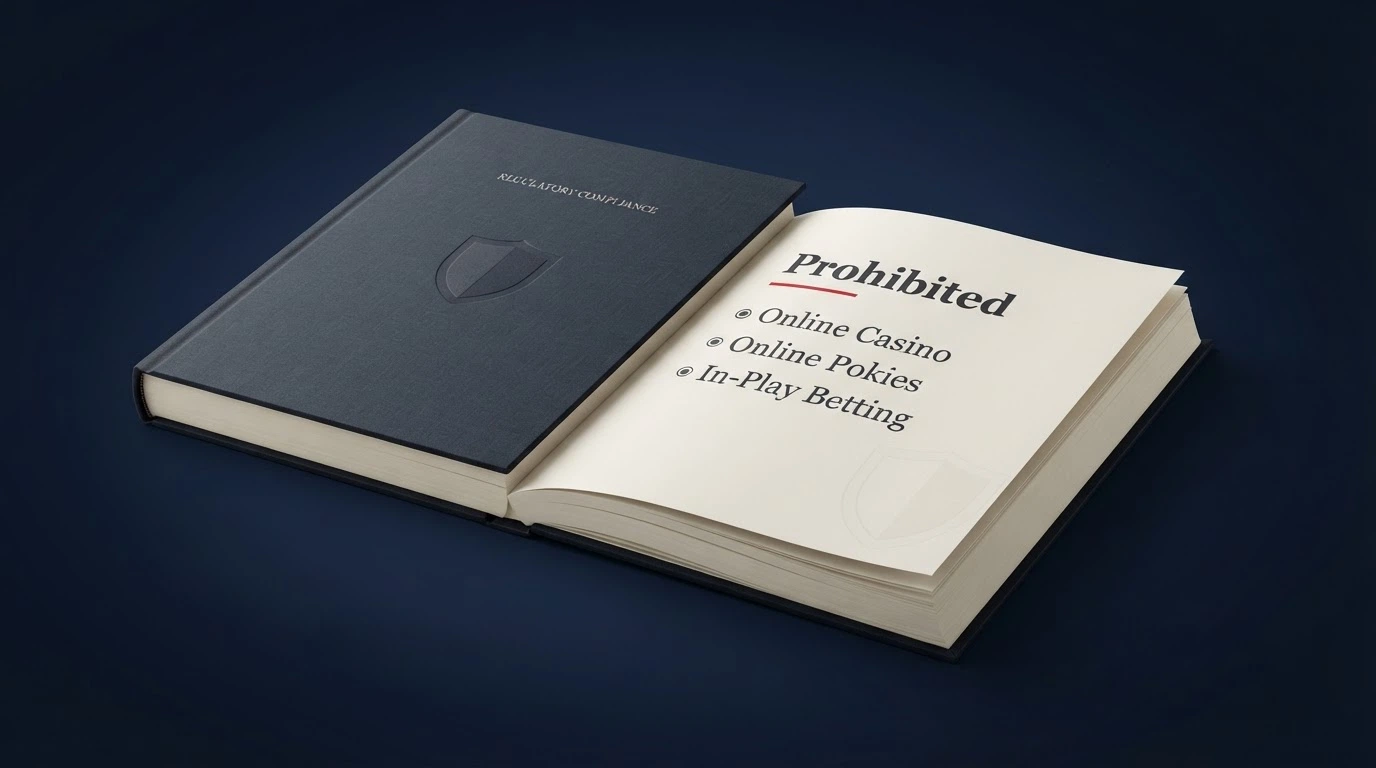
The Two-Tier System Australians Actually Navigate
Australians who gamble online navigate a two-tier system. Tier one is licensed wagering — sports and racing, placed before the event begins, through operators licensed by a state or territory (most concentrate in the Northern Territory, under the Northern Territory Racing and Wagering Commission and Licensing NT). Tier two is offshore casino, which is the product the IGA prohibits, the gap the ACMA blocks, and the tier every reload bonus on this page sits in.
The licensed tier has a defined payment-method perimeter. Debit card, bank transfer, PayID and Osko, and BPAY are the legal deposit methods. Credit cards, credit-related products and digital currency are banned as payment for online wagering under legislation that took effect on 11 June 2024. The ban is at the payment-method level, not the deposit-amount level — Australia caps the payment method, not the stake. The licensed tier also requires identity verification at sign-up, and the operator is bound by Australian consumer law, dispute resolution and BetStop.
The offshore tier is the reverse. The operator accepts whatever payment method the player can route through, including the ones Australia has banned for licensed wagering. The operator is not bound by Australian consumer law, dispute resolution or BetStop. The site can be blocked at the ISP level at any time. The reload bonus the player is depositing into lives in this tier, and the protections of the licensed tier do not extend to it.
The state-level tax structure is the licensed tier’s economics. The Northern Territory levies a 5% wagering tax on wagers minus payouts plus a 0.05% racing levy; each state sets its own point-of-consumption tax, typically 10–15% of net wagering revenue. The offshore tier is taxed in its licensing jurisdiction, not in Australia, and player winnings are not assessable income under section 6-5 of the ITAA 1997 for an ordinary punter. Gambling losses are not deductible under section 8-1, unless the person is carrying on a business of betting.
What You Lose When You Play Offshore
Playing at an offshore casino costs the Australian player the four protections the licensed tier provides. The first is BetStop coverage: BetStop excludes a person from around 150 Australian-licensed wagering providers in one registration, and an offshore casino is not on that list. A self-excluded Australian can still open an account, deposit, and claim a reload at any offshore operator. The second is Australian consumer law: the operator’s terms are governed by the licensing jurisdiction (typically Curaçao), and an Australian court is not the right venue for a dispute. The third is ACMA enforcement: the regulator can block the site at the ISP level, and the player’s balance at the time of the block is held by an offshore entity with no Australian route to recover it. The fourth is the dispute resolution infrastructure: there is no Australian equivalent of the UK Gambling Commission or the Malta Gaming Authority for an Australian player to escalate to.
The offshore gap is the gap the ACMA’s blocking actions have been trying to close. More than 1,564 illegal sites have been blocked since November 2019, and more than 225 services have withdrawn from the Australian market since 2017. The blocking works at the DNS level — Australian ISPs redirect the domain to a notice page, and the site disappears from Australian connections. A blocked site can reappear at a new domain, and the ACMA’s blocking requests are an ongoing cycle.
The BetStop gap is the one a self-excluded player needs to hold in mind. BetStop binds licensed wagering providers, not offshore casinos, and the offshore reload bonus is a product a self-excluded Australian can still access. The licensed tier’s protection does not cross the tier boundary, and a player who has self-excluded to stop gambling needs to know the offshore tier is the gap in that protection.
What the 2026 Reform Changes for Australian Players
The Interactive Gambling Amendment (Gambling Reform) Bill 2026 passed Parliament on 19 August 2026, and its key measures commence on 1 January 2027. The reform is the third major strengthening of the IGA since 2001, and it changes the perimeter the reload bonuses on this page sit in.
The first change is to prohibited products. Online keno and foreign-matched lotteries are added to the prohibited list from 1 January 2027. Online casino and online pokies remain prohibited (the prohibition pre-dates the 2026 reform). In-play sports betting remains prohibited.
The second change is to advertising. From commencement, no more than three wagering advertisements per hour can air between 5am and 8:30pm, with a live-sport blackout running from 15 minutes before the event to 5 minutes after, between 5am and 8:30pm. Radio wagering advertisements are banned during school commute and lunch times. Athletes, celebrities and influencers are barred from promoting wagering products. The advertising restrictions are phased over three years for the broader Stop the Gambling Ads measure, with Phase 4 (year 3) being a full prohibition with defined exemptions.
The third change is to inducements. Direct marketing of wagering inducements is prohibited for 14 days after sign-up, 3 months after BetStop deregistration, and indefinitely for at-risk customers. The restriction applies to licensed wagering, and it specifically targets the reload-bonus calendar the licensed tier runs. The offshore tier is not bound by the inducement restrictions, which means licensed operators cannot send a reload email to a new sign-up, while an offshore casino can.
The fourth change is to payment. From 1 January 2027, banks and payment providers gain express authority to block transactions to illegal gambling operators. The transaction is the one route Australian regulators can reach directly. A blocked payment at the bank stops the next deposit; it does not return the balance already on an offshore site. A player who uses an Australian bank for an offshore deposit in 2026 is the player who will find the deposit declined in 2026 once the reform commences.
The reform also introduces the Wagering Advertising Opt-out Register (AdStop), which lets consumers opt out of wagering marketing. The register is at the licensed-tier level. The offshore-tier marketing does not pass through the same opt-out infrastructure, and a player who registers for AdStop is still on the offshore marketing lists.
Responsible Gambling: What Reload Bonuses Do to Your Play
Reload bonuses are a repeat-deposit mechanism. The weekend offer pulls a player in on Saturday. The Daily Boost pulls them in on Wednesday evening. The Monthly Power-Up pulls them in on the first of the month. The calendar is built to convert one welcome deposit into a habit of repeat deposits, and the player who does not read the calendar that way is reading it the way the operator intends.

The cost of the calendar is not just the wagering requirement. The cost is the deposit pattern the calendar creates — a player who would have deposited A$200 in a month depositing A$200 every weekend because the reload is on offer, and a player who would have stopped after a losing session depositing again on Tuesday because the free spin bundle is on the page. The bonus drives the deposit, and the deposit is what the bonus is paid to keep happening. The operator is, in market terms, paying for the habit, and the player who does not recognise the structure is the player the structure is built for.
How to Set Deposit Limits That Reload Bonuses Cannot Break
The single most effective tool a player has against a reload calendar is a deposit limit set before the calendar opens. The mechanics are simple.
- Set a weekly deposit cap at the operator before claiming a reload. The cap is the line the bonus cannot push the deposit past. The cap should be set in the account settings, not in the player’s head — the head adjusts; the operator’s settings do not.
- Activate the operator’s time-out or take-a-break tool between sessions. A 24-hour or 48-hour time-out after a long session interrupts the reload cycle, and the cycle is what the bonus is built to maintain. The break is the part of the strategy the bonus cannot offer against.
- Review the activity statement at the end of every month. The statement shows deposits, withdrawals, net position and bonus claims. The numbers in the statement are the ones the bonus does not show in the offer. The trend over three months is the part that decides whether the calendar is in control.
- Use a separate bank account or e-wallet for gambling funds. A hard ceiling enforced by the balance, not by the player’s intention. The reload offer does not push the deposit past the balance in the gambling account. The balance is the cap.
The four tools are the same ones a player would set on a licensed wagering account. At an offshore casino, the tools are operator-by-operator, and the player who uses more than one operator needs to set them on each one. The reload calendar rewards the player who does not set the limit, and the limit is the part of the strategy the calendar cannot reach.
BetStop: What It Covers and What It Does Not
BetStop is the National Self-Exclusion Register, launched on 21 August 2023. The register is run by ACMA, and a single registration excludes a person from every Australian-licensed online and phone wagering service — approximately 150 operators covering sports and racing. As of 31 March 2026, 59,830 Australians had registered, and 37,247 had active exclusions. The minimum exclusion period is three months, with no maximum, and the periods run up to a lifetime. A person cannot apply to be removed in the first three months, and removal requires a statutory declaration confirming counselling.
BetStop does not cover offshore casinos. A self-excluded Australian can still open an account, deposit AUD, and claim a reload bonus at any of the ten operators reviewed on this page. The exclusion is the licensed tier’s protection, and the offshore tier is outside the perimeter. The offshore reload calendar a self-excluded player is trying to avoid is the one BetStop cannot reach, and the offshore reload calendar a self-excluded player is being marketed to is the one BetStop does not stop.
The structural gap is the one to hold in mind. BetStop is the right tool for a player whose gambling has spread to licensed wagering operators. It is the wrong tool for a player whose gambling has migrated to offshore casinos. The two-tier system means two tiers of protection, and the offshore tier’s protection is, in effect, the player’s own deposit limit and self-exclusion at each operator. The help resources in the section below are the ones a player who has crossed that line should reach.
The Reload Loop: How Bonuses Drive Repeat Deposits
The reload loop is the cycle the operator’s calendar is built to maintain: deposit, claim, wager, withdraw (or run out), wait for the next offer, deposit again. The loop runs on the time between offers, and the player’s deposit pattern aligns to the calendar. A player who is not reading the calendar as a calendar is reading it the way the operator intends.
The prevalence of gambling harm in Australia puts the loop in proportion. Approximately 3.29 million Australians aged five and over are affected annually by their own or another person’s gambling, with an estimated 1.97 million adults classified as at-risk or problem gambling. The Roy Morgan Gambling Harm Index (March 2026) puts 15.1% of Australian adults — an estimated 3.32 million people — at some level of gambling harm, with 13.0% (around 2.86 million) from their own gambling and 5.4% (around 1.18 million) from another person’s. The annual health loss associated with gambling harm in Australian adults is estimated at over 400,000 Years Lived with Disability. About 2.1% of Australian adults — roughly 430,000 people — experience problem gambling, and the Australian Institute of Health and Welfare put high-risk gambling at 1.8% in 2022.
The warning signs that a reload calendar is driving a player’s deposits are concrete: depositing earlier in the week than usual to claim a Tuesday offer; depositing on a Sunday night to claim a Monday cashback; topping up specifically to extend a wagering window that is about to expire; opening a second or third offshore account to keep the offers coming. The cycle is recognisable because the calendar is the same one every week. A player who sees the pattern is the player who can change it, and the help resources below are the ones a player who has crossed that line should reach.
The National Gambling Helpline is 1800 858 858 — free, confidential, 24 hours a day, 7 days a week, with online chat and counselling through Gambling Help Online. The line is staffed by professionals, and a call is the first step a player who recognises the pattern can take. The reload loop is the operator’s design. The exit from the loop is the player’s.
How We Evaluated These Reload Casinos
The evaluation behind this page draws on three sources. The first is the ACMA register of blocked illegal gambling services, the BetStop register of licensed wagering providers, and the Interactive Gambling Act 2001 — the federal sources that determine whether a casino is licensed in Australia (none are) and whether a casino is on the ACMA’s blocking list (some have been, historically). The second is the operators’ own terms pages, which carry the match percentages, wagering multiples, validity windows, eligible games, max bet caps, and bonus structures cited in the operator write-ups. The third is reputable third-party casino review sources, used to cross-check the operator-published terms.
The evaluation criteria were: reload offer value (match percentage, cap, free spin bundle, validity), wagering terms (multiple, formula — bonus-only vs deposit-plus-bonus, contribution table), reload frequency (weekly, monthly, daily), and legal-status transparency (whether the operator’s licence is verifiable from the regulator’s own register). No operator reviewed holds an Australian online casino licence, because none exists. Operators whose reload terms could not be confirmed from the operator’s own page or a reputable review source are listed in the operator comparison with the no-data marker, not ranked.
The evaluation did not include deposit, game, or session testing. The reload terms in the write-ups are the operator’s published terms at the time of review, and a player considering a deposit should verify the current terms directly with the operator. The legal-status column in the operator comparison is the result of a check against the ACMA register and the Interactive Gambling Act 2001, not a guarantee of the operator’s status at the time of reading. The page is a guide to the offers, not an endorsement of any operator, and a player who reads it as either is reading it the wrong way.
What Your Reload Bonus Strategy Should Actually Look Like
A reload-bonus strategy that costs the player less than the bonus pays back starts with the legal frame. The first decision is whether to play at all. The Interactive Gambling Act 2001 prohibits the offer; the player is not prosecuted for claiming it, but the protections of an Australian licence do not apply at any of the ten operators reviewed. The licensed wagering tier exists for sports and racing. The reload calendar on this page is the offshore tier, and the choice to enter it is the player’s.

The second decision is the wagering formula. RocketPlay applies 40x to the bonus alone, which is the cleanest structure in the set. WinSpirit applies 30x to the bonus amount, with a 24-hour Daily Boost at 20x. AzurSlot applies 45x to the reload, the steepest in the set. Fair Go applies 30x to deposit plus bonus, which is the closest structure to 60x on the bonus alone. The formula in the terms decides the actual turnover, and the actual turnover decides how many spins and how many hours the bonus takes to clear. The A$1,000 reload at 35x in the section on what a A$1,000 reload actually costs is the rough shape of a top-of-range weekend offer, and a player who treats that as a ten-hour commitment to clear is reading the offer honestly.
The third decision is the reload type. A weekend match at 50–75% up to A$1,000 is the largest cap. A midweek reload at 40–60% is the most frequent. A monthly power-up at 75% is the highest match on a longer cycle. A daily boost at 10–25% is the smallest, in the shortest window. The reload type that matches the player’s deposit pattern is the one to claim; the reload type that does not is the one the calendar is trying to pull a player into.
The fourth decision is the game. Pokies at 100% contribution are the only rational play for clearing a reload. Table games at 10–20% contribution are not feasible in the time window. Live casino is excluded at most operators. A player who plans to clear a reload on table games is funding the contribution reduction out of the bonus funds, and the bonus funds do not stretch that far.
The fifth decision is the limit. The deposit limits covered earlier in the page are the framework, and the limit should be set before the calendar opens, not after the first offer lands. The reload loop is the operator’s design; the exit from the loop is the player’s.
The last word on a reload bonus is the player’s. The calendar is the operator’s; the wagering is the terms’; the legal frame is the IGA’s. The choice of which offer to claim, whether to claim it at all, and how much of the bankroll to commit to it, is the part the player owns. The numbers on this page are the tools to make that call. The call is yours.
Frequently Asked Questions
What are the typical wagering requirements for reload bonuses at Australian-accessible online casinos?
Reload bonuses in the Australian market run 30x to 40x on the bonus amount, with the steepest reviewed offer at 45x. A 30x on deposit plus bonus is roughly 60x on the bonus alone, which doubles the actual turnover. The formula in the terms is what decides the actual time to clear, and the time is what a player should weigh before claiming.
How do free spins work with reload bonuses, and what are the usual cashout caps?
Free spin bundles credit spins on a specific pokie, with winnings paid as bonus funds subject to 20x to 30x wagering. The cashout cap is the part to check: most Australian-accessible casinos cap free spin winnings at A$50 to A$100. A four-figure spin win can pay out as a two-figure one. The cap is the operator’s ceiling on the upside.
What is the maximum bet allowed while wagering a reload bonus?
The maximum bet while wagering a reload bonus is typically capped at A$5 per spin, with the reviewed range running from A$2 to A$8. SkyCrown’s high-roller reload is the one offer with a higher cap, at A$10 per spin. The cap applies per spin regardless of game type. The cap is what stops a player clearing the bonus in a single large bet.
Can I use PayID or Bitcoin to get a bigger reload bonus?
Some operators boost a standard 50% reload to 75% for PayID or crypto depositors, passing back the lower processing cost. PayID is legal for both licensed wagering and offshore casinos. Bitcoin is not legal for licensed wagering under the June 2024 ban, and a Bitcoin deposit at an offshore casino is a signal the operator is operating outside Australian rules.
Does BetStop self-exclusion cover offshore casino sites with reload bonuses?
BetStop covers approximately 150 Australian-licensed wagering providers — sports and racing operators, the only interactive gambling Australia permits online. An offshore casino is not connected to the register. A self-excluded Australian can still open an account, deposit AUD, and claim a reload at any offshore operator. The protection does not cross the tier boundary.