
The $100 No-Deposit Bonus Casino in Australia: What You Can Actually Reach in 2026
 Available in AU
A hundred-dollar no-deposit bonus looks like free money. It isn’t. The product it funds — an online casino — is prohibited in Australia under the Interactive Gambling Act 2001, and has been since the Act commenced. No licence for online casino exists anywhere in the country: not federally, not in any state, not in any territory. Every $100 no-deposit offer an Australian can actually claim therefore comes from an offshore operator outside Australian regulatory reach, outside any local complaints body, and outside the consumer-protection framework a punter at a licensed Australian wagering service takes for granted. What follows walks through the bonus construct, the ten offshore brands Australians actually reach, the games those bonuses cover, the payment routes that fund these accounts, the law that has shaped the market and the harm-minimisation tools that work regardless of where the casino is licensed. The conclusion is the picture, drawn honestly, before the reader decides.

Data current as of 22 October 2026 · licence claims verified against the Interactive Gambling Act 2001 (Cth) and ACMA records.
Table of Contents
- What a $100 Online Casino Bonus Actually Means for Australian Players
- Why Your 2026 $100 No-Deposit Bonus Is Smaller Than It Looks
- 10 Offshore Casinos Where Australians Chase a $100 No-Deposit Bonus
- The Pokies Your $100 Bonus Lets You Play — and the Ones It Doesn’t
- Paying an Offshore Casino From Australia — and Getting Your Money Back
- The Law Every $100 Bonus Guide Leaves Out
- Staying in Control When the Safety Net Doesn’t Reach Offshore
- How We Evaluated These $100 No-Deposit Bonus Casinos
- Your Move: What to Actually Do With a $100 No-Deposit Bonus Offer
- Frequently Asked Questions
What a $100 Online Casino Bonus Actually Means for Australian Players
The Interactive Gambling Act 2001 makes it an offence to provide an online casino, online pokies or in-play sports betting to a person physically in Australia. The wording of the prohibition is straightforward: the provider — the company operating the website — is the party that commits the offence, not the player sitting at the other end of the connection. That legal detail, repeated by almost every guide that touches this subject, is also the bit most of those guides stop at. They use it to claim the Australian player is in the clear, which misses the practical weight of the same provision. An Australian who plays at an offshore casino has no Australian regulator to complain to if the casino refuses to withdraw, voids a bonus, closes the account or disappears. The Interactive Gambling Act does not target the player. It also does not protect the player. The protection lives on the same side of the law as the prohibition: with the licensed operator that doesn’t exist for this product.
There is no online-casino licence in Australia. That sentence is worth reading twice, because most of the operator pages ranking “best Australian online casino” do not say it. They write as if the brands they list are licensed here, or licensed in a way that confers some protection on an Australian player. None of them are. The Northern Territory Racing and Wagering Commission, which sits inside Licensing NT, is the de facto national licensor for online wagering in Australia. Wagering, not casino. The product licensed under that regime is a sports or racing bet placed before the event begins, not a hand of blackjack, not a spin of a pokie reel, not a live-dealer roulette wheel. The licensed product is also capped by payment rules — credit cards and crypto have been banned as a way to fund it since 11 June 2024 — and bounded by advertising rules that tighten further from 1 January 2027. Online casino has no analogue on the licensed side. There is no equivalent consumer guarantee to invoke, no BetStop registration that binds it, no regulator to escalate to.
The dollar figure itself travels from one promotion to the next without quite attaching to anything. A “no-deposit” $100 means the casino credits a hundred dollars to a new account without an upfront deposit, on terms that almost always include a wagering multiple and a maximum cashout. A “first-deposit” $100 means the casino matches the first deposit up to a hundred dollars, on terms that compound across more deposits. A “free chip” $100 and a “welcome bonus” $100 and a “sign-up bonus” $100 all read as different products in marketing copy and resolve to one of two structures underneath: either a free balance attached to a sign-up, or a matched balance attached to a deposit. The difference matters, because the second one is not free, and the popularity of the search terms largely reflects pages that sell the second one under the first one’s banner.
The $100 casino bonus landscape — what it is and why it exists
The public interest in these offers is dense and repetitive. The head term — “$100 no-deposit bonus” — branches into a thicket of variants: $100 free no-deposit bonus, $100 sign-up bonus, $100 first-deposit bonus, $100 match bonus, free $100 pokies no-deposit sign-up bonus, $100 bonus slots, $100 slots bonus, $100 PayID deposit. Each variant is a permutation of the same offer family. These permutations exist because promotional sites want to rank for as many of them as possible, and offshore operators want to capture the player who arrives through any of them. The offer itself does not have that many shapes; the variations do, because they are how the offer is marketed.
The economic logic behind no-deposit bonuses is acquisition cost. An offshore casino that cannot advertise to Australian audiences under Australian rules — and which from 1 January 2027 will be further constrained as the IGA reform takes effect — still wants Australian sign-ups, because an Australian sign-up is a player account that can be marketed to with emails, bonus reloads and loyalty promotions. The $100 no-deposit bonus is the price of that acquisition. It is paid in bonus credit, not real money; it carries a wagering requirement; it carries a maximum cashout; it carries game eligibility restrictions. Those three conditions are the cost the casino pays to acquire the player. They are also the three conditions the player must clear before any of the bonus becomes theirs in the conventional sense.
The disconnect between the marketing and the law sits at the heart of this niche. A player looking for a “$100 no-deposit bonus” is, by definition, an Australian player looking for a casino. The Interactive Gambling Act 2001 says no licensed casino will serve them. The result they reach is therefore an unlicensed, offshore casino. Every review page highlighting these offers presents them as if the licensing question were settled — as if the offer were legal because the casino says it is, because the party who is being paid to send them there says it is, or because the regulator in some offshore jurisdiction says it is. None of those licences reach into Australian consumer law. The Australian Competition and Consumer Commission’s Australian Consumer Law does not apply to an offshore operator in any practical sense. The page a player reaches through such an offer is, in plain language, an offshore site outside Australian jurisdiction.
The Australian Communications and Media Authority has run an active enforcement regime against these operations since November 2019. The details of that record — how many sites have been blocked, how many services have withdrawn, what changes the 2026 reform brings — are covered in the enforcement section below. The headline fact is enough to set up this guide: the regulator has the tools, uses them routinely, and these businesses have continued to operate anyway. The landscape the reader is looking within is a landscape the regulator is actively trying to close. That tension is the single most important fact about any offer reached this way.
Why Your 2026 $100 No-Deposit Bonus Is Smaller Than It Looks
The $100 in the headline is the marketing number, not the spendable number. The spendable number sits three places further down the terms: in the wagering requirement, in the maximum-cashout ceiling and in the list of eligible games. Each of those three clauses can shrink a hundred-dollar headline into something smaller. Each is also negotiable across the offer family, which is why “what the bonus is actually worth” is a question the player answers offer by offer, term by term. This section covers the five shapes the offer takes in this market — pure no-deposit, welcome package, deposit match, bonus code, and the cashout terms that govern all of them. Per-operator specifics were not confirmed for any of the brands reviewed below; the descriptions here are the segment norms a player should expect to encounter, not claims about a particular operator’s offer.

No-deposit bonuses — the free hit that costs the casino
A pure no-deposit bonus credits a real-money balance to a new account on sign-up. No deposit is required to claim it; no payment detail is needed to trigger it; no deposit must be made before the bonus is usable. In return, the casino takes a position: it gives the player house money on the assumption that most players will lose it before clearing the conditions. The position is the casino’s marketing cost. The cost is real because the bonus is real, in the sense that the bonus balance is a real balance on the casino’s platform, denominated in the casino’s currency, playable on the casino’s games, against the casino’s terms.
The restrictions attached to a true no-deposit bonus are tighter than those on any other offer in this family. Three restrictions show up almost universally. The first is a high wagering multiple — a turnover requirement expressed as a multiplier of the bonus, most often between thirty and fifty times the bonus amount. A $100 bonus with a 40x wagering requirement means the player must place $4,000 of bets before any withdrawal is permitted. The second is a low maximum-cashout cap. A typical cap is between $100 and $200 of withdrawable winnings derived from the bonus, regardless of how much the bonus balance grows during play. The third is game eligibility — most often restricted to pokies and excluding table games, live-dealer titles and jackpot slots, which means the bonus cannot be deployed on the games that pay the largest prizes. These three restrictions are not optional. They are what the offer is.
The way a player should read a no-deposit bonus is as a chance to evaluate the casino at the casino’s expense, not as a route to a windfall. The casino’s expense is the bonus credit it gives away. The player’s expense is the time it takes to clear the wagering requirement. If the bonus is large and the wagering multiple is low and the eligible-game list is wide and the max cashout is uncapped or generously capped, the bonus is real value. If any one of those four terms is harsh, the bonus is marketing, and the player is paying for the marketing with their time. The pattern is universal across the offer family, but the specifics are per-offer and must be checked on the operator’s own terms page before any offer is claimed.
Welcome and sign-up packages — bigger promises, bigger strings
Welcome and sign-up bonuses are usually deposit-gated. The wording varies — “welcome bonus”, “sign-up bonus”, “new player offer” — but the structure is consistent: a multi-part package spread across the first two, three or four deposits, with the headline figure usually attached to the first deposit and the rest of the package disclosed in smaller type. A “$100 welcome bonus” headline might mean $100 on the first deposit plus $50 on the second plus $50 on the third plus free spins, all governed by separate wagering and game-eligibility terms. The aggregate value is larger than a pure no-deposit, and so is the aggregate cost: the player must fund the deposits to claim the package.
The trade-off is real. A multi-deposit welcome package can hand a player several hundred dollars of bonus credit plus a stack of free spins across the first week of play. The cost is several hundred dollars of real deposits the player must make first. If the player deposits the maximum the package rewards, the cost roughly equals the headline bonus; if they deposit less, the cost is less but so is the bonus. Welcome packages are not free money. They are matched money, with the match paid by the player.
Sign-up terminology overlaps with welcome terminology in casual use, but the two phrases are not identical in stricter reading. A “sign-up bonus” can sometimes mean the no-deposit offer attached to creating an account; a “welcome bonus” more reliably means the deposit package that follows. The same casino can run both: a small no-deposit chip on registration, then a larger deposit-gated welcome package on the first deposit. The reader comparing offers should distinguish the two by reading the eligibility line, not by parsing the words.
First-deposit and matched bonuses — when your $100 needs a deposit
The matched-deposit bonus is the dominant shape in the deposit-gated half of the $100-bonus options. The mechanic is a percentage match of the player’s deposit, capped at a stated ceiling. A “100% match up to $100” offer doubles the first $100 of deposit; a “200% match up to $200” offer triples the first $100 of deposit; a “50% match up to $500” offer returns half the first $1,000 of deposit. The $100 figure in these offers shows up in all three constructions, both as the match cap and as a frequently-quoted deposit threshold. Some offers are tied to a minimum deposit — a “$100 bonus on a $20 minimum deposit” means the player must deposit at least $20 to claim a bonus that caps out at $100.
The matched-deposit offer is fundamentally a marketing discount on the player’s first deposit, structured to look larger than a normal deposit bonus. The player’s cost is the deposit itself; the casino’s cost is the matched credit. The bonus comes with the same three restrictions that govern the no-deposit side — a wagering multiple on the bonus, an eligible-games list, and usually a maximum-cashout ceiling — plus the additional condition that the player must deposit first. The deposit also pulls in the payment-method question, which carries its own considerations for Australian players: PayID works at most offshore casinos, BPAY is less commonly supported, credit cards and crypto are banned for licensed wagering but are routinely accepted at offshore casinos, and the practical deposit routes are the ones the player can actually use from an Australian bank account.
Bonus codes — what they unlock and where they come from
Bonus codes are distribution tokens, not offer types. The code itself is a string — usually an alphanumeric sequence — that unlocks a specific offer when entered at sign-up, at deposit or in a casino’s “bonuses” tab. The offer the code unlocks is one of the structures above: a no-deposit bonus, a deposit match, a free-spins grant, a reload promotion. The code is the mechanism; the offer is the substance. Where codes come from matters more than what they unlock, because the route a code takes to a player is the route the marketing takes to the player.
Three sources account for most of the codes an Australian player encounters. The first is the casino itself, in email campaigns, on-site promotional banners and SMS pushes after sign-up. The second is promotional sites — pages that highlight bonus-code variants and link through to the casino. The third is the broader promotional ecosystem: review aggregators, comparison sites, YouTube channels and Reddit threads, all of which circulate codes as a way to monetise traffic. The codes themselves are time-limited, single-use per account, and sometimes tied to specific games or deposit amounts. The expiry of a code is part of the marketing: codes create urgency because they will not work tomorrow.
The distinction between a code and the offer it unlocks is the distinction the reader should hold. A “code” is the lockpick. The offer behind it is what the lockpick opens. Reading the offer’s terms — wagering, max cashout, eligible games — tells the reader what the bonus is worth. The code is irrelevant to that question. A valid code for a bonus with a 60x wagering multiple and a $50 cashout cap is not worth chasing, regardless of how prominent the affiliate page makes it sound.
Real-money play and cashout conditions — when the bonus becomes yours
The bonus balance becomes withdrawable cash only when the casino’s terms say it does. The conversion happens behind three gates. The first is the wagering requirement, expressed as a turnover multiple on the bonus amount or, less often, on the bonus plus the deposit. A 40x wagering requirement on a $100 bonus means $4,000 of qualifying bets must be placed before withdrawal. Only bets on eligible games count toward the requirement, and eligible games contribute at the weighting the terms specify — pokies usually at 100%, table games often at 10–20%, live-dealer titles often at zero. The second gate is the maximum-cashout ceiling, which caps the withdrawable amount from a bonus at a stated figure regardless of the bonus balance’s growth during play. The third gate is the KYC check — the player must verify identity, address and payment method before the casino processes a withdrawal.
Game contribution weightings are where many bonuses silently shrink. A player who treats the bonus as a $100 bankroll and plays blackjack at 10% contribution will need to bet ten times as much as a pokies player to clear the same requirement. A player who plays live-dealer roulette at 0% contribution will never clear it at all. The terms always disclose the weighting. The marketing almost never mentions it. A bonus that is “playable on all games” is usually playable on all games for the bonus balance, but contributes to wagering only on the eligible games at the eligible weightings.
Winnings from bonuses at offshore casinos are not assessable income in Australia. The Income Tax Assessment Act 1997, section 6-5, treats recreational gambling winnings as non-assessable, and section 8-1 prevents the offsetting of recreational gambling losses against other income. This is a tax fact about the player, not a protection for the player. It means the ATO is not interested in the winnings, but it also means the ATO is not interested in the losses. A player who loses a thousand dollars at an offshore casino cannot claim that loss against their income. The tax treatment is symmetric in the unhelpful direction: the house keeps what the player loses, and the player keeps what the house pays out, but neither is taxed either way.
10 Offshore Casinos Where Australians Chase a $100 No-Deposit Bonus
The table below ranks the ten featured brands by market share in the AU-facing segment, with revenue figures from the BLASK BRANDS AU dataset and the Australian-legal status carried alongside. Every brand in this table is offshore. None holds an Australian licence. None operates under Australian consumer law. The Australian-legal column reads the same for all ten rows, by design: it is the defining property of the market this guide describes, not a per-operator variable.

| Operator | AU Legal Status | Market Share (%) | Est. Revenue (AUD) |
|---|---|---|---|
| Rocket Play | Offshore (not licensed in AU) | 9.40 | $632.69M |
| Skycrown | Offshore (not licensed in AU) | 8.55 | $436.07M |
| Royal Reels | Offshore (not licensed in AU) | 2.51 | $243.99M |
| WinSpirit | Offshore (not licensed in AU) | 1.55 | $110.30M |
| Stake | Offshore (not licensed in AU) | 1.28 | $115.67M |
| Rainbet | Offshore (not licensed in AU) | 1.28 | $83.13M |
| Scream Casino | Offshore (not licensed in AU) | 0.99 | $94.87M |
| FairGO | Offshore (not licensed in AU) | 0.80 | $69.11M |
| Bizzo Casino | Offshore (not licensed in AU) | 0.57 | $51.38M |
| Rocket Casino | Offshore (not licensed in AU) | 0.57 | $43.22M |
The market-share and revenue figures are point-in-time snapshots of where each brand sits in the AU-facing segment — that is, the segment reached by Australian players regardless of where the brand is licensed. They are not measures of how good the bonus is, how fair the games are, or how quickly a withdrawal clears. They measure visibility: the proportion of AU-facing traffic the brand captures, and the AU-facing revenue it earns. A large share reflects a large marketing operation, a familiar name in the segment, and an established payment and game library — none of which is the same thing as player protection.
Rocket Play — Market Leader, Zero Australian Oversight
Rocket Play is the largest operator in this ranking by both market share and revenue, at 9.40% and $632.69 million respectively. The brand’s AU-facing footprint is built on the same levers as every other operator in the table — search-engine visibility, affiliate channels, sign-up promotions — but with a larger budget behind them. The brand runs a familiar offshore structure: a Curaçao or Malta-issued licence, a games library assembled from mainstream and tier-two providers, and a payments page that lists the methods an Australian can actually use to fund an account from an Australian bank. None of those features converts to Australian consumer protection. A licence issued outside Australia does not give an Australian player standing under Australian consumer law, and an offshore operator is not subject to ACMA enforcement in the way a domestically licensed service would be.
The substantive question for a player evaluating Rocket Play is not the brand’s revenue. It is whether the operator’s terms on a specific bonus are favourable: the wagering multiple, the eligible-games list, the maximum cashout, the verification procedure on withdrawal, and the dispute resolution path if the operator stalls. Per-offer terms were not confirmed for this guide, and the reader is best served by treating the absence of confirmation as a reason to read the terms carefully rather than a reason to assume they are harsh. Rocket Play is the brand a player in this segment is most likely to reach first. Whether that means it is the brand a player should reach for is a question the operator’s own bonus page answers, not this guide. The market leader earns its position with marketing reach, not with regulatory standing, and the reader should treat both for what they are.
Skycrown — $436M Revenue, No Australian Licence
Skycrown sits second in popularity at 8.55% market share and $436.07 million in AU-facing revenue. The brand’s profile reads as broadly similar to Rocket Play’s: an offshore licence, a large pokies catalogue, and a bonus programme that runs across no-deposit offers, deposit matches and reload promotions. Skycrown has a slightly smaller presence in the market than the leader but still commands a meaningful share of Australian search traffic, which makes it a fixture on promotional pages for the same offers this guide covers.
The same evaluation framework applies. The offshore status means no Australian regulator has oversight; the AU-facing revenue figure means a substantial number of Australians are reaching the site; the bonus programme means the player who arrives via these offers is encountering a familiar construct with a familiar set of restrictions attached. Skycrown is a reasonable second-look for a player who has decided to play in this segment and is comparing the top-tier brands. It is not a recommendation in the regulatory sense. The deciding factor between it and its peers is the operator’s own terms — and those require reading the operator’s bonus page rather than the affiliate summary.
Royal Reels — Heavy on Promises, Light on Protection
Royal Reels carries 2.51% of the AU-facing segment by market share and $243.99 million in AU-facing revenue. The brand’s name reads as a deliberate echo of Australian pub and club culture — Royal Reels sounds like a venue brand an Australian punter would already know, which is the marketing point. The legal status is identical to every other operator in this table: offshore, unlicensed in Australia, outside the Interactive Gambling Act’s consumer-protection reach. The cultural familiarity of the name is not a regulatory feature. It is a marketing surface.
Royal Reels is one of the larger mid-tier brands in the ranking — smaller than the top two by a factor of three to four, but still earning nine figures in AU-facing revenue. The brand’s offerings across the no-deposit and deposit-gated bonus family will track the segment norms rather than depart from them. Per-operator specifics, as with every other brand in this table, were not confirmed this run; the reader evaluating Royal Reels is best served by the same discipline of checking the bonus terms on the operator’s own pages before claiming.
WinSpirit — Small Player, Same Offshore Risk
WinSpirit carries 1.55% market share and $110.30 million in AU-facing revenue. The brand sits in the middle of the table — well below the top two, well above the smallest operator. The AU-facing revenue figure is meaningful: it indicates a brand that an Australian searcher for “$100 no deposit bonus casino australia” terms will encounter repeatedly, and a brand that has built enough of a track record in the segment to earn nine figures in AU-facing flows. None of that translates to Australian consumer protection. WinSpirit’s offshore status is the same as every other operator in this table.
The smaller revenue base is sometimes read by players as a lower-risk signal. The reading is wrong. The risk profile of an offshore casino does not scale with the operator’s AU-facing revenue; it scales with the operator’s regulatory status, and that status is identical across the table. A smaller operator can still refuse withdrawals, void bonuses, close accounts and stall KYC. A smaller operator may in fact do these things more readily than a larger one, because a smaller operator has less reputational capital at stake and less incentive to absorb a complaint. The size of the revenue figure is information about the brand’s reach, not about the brand’s trustworthiness.
Stake — Crypto-First, Regulation-Last
Stake carries 1.28% market share and $115.67 million in AU-facing revenue. The brand is the most distinctive operator in this ranking on one axis: it is built around cryptocurrency as the default payment rail. The brand’s marketing emphasises crypto deposits and crypto-native games; its sign-up flow offers crypto wallet connections as a primary funding path; its bonus structure is denominated in crypto rather than fiat. The crypto-first posture is the brand’s differentiator in a segment where most operators treat crypto as one option among several.
For an Australian player, the crypto posture intersects with two regulatory facts. The first is the Interactive Gambling Act 2001’s prohibition on online casino: it does not matter whether the player funds the account in dollars or in crypto, the casino is offshore and unlicensed in either case. The second is the credit and crypto ban for online wagering that took effect on 11 June 2024: that ban applies to licensed Australian wagering services, which Stake is not. An Australian player who deposits in crypto at Stake is therefore using a payment method that is banned for licensed wagering, at an operator that is offshore regardless. The combination is offshore plus an unsupported payment method, and the only Australian body with jurisdiction over either fact is the ACMA, which targets the provider — not the player. Stake is a crypto casino. For a player who specifically wants a crypto casino, it is among the more established names in the segment. For everyone else, the crypto-first posture is one more layer of friction on top of the offshore status.
Rainbet — Another Face in the Offshore Crowd
Rainbet carries 1.28% market share and $83.13 million in AU-facing revenue. The brand sits in the middle of the table — same market share as Stake, lower AU-facing revenue. The brand’s profile tracks the segment norms: an offshore licence, a pokies-heavy games library, a bonus programme structured around no-deposit offers and deposit matches. There is little in the public-facing profile of Rainbet that distinguishes it from the other mid-tier brands in this ranking. That is not a weakness in itself, because no operator in this table can claim a regulatory distinction that would set it above the others. The reader is comparing brands at the same regulatory altitude.
Per-operator terms for Rainbet were not confirmed this run. The reader who lands on Rainbet and finds themselves considering these offers should apply the same evaluation framework as for every other brand in this table — wagering multiple, eligible games, max cashout, KYC procedure on withdrawal — and should treat the absence of confirmed terms as a reason to read the operator’s own pages rather than a reason to skip the check.
Scream Casino — Loud Name, Quiet on Your Rights
Scream Casino carries 0.99% market share and $94.87 million in AU-facing revenue. The brand is sub-1% in market share but earns more AU-facing revenue than two of the operators with comparable share — a reflection of the segment’s skew toward high-value players and toward bonus-driven acquisition, where one player’s first deposit can drive a meaningful slice of an operator’s monthly revenue. The name is loud; the regulatory status is silent. The offshore framework applies in full, and the Australian player’s recourse in a dispute is what it would be at any other brand in this table: none under Australian law.
The reader should not read the brand’s name as a quality signal. The marketing wraps every offshore casino in identical silk. Scream Casino’s $94.87 million in AU-facing revenue is a fact about how many Australians the brand has reached and how much they have deposited, not a fact about how the brand handles a withdrawal request. The same evaluation framework applies as for every other brand in the table.
FairGO — Sounds Australian, Licensed Nowhere Near Here
FairGO carries 0.80% market share and $69.11 million in AU-facing revenue. The brand’s name is a deliberate marker of Australian identity — “fair go” is a common Australian-English phrase for an even break, a reasonable chance, a square deal. The branding strategy is transparent: the brand wants to read as Australian, even though the licence is not. FairGO is offshore, not licensed in Australia, and operates under the same framework as every other brand in this table. The name does not change the legal status. It does, however, change the player’s expectations, and that is its function.
The naming strategy is worth naming explicitly, because it is a feature of the segment rather than a quirk of this one brand. Several operators in the offshore casino market use Australian-vernacular names, Australian-themed branding or Australian-flag iconography to signal a familiarity the legal status does not support. FairGO is one example. Royal Reels above is another. The reader should treat Australian-sounding branding as a marketing signal, not as a regulatory signal. An Australian-flagged logo is not an Australian licence.
Bizzo Casino — Growing Fast, Fully Offshore
Bizzo Casino carries 0.57% market share and $51.38 million in AU-facing revenue. The brand is in the bottom half of the table by both measures — smaller market share than every brand above it, smaller AU-facing revenue than every brand above it except Rocket Casino. The growth framing in this guide reflects the brand’s pace of acquisition in the market over recent periods rather than its absolute size. A 0.57% share in a segment of this scale still represents a substantial flow of AU-facing deposits, and Bizzo is a brand an Australian player will encounter regularly.
The growth trajectory is the only fact about Bizzo that distinguishes it from the bottom of the ranking. The regulatory status is identical to every other brand in the table; the bonus construct is drawn from the same segment norms; the offshore framework applies in full. A growing brand is not a safer brand. It is sometimes the opposite: a brand that is acquiring new players aggressively is, by definition, paying for that acquisition with bonus credit, and a player evaluating one of those bonuses is encountering an offer whose economics the operator has tuned to acquire more players like them.
Rocket Casino — Familiar Name, Same Unregulated Reality
Rocket Casino carries 0.57% market share and $43.22 million in AU-facing revenue. The brand shares a name root with the market leader — Rocket Play — but the two are not the same operator. They are separate brands, separately licensed in their respective offshore jurisdictions, with separate games libraries, separate bonus programmes and separate terms. The naming proximity is a feature of how the offshore segment positions itself: similar names, similar branding, similar offers, because the segment sells on familiarity and the operators compete for search traffic.
Rocket Casino’s market share and revenue put it at the bottom of this table. The brand is the smallest in the ranking by revenue and tied for smallest by market share. None of that translates to a difference in regulatory status. Rocket Casino is offshore, not licensed in Australia, and the framework that applies to every other brand in this table applies to it. The reader comparing Rocket Casino to Rocket Play should look past the naming proximity and read each brand’s own terms. They are not interchangeable, and treating them as interchangeable misreads the segment.
How these operators compare — the criteria that matter
The table above is a thin slice of what could be compared across these ten operators. The columns it carries — market share, revenue, Australian-legal status — are the columns the underlying data confirms. Several other columns a reader might expect to see — wagering multiples, eligible games, max cashout, payment methods, payout times, KYC requirements — were not confirmed per-operator this run and have been deliberately omitted rather than left blank. A table that fills with “not confirmed” across half its cells is a table that fails the reader; a table that omits those columns is a table that says plainly what it does and does not compare.
The criteria the reader should weigh beyond the table are the ones the table cannot carry. The first is the licence jurisdiction: every brand in this ranking is licensed somewhere outside Australia, and the jurisdiction matters. A Malta Gaming Authority licence is not equivalent to a Curaçao licence, and neither is equivalent to an Anjouan licence; the consumer-protection floor varies. The second criterion is the payment-route reality for Australian-funded deposits: which methods the operator actually accepts from an Australian bank, what the deposit and withdrawal limits are on each, and what the operator’s track record is on clearing withdrawals within a stated window. The third is the dispute history, where it can be found — affiliate forums, player complaint boards, and the ACMA’s published list of services it has acted against. The fourth is the bonus-terms specifics that this guide has described qualitatively: the wagering multiple, the eligible-games list, the max-cashout ceiling, and the verification procedure the operator runs before a withdrawal is processed.
The Interactive Gambling Act 2001 is the frame. None of the operators in this table holds an Australian licence. None is regulated by an Australian body. None is bound by BetStop. None is subject to ACMA complaints handling. The scale of the ACMA’s enforcement is covered in the section below, and the 1,564 sites it has had blocked since November 2019 is the evidence that the framework is enforced — and that it can cut off an operator’s access to Australian players overnight. The market-share and revenue figures in the table measure where each brand sits in the segment today. They do not measure where the brand sits tomorrow, and the legal status of the entire segment is shifting as the 2026 reform takes effect.
The Pokies Your $100 Bonus Lets You Play — and the Ones It Doesn’t
Pokies dominate the eligible-games list on virtually every $100-bonus offer in this segment. The reason is structural rather than coincidental: pokies contribute 100% toward wagering requirements at most casinos, while table games contribute a fraction of that or nothing at all. A bonus whose terms say “playable on all games” can be played on all games for the bonus balance — but the contribution to clearing the wagering requirement is governed by the per-game weighting the terms specify. A bonus whose terms say “pokies only” can be played only on pokies, with no table-game contribution and no live-dealer contribution. Either way, pokies are the game the bonus terms assume the player will play.

Pokies that qualify for the bonus — and pokies that don’t
The eligible-pokies list is the slice of the casino’s library the bonus terms permit. It is almost never the whole library. Most bonus terms exclude progressive jackpot pokies — the games whose prize pools grow across a network, on the grounds that a jackpot win during bonus play would cost the casino a large sum it is not prepared to risk on bonus credit. Many bonus terms exclude a short list of high-RTP pokies — the games where the casino’s house edge is smallest — for the same reason. Some bonus terms exclude the newest releases: the casino wants to incentivise play on games it has had time to evaluate, and the freshest titles in the library are sometimes excluded until they have been played enough for the operator to be confident in their mathematics.
The player evaluating a no-deposit bonus should expect to encounter all three exclusions. The player who finds their favourite pokie excluded from the bonus terms faces a choice: play a different pokie to clear the bonus, or forfeit the bonus and play the favourite pokie on a real-money balance. Neither is wrong. Both have an opportunity cost. The terms of the offer are the terms — and the offer is what it lets the player play.
Provider restrictions can also narrow the eligible list. Some bonus terms exclude games from specific providers — usually the providers whose games the casino considers too high-variance or whose jackpots the casino does not want exposed to bonus credit. The exclusion is usually disclosed in the bonus terms, but not always prominently. The reader should look for the provider list before assuming the entire library is in play.
Slots vs table games — what your bonus actually covers
The contribution-weighting gap between pokies and table games is the structural reason pokies dominate bonus play. A $100 bonus with a 40x wagering requirement needs $4,000 of qualifying bets before the bonus converts. If pokies contribute 100%, the player needs $4,000 in pokie bets. If table games contribute 10%, the player needs $40,000 in table-game bets to clear the same requirement. If live-dealer titles contribute 0%, no amount of live-dealer play will clear it. The weighting is not a feature of the games; it is a feature of the offer. Two casinos offering the same bonus on the same games library can have very different weighting tables, and the difference is the difference between a bonus the player can clear and a bonus the player cannot.
The practical effect on wagering-completion speed is decisive. A player who clears a 40x bonus on pokies at 100% weighting will finish the requirement in a fraction of the time it would take to clear the same bonus on table games at 10% weighting, even if the player prefers table games. The bonus terms, in effect, subsidise one form of play over another. The player who wants to play table games with a bonus either accepts the slow grind of low-weighting play, plays pokies instead, or skips the bonus and plays the table game on a real-money balance.
The reader should expect weighting tables to vary by offer, not just by casino. A welcome package might give one weighting table on the first deposit and a different one on the second. A no-deposit offer might give a third. The same casino can run a dozen offers in a year, each with its own eligible-games list. Reading the offer’s specific terms is the only reliable way to know what the offer covers.
New-casino slot offers — fresh titles, same offshore risk
The “new casino” phrasing in this landscape targets a specific acquisition pattern: newer offshore brands promoting slot-first bonuses to capture AU-facing players. The offers are often the most generous — fresh pokies, a wide library, sometimes a no-deposit grant attached to a launch promotion. The trade-off is a shorter track record. A new casino has no Australian-facing history to evaluate. Its withdrawal track record, its dispute history, its KYC behaviour — all the data a player can find for an established brand — are not yet available for a brand that has only been live for a few months.
The new-casino slot offer is a familiar shape in the segment for a reason: it works on players. A fresh pokies library, a generous first-deposit match, and a no-deposit grant on top are a hard offer to pass up at face value. The face value is the part the marketing controls. The terms behind the offer — wagering, eligibility, max cashout, withdrawal friction — are the part the player should read before claiming. The shorter track record does not make the offer worse; it makes the offer harder to verify in advance, which is the same thing for the reader who has to decide whether to deposit.
Paying an Offshore Casino From Australia — and Getting Your Money Back
The payment routes that fund an offshore casino account from Australia intersect with Australian payment rules at a specific point: the rules that govern licensed wagering. Credit cards and crypto have been banned as payment methods for online wagering in Australia since 11 June 2024. The ban applies to operators licensed in Australia, not to offshore casinos. An Australian who deposits at an offshore casino with a credit card is not personally in breach of the ban — the ban targets the licensed operator. The licensed operator is not the one accepting the deposit. The offshore casino is. The legal posture is the usual IGA one: the provider commits the offence, not the player.
PayID and Australian deposit routes into an offshore casino
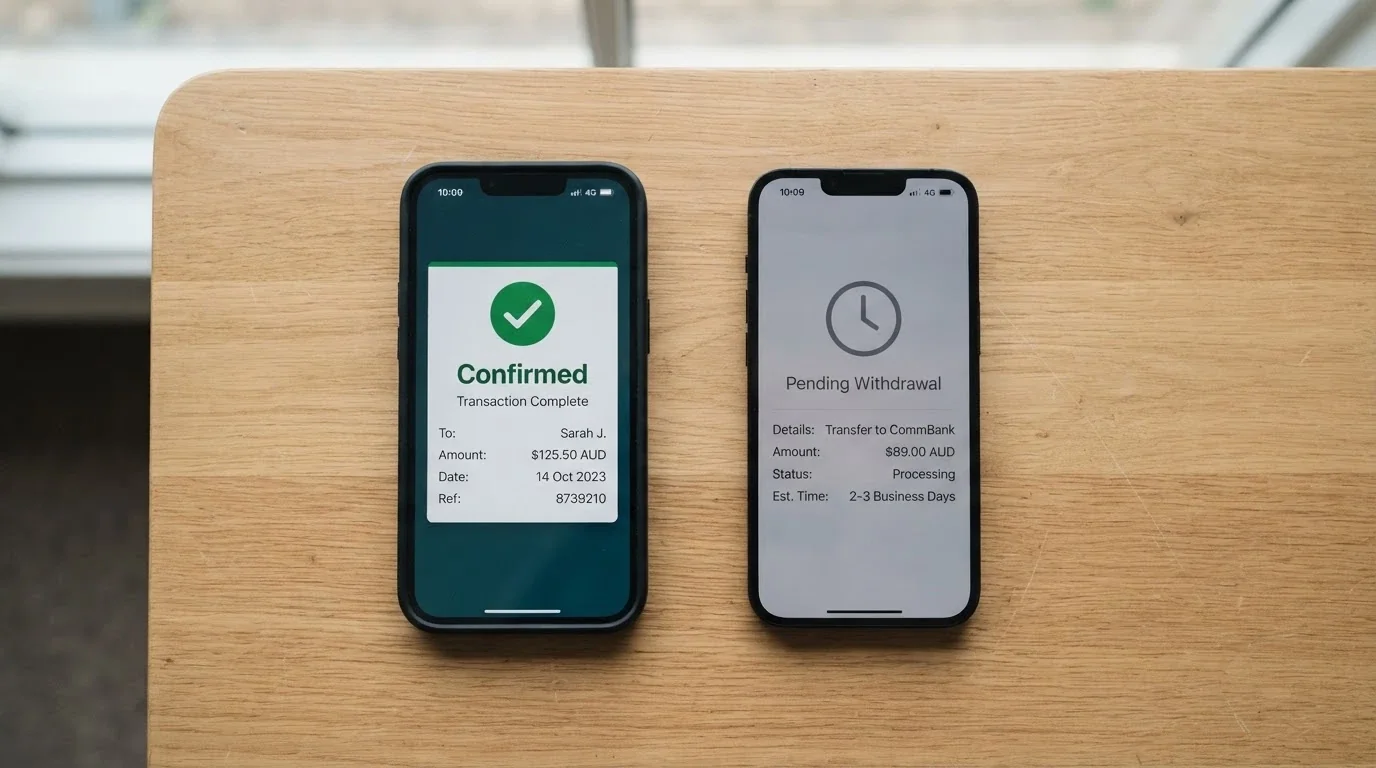
PayID is the dominant AU-facing deposit method in these offers. PayID is the Australian real-time payments overlay on the New Payments Platform, marketed by most banks as Osko. It links a payment to a mobile number, an email address or an ABN, and clears in seconds. The speed is the marketing point: a PayID deposit at an offshore casino clears in the time it takes to authorise a payment, where a bank transfer or BPAY deposit can take a working day or longer. PayID’s convenience for the player is real. Its presence is a reflection of how the offshore segment has built its payment stack around the routes Australian players actually use.
The legal deposit routes for licensed Australian wagering — debit card, bank transfer, PayID/Osko, BPAY — are the same routes an offshore casino accepts, because they are the routes an Australian bank account can actually send money through. The licensed-versus-offshore line is not drawn at the payment method; it is drawn at the operator. A licensed wagering operator using PayID is bound by Australian rules. An offshore casino using PayID is not. From 1 January 2027, banks and payment providers gain express authority to block transactions to illegal gambling operators — a payment-blocking power the ACMA has sought for several years and which the IGA reform grants. The implication for a player funding an offshore casino from an Australian bank account is that the funding route is becoming more closely policed on the bank side. Whether a particular bank exercises the new power on a particular transaction is a question that will resolve over the early months of 2026.
The $100 deposit threshold — why that number keeps showing up
The $100 figure in these offers is both bonus value and deposit floor. A “100% match up to $100” offer means the casino matches the first $100 of the player’s deposit — a one-hundred-dollar deposit generates a one-hundred-dollar bonus, and the maximum bonus is reached at the $100 threshold. A “$100 bonus on a $20 minimum deposit” means the player can claim the bonus by depositing at least $20, and the $100 figure is the maximum bonus they can receive, not the deposit required to receive it. The two constructions share the number $100 but attach it to different sides of the deal.
The deposit threshold is the marketing’s leverage point. A player who sees a $100 bonus headline and a $20 minimum deposit is being invited to deposit $20 and claim a $100 bonus — a 5x return on the deposit. The leverage is the gap between the deposit required and the bonus received. The gap is real. The bonus is real. The terms behind the bonus — wagering multiple, eligible games, max cashout — are the part the headline undersells.
Getting your money back — payout reality at offshore casinos
Withdrawal speed at offshore casinos is where the marketing’s promise meets the operator’s practice. A deposit via PayID clears in seconds; a withdrawal via the same route, or via bank transfer, can clear in hours or in days, depending on the operator. The bottleneck is rarely the payment rail. It is the casino’s KYC procedure — the verification step the operator runs before processing a withdrawal, which can include identity documents, address documents, payment-method proof, and source-of-funds checks for larger withdrawals. KYC is a regulatory feature of the licensed Australian wagering segment and a commercial risk-management feature at offshore casinos. Either way, it slows withdrawals.
The player who stalls on a withdrawal at an offshore casino has no Australian regulator to escalate to. The ACMA does not handle consumer complaints about offshore operators; the operator’s licensing jurisdiction handles them, and the operator’s licensing jurisdiction is outside Australia. The Australian Consumer Law does not reach an offshore operator in any practical sense. The player’s recourse is the casino’s own internal dispute process, the licensing authority in the operator’s jurisdiction, and — for the largest complaints — a public dispute on player forums, which is a reputational pressure rather than a legal remedy.
The ACMA’s blocking record, detailed in the enforcement section below, is the operational evidence of what offshore status costs. A site can be blocked while a player has an active balance on it. The block is implemented at the ISP and DNS level: the site becomes unreachable through Australian internet connections. The block does not void the player’s balance on the operator’s servers. It does, however, make it harder for the player to log in, request a withdrawal, or communicate with the operator’s support — depending on whether the operator keeps alternative access routes open for existing customers. A player who reaches a $100 no-deposit bonus offer, plays it through, accumulates a balance and then sees the site blocked is in a difficult position: the money is on the operator’s books, the operator’s site is unreachable, and the operator has no Australian obligation to release it. The outcome depends on the operator’s discretion.
The Law Every $100 Bonus Guide Leaves Out
The Interactive Gambling Act 2001 is the law that defines what an Australian can and cannot reach in this market. Most competing pages do not mention it. The pages that do mention it usually paraphrase it as “online gambling is illegal in Australia” — a shorthand that misses the structure of the prohibition and the gap between the prohibition and the player’s situation.
The Interactive Gambling Act — what it actually prohibits
The Interactive Gambling Act 2001 prohibits the provision of three categories of gambling service to a person physically in Australia. The first is online casino games. The second is online pokies — slot-machine-style games operated over the internet. The third is in-play sports betting — wagering on a sporting event after it has begun. The Act does not prohibit wagering on a sporting event placed before the event begins; it does not prohibit lotteries or keno; it does not prohibit any form of land-based gambling. The prohibited categories are specific, and the structure of the prohibition is what shapes the market the reader is searching within.
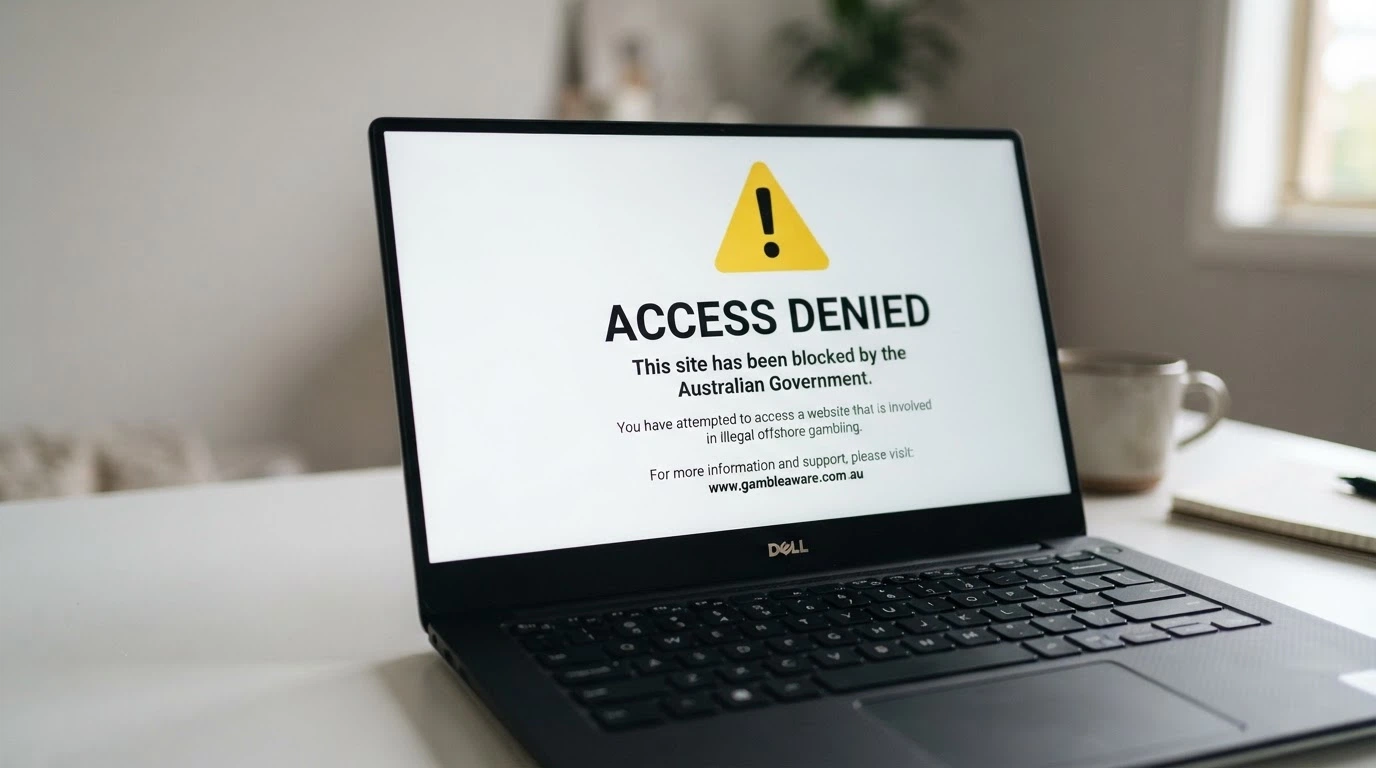
The Interactive Gambling Amendment Act 2017 strengthened the framework and gave the Australian Communications and Media Authority its enforcement powers. The amendment closed offshore loopholes that had allowed providers to route around the prohibition, gave the ACMA the power to issue formal warnings and civil penalty proceedings, and authorised the ACMA to direct Australian ISPs to block illegal gambling websites. The 2017 amendment is the reason the ACMA can act on an offshore casino without going to court for each block. The mechanism is administrative and routine; it does not require the cooperation of the operator or the operator’s home jurisdiction.
The Interactive Gambling Amendment (Gambling Reform) Bill 2026 passed Parliament on 19 August 2026, and its measures commence 1 January 2027. The reform does not legalise online casino. It tightens the framework around what is already licensed and tightens the ring around what is not. The key measures are: a maximum of three wagering advertisements per hour between 6:00 am and 8:30 pm; a live-sport blackout on wagering advertising from fifteen minutes before a live sporting event until five minutes after it ends; an outright ban on broadcasting sporting odds; restrictions on online wagering advertising to logged-in, age-verified users only; a ban on wagering advertising inside sports venues and on player and official uniforms; a bar on radio wagering advertising during school drop-off and pick-up times; a ban on athletes, celebrities and influencers promoting wagering products; and a series of inducement marketing prohibitions. The inducement prohibitions are the most directly relevant to offshore marketing: from 1 January 2027, direct marketing of inducements is prohibited for fourteen days after a customer signs up with a licensed operator, for three months after a person deregisters from BetStop, and indefinitely for customers identified as at risk of gambling-related harm. The reform does not change the status of offshore casinos — they remain prohibited — but it changes the inducement environment the licensed market can offer and tightens the gap between the licensed and unlicensed segments.
Offshore operators vs licensed Australian wagering — the gap in one table
| Protection | Licensed AU Wagering | Offshore Casino (AU-facing) |
|---|---|---|
| Regulator oversight | Northern Territory Racing and Wagering Commission / state/territory regulators; ACMA | Regulator in operator’s home jurisdiction; none in Australia |
| Consumer-law protection | Australian Consumer Law applies; ACCC and state fair-trading bodies | Australian Consumer Law not practically enforceable; disputes resolved in operator’s jurisdiction |
| BetStop coverage | Yes — self-exclusion applies across all licensed services | No — offshore casino is not connected to BetStop |
| Payment protections | Credit cards and crypto banned; legal routes are debit card, bank transfer, PayID/Osko, BPAY; transaction-blocking from 1 January 2027 | Operator’s own terms; credit cards and crypto often accepted; no Australian payment-rule enforcement |
| Dispute resolution | Internal dispute process then external adjudicator (e.g. state/territory gambling regulator) | Internal dispute process only; jurisdiction is offshore |
| Advertising rules | Hourly ad caps, live-sport blackout, logged-in age-verified online ads, athlete/celebrity ban (from 1 January 2027) | Not subject to Australian advertising rules; subject to rules in operator’s jurisdiction |
The gap between the two columns is not a matter of degree. It is a matter of jurisdiction. The licensed wagering side is governed by Australian law and reachable by Australian regulators and dispute bodies. The offshore casino side is governed by the law of whatever jurisdiction issued the operator’s licence, and is not reachable by Australian regulators or dispute bodies. The protections the player takes for granted at a licensed operator do not exist at an offshore casino. Some operators run internal dispute processes that resolve complaints fairly; some do not. The reader cannot tell in advance which category the operator they choose falls into, and that uncertainty is part of the cost of choosing an offshore casino.
ACMA enforcement — site blocking, withdrawals and the 2026 reform timeline
The ACMA’s enforcement toolkit has three working parts. The first is formal warnings: a regulator-to-operator letter flagging a breach and inviting compliance. The second is civil penalty proceedings: regulator-initiated court action that can result in fines against an operator that does not comply. The third is site-blocking orders: an instruction to Australian ISPs to block access to a specific illegal gambling website at the DNS level. Since November 2019, the ACMA has had 1,564 illegal gambling and affiliate websites blocked under that power, with the figure current as of March 2026. More than 225 illegal services have withdrawn from the Australian market entirely since 2017, choosing to leave rather than continue to operate against an enforcement environment that has tightened year on year.
The mechanism is well-tested but has limits. The ACMA can block a site, but it cannot compel an offshore operator to refund a player balance. The ACMA can issue warnings, but it cannot reach an operator in a jurisdiction that does not cooperate with Australian enforcement. The ACMA can direct ISPs to block, but it cannot prevent an operator from registering a new domain and reappearing under a new URL. The 1,564 sites the ACMA has blocked since 2019 is the evidence of consistent enforcement, and the rotation behaviour of the segment is the evidence of the limits of that enforcement. A player who reaches an offshore casino today may be reaching a site the ACMA has not yet acted against, a site the ACMA has blocked but which has rotated to a new domain, or a site the ACMA has decided not to pursue.
The bank-side transaction-blocking power that takes effect from 1 January 2027 is the next enforcement front. The reform gives Australian banks and payment providers express authority to block transactions to illegal gambling operators — closing the funding route that the current enforcement regime has left open. The IGA already prohibits the operator from accepting Australian customers; the reform prohibits the bank from facilitating the operator’s acceptance. For a player funding an offshore casino account from an Australian bank, the practical implication is that the deposit may be declined by the bank on the basis that the destination is an illegal gambling operator. The mechanism is new; the thresholds for action will be set by individual banks in their own fraud and compliance policies; and the segment will adapt.
The presence of the credit-card and crypto ban for licensed wagering — in force since 11 June 2024, with penalties of up to $247,500 for non-compliance by licensed operators — is a useful tell for a player evaluating an offer. An Australian who is asked for a credit card or a crypto deposit by a gambling site is being served by someone outside the Australian rules. The payment method is itself a tell.
Staying in Control When the Safety Net Doesn’t Reach Offshore
Australia’s harm-minimisation infrastructure is among the most developed in the world. BetStop, the National Self-Exclusion Register, has been live since August 2023. The National Gambling Helpline — 1800 858 858 — operates free, confidential and 24/7. The prevalence data is unflinching: about 2.1% of Australian adults — roughly 430,000 people — experience problem gambling, and the Australian Institute of Health and Welfare put high-risk gambling at 1.8% in 2022. The infrastructure exists because the prevalence is real. The infrastructure has a hard limit: it does not bind offshore casinos.
Deposit limits and session tools — what offshore casinos offer vs what you need
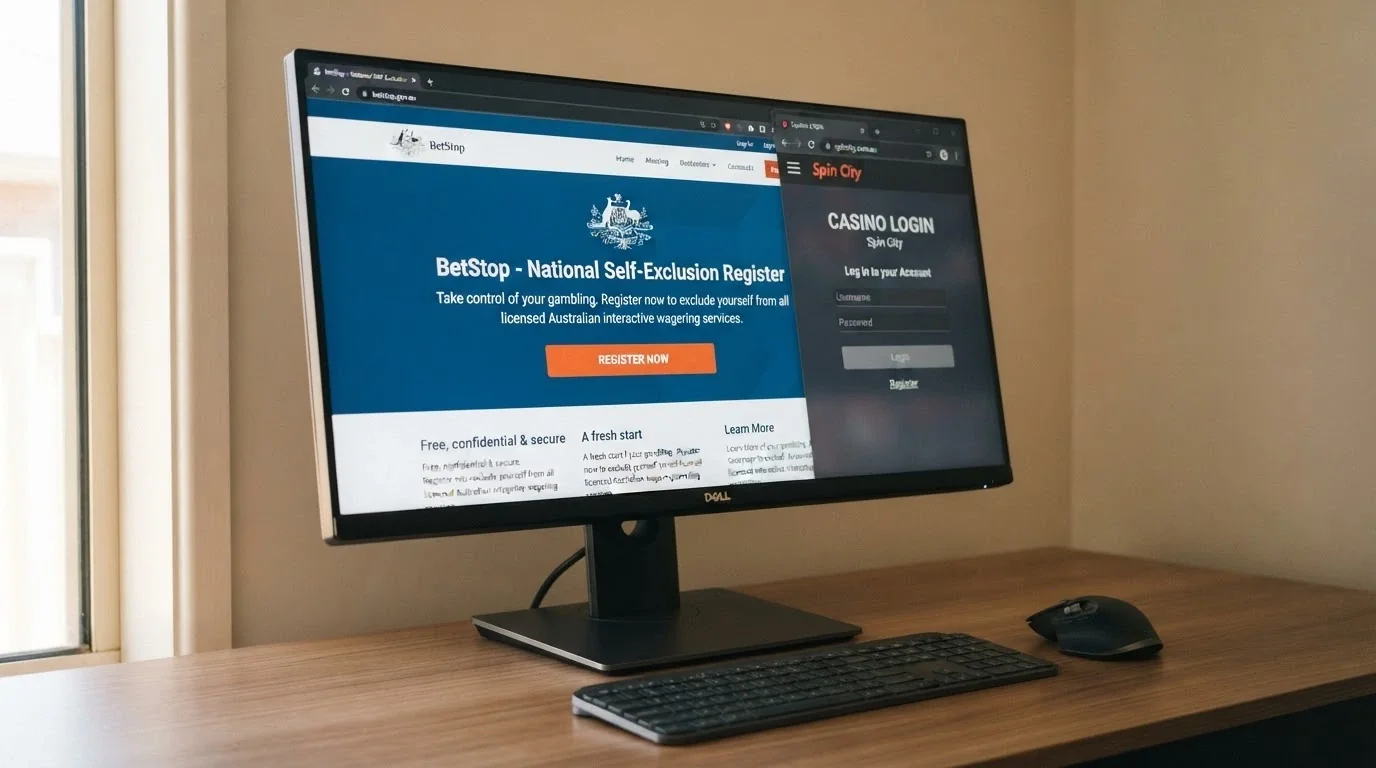
Deposit-limit setting is a standard harm-minimisation tool at licensed Australian wagering operators. A player sets a daily, weekly or monthly deposit cap; the operator enforces it; the cap cannot be raised without a cooling-off period. The mechanic is regulatory at licensed operators: the Australian framework requires it, and the operator’s compliance team is bound by it. At offshore casinos, the same setting usually exists, but its enforcement is the operator’s choice rather than the regulator’s requirement. Some offshore operators enforce deposit limits strictly; others raise them on request without a cooling-off period; others do not offer the feature at all. The reader cannot tell in advance which category an operator falls into, and the absence of a regulator behind the setting means a player who finds their limit ineffective has no escalation path.
Session-time and loss-limit tools follow the same pattern. Reality-check prompts — a pop-up the player sees every thirty minutes reminding them how long they have been playing — are a feature of the licensed segment’s product design and a discretionary feature at offshore casinos. The player’s recourse if an offshore casino does not offer a tool is to leave the casino, which is also the player’s recourse if the casino does offer the tool but does not enforce it.
Practical steps the player can take unilaterally do not depend on the casino’s cooperation. Bank-side gambling blocks — instructions a player can give their own bank to decline transactions to gambling merchants — are available at most Australian banks. Prepaid-card ceilings — a maximum balance the player loads onto a prepaid card — are a deposit-cap the casino cannot override. Both are crude tools, but they are tools the player controls and the casino does not.
BetStop and self-exclusion — the safety net that stops at the border
BetStop is the National Self-Exclusion Register, run by the ACMA and live since August 2023. As at 31 July 2026, BetStop had 67,480 registrations in three years, of which 41,290 exclusions were still active. The demographics skew young: 78% of registrants were under 40, and 38% chose lifetime exclusion. The numbers reflect a population that has used the register in significant volume, with most exclusions still in force and a substantial share electing to exclude permanently.
BetStop binds Australian-licensed wagering services only. An offshore casino is not connected to the register. A person who has self-excluded through BetStop and then logs in to an offshore casino will not be blocked by the casino, will not be flagged by BetStop, and will not be detected until or unless the casino chooses to verify identities against the register. The casino is not obligated to do so. The offshore casino is not bound by BetStop in any operational sense. The deregistration period from BetStop triggers a three-month inducement-marketing prohibition at licensed wagering operators from 1 January 2027 — a measure that prevents the licensed segment from immediately re-marketing to a person who has chosen to leave — but does not extend the same protection to offshore casinos.
The gap matters because the population most likely to use BetStop is the population most likely to be at risk from an offshore casino. The two facts are linked: a person who has self-excluded at licensed operators has often self-excluded because their gambling has become harmful. If the same person reaches an offshore casino through one of the offers discussed in this guide, the casino does not know they have self-excluded, and the register cannot stop them. The safety net stops at the border.
Where to get help — the numbers that work from Australia
The National Gambling Helpline — 1800 858 858 — is free, confidential and staffed 24 hours a day, 7 days a week, nationwide. Online chat and counselling is available through Gambling Help Online (gamblinghelponline.org.au). State-based services — Gambler’s Help in Victoria, Gambling Help in NSW, Gambling Help Queensland and the equivalent bodies in other jurisdictions — provide face-to-face and phone counselling for people who prefer local support. All of these services work regardless of where the player has been gambling. A player who has been playing at an offshore casino can call the helpline, use the chat service or contact a state-based counsellor and receive the same support a player at a licensed operator would receive. The services do not ask which casino the player has been using; they do not require the player to disclose their gambling activity; they do not report the player to a regulator.
The prevalence data — 2.1% of Australian adults, roughly 430,000 people, with high-risk gambling at 1.8% — is the honest frame for this section. Problem gambling in Australia is not rare. It is not a hypothetical. It affects a substantial population, and the infrastructure built to help that population is substantial in return. The minimum age for all commercial gambling in Australia is 18. A player under 18 should not be playing at any operator, offshore or licensed; the prohibition is straightforward and the licensed segment enforces it. The offshore segment does not always verify age.
How We Evaluated These $100 No-Deposit Bonus Casinos
The operators in this guide’s table were sourced from the Australian operators shortlist and ranked by AU-facing market share, with revenue figures from the BLASK BRANDS AU dataset. The Australian-legal status of each operator was checked against the Interactive Gambling Act 2001 and ACMA records. Every operator’s status reads as offshore, unlicensed in Australia. The evaluation criteria were four: legal status, market presence, bonus construct and payment accessibility.
Legal status was the most important criterion and the easiest to evaluate. The Interactive Gambling Act 2001 makes online casino prohibited in Australia. There is no Australian licence for online casino, anywhere, at any level of government. The status of every operator in the ranking is therefore the same: offshore, unlicensed in Australia. The criterion is binary. The result is uniform.
Market presence was the criterion that determined ranking order. Market share and AU-facing revenue are the two measures carried; both are drawn from the BLASK BRANDS AU dataset and reflect AU-facing traffic and revenue rather than global figures. The ranking order is informative about where each brand sits in the segment an Australian searcher is reaching. It is not informative about the brand’s quality, its fairness or its player-protection posture.
Bonus construct was the criterion that should have carried the most weight in the comparison, and the criterion that could not be evaluated this run. Per-operator bonus terms — wagering multiples, eligible games, max cashout, bonus validity, KYC requirements, payout times — were not confirmed for any of the ten brands. The bonus-construct column in the comparison table is therefore missing by design: a table with confirmed market share and revenue and unconfirmed bonus terms would be a table that mixes apples with “not confirmed.” The reader evaluating an offer from any of these brands should treat the absence of confirmed terms as a reason to read the operator’s own bonus page before claiming.
Payment accessibility was the criterion the segment norms determine. PayID, debit card, bank transfer and BPAY are the routes an Australian bank account can fund; the offshore segment accepts all four with varying friction. Crypto is offered at some operators (Stake notably) and is banned for licensed wagering. The criterion is more about operator practice than regulatory status, and the segment’s practice is broadly consistent across the ranking.
The honest limitation of this guide is the bonus-terms gap. The article identifies where values are qualitative and where they are confirmed. The reader should treat the qualitative sections as orientation — what to look for, what the terms usually say — and the confirmed figures as the page’s load-bearing facts. The legal status is confirmed. The market share is confirmed. The revenue is confirmed. The bonus terms are not. The page is honest about which is which.
Your Move: What to Actually Do With a $100 No-Deposit Bonus Offer
The picture the previous sections have drawn is not ambiguous, and the conclusion follows from it without effort.

Every $100 no-deposit bonus offer an Australian can claim comes from an offshore, unlicensed operator. The Interactive Gambling Act 2001 makes online casino prohibited in Australia, and there is no Australian licence for the product. The bonus the reader is considering is offered by an entity outside Australian regulatory reach, with no obligation under Australian consumer law and no consumer-protection framework an Australian player can invoke. The ACMA’s enforcement record — 1,564 sites blocked since November 2019 — is the evidence that the framework is enforced; the absence of a pathway for the player to recover a balance from a blocked site is the evidence of what offshore status costs.
The bonus terms shrink the face value. A $100 no-deposit bonus is almost universally subject to a high wagering multiple, a low max-cashout cap and an eligible-games list that restricts where the bonus can be deployed. A $100 deposit-match bonus is gated by the player’s own deposit, governed by the same restrictions, and amplifies the cost the player is taking on. The marketing presents the offer. The terms govern it. The terms usually tell a smaller story than the marketing does.
The harm-minimisation infrastructure is real and reachable. The help section’s number — 1800 858 858 — is free, confidential and 24/7. BetStop is live and binding at licensed wagering services. The state-based counselling services are operating. None of this infrastructure binds an offshore casino. The protection that stops at the border is not protection. A player who needs the protection should not cross the border.
The reader’s move, if there is one, is to read the full terms of any offer before claiming it, to set a deposit limit at a level they can afford to lose at an entity with no Australian legal protection, and to know the helpline number before they need it. That number — 1800 858 858 — is the one number from this page worth keeping in a phone.
Frequently Asked Questions
Is a $100 no deposit bonus legal for Australian players?
No — there is no Australian licence for online casino anywhere in the country. Every $100 no-deposit bonus an Australian can claim comes from an offshore operator outside the Interactive Gambling Act 2001. The Act targets the provider, not the player, but the player also has no Australian regulator to complain to and no Australian consumer law that reaches the operator.
Can I withdraw real money from a $100 no deposit bonus in Australia?
In principle, yes — if the operator’s terms are met. In practice, almost every no-deposit bonus carries a wagering multiple on the bonus, an eligible-games list restricting where it can be played, and a maximum-cashout cap on withdrawable winnings. KYC verification is standard before withdrawal. The reader should expect friction.
Does BetStop cover offshore online casinos offering $100 no deposit bonuses?
No. BetStop — the National Self-Exclusion Register — binds Australian-licensed wagering services only. An offshore casino is not connected to the register. A person who has self-excluded through BetStop can still reach an offshore casino through the promotional offers detailed here, and the casino has no obligation to detect or block them.
What happens if an offshore casino refuses to pay out my $100 no deposit bonus winnings?
The player has no Australian regulator to escalate to. The ACMA does not handle consumer disputes; the relevant body is the regulator in the operator’s home jurisdiction, which is not Australia. The recourse is the operator’s internal dispute process, public pressure on player forums, and the offshore licensing authority — none of which is quick or guaranteed.
Are $100 no deposit bonus codes safe to use from Australia?
A code is a distribution token, not a safety signal. The code is irrelevant to whether the bonus it unlocks is safe; what matters is the bonus’s terms — the wagering multiple, the eligible games, the maximum cashout and the KYC procedure on withdrawal. No code from an offshore casino carries the consumer protections a code at a licensed Australian wagering operator would.
Written by the editors at Best Casino Sydney.