
Reading the Highest Payout Casino Claims in Australia
Current as of 22 November 2026 against ACMA’s IGA register and Curaçao Gaming Authority licensing data.

A player typing “highest payout online casino Australia” into a search bar is, on paper, asking a simple question. Which site returns the most? In practice the question forks into three before it gets an answer. There is the theoretical return the games are built to deliver over millions of spins. There is the speed at which a real balance leaves the cashier. And there is the legality of the whole operation, which in Australia is the part nobody wants to read about. The page ahead works through all three.
A central fact sits over the entire topic: online casino is prohibited in Australia under the Interactive Gambling Act 2001. Every operator an Australian player can actually load in a browser sits outside Australian law. The list you can build in an afternoon consists entirely of offshore brands, mostly Curaçao-licensed, all of them offering a product the federal regulator is actively trying to block. The IGA targets the provider, not the player, which is why the search returns ten casino-review sites and zero regulatory warnings. The legal reality is the first thing that earns a place in this conversation, not the last.
The page that follows ranks ten offshore casinos by what they actually deliver on the payout question — RTP coverage, withdrawal speed, the bonus terms that decide what a welcome offer is really worth — and explains the RTP arithmetic and the licensing situation well enough that you can read any future casino advertisement with a sharper eye. The decision to use any of them is the player’s own. The information gap is what this page closes.
Table of Contents
- What “Highest Payout” Actually Means at an Online Casino in 2026
- Why Your 2026 Casino’s Payout Percentage Is Smaller Than the Advertised Number
- Which Casino Games Give You the Best Shot at a High Payout
- The Highest-RTP Pokies Australian Players Can Actually Access in 2026
- Getting Your Money Out: Why Withdrawal Speed Matters as Much as RTP
- 10 Offshore Casinos Australian Players Use — Ranked by Payout Value in 2026
- The Law Australian Casino Sites Operate Outside Of
- Staying Safe While Playing: Responsible Gambling Tools and Their Limits
- How to Pick a High-Payout Casino You Will Not Regret
- How We Evaluated These Casinos
- What the Highest-Payout Casino Search Actually Tells You About Playing From Australia
- Frequently Asked Questions About High-Payout Casinos in Australia
What “Highest Payout” Actually Means at an Online Casino in 2026
“Payout” is a word the industry has spent a decade stretching. In its honest sense it means the share of money wagered that a game returns to players over the long run, the figure statisticians call return to player or RTP. In its commercial sense it means the speed at which a casino releases your winnings once you ask for them. In its marketing sense it means whatever the affiliate page ranking it wants to rank highest has decided it should mean.
A useful page on the subject separates the three. The numbers worth comparing are RTP and withdrawal speed. Both are measurable. Both can be verified. Both are routinely inflated in copy that does not bother with the difference. Where this page writes “payout percentage” it means RTP. Where it writes “payout speed” it means withdrawal time. Where it writes “highest payout” without further qualification, it means the operator offering the strongest combination of the two — high-RTP games plus fast, reliable withdrawals — relative to the rest of the set.
The Australian market has a structural feature that bends every ranking written about it. There is no Australian online casino licence. The Interactive Gambling Act 2001 prohibits the provision of online casino games to people in Australia. None of the operators reviewed on this page is licensed in Australia; none could be. They are licensed elsewhere — most commonly in Curaçao — and they accept Australian players because Australia’s prohibition is enforced against the provider, not the player. ACMA has had 1,564 illegal gambling and affiliate websites blocked by Australian ISPs since November 2019, and more than 225 illegal services have withdrawn from the Australian market since 2017, which gives a sense of the practical enforcement environment but not of its completeness.
What this means for a player choosing between sites is that every comparison on the page is a comparison of unregulated products offered to Australians from overseas. The ranking below does not endorse any of them as safe or licensed. It ranks them on payout-relevant criteria — RTP coverage, withdrawal speed, bonus value — and leaves the legal, financial and personal calculation to you. That is the only honest framing for a market the law itself does not recognise.
Why Your 2026 Casino’s Payout Percentage Is Smaller Than the Advertised Number
The number an affiliate site prints next to a pokie is rarely the number the casino is actually running. A 96.5% RTP advertised on a review page can be 87% in practice, with no visual difference between the two games. This is the single most consequential gap between marketing and reality on the entire page, and the section that follows explains how it opens.

Return to player is a long-run statistical average. A 96% pokie does not pay back A$0.96 of every A$1 on every spin. It pays back that share averaged over millions of spins across thousands of players. On any single session, the actual return can swing from positive to deeply negative. The figure describes the house’s statistical edge, not your evening’s outcome. House edge is simply the other side of the same coin: a 96% RTP game carries a 4% house edge. Blackjack, played with perfect strategy, reaches 99.5% RTP — a house edge of half a percent. Most pokies sit somewhere between 94% and 97%, which is why the difference between “highest payout” pokies and ordinary ones is measured in single-digit percentage points that nonetheless compound session by session.
How RTP Is Calculated and Certified
RTP is derived during the game’s mathematical certification process by an independent testing laboratory — iTech Labs, eCOGRA or BMM Testlabs are the names that recur in this space — before the game is ever released to an operator. The lab runs millions of simulated spins through the game’s random number generator, records the payouts, and arrives at the figure the provider then advertises. The certification is real, the methodology is rigorous, and the published percentage is a meaningful number.
It is also a number the lab certifies for a specific configuration. The same game can ship with several.
The RTP Configuration Trap: Same Game, Different Return
Game providers typically develop pokies with multiple RTP configurations. The casino chooses which configuration to deploy. Pragmatic Play’s Sweet Bonanza, a popular title across the offshore sites Australian players use, ships with at least four: 96.48%, 95.45%, 94.09% and 87.00%. The player sees identical graphics, identical reels, identical bonus rounds. The only difference is the percentage of every wager the game returns — and that difference can be nine percentage points. Over a session, nine points is the entire margin between a casino’s theoretical profit and the player’s.
Most modern pokies carry this feature. Gates of Olympus runs at 96.50% in its default setting but can drop lower at the casino’s election. Starburst’s default of 96.09% has variants at roughly 94.05% and 92.01%. Book of Dead sits at 96.21% but can be configured to 94.25%. Rise of Olympus 1000 has a best-case 96.24% — and a worst case as low as 84.24%, an effective doubling of the house edge. The player has no way to see which version is loaded without checking the in-game information screen or paytable, and most players never look.
The fix is mechanical and fast. Open any pokie, find the information or help menu, scroll to the RTP line, compare it against the figure the review site advertised. If the casino is running the lowest configuration, the choice is yours: load a different title or move to a different site. No casino is required to run the highest configuration. The certification only proves the configuration you are playing was mathematically tested. It does not prove the casino chose the kindest one.
House Edge: What the Casino Keeps on Every Dollar You Wager
House edge is RTP inverted. A 96% game keeps 4% of every dollar wagered, on average, across enough spins that the variance flattens out. A 99.5% blackjack hand keeps 0.5%. Across a session of 1,000 spins at A$1 each on a 96% pokie, the expected loss is A$40 — meaning the house keeps A$40 of every A$1,000 staked across the population of players. Across a session of 1,000 blackjack hands at A$10 each on a 99.5% table, the expected loss is A$50, in absolute terms higher but on a per-dollar basis almost an order of magnitude smaller.
The reason table games dominate the top of the return curve is that their rules are constrained in ways pokies are not. Blackjack pays 3:2 on a natural, the dealer stands on 17, doubling down and splitting are available — and the optimal strategy is known. Baccarat offers a banker bet that returns 98.94% with no decision-making at all. These are mechanical edges, not luck-based ones. Pokies rely on a random number generator the player cannot predict or influence. Blackjack hands can be played with perfect information.
A worked example makes the calculation concrete. Skycrown’s welcome offer, taken at its A$8,000 maximum, requires 40x wagering — A$320,000 of play before the bonus and any winnings can be withdrawn. Assuming only the bonus amount is wagered and a representative 96% RTP on the games eligible for the bonus, the player’s expected loss across that required turnover works out to roughly A$12,800. That is the bonus’s statistical cost: the player is staking A$320,000 to chase an A$8,000 credit, and the house edge takes A$12,800 of it on average. Some sessions come in ahead. The population as a whole pays A$12,800 per A$8,000 bonus claimed. No marketing copy mentions this number.
The same arithmetic works in reverse for any welcome offer. A 30x wagering requirement on an AU$500 bonus at WinSpirit is A$15,000 of required play, around A$600 of expected loss at 96% RTP, against a bonus worth AU$500. The bonus’s expected value, ignoring everything else, is slightly negative. The headline rate of “free money” survives only because the multiplier and the percentage are never multiplied together on the same page of the brochure.
Which Casino Games Give You the Best Shot at a High Payout
The hierarchy is mechanical, not subjective. Blackjack and baccarat sit at the top. Video poker, when played with optimal strategy, is close behind. Pokies span the range, from the 99% of Mega Joker’s Supermeter mode down to the 87% that the lowest configuration of Sweet Bonanza can run. Live dealer games typically match the RNG versions of the same titles on RTP. The graphics change; the math does not.
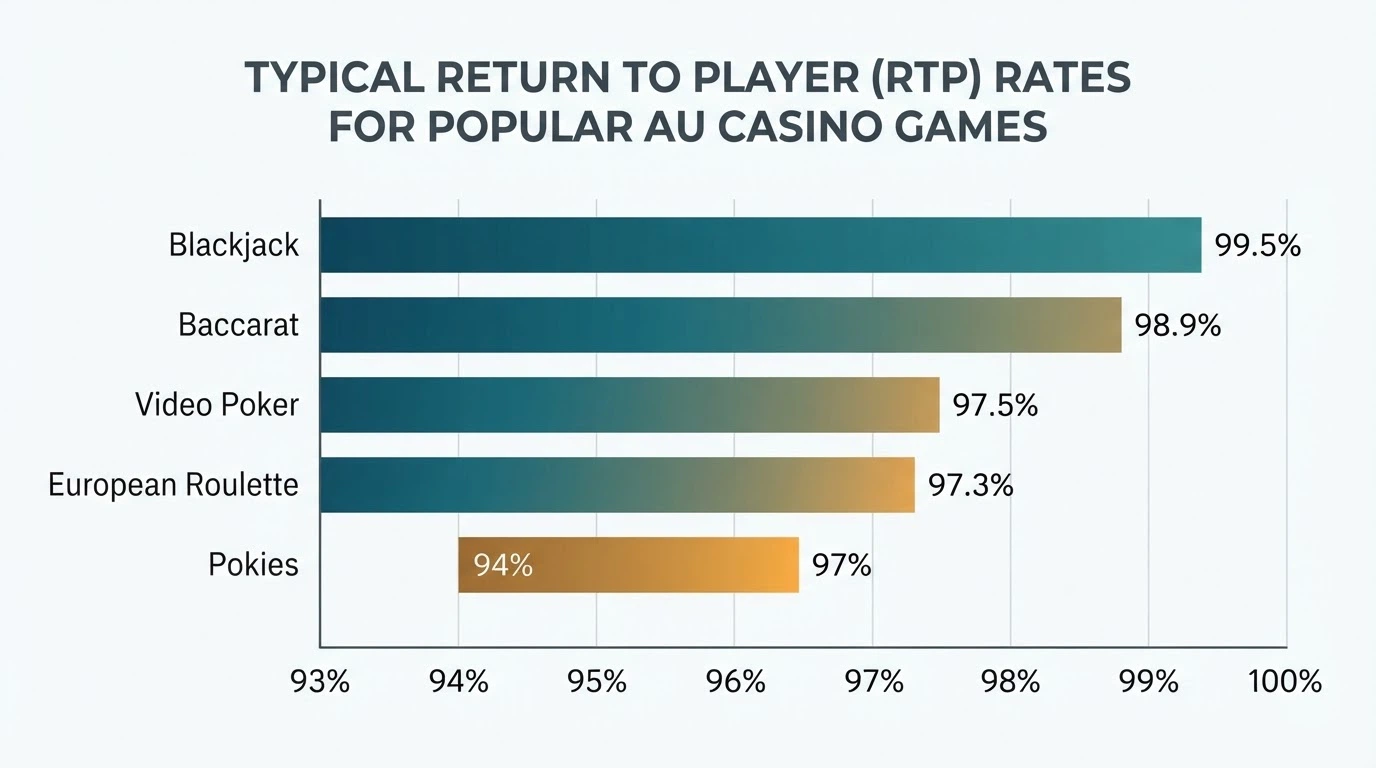
A player who wants the highest theoretical return and is content to learn basic strategy should be playing blackjack or baccarat, not pokies. A player who wants pokies should at least know which ones return the most and which version of them the casino is running. The market pushes most players toward pokies — they are louder, faster, easier to start — which is part of why the casino industry is built around them.
Table Games: Blackjack, Baccarat and the 99%+ Return Club
Blackjack, played with perfect basic strategy, reaches 99.5% RTP — a house edge of half a percent on every dollar wagered. The rules matter: the dealer must stand on all 17s, blackjack must pay 3:2 rather than 6:5, doubling down after splitting must be allowed. A blackjack variant that pays 6:5 instead of 3:2 on a natural adds 1.4% to the house edge in a single rule change, dropping RTP from 99.5% to 98.1% without any visible difference at the table.
Baccarat offers three bets. The banker bet returns 98.94% — the highest of the three and one of the highest returns in any casino game. The player bet returns 98.76%. The tie bet, despite paying 8:1 or 9:1, returns under 86% and is the worst regular wager on the floor. There is no strategy to learn; the decision is the bet. Most serious baccarat players stake the banker bet and never deviate.
Roulette sits a step below. European roulette, with its single zero, returns 97.3%. American roulette, with the additional double zero, returns 94.7% — the same range as a middling pokie. Live dealer versions of all three games typically run the same RTP as their RNG counterparts. The live format adds a human element and slows the play; it does not change the underlying mathematics.
The trade-off, for most players, is entertainment. A session of blackjack at A$10 a hand produces a small number of decisions per minute and a low-variance experience. A session of pokies produces hundreds of outcomes per minute and a session that can swing wildly in either direction. The expected return is higher at the table. The session feels flatter. Players who value the experience over the mathematics pick pokies. Players who value the mathematics over the experience pick blackjack. There is no objectively correct choice, only the honest trade-off.
The Highest-RTP Pokies Australian Players Can Actually Access in 2026
The pokie library at a typical offshore casino runs into the thousands. Sorting them by theoretical return narrows the field fast. The table below lists the ten highest-RTP pokies a player at an Australian-accessible offshore casino is most likely to find, drawn from the public RTP data on provider and review sites. Volatility and max win are listed where the data is solid; an em dash marks where it is not.

| Pokie Title | RTP | Provider | Volatility | Max Win |
|---|---|---|---|---|
| Mega Joker | 99.00% (Supermeter max) | NetEnt | — | — |
| Book of 99 | 99.00% | Relax Gaming | High | 12,075x |
| 1429 Uncharted Seas | 98.60% | Thunderkick | Low | 670x |
| Blood Suckers | 98.00% | NetEnt | Low | — |
| White Rabbit Megaways | 97.72% | Big Time Gaming | High | 13,029x |
| Big Bass Bonanza | 96.71% | Pragmatic Play | Medium-High | 2,100x |
| Gates of Olympus | 96.50% | Pragmatic Play | High | 5,000x |
| Sweet Bonanza | 96.48% | Pragmatic Play | High | — |
| Rise of Olympus 1000 | 96.24% | Play’n GO | — | 60,000x |
| Book of Dead | 96.21% | Play’n GO | — | — |
Mega Joker’s 99.00% applies to its Supermeter mode only; base play returns between 76.9% and 85.1%. Book of 99, which is purpose-built around its 99% return, is a more honest 99% in standard play but carries high volatility, meaning long dry stretches between wins and a 12,075x ceiling on what a lucky spin can produce. Blood Suckers, at 98% with low volatility, is the favourite pokie among bonus-wagering grinders because its hit frequency above 35% returns enough small wins to keep a session moving while bonus requirements tick down.
These figures are the highest published RTP for each title. A casino running the lowest configuration of any of them drops the percentage by several points with no visible change to the player.
Why RTP Alone Does Not Tell the Full Story: Volatility, Hit Frequency and Max Win
Two pokies with identical 97% RTP can play like entirely different games. Volatility — sometimes called variance — describes the size and frequency of payouts. A low-volatility pokie returns small wins often. A high-volatility pokie returns large wins rarely. The total return, over enough spins, lands at 97% either way. The lived experience is not even close.
Blood Suckers and Book of 99 are the textbook case. Both return close to 99%. Blood Suckers does so with low volatility and a hit frequency above 35% — small wins drip back almost continuously, which is why it is the pokie bonus-wagering grinders load when they need to clear a 40x requirement. Book of 99 does so with high volatility — most spins lose, and the return is delivered through occasional large wins from a 12,075x maximum. The same RTP, the opposite experience. A player on a small bankroll who loads Book of 99 is more likely to bust out before any of those large wins arrive. A player on the same bankroll who loads Blood Suckers will probably grind through it intact.
Hit frequency measures how often a spin produces any payout at all, regardless of size. Max win is the upper bound on a single spin’s payout as a multiple of the stake — a 60,000x max on Rise of Olympus 1000 means a A$1 spin can theoretically return A$60,000. That ceiling matters because it defines the upside of the high-volatility games. A high-RTP pokie with a low max win is unlikely to produce a session-defining payout even at its best. A high-RTP pokie with a six-figure max is the one that occasionally makes a player famous for a week.
For most Australian players, the practical reading is straightforward. Match the pokie to the goal. Bonus clearing: low volatility, high hit frequency. Session on a small bankroll: low to medium volatility. Hunting a life-changing spin: high volatility, with the bankroll to absorb the dry stretches between wins. RTP is necessary information. It is not sufficient.
Getting Your Money Out: Why Withdrawal Speed Matters as Much as RTP
A 99% RTP is worthless if the winnings sit in pending for a week. A player who takes A$10,000 out of a 99% pokie and waits seven business days for the bank transfer has, in any practical sense, lost the time value of that money. The “highest payout” question, answered honestly, is two questions: how much the games return, and how quickly the cashier returns what the games win.
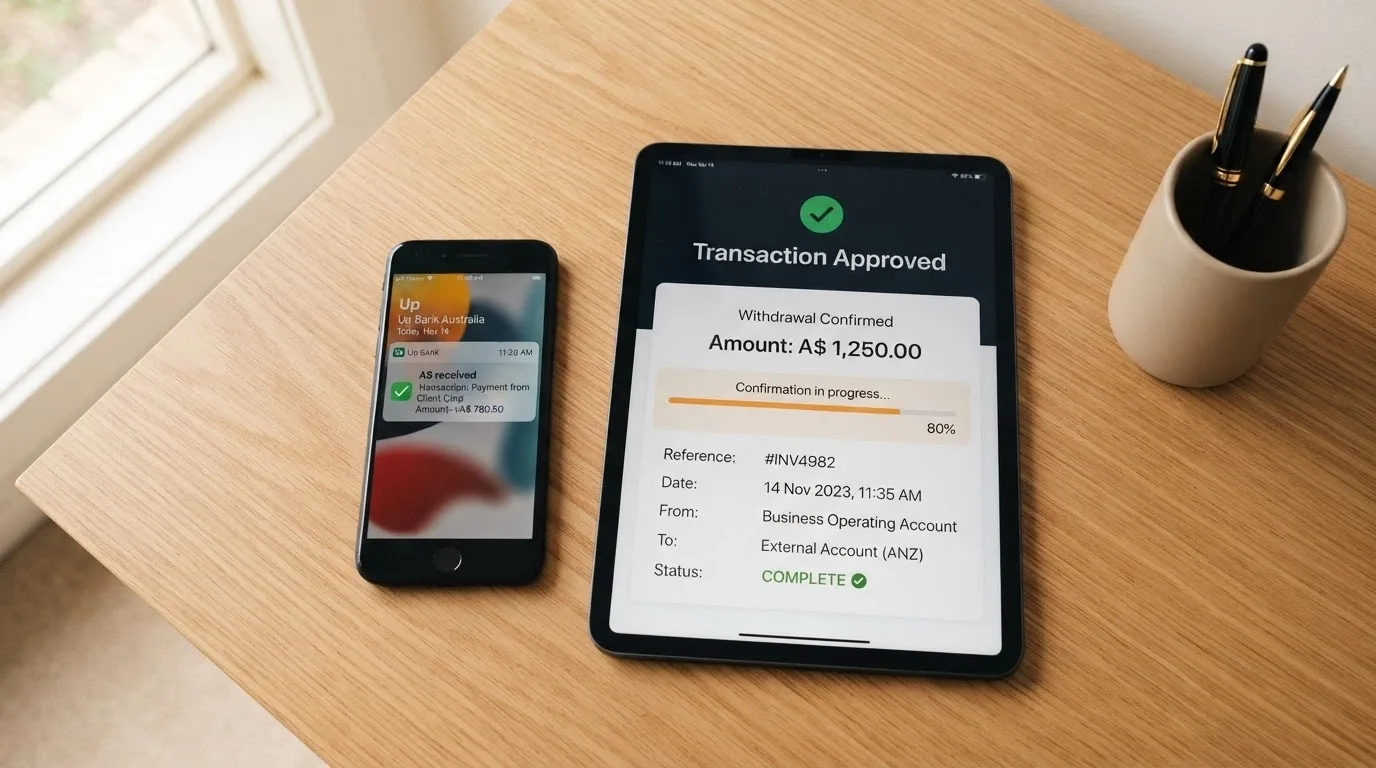
Withdrawal speed in the offshore casino market varies from minutes to a week. The fastest methods — PayID and certain cryptocurrencies — can land in under an hour once the casino approves the request. The slowest — debit cards and bank transfers — run one to five business days on top of whatever the casino’s own processing window adds. The gap between the two is the difference between a casino that respects your balance and one that holds it as a hostage while you decide whether to play it back.
Fastest Withdrawal Methods for Australian Players
The table below ranks the standard methods available at most offshore casinos serving Australian customers. Times assume the casino has already approved the withdrawal; the approval window is a separate delay and varies by operator.
| Method | Typical Time Once Approved | Notes |
|---|---|---|
| PayID (NPP) | 10–60 minutes | Runs on Australia’s New Payments Platform; near-instant once approved |
| USDT (TRC20) / Solana | Under 5 minutes | Network-dependent; near-instant once broadcast |
| Ethereum / Litecoin | 5–30 minutes | Network congestion can extend times |
| Bitcoin | 30–60+ minutes | Slowest major crypto; chain congestion can delay further |
| E-wallets (Skrill, Neteller, MiFinity) | 1–6 hours | Common at offshore casinos; some operators exclude e-wallet deposits from bonuses |
| Debit card | 1–3 business days | Subject to issuer processing; weekends push times further |
| Bank transfer | 3–5 business days | Slowest standard method; survives most casino-side restrictions |
Crypto and PayID are the fastest methods available to Australian players at offshore casinos; the best instant-withdrawal operators process both inside an hour. USDT on the TRC20 network and Solana settle fastest among the cryptocurrencies. Bitcoin is the slowest major coin — chain congestion has pushed individual confirmations past an hour on busy days.
E-wallets sit in the middle: reliable, supported by most operators, slower than crypto. Debit cards and bank transfers trail the field. Bank transfers remain useful when no faster method is supported, but they cost the player two to five business days the casino will not refund.
Withdrawal Limits, KYC and the Fine Print That Delays Your Cashout
A casino can process a withdrawal in ten minutes and still hold the funds for a week. The approval window and the funds-arrival window are two separate delays, and the fine print defines both. Most offshore casinos serving Australia impose weekly and monthly caps. Skycrown, for example, caps withdrawals at A$7,500 per week and A$45,000 per month — generous against the average pokie balance, restrictive against the rare A$100,000 month. Other operators impose tighter caps or none at all.
KYC — Know Your Customer — is the second source of delay. The casino’s first duty on a withdrawal is to verify identity: driver licence, passport, proof of address, sometimes the source of funds. A first withdrawal can take several days while the verification team works through the documents. Subsequent withdrawals usually process faster, but any change in payment method or unusually large sum can trigger a fresh review. Players who complete KYC at deposit time, when the option is offered, save themselves the wait.
Crypto carries its own friction. Network fees are typically modest — between A$0.02 and A$5 per transaction — but they exist, and they accumulate across multiple small withdrawals. The casino may also require a minimum withdrawal to cover its own processing cost. A$100 is a common floor; anything below is returned to the balance.
The fine print that matters most is rarely the headline withdrawal time. It is the cap, the KYC trigger thresholds, the list of excluded payment methods for bonuses, and the conditions under which the casino reserves the right to “review” a withdrawal into a second or third week. None of these are reasons to skip a casino. All of them are reasons to know what you have agreed to before the withdrawal request lands.
10 Offshore Casinos Australian Players Use — Ranked by Payout Value in 2026
The casino landscape accessible to Australian players is structurally uniform: every brand is offshore, every licence sits outside Australia, every product sits in the legal grey zone the IGA defines. The differences are in execution. Some operators run hundreds of providers, some run one. Some process withdrawals in ten minutes, some take days. Some impose a 30x wagering requirement, some a 40x. The ranking below is by payout value — the combination of RTP game availability, withdrawal speed, bonus economics and provider breadth — within that constrained universe.

How These Operators Are Compared
The table below ranks the ten operators reviewed in this section by the criteria that matter for payout value. Cells are populated where independent data exists; an em dash marks cells where the operator has not published terms or where third-party verification is incomplete. The columns are: the licence held, the game providers whose content is available, the headline welcome offer, the free-spins component and the wagering requirement.
| Casino | Licence | Game Providers | Welcome Bonus | Free Spins | Wagering |
|---|---|---|---|---|---|
| Skycrown | Curacao eGaming | Pragmatic Play, Play’n GO, IGTech, 100+ | 450% up to A$8,000 (4 deposits) | 400 FS | 40x deposit; 40x FS |
| Rocket Play | Curacao eGaming | BGaming, Pragmatic Play, 100+ | 100% up to A$1,000 (1st); 200% up to A$1,000 (2nd) | 100 FS on Aztec Magic | 40x bonus + FS |
| Royal Reels | Curacao eGaming | — | — | — | — |
| WinSpirit | Curacao eGaming | Betsoft, Pragmatic Play, BGaming | 100% up to AU$500 | 50 FS | 30x bonus |
| Stake | Curacao eGaming | Pragmatic Play, Hacksaw, Nolimit City | — | — | — |
| Rainbet | Curacao eGaming | — | — | — | — |
| Scream Casino | Curacao eGaming | — | — | — | — |
| Fair Go | Curacao eGaming | RealTime Gaming | 100% up to A$200 × 5 | None | 30x deposit + bonus |
| Bizzo Casino | Curacao eGaming | 70+ studios | Up to A$7,250 + 175 FS (4 deposits) | 175 FS | 40x |
| Rocket Casino | Curacao eGaming | — | — | — | — |
The em-dash cells are not editorial judgement; they reflect that the operator has not published the term in a way third-party reviewers could verify. A blank cell is, in some sense, the most important cell in the table — it is the gap between what the operator claims and what an outsider can confirm.
Skycrown
Skycrown is the largest brand by tracked Australian market share among the operators reviewed here — 8.55% of the tracked market, with A$436.07M in tracked revenue — and it shows in the breadth of its offering. The welcome package combines a 450% deposit match up to A$8,000 across four deposits with 400 free spins on a rotating set of Pragmatic Play titles. The wagering requirement is 40x on both the deposit match and the free-spin winnings, with a 14-day bonus validity and an A$5,000 maximum conversion from bonus funds to cash.
The 40x on a four-deposit bonus is the number worth scrutinising. The Skycrown welcome at its A$8,000 maximum requires A$320,000 of eligible play before the bonus and any associated winnings can be withdrawn. At a representative 96% RTP on the games eligible for wagering, the expected loss across that turnover is roughly A$12,800 — more than the bonus itself. The bonus is, on a population basis, a transaction that costs the player A$4,800 of expected value even when fully cleared. Some sessions come in ahead. The arithmetic does not.
Withdrawal processing at Skycrown averages ten minutes, occasionally stretching to 24 hours during peak periods. The cap is A$7,500 per week and A$45,000 per month, which is generous against typical pokie balances and constraining only at the upper tail. The library runs 100-plus providers, including Pragmatic Play and Play’n GO for the high-RTP pokies.
For a player who values provider breadth and the largest bonus headline, Skycrown delivers on its offer. For a player who values expected return, the 40x wagering and the 14-day window turn the bonus into a cost most players will absorb before they ever see a withdrawal.
Rocket Play
Rocket Play’s welcome package splits across two deposits rather than four: 100% up to A$1,000 on the first deposit plus 100 free spins on BGaming’s Aztec Magic, and 200% up to A$1,000 on the second deposit at a minimum of A$75. The wagering requirement is 40x on both bonus funds and free-spin winnings, with a tight 5-day window — significantly shorter than Skycrown’s 14 days — and an A$7.50 maximum bet per round. The maximum conversion from bonus to cash is A$5,000.
Rocket Play’s Australian market position is the largest in the set: 9.4% market share with A$632.69M in tracked revenue. The provider list runs to 100-plus names, anchored by BGaming, Pragmatic Play and Platipus. Aztec Magic is a steady, medium-volatility pokie, not a high-RTP title, and the free-spin value is moderate as a result.
The 5-day validity is the number to watch. A bonus with 40x wagering and 5 days to clear requires a pace most sessions do not maintain, and the player who runs out of time forfeits the bonus and any winnings tied to it. For a player who can deposit and play immediately, the offer is workable. For anyone taking a measured approach, the validity window does most of the work.
Rocket Play’s payout value sits in its market presence and its provider spread rather than in its bonus economics. The bonus is competitive at the headline; it is unforgiving on the calendar.
Royal Reels
Royal Reels holds a Curaçao eGaming licence and offers its product to Australian players from outside Australia. Beyond the licence and the offshore status, independent verification of the operator’s bonus terms, provider list, or game library is limited. Public-facing information is what exists.
A player considering Royal Reels should treat the absence of third-party data as the most useful fact available. The same Curaçao licence is held by operators with thousands of games and operators with hundreds; the licence itself does not differentiate. Until Royal Reels publishes a full terms page that third-party reviewers can check against, the operator is best approached as an unknown rather than as a comparable to the operators with verified terms elsewhere on this list.
Royal Reels is, in this comparison, the operator a player approaches with the least independent data and the same caution as any other operator that does not publish verifiable terms. The page that documents what it covers and what it does not is more useful to a player than the page that confidently names a bonus the operator has never confirmed.
WinSpirit
WinSpirit’s welcome package is the lowest-wagering offer in the set: 100% up to AU$500 plus 50 free spins, with 30x wagering on the bonus amount and a 30-day validity window. The provider set includes Betsoft, Pragmatic Play and BGaming — solid mainstream studios, though smaller than Skycrown’s or Bizzo’s library.
The 30x wagering is the figure that distinguishes WinSpirit. On a AU$500 bonus, the required turnover is A$15,000 — roughly A$600 of expected loss at 96% RTP — against a bonus worth AU$500. The bonus is still, on a population average, a slightly negative transaction, but it is meaningfully less negative than the 40x offers elsewhere. The 30-day validity gives the player the time to clear the requirement at a comfortable pace rather than the racing-the-clock feel of Rocket Play’s 5-day window.
WinSpirit suits a player who values the lower wagering and the longer validity over absolute bonus size. The trade-off is a smaller library and fewer studios than the larger operators in the set.
Stake
Stake is a high-profile crypto-first platform with a Curaçao eGaming licence and a game library anchored by Pragmatic Play, Hacksaw Gaming and Nolimit City — a combination that covers the high-RTP end of the market more thoroughly than most operators. Stake accepts Australian players, processes withdrawals in crypto, and runs a sportsbook alongside the casino product.
Independent terms for Stake’s welcome bonus are not publicly available at the time of writing, which makes a payout-value comparison harder than for operators that publish full terms. What Stake offers the player that most of the set does not is access to the Nolimit City catalogue — titles like San Quentin xWays and the Tombstone series, which carry RTP figures in the 96% range alongside the kind of extreme max-win ceilings (150,000x to 500,000x) that high-volatility players specifically look for.
A player whose primary interest is high-RTP, high-volatility content and who prefers crypto banking fits Stake’s profile. The lack of a clear welcome-bonus headline is, for a comparison page, a gap; for the player who is choosing between operators, it is a smaller one than it sounds.
Rainbet
Rainbet holds a Curaçao eGaming licence and operates from offshore. Independent verification of its bonus terms, game library or withdrawal conditions is limited at the time of writing.
A player considering Rainbet is in the same position as a player considering Royal Reels: the licence proves the operator is registered somewhere, not that the offering is competitive or transparent. Where the rest of this list compares terms side by side, Rainbet sits as a name without the data to back a ranking. The honest answer is to verify before depositing — check what the operator publishes, check whether the terms have been reviewed independently, check the withdrawal terms with the same attention you would give any operator in this market.
Rainbet is, for the comparison this page makes, an operator without the data to be ranked — which is, in itself, the most useful ranking of all. What matters beyond the licence is what the operator publishes and whether it can be checked.
Scream Casino
Scream Casino holds a Curaçao eGaming licence and operates from offshore. Like Rainbet and Royal Reels, the operator’s bonus terms, provider list, and withdrawal conditions are not independently verified at the time of writing.
A player evaluating Scream Casino should approach it on the same terms as any operator that does not publish a third-party-verifiable bonus or withdrawal policy. The licence is a registration, not a guarantee. The comparison to operators with verified terms is, by construction, incomplete — but the comparison is the only honest one to make.
Scream Casino’s name is louder than the data available about it; a player weighing it against the documented operators on this list should weigh the documented operators more heavily. The branding is marketing; the absence of independent verification is the fact that matters.
Fair Go
Fair Go is the structural outlier in the set. It runs on RealTime Gaming exclusively, with a library of approximately 280 games — a tiny fraction of what the multi-provider operators offer, and a sharp constraint on the variety of high-return pokies a player can access. The welcome package, though, is unusually generous against the market: 100% up to A$200 on each of the first five deposits (A$1,000 total), with 30x wagering on the deposit and bonus combined and no maximum cashout on the deposit bonuses. The minimum deposit is A$20.
The absence of a maximum cashout is the figure worth underlining. Most offshore welcome bonuses cap the conversion from bonus funds to withdrawable cash — Skycrown at A$5,000, Rocket Play at A$5,000 — and the cap quietly clips the upside of any lucky run. Fair Go does not impose that cap on deposit bonuses. A player who clears the wagering on the full A$1,000 bonus and wins significantly during the wagering period can withdraw the full amount.
The trade-off is the single-provider library. RealTime Gaming makes solid, mid-RTP pokies; it does not produce the 99% titles that NetEnt or Relax Gaming make. A player at Fair Go is choosing bonus generosity and the no-cashout-cap over RTP variety. The choice is reasonable. It is a real trade-off, not a free lunch.
Bizzo Casino
Bizzo is the largest library in the set — 8,000-plus games from 70-plus studios — and one of the strongest on the payments side. PayID is supported for both deposits and withdrawals, which gives Australian players the fastest domestic payment route at an operator whose size justifies the wider provider list.
The welcome package is up to A$7,250 plus 175 free spins across four deposits, with 40x wagering and an A$8 maximum bet. The first deposit tier is 125% at a minimum of A$250 — a steeper entry threshold than most operators in the set, but a higher match for players willing to clear it. The total bonus is in the same bracket as Skycrown’s, with the same 40x multiplier and the same population-average expected-loss profile for players who fully clear it.
For a player who values game variety, payments flexibility and the broadest RTP coverage, Bizzo is the strongest library on the page. The bonus terms are competitive rather than standout; the operational side is where the operator earns its position.
Rocket Casino
Rocket Casino shares a name with Rocket Play but is a separate entity. It holds a Curaçao eGaming licence and operates from offshore. Independent verification of its bonus terms, game library and withdrawal conditions is limited at the time of writing.
A player considering Rocket Casino should not confuse it with Rocket Play. The names are similar; the operators are not. Where Rocket Play has a verified welcome offer, a published provider list and a clear market position, Rocket Casino is documented at the licence level only. The honest ranking on this page treats them as unrelated operators, which is what they are.
The same advice applies as to Royal Reels, Rainbet and Scream Casino. A licence is a registration, not a recommendation. The page that names what is known and what is not is more useful to a player than the page that ranks an unverifiable operator by the same criteria as a thoroughly documented one.
The Law Australian Casino Sites Operate Outside Of
Online casino is prohibited in Australia. The prohibition is federal, has been in force since 2001, and has been strengthened twice — by amendments in 2017 and by further reform passed in 2026. Every operator on this page offers a product the law says cannot be provided to people in Australia. Understanding what the law actually prohibits — and what it does not — is part of using this page honestly.

What the Interactive Gambling Act Actually Prohibits
The Interactive Gambling Act 2001 prohibits the provision of online casino games, online pokies and in-play sports betting to people in Australia. The Act targets the provider, not the player; ACMA confirms the prohibition, and individual players are not prosecuted for using offshore sites. The 2017 amendments extended the prohibition to cover more service types and gave ACMA stronger enforcement tools. The Interactive Gambling Amendment (Credit and Other Measures) Act 2023, in force since 11 June 2024, banned credit cards, credit-related products and digital currency as payment methods for online wagering.
The Interactive Gambling Amendment (Gambling Reform) Bill 2026 passed Parliament on 19 August 2026. Its measures commence on 1 January 2027. The reform bans wagering advertising during live sporting events (15 minutes before to 5 minutes after, between 5:00 am and 8:30 pm), caps television wagering advertisements to no more than three per hour in the same window, and prohibits direct marketing of inducements for 14 days after a customer signs up, for three months after a person deregisters from BetStop, and indefinitely for customers identified as at risk of gambling-related harm. From the same date, banks and payment providers gain express authority to block transactions to illegal gambling operators.
The 2026 reform does not legalise online casino in Australia. It tightens the perimeter around the prohibition. The practical effect for a player at an offshore casino is that the route into the site (payment blocking), the marketing that reaches them (advertising restrictions) and the way the operator can pitch (inducement bans) all narrow from January 2027.
What IS Licensed in Australia — and What That Means for Casino Players
Australia licenses wagering on races and sport placed before the event begins, lotteries and keno, through state and territory regulators. In practice, online wagering licensing concentrates in the Northern Territory through Licensing NT and the Northern Territory Racing and Wagering Commission. Licences run for terms of up to 20 years. The minimum age for all commercial gambling is 18.
There is no Australian online casino licence. The licensed wagering operators — Sportsbet, bet365, Ladbrokes, the TAB brands, PointsBet, Neds, Betr, Picklebet, Betfair — offer sports and race wagering, not casino games. They are not an alternative to the offshore casinos on this page; they are a different product entirely. Players looking for online pokies or live dealer games in Australia will not find them at a licensed Australian operator.
Tax on winnings is not an issue for the player. Betting and gambling winnings are not assessable income under section 6-5 of the ITAA 1997, and gambling losses are not deductible under section 8-1, unless the person is carrying on a business of betting or gambling. The tax that does apply is on the operator: state-based point-of-consumption tax, typically 10–15% of net wagering revenue, and the NT’s 5% wagering tax on wagers minus payouts. Players do not pay it. The offshore casinos do not pay it.
Staying Safe While Playing: Responsible Gambling Tools and Their Limits
The Australian harm-minimisation system is well-developed. The National Gambling Helpline is free, confidential and staffed 24 hours a day. BetStop, the National Self-Exclusion Register, lets a person exclude themselves from every Australian-licensed wagering service with a single registration. Gambling Help Online offers chat and email counselling around the clock. None of these tools is perfect, and the gap between them and the offshore casinos on this page is the practical reality every Australian player has to weigh.
About 2.1% of Australian adults — roughly 430,000 people — experience problem gambling. The Australian Institute of Health and Welfare put high-risk gambling at 1.8% in 2022. These are the figures behind the BetStop registrations and the helpline calls; they are also the figures that put the offshore route in perspective. The tools exist because the harm exists, and the tools work best when they are operating on the system they were designed for.
The BetStop Gap: Why Self-Exclusion Does Not Reach Offshore Casinos
BetStop had 67,480 registrations as at 31 July 2026, of which 41,290 exclusions were still active. 78% of registrants were under 40, and 38% chose lifetime exclusion. A BetStop enrolment excludes the person from every Australian-licensed online and phone wagering service in a single step. The licensed operators must not accept them and must not send them marketing.
BetStop binds Australian-licensed wagering services only. An offshore casino is not connected to the register. A person who has registered with BetStop and then opens an account at an offshore casino is, from BetStop’s perspective, fully self-excluded. From the offshore casino’s perspective, the exclusion does not exist. The protection works on the system it was built for. The offshore system is not that system.
This is the cleanest harm argument against the offshore route. A person taking the responsible step of self-excluding from gambling has done the right thing. The offshore route undoes that step by design. The information belongs in any honest assessment of the trade-off.
Getting Help: Australian Support Services That Work Regardless of Where You Play
The helpline and counselling services do not care which casino the person used. They work for players at licensed Australian wagering operators, for players at offshore casinos, and for people who have not placed a bet. They are free, confidential and available 24 hours a day.
- National Gambling Helpline: 1800 858 858 — free, confidential, staffed 24 hours a day, 7 days a week
- Gambling Help Online: free 24/7 chat and email counselling through gamblinghelponline.org.au
Practical steps for someone concerned about their own play or a family member’s play start with the helpline. A trained counsellor can work through the options — BetStop for the licensed system, deposit limits where the operator supports them, blocking software for the device level, financial counselling where debt has built up. The first conversation is the one that makes the rest possible.
How to Pick a High-Payout Casino You Will Not Regret
Three checks decide whether a casino deserves a deposit. They are not the checks the marketing pages run through, which is the point. The marketing page asks whether the bonus looks generous. The checks below ask whether the bonus and the casino behind it are what they claim to be.
The Three Checks Every Player Should Make Before Depositing
First: verify the RTP at the casino you are about to play. Open any pokie the operator offers, navigate to the in-game information or help menu, scroll to the RTP line, compare it to the figure on the review site that brought you there. If the casino is running the lowest configuration of a 96.5% pokie — 87% for Sweet Bonanza, 84.24% for Rise of Olympus 1000 — the decision is yours. The verification takes 30 seconds per game and answers the question the headline number does not.
Second: read the withdrawal terms before depositing. Look for the weekly and monthly caps, the KYC requirements, the list of payment methods excluded from bonuses, and the conditions under which the casino reserves the right to extend the processing window. A casino that processes withdrawals in ten minutes but caps them at A$1,000 per week is not as fast as its marketing claims. A casino that imposes no cap but takes five business days to process is not as slow as the cap absence alone suggests. The two figures together describe the experience.
Third: verify the licence. A Curaçao eGaming licence is real and it is what every operator on this page holds. It is not, however, an Australian casino licence — no such licence exists. The licence tells you the operator is registered somewhere and subject to some oversight; it does not tell you the oversight is robust, that disputes will be resolved in your favour, or that your balance is safe if the operator disappears. The honest reading of a Curaçao licence is that it is necessary and not sufficient.
Red Flags That Signal a Low Effective Payout
The warning signs that turn a “highest payout” claim into a losing session are not subtle once you know to look for them.
- No in-game RTP display. Modern pokies publish their RTP in the information or help menu. A casino running the lowest configuration may suppress this, may display it only after registration, or may run titles whose certification does not include an RTP. None of these is acceptable.
- Withdrawal limits below A$5,000 per month. Anything below that threshold caps the upside of any lucky session and forces the player back to the cashier at an inconvenient frequency.
- Unexplained processing delays. A casino that quotes “1–3 business days” for e-wallet withdrawals is hedging; a casino that quotes “instant” but takes 24 hours is misrepresenting. The honest answer is a narrow range with no asterisks.
- Vague or missing licence information. An operator that does not name its licence, its regulator, or its company registration on its terms page is asking the player to trust the operator with money. Trust without verification is the highest-risk transaction the page describes.
- Bonus terms with wagering above 50x. A 50x multiplier on a deposit match turns the bonus into a transaction that costs more than it pays on average. Anything above 50x is the same arithmetic at greater cost.
How We Evaluated These Casinos
The ranking on this page is built on four inputs and only four inputs: the RTP figures published by game providers and certified by independent testing laboratories, the withdrawal terms published by the operators themselves, the bonus terms published by the operators and verified against third-party review sites, and the licence information on each operator’s own regulatory page.
No invented weightings, no fabricated scores. The ranking order is by fit to this page’s topic — payout value — within the constrained universe of offshore operators accessible from Australia. The criteria that decided the order were RTP game availability, withdrawal speed and limits, bonus value net of wagering, and provider breadth. Where two operators tied on the verifiable criteria, the one with the longer independent review history took the higher position.
The operators checked were the ten listed. The ACMA register and the Curaçao eGaming database were consulted for licence verification. Where the licence could not be confirmed or the terms could not be verified independently, the table cell was left blank rather than filled with a guess. The blank is the answer. The page does not claim to have evaluated what it has not evaluated.
What the Highest-Payout Casino Search Actually Tells You About Playing From Australia
The search for the highest payout leads to a trade-off every Australian player has to weigh alone. The games with the strongest theoretical return sit inside offshore casinos that operate outside Australian law, with no Australian consumer protection, no BetStop coverage and no recourse if the operator refuses a withdrawal or closes the account. The 2026 reform tightens the perimeter: from January 2027, banks gain the authority to block transactions to illegal operators, and the advertising that reaches the player becomes harder to find. The route does not close. The friction rises.
The RTP arithmetic is unambiguous on one side of the trade-off. The 99% pokies exist. The 40x wagering requirements exist. The 4% house edge is what it is. The arithmetic does not care whether the casino is licensed in Australia or in Curaçao; it applies in both cases. What it cannot tell you is whether the value of playing at the higher RTP, unlicensed casino outweighs the loss of the licensed protections you would give up — and that calculation depends on what you can afford to lose, what other entertainment the money buys, and how you personally handle a session that runs cold.
The information gap this page set out to close is now closed. The numbers are on the page. The legal situation is on the page. The withdrawal speeds are on the page. The bonus economics are on the page. The rest of the decision is yours, and the decision is the only part of this page that no ranking can make for you.
Frequently Asked Questions About High-Payout Casinos in Australia
Can a casino change a pokie’s RTP after I start playing, or is it fixed?
The RTP is fixed for the session but configurable by the casino before the game loads. Game providers ship pokies with several RTP versions — Sweet Bonanza has four, ranging from 96.48% down to 87.00% — and the operator picks which one to deploy. The configuration does not change mid-session, but the casino can swap the entire game to a different version at any time. The player’s check is the in-game information screen.
Are welcome bonuses at offshore casinos affected by Australia’s 2026 gambling reforms?
The 2026 reform does not directly restrict what an offshore casino can offer to an Australian player. It restricts what licensed operators and the broader Australian market can do: inducement marketing is prohibited for 14 days after sign-up from January 2027, and banks gain the authority to block transactions to illegal operators from the same date. Offshore welcome bonuses remain technically available; the path to them becomes harder for the player to find and harder to fund.
What is the single highest-RTP pokie an Australian player can access right now?
Mega Joker (NetEnt) reaches 99.00% RTP in its Supermeter mode, with base play returning 76.9% to 85.1%. Book of 99 (Relax Gaming) is the more consistent 99% title at standard play, with high volatility and a 12,075x maximum win. The honest answer depends on the casino’s configuration. Always check the in-game RTP before staking.
How long does a PayID casino withdrawal actually take from approval to bank account?
Once the casino approves the withdrawal, PayID runs on Australia’s New Payments Platform and typically lands in the player’s account in 10 to 60 minutes. The approval window is the variable part. The fastest operators process in under an hour end-to-end; the slowest take a day or two. The PayID transfer itself is the fastest part.
Do Australian players pay tax on online casino winnings?
No. Betting and gambling winnings are not assessable income under section 6-5 of the ITAA 1997, and gambling losses are not deductible under section 8-1, unless the person is carrying on a business of betting or gambling. The tax is on the operator, not the player, and operators pay state-based point-of-consumption tax (typically 10–15% of net wagering revenue) and the NT’s 5% wagering tax.
Can a high-volatility pokie with great RTP still drain a small bankroll in minutes?
Yes. Volatility describes the size and frequency of payouts; high volatility means most spins lose and the return arrives through occasional large wins. A 99% RTP pokie on a A$50 bankroll can deliver the 99% over millions of spins but produce nothing but losses for the player who runs out of money first. The total return is real. The order in which it arrives is the risk.