
Live baccarat online in Australia: the tables, the maths, the offshore frame
Current as of 22 November 2026. Operator licence claims checked against the ACMA register, the Curaçao eGaming and Anjouan licensing directories, and the Interactive Gambling Act 2001.
There is a peculiarity at the centre of this page that any reader comparing options has to clear up before they sit at a virtual felt. The phrase “licensed online baccarat casino in Australia” describes a category that does not exist. The Interactive Gambling Act 2001 makes providing online casino games — baccarat included — to a person in Australia illegal. There is no licence for it, not federally and not in any state or territory. Every operator this page reviews is an offshore brand reaching Australian players from outside Australia, on a licence that carries no Australian consumer protection. That frame is the first thing to know, and it is the context that makes the comparison honest.
What follows is the practical version of that fact. The live-dealer experience that has made baccarat the second-most-played table game in the world, the rules and odds that determine what a hand is worth, ten offshore casinos Australians can actually reach, and the harm-minimisation tools that work regardless of which site a punter ends up at.
Table of Contents
- Why live baccarat beats the screen: the real-dealer difference
- Baccarat in two minutes: the casino game every Australian player is searching for
- How baccarat works: the rules, the odds and the only strategy that matters
- Beyond the standard table: baccarat variants worth knowing
- Why every online baccarat casino available in Australia is offshore
- Australian-facing live baccarat casinos ranked for 2026
- Crypto baccarat: the banned payment method offshore casinos still offer
- Playing within limits: the safer-gambling tools every punter should know
- How we selected and ranked these baccarat casinos
- What the smart punter does about live baccarat in Australia
- Frequently asked questions
Why live baccarat beats the screen: the real-dealer difference
The difference between live baccarat and the screen version is the difference between watching sport on television and being in the stands. Same game, different relationship to it. A live baccarat studio streams a human dealer, a real shoe and physical cards from a professional studio to a player’s screen in real time; the RNG version generates the result on the server and animates it on the player’s device. The maths of the game is identical either way. The experience is not.
Inside the live baccarat studio: the dealer, the shoe and the stream
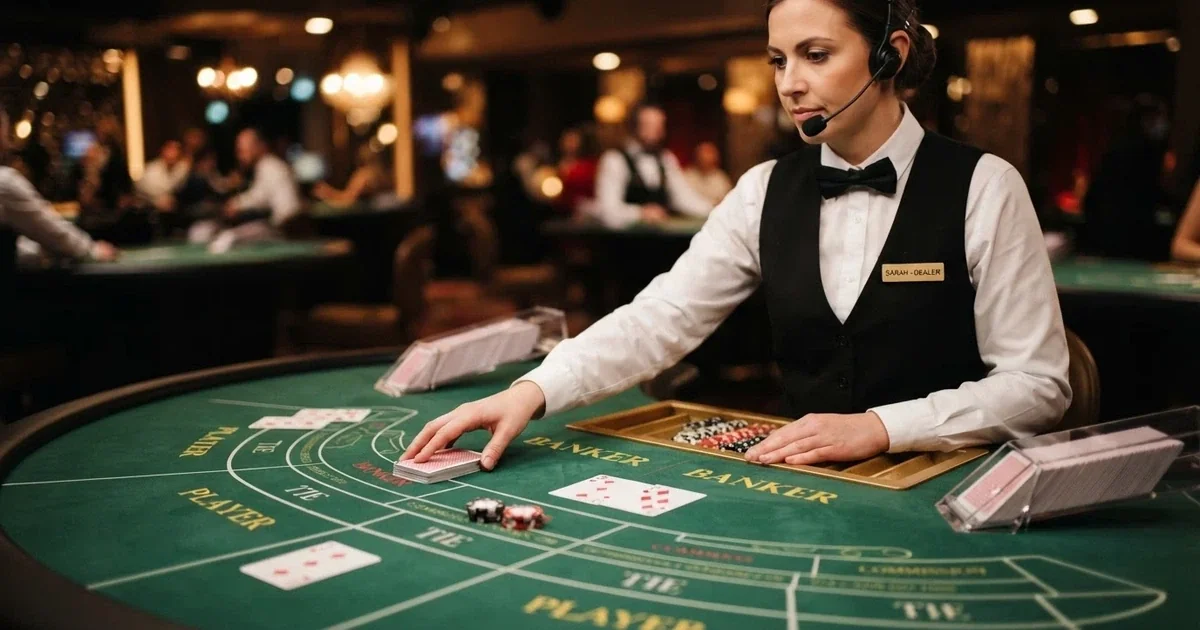
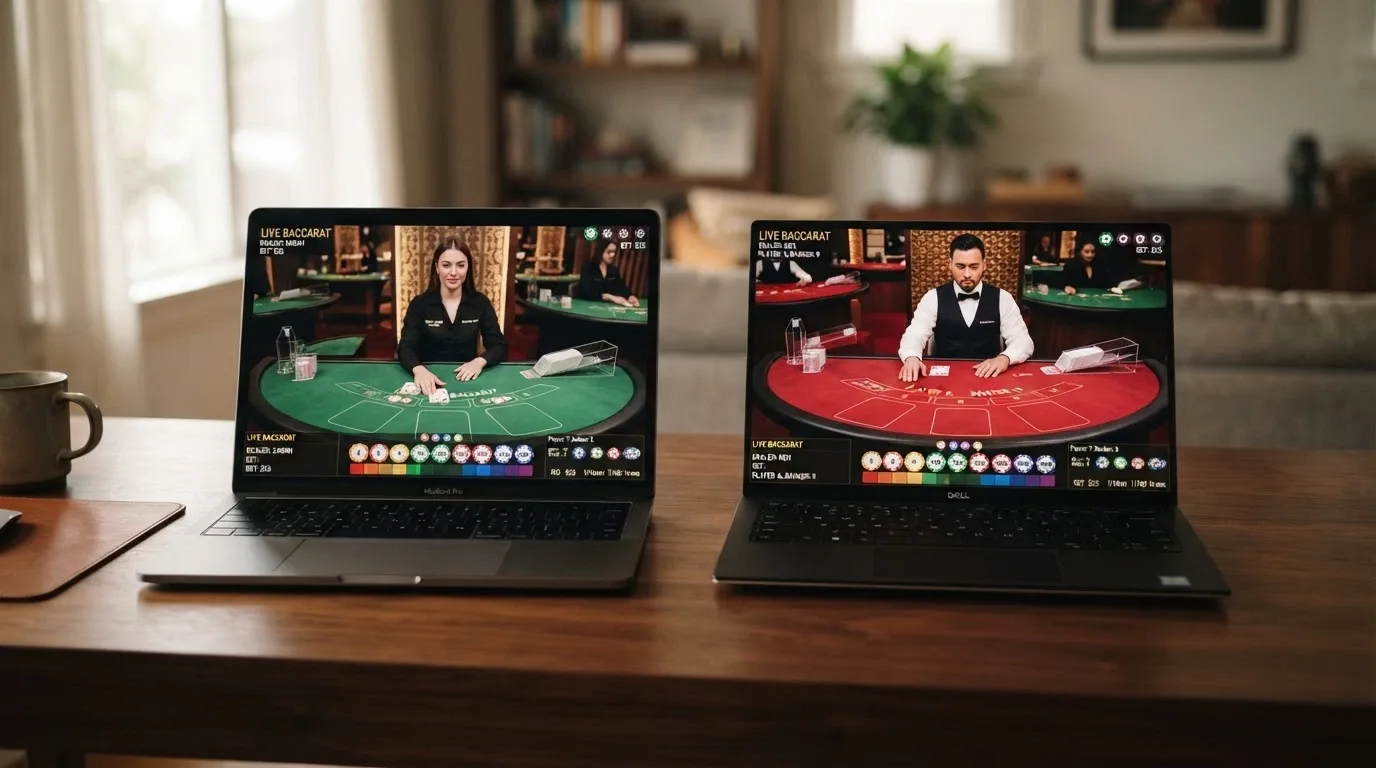
What the player sees is a multi-camera feed of a felt laid out exactly like a baccarat table in any high-end land casino. The dealer stands behind the shoe, dealing two hands — Banker and Player — and the camera angles switch between wide shots of the table, close-ups of the cards being turned and overhead views of the betting layout. The chip selector, the betting timer and a live chat box sit on the player’s side of the interface. The dealer reads results aloud; in some games they acknowledge chat. From the player’s seat, the felt is real, the shoe is real, the cards are real, and the result is whatever those cards actually are.
Evolution Gaming dominates the Australian-facing live baccarat market, and the practical consequence of that dominance is that the look and feel is similar across most offshore casinos an Australian can reach. Standard Evolution tables carry bet limits from as little as A$1 per hand to as much as A$25,000, which covers every stake between a casual punter on a coffee budget and a high roller who treats the table like an investment. The provider’s commission-free variant drops the 5% Banker commission in exchange for the Super 6 side bet, which pays 12:1 when the Banker wins with a total of six points — a trade-off that changes the maths but keeps the table familiar. Other providers in the live space include Pragmatic Play Live, Playtech Live and Lucky Streak, with product variation mostly in the side-bet catalogue and the studio aesthetic rather than in the underlying mechanics.
Live baccarat versus screen baccarat: why the dealer changes everything
The screen version of baccarat — what the trade calls RNG baccarat — runs an animated dealer over a result the server has already produced. It is faster, sometimes cheaper to play at low stakes, and a perfectly legitimate way to grind through a bonus requirement. Live baccarat costs the player time, because each hand takes roughly fifteen to twenty seconds from bet-close to result, and the minimum bet on the cheaper live tables tends to start a touch higher than the cheapest RNG tables. The player trades that time for something harder to put a number on: trust. A punter watching a real shoe knows the result was not generated for them, and the pacing and ritual of a hand — bet, deal, draw, result, clear — mirror the cadence of a land table rather than the slot-machine rhythm of an RNG game.
The social layer is the other thing the live version does that the screen does not. A live dealer greets players by name when their chat nickname shows, acknowledges a winning streak and occasionally wishes the table well. For a punter sitting alone at home on a Tuesday night, the social warmth of a live studio is a small thing that the RNG game does not offer. The trade-off is real: a live table eats time in a way the screen does not, and that matters in a game where the house edge is so thin that the marginal value of a session is mostly the time the player spends at the table.
Baccarat in two minutes: the casino game every Australian player is searching for
Baccarat is a 500-year-old comparing-card game that originated in Italy in the 1500s, spread through France under the name chemin de fer in the nineteenth century, and crossed into Asia in the form now known as punto banco — the variant played in almost every modern casino, online and offline. The reason it survives is mechanical. Two hands are dealt, the player bets on one of three outcomes, and the rules governing when each hand draws a third card are fixed. There is no decision for the player to make once the bet is down, and there is no skill to learn. The game’s hold on the high-roller room comes from that simplicity combined with a house edge lower than almost any other table game.
Real-money baccarat at Australian-facing online casinos
An Australian who wants to play baccarat for real money opens an account at an offshore casino, deposits in Australian dollars, and selects a live baccarat table from the casino’s lobby. Account creation requires an email address and a password at most operators, with identity verification — driver licence, passport, proof of address — triggered at withdrawal rather than at sign-up, and increasingly at sign-up as operators tighten their compliance. Deposits run through debit cards, bank transfer, e-wallets (Skrill, Neteller, MiFinity), and at some operators through PayID through an offshore channel; credit cards and cryptocurrency have been banned as payment for online wagering in Australia since 11 June 2024, so an Australian asked for those methods at a casino is being served by someone outside the Australian rules.
Stakes on the standard live baccarat tables start at A$1 per hand on the lower-limit rooms and run into the thousands on the VIP variants. The recreational tax position is straightforward: gambling winnings are not assessable income under section 6-5 of the Income Tax Assessment Act 1997 for a person who is not carrying on a business of betting, and gambling losses are not deductible under section 8-1. A casual punter’s baccarat session — winning or losing — does not appear on their tax return and is not refundable if it loses. The high-volume professional who can show they run betting as a business is in a different position; that category is the minority of the audience reading this page.
How baccarat works: the rules, the odds and the only strategy that matters
Baccarat’s mechanical simplicity is the source of its enduring appeal at the high-stakes table. Two hands, three bets, fixed drawing rules, no decisions once the chips are down. The strategy conversation is the shortest in the casino because the maths has already made it for the player.
Card values and the third-card rule
The game is played with eight standard 52-card decks — 416 cards in the shoe — shuffled together at the start of a shoe and dealt from a plastic dealing box. Card values are the only thing a player has to memorise, and they are unusual: aces count as one, cards two through nine count at face value, and tens and face cards count as zero. When the cards in a hand are summed, only the last digit of the total counts — a hand with a seven and a six totals three, not thirteen. The closest hand to nine wins. A two-card total of eight or nine is a natural and ends the hand before any third card is drawn.
Whether the Player or Banker hand draws a third card is governed by a fixed rule table that the dealer applies without consultation. The Player hand draws on a total of zero, one, two, three, four or five, and stands on six or seven. The Banker hand’s draw depends on the Player’s third card — draw on zero, one or two always; stand on seven always; on three, four, five and six, the rule is conditional on the rank of the Player’s third card. The Player never decides whether to draw, the Banker never decides whether to draw, and the punter never decides anything once the bet is down. The whole game runs on a script written out in a casino procedure manual.
The banker, the player and the tie: three bets, three edges
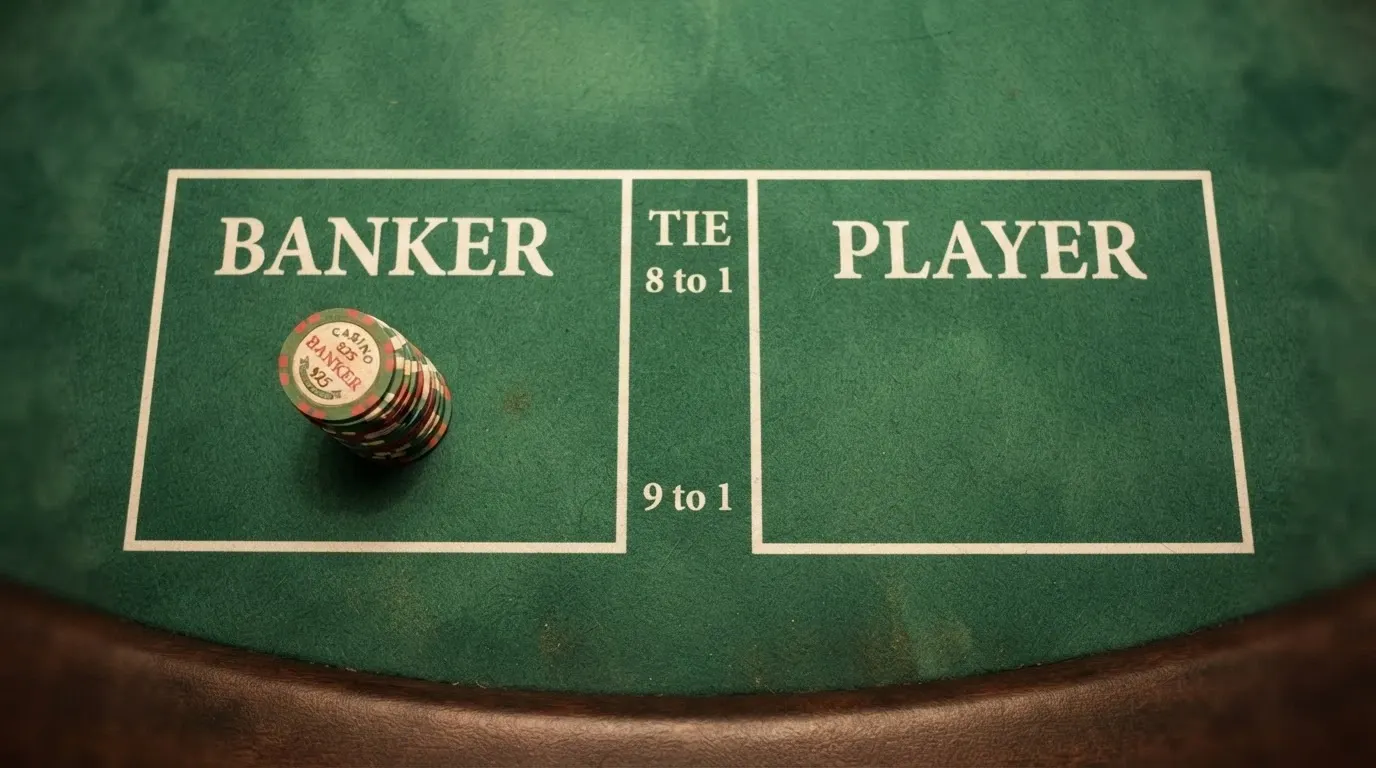
There are three betting positions on the layout, and the spread of mathematical cost between them is the widest on the casino floor. The Banker bet costs the player 1.06% in expected value over the long run. The Player bet costs 1.24%. The Tie bet costs 14.36% — roughly thirteen times the cost of the Banker bet, because the payout of 8-to-1 on a Tie looks generous but is calibrated against a result that occurs in fewer than one in ten hands.
| Bet | House Edge | Win Probability |
|---|---|---|
| Banker | 1.06% | 45.8% |
| Player | 1.24% | 44.6% |
| Tie | 14.36% | 9.6% |
The Banker bet pays 1-to-1 with a 5% commission on wins; the Player bet pays 1-to-1 with no commission; the Tie bet pays 8-to-1 (or 9-to-1 at some tables) with no commission. The reason the Banker bet has the lowest house edge despite carrying a commission is that it wins more often than the Player hand — the drawing rule slightly favours the side that acts second, because the Banker sees the Player’s third card before deciding its own move. Over a thousand hands at the standard table, the Banker bet costs the player less than A$11 per A$1,000 wagered; the Player bet costs A$12.40; the Tie bet costs A$143.60. The Tie bet is, by a margin that nobody argues with, a sucker bet.
Baccarat strategy: why the banker bet is the only play the maths supports
The shortest strategy guide in the casino reads: always bet Banker, manage your bankroll, ignore the scoreboard. Every serious treatment of baccarat strategy says the same thing in different words, and the reason is arithmetic. The 1.06% edge on Banker is the cheapest seat in the house outside the pass line at craps with full odds, and it is the only bet at the table that gives a player a realistic chance of walking away with a session win. Any deviation from Banker — alternating with Player to chase the appearance of a pattern, raising stakes after a loss, betting Tie to “win big” — costs the player edge in expectation and nothing in return.
The scoreboard and pattern-tracking that look so compelling on the felt beside the dealer are decorative. The past several hands are visible because the house wants players to bet on something, and pattern-tracking feels like strategy, but each hand of baccarat is statistically independent of the last — the cards do not remember. A streak of Banker wins does not raise the probability of the next hand being a Player win; a streak of Ties does not make a Tie “due”. The decision a player should make is the same one every hand: bet Banker, bet an amount the player has pre-decided, stop when the stop-loss or session-profit target is hit.
Bankroll management for baccarat is simpler than for most table games because the player has no decisions to make. The two variables are stake size and session length. A punter with a A$200 budget for a session at a A$5 table is running 40 hands at expected loss of A$8.48 over that span — the house edge compounds slowly, so a short session is a survivable one. The same punter at a A$25 table is running eight hands at expected loss of A$8.48, and the variance on eight hands is large enough that the result can run either way; the maths is the same, the experience is more concentrated.
The table, the shoe and the scoreboard
A traditional baccarat table seats up to fourteen players in three zones — Banker zone, Player zone, middle — with the dealer standing on the short side of the table facing the bettors. The felt is the same shape as every baccarat table in the world: the Player betting area on one side, the Banker betting area on the other, the Tie in the middle, with numbered positions for each player to mark their bet. The shoe sits in front of the dealer on a wooden stand; cards are slid face-up into a discard tray as the hand resolves.
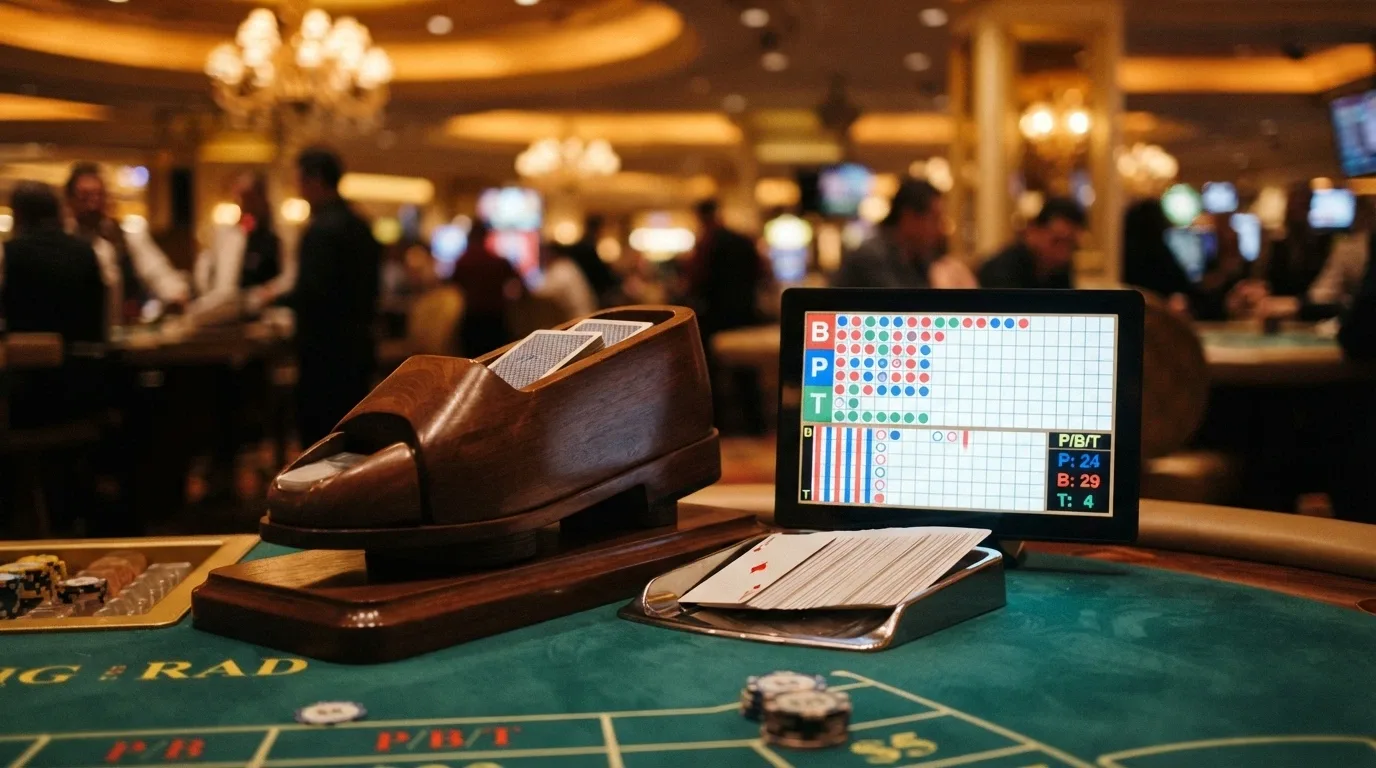
The electronic scoreboard beside the dealer — the bead plate and the derived roads (big road, big eye boy, small road, cockroach) — displays the result of every hand in the shoe, colour-coded for Banker, Player and Tie, with derived roads highlighting patterns the punter can read. The roads are visually elegant, mathematically inert, and worth ignoring as a decision input. The only road that matters to a punter’s bankroll is the one they have drawn themselves before the session: the limit at which they walk away.
Beyond the standard table: baccarat variants worth knowing
The standard punto banco game has spawned a family of variants — smaller tables, electronic formats, baccarat-themed slot titles — that sit alongside the main game at the Australian-facing operators and that deserve their own short treatment.
Mini baccarat: faster, cheaper and seven seats
Mini baccarat is the scaled-down version that dominates the lower-stakes space — land-based and online alike. The table seats a maximum of seven players rather than the fourteen of the full-size game, the minimum bets run lower, and the pace accelerates because the casino always acts as the banker and the dealing cadence is tighter. Mini tables usually do not offer side bets, which keeps the maths cleaner and removes the temptation of the Tie wager. The single-dealer setup that gives mini its speed is also the reason it appears in the lower-stakes room of land casinos and as the default live table for casual players online.
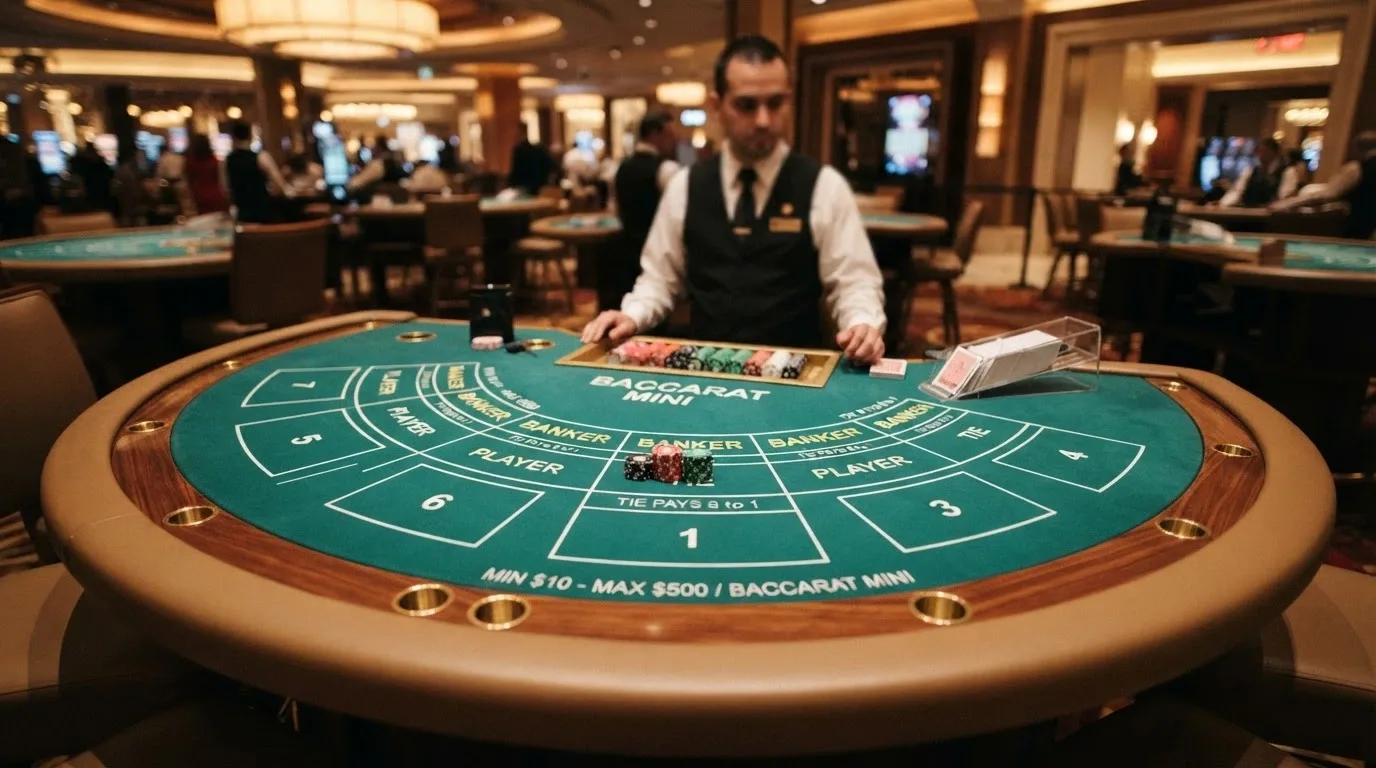
Casino Canberra ran a Mini Baccarat Tournament in July 2026 with a A$3,000 prize pool, an indication that the format has a following in Australian land venues even if the offshore online scene treats it as a default rather than a specialty. Crown Melbourne’s Dragon Tiger Baccarat — a two-card variant with three new side wagers alongside the traditional versions — is another variant worth knowing if a punter ends up in a land venue rather than at a screen.
Baccarat-themed slots and electronic games
For players who like the baccarat theme without the live-dealer pace, the offshore lobbies carry a handful of baccarat-themed electronic games and slot titles. Two of them carry published return-to-player figures worth recording.
| Title | Provider | RTP | Volatility |
|---|---|---|---|
| Bacarrat | Wicked Games | 98.95% | — |
| Mini Baccarat | Play’n GO | 96.76% | — |
The Bacarrat slot from Wicked Games landed on 14 August 2026 with an RTP of 98.95%, which is high for a slot title and unusual in a baccarat-themed product where the table game itself runs at 98.94% on the Banker bet. Mini Baccarat from Play’n GO has been around since 23 June 2012 and carries an RTP of 96.76%, with stakes from A$1 to A$100 per round — a lower ceiling than the live tables but a more concentrated play pattern for a punter on a tighter budget. Electronic baccarat machines — RNG versions of the table game with an animated dealer — sit between these slots and the live studios in pace and feel; most operators carry them under their “table games” tab without publishing an RTP at the title level.
Why every online baccarat casino available in Australia is offshore
The legal frame is the single most important fact on this page, and it is the one a punter most needs to internalise before comparing welcome bonuses. Every online casino accessible to an Australian is operating illegally under the Interactive Gambling Act. The provider is the target, not the player, but the player forfeits the protection frame that goes with a licensed market: no Australian consumer protection, no BetStop coverage, no ACMA recourse if the operator refuses a withdrawal. Offshore brand, offshore rules.

The Interactive Gambling Act 2001: what it bans and what it permits
The Interactive Gambling Act 2001 — the IGA — makes it an offence to provide an interactive gambling service to a person in Australia where that service is a prohibited one. The prohibited services are online casino games (baccarat, blackjack, roulette, slots), online poker and in-play sports betting — wagering on a sporting event after it has started. Permitted and licensable under state and territory law are wagering on racing and sporting events placed before the event begins, lotteries, keno and land-based casino games. Online casino sits on the prohibited side of that line, which is why no licence for it exists federally and no licence exists in any state or territory — the product the licence would cover is the product the statute prohibits.
The penalty regime targets the provider, not the player. Civil penalties for providing a prohibited interactive gambling service run to A$2,475,000 per day for an individual and A$12,375,000 per day for a corporation. The minimum age for any commercial gambling in Australia is 18. A page describing the “best licensed online casinos in Australia” is describing a category that does not exist, and the comparison this page runs is across offshore brands — every one of them holds a licence that is not an Australian licence, because no Australian licence exists.
ACMA enforcement: 1,564 sites blocked and 225-plus withdrawals
The Australian Communications and Media Authority — ACMA — is the federal regulator that enforces the online prohibition. ACMA investigates complaints, issues formal warnings, runs civil penalty proceedings and directs Australian internet service providers to block illegal gambling sites at the DNS level. The first blocking request went out in November 2019, and since then the regulator has directed ISPs to block 1,564 illegal gambling and affiliate websites — a figure that covers the brand sites themselves and the affiliate pages that marketed them. More than 225 illegal services have withdrawn from the Australian market since enforcement was strengthened by the 2017 amendments to the IGA. The “withdrawn” figure is important: it counts operators who decided that an Australian audience was not worth the regulatory risk and pulled out rather than waiting to be blocked.
The ACMA’s enforcement record is the practical consequence of the legal frame. An offshore casino accessible to an Australian today may be inaccessible tomorrow; the site an Australian opened an account with this week may be the site that gets blocked next week, with a balance still sitting on it. That is the structural risk of an offshore site, and no welcome bonus compensates for it.
The 2026 reform: what changes for Australian players from 1 January 2027
The Interactive Gambling Amendment (Gambling Reform) Bill 2026 passed Parliament on 19 August 2026 and is not yet in force — its measures commence on 1 January 2027. Three changes matter for the baccarat player comparing offshore casinos in 2026.
The first is the advertising cap. From 1 January 2027, wagering advertising is limited to three ads per hour between 6:00 am and 8:30 pm, with a live-sport blackout running from 15 minutes before kick-off to five minutes after the final whistle. Radio ads are barred during school drop-off and pick-up, broadcasting sporting odds is banned, online ads can run only to logged-in over-18 users who have not opted out, and there are no ads in sports venues or on team uniforms. Athletes, celebrities and influencers are barred from promoting wagering. The visible wagering advertising environment tightens materially.
The second is the inducement ban. From 1 January 2027, licensed operators cannot market inducements — sign-up offers, referral bonuses, free bets — to a customer for 14 days after sign-up, for three months after a person deregisters from BetStop, and indefinitely for customers identified as at risk of gambling-related harm. The 14-day post-sign-up window is the most relevant change for the comparison this page runs: the bulk of the welcome-bonus marketing at licensed Australian operators will fall inside that window.
The third is the bank-blocking power. From 1 January 2027, banks and payment providers gain express statutory authority to block transactions to illegal gambling operators. That is the change with the most direct consequence for an Australian punter using an offshore site. A bank that decides a given operator is on the prohibited list can refuse the transaction before it leaves the customer’s account — a development that turns the offshore route from a grey legal area into a route that the customer’s own bank can close.
Australian-facing live baccarat casinos ranked for 2026
The ten operators below are the offshore brands Australian players can reach for live baccarat in 2026, ordered by fit to the head-theme — live baccarat availability, welcome-bonus value and AUD support. Every one is an offshore brand without an Australian online casino licence, because no Australian online casino licence exists. Players using these sites forfeit Australian consumer protection, BetStop coverage and ACMA recourse. That line is true of all ten.
| Operator | Licence | Welcome Bonus | Wagering Requirement |
|---|---|---|---|
| Skycrown | Curaçao eGaming (offshore) | Up to A$8,000 + 400 free spins (4 deposits) | 40x (bonus + deposit) |
| Royal Reels | Curaçao eGaming (offshore) | Up to A$4,500 + 250 free spins (3 deposits) | 40x (bonus + deposit) |
| RocketPlay | Curaçao eGaming (offshore) | 100% up to €1,000 + 100 free spins | 35x |
| Bizzo Casino | Curaçao (offshore) | Up to A$2,500 + 300 free spins (4 deposits) | 35x (bonus + deposit) |
| WinSpirit | — | 200% + 25 free spins | 40x |
| FairGO | — | 30 free spins no deposit | 30x (on winnings) |
| Rainbet | Anjouan (offshore) | Tiered: 100%+20 FS / 50%+20 FS / 100%+20 FS | 40x |
| Stake | Curaçao (offshore) | — | — |
| Scream Casino | — | — | — |
| Rocket Casino | — | — | — |
A worked example, drawn from the comparison’s largest welcome package: Skycrown’s headline offer of up to A$8,000 across four deposits, run against the Banker bet at a 1.06% house edge. The required turnover at 40x the bonus amount is A$320,000; the expected loss on that turnover, assuming the entire bonus is played on the Banker bet at a published house edge of 1.06%, is A$3,392. That figure is an average over many hands under the stated assumption that only the bonus amount is wagered — it is a statistical estimate, not a forecast of any individual session. The bonus’s real cost is the expected loss before any cash balance comes out the other side.
Skycrown
Skycrown sits at the top of the comparison on welcome-package size. The headline offer is up to A$8,000 plus 400 free spins across four deposits, with a 250% aggregate match, a minimum qualifying deposit of A$20 and a 40x wagering requirement on bonus plus deposit. The platform carries more than 5,000 games from over 100 providers, and the live baccarat lobby runs on Evolution Gaming, which is the provider that determines how the live-dealer experience feels at this site.
The Curacao eGaming licence is the offshore frame every Australian-facing operator on this list shares. It is not an Australian licence; it does not carry BetStop coverage; it does not give an Australian player a domestic avenue of recourse if the operator refuses a withdrawal. The welcome package is the largest in the comparison and that is the headline number; the worked example above shows what running that headline number through the Banker bet actually costs in expected value.
Royal Reels
Royal Reels runs two welcome structures: a simple A$500 first-deposit match with 35x wagering and an A$10 minimum, and an extended package worth up to A$4,500 plus 250 free spins across three deposits at 200%, 150% and 100% match with 40x wagering per tier and a 30-day bonus validity per tier. The platform holds a Curaçao eGaming licence and carries more than 2,200 games with Evolution-powered live casino content. Royal Reels is the most accessible entry on the comparison at the simple welcome level because the A$10 minimum deposit is the lowest in the set. The extended welcome is competitive in dollar value with the larger packages on this page, but the per-tier 30-day validity window means a punter who drags their feet on a tier loses the bonus.
RocketPlay
RocketPlay is a Curaçao-licensed brand with a 100% match up to €1,000 plus 100 free spins and 35x wagering. The headline number is denominated in euros rather than Australian dollars, which means a punter converting the bonus into AUD takes a currency-translation haircut that varies with the day’s rate. The 35x wagering is below the 40x that dominates this comparison and is the single most concrete advantage RocketPlay carries over the larger packages. Live dealer tables are available at the operator; specific provider and game-count details were not confirmed in this review.
Bizzo Casino
Bizzo runs a four-part welcome worth up to A$2,500 plus 300 free spins, with 75 spins per deposit at A$0.20 each and match percentages of 100%, 75%, 50% and 100% across the four deposits. The wagering requirement is 35x on bonus plus deposit, which sits below the Skycrown and Royal Reels tiers — but the live casino contribution to wagering is capped at 5%. That contribution rate is the headline mechanic. A A$1,000 bet on a live baccarat hand contributes only A$50 toward the A$17,500 turnover requirement on a A$2,500 bonus, which means the player needs roughly 350 times the wagered amount in live baccarat bets to clear the bonus. Evolution Gaming powers the live casino suite, and the live baccarat experience is at the same standard as the operators higher up the comparison.
WinSpirit
WinSpirit runs a 200% welcome bonus plus 25 free spins at 40x wagering on promotions. The headline figure is a high match percentage with a small free-spin top-up. The licence and the game-provider catalogue were not confirmed in this review, which is why the row in the comparison carries the no-data marker for licence and the write-up stops short of any claim about provider or game count. For a punter who values a small bonus with a clear match structure and is comfortable proceeding without the licence confirmation, the offer reads cleanly. For a punter who wants every piece of the operator picture before depositing, WinSpirit is one of the data-thin rows in the table.
FairGO
FairGO is the only no-deposit offer in the comparison: 30 free spins with no deposit required, a 30x wagering requirement on free-spin winnings, and a validity window running until November 2026. No-deposit offers are the most player-friendly terms in the comparison at face value, and the 30x requirement on winnings is below the 40x the deposit-gated packages carry. The offer is constrained by the expiry window — November 2026 is a hard cutoff — and by the absence of a deposit-match component, so a punter who clears the free-spin winnings has no further bonus to extend the session with. Licence was not confirmed in this review.
Rainbet
Rainbet is a crypto-native brand running an Anjouan licence, with a tiered welcome bonus across three deposits: 100% plus 20 free spins on the first, 50% plus 20 on the second, 100% plus 20 on the third — 60 free spins total and 40x wagering on bonus funds, with a minimum deposit of A$30 USD equivalent. Rainbet’s separate wager-lock promotion carries a minimum deposit of A$30 USD, a maximum deposit of A$700 USD, a maximum bet of 2% of the deposit amount, and excludes slots by Hacksaw and Nolimit plus any games with an RTP above 97.4%. The wager-lock promotion is the clearest expression of the operator’s risk discipline on its bonus — high-RTP games are not part of the offer.
The Anjouan licence is offshore; the crypto-native payment structure sits outside the Australian framework that has banned digital currency as payment for online wagering since 11 June 2024. An Australian depositing at Rainbet via crypto is making a payment the Australian statute prohibits the licensed market from accepting.
Stake
Stake is a major crypto-casino brand with a Curaçao licence and live-dealer tables across multiple providers, but the bonus structure differs from the matched-deposit welcome offers that dominate this comparison. There is no standard first-deposit match at Stake in the form the other operators on this page carry; the brand’s promotional structure runs through races, giveaways and reload-style mechanics rather than a single headline welcome. Punters comparing bonuses should treat Stake as a different category of operator rather than as a worse or better version of the same offer — the live-dealer product is at the same standard as the rest of the table.
Scream Casino
Scream Casino is an offshore brand in the featured set, and the publicly confirmed data on its licence, bonus structure, provider catalogue and game count was not in the sources reviewed for this page. The operator appears in the comparison because it features in the offshore-licensed category accessible to Australian players, and the honest write-up is a short one: an offshore operator without a confirmed Australian licence, with the bonus and game-count figures that would normally fill the write-up not confirmed. A punter who wants to compare on the full specification set will need to check the operator’s own terms page directly.
Rocket Casino
Rocket Casino is the second operator in the comparison where the publicly confirmed data is thin. The brand is an offshore operator without a confirmed Australian licence, and the licence, bonus structure, provider catalogue and game count were not confirmed in the sources reviewed for this page. The write-up ends here, the same way Scream Casino’s does: with the comparison row populated to the extent research carries figures and the gaps marked honestly. A punter treating this comparison as a shopping list has to take the data-thin rows as starting points for further checking, not as finished profiles.
Crypto baccarat: the banned payment method offshore casinos still offer
The credit-card and digital-currency ban that took effect on 11 June 2024 under the Interactive Gambling Amendment (Credit and Other Measures) Act 2023 made it illegal for any Australian-licensed wagering operator to accept credit cards, credit-related products or cryptocurrency as payment for online wagering. The penalty for non-compliance is up to A$247,500. The ban targets the licensed market. Offshore operators sit outside the Australian statute and continue to accept crypto deposits — Rainbet is a documented example, accepting bitcoin and other digital currency through its Anjouan-licensed platform.
The position for an Australian punter is uncomfortable in two directions. Using a credit card or crypto at an offshore casino is not itself a criminal offence for the player — the IGA targets the provider, not the punter — but the player is making a payment the Australian statute prohibits the licensed market from accepting, which is the clearest available signal that the operator is outside the Australian rules. The 1 January 2027 bank-blocking power changes the picture again. From that date, banks and payment providers gain express statutory authority to block transactions to illegal gambling operators, and a customer’s bank can refuse a transaction before it leaves the account. A punter using crypto at an offshore casino today is a punter whose bank can decide to close the route tomorrow.
The licensed-market payment routes remain narrow: debit cards, bank transfer, PayID through licensed operators and BPAY. An Australian asked for credit card or crypto at a casino site is being served by someone outside the Australian rules, and that signal is worth taking at face value.
Playing within limits: the safer-gambling tools every punter should know
The Australian harm-minimisation infrastructure is among the strongest in the world — but it was built for the licensed wagering market, and the offshore casinos where Australians play baccarat sit outside it. That is the most concrete single harm of the offshore route: a punter using a Curaçao-licensed site forfeits access to the tools the Australian framework provides.
Approximately 2.1% of Australian adults — roughly 430,000 people — experience problem gambling; the Australian Institute of Health and Welfare put high-risk gambling at 1.8% in 2022. For anyone whose baccarat session has stopped being a session and started being a problem, the entry points are free, confidential and immediate. The National Gambling Helpline — 1800 858 858 — runs 24 hours a day, seven days a week. Gambling Help Online carries the same service over chat at gamblinghelponline.org.au. The National Debt Helpline on 1800 007 007 covers the financial fallout. Lifeline on 13 11 14 is the right number for suicidal thoughts or immediate danger. These are the tools that work regardless of where a punter plays.
BetStop and the self-exclusion gap at offshore casinos
BetStop — the National Self-Exclusion Register — went live on 21 August 2023. One registration excludes a person from every Australian-licensed online and phone wagering service in a single step, for a period ranging from a minimum of three months to a lifetime. As of 31 March 2026, 59,830 people had registered, with 37,247 active exclusions. Seventy-eight per cent of registrants were under 40, and 38% chose lifetime exclusion — a skew toward the youngest demographic and toward the most decisive exclusion period that tells its own story about how the population at risk uses the tool.

The gap is the offshore casino. BetStop binds Australian-licensed wagering providers only — around 150 operators at the count ACMA carries. A Curaçao-licensed brand reachable from Australia is not connected to the register, and a person registered with BetStop can still open an account at an offshore casino, deposit and play baccarat. That is the harm the offshore route delivers in concrete terms: the Australian self-exclusion tool does not reach the operator the Australian actually uses. A punter who registers with BetStop and then plays at an offshore site is not self-excluded — they are merely restricted from one half of the market while remaining exposed to the other.
From 1 January 2027 the inducement ban tightens this further. Direct marketing of inducements is prohibited for three months after a person deregisters from BetStop and indefinitely for customers identified as at risk of gambling-related harm. The licensed market hardens its handling of the at-risk customer. The offshore market, by definition, does not.
How we selected and ranked these baccarat casinos
The operators in the comparison were checked against the ACMA framework and the Curaçao eGaming and Anjouan licensing directories to confirm offshore status — every one of them is an offshore brand, because no Australian online casino licence exists. The ranking prioritised live baccarat availability (Evolution Gaming or equivalent live-dealer product on the lobby), welcome-bonus value and clarity of terms, AUD support, and wagering-requirement competitiveness. Operator websites, affiliate data and the Interactive Gambling Act framework supplied the inputs. The ranking reflects the head-theme — live dealer baccarat — and the bonus-value dimension an Australian punter comparing offers cares about. Where research did not confirm a licence or a game count, the row carries the no-data marker rather than a guessed figure. The ranking is not a recommendation. A punter decides with the facts on this page; the page describes what each operator brings and what each one costs.
What the smart punter does about live baccarat in Australia
The banker’s edge on the table is 1.06%. That is the cheapest seat in the casino outside the craps pass line, and it is the only bet at the baccarat table that gives a player a realistic chance of walking away with a session win. Every other decision the game offers — the Player bet, the Tie bet, the side wagers on commission-free variants, the pattern-tracking on the scoreboard — costs the player edge in expectation and nothing in return. The shortest strategy guide in the casino is also the only one the maths supports.

The offshore reality is the structural cost of playing online baccarat from Australia. Every site is an offshore brand without an Australian consumer-protection frame, every site is outside the BetStop register, and every site can be blocked at the DNS level with a balance still on it. The 1 January 2027 bank-blocking power extends that risk into the payment rail itself. The credit-card and crypto deposit ban that has been in force since 11 June 2024 is the clearest available signal that an operator is outside the Australian rules. None of this is a reason to play; it is a reason to know what the player is paying for the convenience of an offshore site.
The tools that work are independent of the operator. Bankroll limits set before the session, a stop-loss that triggers when it should, a session timer that runs in the background, and the National Gambling Helpline — 1800 858 858 — for the moment the session stops being a session. These work at every table, on every site, and they are the most reliable edges a baccarat player has.
Frequently asked questions
Are there any licensed online baccarat casinos in Australia?
No. The Interactive Gambling Act 2001 makes providing online casino games to a person in Australia illegal, and there is no licence for online casino anywhere in the country — federally or in any state or territory. Every operator an Australian can reach is an offshore brand holding a non-Australian licence. The player forfeits Australian consumer protection, BetStop coverage and ACMA recourse by using an offshore site.
What is the house edge on live baccarat bets?
The Banker bet carries a house edge of 1.06% in an eight-deck game, the Player bet 1.24%, and the Tie bet 14.36%. The Banker hand wins 45.8% of the time, the Player hand 44.6%, and Ties occur 9.6% of hands. The Banker bet is the only one of the three that gives the player a realistic chance of a session win.
How do I play live dealer baccarat for real money in Australia?
Open an account at an offshore casino, deposit in Australian dollars through debit card, bank transfer or an accepted e-wallet, and select a live baccarat table from the lobby. Standard Evolution tables run from A$1 to A$25,000 per hand. Credit cards and crypto have been banned as payment for online wagering since 11 June 2024, so an Australian asked for those methods is being served by someone outside the Australian rules.
What is the difference between mini baccarat and standard baccarat?
Mini baccarat seats a maximum of seven players versus up to fourteen for the standard game, runs at lower minimum bets, plays at a faster pace, has the casino always banking and usually does not offer side bets. The basic rules are identical — the same card values, the same third-card draw — and the Banker bet still carries the same 1.06% house edge. Mini is the lower-stakes, faster-cadence version of the same game.
Can I use PayID or crypto to deposit at an online baccarat casino in Australia?
Credit cards, credit-related products and digital currency have been banned as payment for online wagering in Australia since 11 June 2024. PayID runs through the licensed wagering market; crypto is accepted at some offshore sites but is the clearest available signal that the operator is outside the Australian rules. From 1 January 2027, banks gain express authority to block transactions to illegal gambling operators.
What happens if an offshore casino blocks my account or refuses a withdrawal?
An Australian player at an offshore site has no Australian consumer-protection avenue. The IGA targets the provider, not the player, and the player is not prosecuted — but the player also has no ACMA recourse, no BetStop coverage and no Australian court forum. The operator’s house rules apply, and ACMA can direct ISPs to block the site at the DNS level with a balance still on the player’s account. The risk is structural to the offshore route, not a quirk of one operator.