
How Fast Can Australian Players Actually Get Paid at an Online Casino?
The phrase “instant withdrawal” carries weight on Australian-facing casino sites. It appears in welcome pages, on banner ads, in the small print of bonus offers — and it is, almost without exception, marketing rather than measurement. The honest reading is more ordinary. The fastest legitimate payouts at Australian-facing offshore casinos land in five to fifteen minutes after approval; the slowest stretch across three to ten business days when the player pulls funds back to a bank account. Everything in between sits on the payment rail the player chose, the casino’s internal processing posture, and the moment a player first proves their identity.

Current as of 22 November 2026 · Operator offers and licences verified against the ACMA register and the listed Curacao, MGA and GCA registries
Table of Contents
- What “Quick Withdrawal” Really Means at an Online Casino
- Why Your Withdrawal Speed Depends on How You Cash Out
- The Fastest-Payout Casinos Serving Australians in 2026
- The Legal Reality: No Quick-Withdrawal Casino Holds an Australian Licence
- Staying in Control When the Payouts Are Fast
- How We Selected and Ranked These Casinos
- Is a Quick-Withdrawal Casino Worth the Trade-Off?
- Frequently Asked Questions About Quick-Withdrawal Casinos in Australia
What “Quick Withdrawal” Really Means at an Online Casino
A “quick-withdrawal” casino, in the language the marketing uses it, is an operator that processes cashouts faster than the industry standard. The industry standard itself has shifted — what passed for fast in 2018 (a 24-hour e-wallet payout) is now table stakes, and what counts as “quick” in 2026 is measured in minutes. The label says less about the operator than the wording does about a buyer trying to differentiate in a crowded market. Setting that aside, a fast-payout casino is one where three things line up: an internal processing window measured in hours rather than days, a payment-method mix that includes crypto and PayID, and a Know Your Customer posture that lets most verified players pass first withdrawal without sending a utility bill.
The gap between advertised speed and tested speed is real, and it is not random. The fastest tier of Australian-facing casinos — Neospin, SkyCrown, BitStarz — has tested crypto payouts landing between five and fifteen minutes after the player hits withdraw. Marketing claims on the same sites routinely use the word “instant”, which no legitimate operator will guarantee; verification, even an automated one, takes some non-zero time. The phrase that appears across the better-ranked operators’ terms — “endeavours within” — is doing real work. It commits the operator to try, not to deliver. Players who read that wording as a promise are reading past it.
The payment rail is the second half of the answer. Crypto and PayID dominate the fast end because settlement happens between two computers or two Australian banks in real time, not through a card scheme or a wire that batches transactions overnight. Card withdrawals take two to five business days because Visa and Mastercard run on legacy batch processing; bank transfers take one to three business days for the same reason; only the rails built for instant settlement actually clear in minutes. A casino cannot make a bank transfer faster than the bank’s clearing window allows. What it can do is pick the methods that do not go through the slow rail and lean into them in its payment page.
Internal Processing vs. Player-Facing Speed
Inside the operator’s own accounting system, a “quick withdrawal” is the interval between a customer clicking the cashout button and funds leaving the operator’s bank or wallet. The customer-facing version of that interval starts at the same click but ends when the funds arrive in the customer’s wallet — and that second endpoint is the one a player actually feels. The two intervals are not identical. A casino with a five-minute internal approval window that pays in Bitcoin is not the same as a casino with a forty-five-minute internal approval window that pays in PayID, even though the headline number (“fast!”) reads the same on a banner.
The word “instant” is doing a specific job in this market. It signals to a buyer comparing welcome pages that the operator has invested in processing infrastructure — auto-approval systems, crypto payment partners, 24/7 payments teams — rather than letting requests queue for the next business day. That investment is real. The implication that the operator can deliver the funds in zero seconds is not. Every legitimate operator runs account verification before the first withdrawal; even a fully automated system has to query a payment processor, sign a transaction, and broadcast it to a network. The honest framing is “fast”, not “instant”, and the fastest tier on this page delivers measured times rather than the word.
What a tested withdrawal time actually measures is the second-by-second reality of one transaction at one moment. It does not control for the operator’s KYC queue on a given day, for the player’s chosen method, or for the bonus terms that may delay withdrawal until wagering clears. A reader who reads “5–10 minutes” should understand that as the operator’s best-case window, achieved on an approved, fully-verified, real-money withdrawal in crypto, on a quiet processing day. The operator that hits five minutes on Monday may hit thirty minutes on Saturday after a sportsbook settlement surge.
How a fast-payout casino differs from a standard one
The differentiators between a fast-payout operator and a standard one are mostly invisible on the welcome page. Auto-approval thresholds, the KYC posture that lets small withdrawals skip a manual review, are the most consequential. A tested comparison of fast-payout brands found one operator settling a crypto withdrawal in approximately four minutes with no ID check for amounts under A$2,000. Above that threshold the same operator runs full verification. That threshold is the operator’s answer to the question “how do we pay fast without breaking anti-money-laundering law?” — and the answer is to draw a line and trust the framework above it.
Payment-method mix is the second differentiator. A casino offering five cryptocurrencies, PayID, two e-wallets, and bank transfer will payout faster across more player situations than a casino offering bank transfer and a single e-wallet. The slow-rail payouts at a fast-payout casino are still slow — Bitcoin’s 30–60 minutes after three to six confirmations is the slowest crypto on the comparison set, and bank transfers still take days. The fast-payout label applies to the operator’s best rail, not to every rail.
The processing posture itself varies more than the marketing suggests. A casino running a 24/7 payments team with auto-approval under a defined limit will clear a withdrawal while the player sleeps. A casino running a nine-to-five payments team will queue the same withdrawal until the next business day. The two casinos look identical on their welcome pages. Only the tested withdrawal time reveals the difference, and only the player’s first withdrawal at quiet hours exposes whether the queue is actually empty.
Who a quick-withdrawal casino suits
Crypto-native players who already hold USDT or Bitcoin and value same-day settlement are the first group. For them, the fast-payout tier is the table-stakes tier — anything slower than fifteen minutes reads as a slow operator. Regular real-money players who withdraw frequently benefit second. Their need is separation: keeping their playing balance at the casino and their winnings in their own wallet, on a rotation that fits their bankroll management. Punters who treat a casino win as a closed transaction and prefer to move it to a wallet they control within the hour are the third group. They are not high-volume; they are cautious.
Casual demo-mode players gain nothing from withdrawal speed. A demo balance cannot be withdrawn — the casino is running a simulation against fake money, and the balance, however large, does not exist outside the casino’s software. The transition to real money requires a deposit, and only deposits generate a right to a withdrawal. A player who enjoys the games in demo mode and never deposits has no use for the speed infrastructure described on this page. A player who deposits real money and values keeping that money separate from their playing bankroll is exactly who the fast-payout tier was built for.
Why Your Withdrawal Speed Depends on How You Cash Out
The payment method is the single biggest lever the player controls. Not the casino’s licence, not its welcome bonus, not even its terms — the rail a withdrawal rides on is the difference between a five-minute cashout and a five-day wait. Most Australian-facing casinos offer the same five rails in different proportions: crypto, PayID, e-wallets, bank transfer, and cards. Each clears on its own clock. The crypto and PayID clocks are measured in minutes; the e-wallet clock in hours; the bank and card clocks in business days. There is no way to talk about a casino’s withdrawal speed without first talking about the rail the player chose.
Withdrawal time and speed by method
| Payment method | Settlement time after approval | Notes |
|---|---|---|
| Cryptocurrency | 5–60 minutes | USDT on TRC-20 in under 5 minutes with near-zero fees; Bitcoin 30–60 minutes after 3–6 confirmations; the slowest major crypto |
| PayID | 1–60 minutes | Fastest AUD-native rail; uses the New Payments Platform and clears through the player’s bank |
| E-wallets (Skrill, Neteller) | 1–6 hours | Operator-side processing dominates; not all casinos offer these to Australians |
| Bank transfer | 1–3 business days | Oldest rail, slowest AUD-friendly option; weekends and public holidays extend the window |
| Visa/Mastercard | 2–5 business days | Card schemes rarely offered by offshore casinos; some operators refund back to the deposit card only |
The five-method gap is not a small one. A PayID withdrawal that lands in fifteen minutes and a Visa refund that takes four business days differ by a factor of several hundred in elapsed time, for the same winnings at the same casino. That is the player-controllable lever. Crypto’s edge sits inside that gap — USDT on TRC-20 typically settles in under five minutes with near-zero fees, which is why several operators’ fastest-payout claims sit at the crypto boundary rather than the PayID one. Bitcoin is the slowest of the major cryptocurrencies, requiring three to six confirmations and stretching to thirty to sixty minutes.

The settlement time in the table is the time after casino approval. The pending period every casino runs — the queue between the player’s request and the operator signing the transaction — is a separate clock that adds on top. Operators that publish a “pending period” of zero hours do exist; operators that publish 24–48 hours are also common. A PayID withdrawal with a 24-hour pending period does not settle in one to sixty minutes; it settles in twenty-five to twenty-five-and-a-half hours. The pending period is invisible to a reader who reads the payment-method table without checking the operator’s terms.
No-verification and instant-payout withdrawals
KYC is the single biggest cause of delayed payouts at every legitimate casino, and it is the mechanism that turns a five-minute crypto withdrawal into a forty-eight-hour wait. The reason is structural: anti-money-laundering law in nearly every jurisdiction that licenses an online casino requires the operator to verify the customer’s identity, address, and source of funds before processing a withdrawal — and the verification has to happen on the operator’s side, not the player’s. No legitimate operator skips it. As one industry observer put it: “No casino site is truly instant. Every legitimate operator runs account verification before your first withdrawal.”

The no-verification casinos that do exist operate inside a narrow window. Tested operators that accept crypto under a defined threshold — A$2,000 in the case of one tested brand — will release the funds without ID on a first withdrawal, and will run the check later if the customer comes back. That structure trades consumer protection for speed. A player who withdraws under the threshold gets their money in four minutes; a player whose withdrawal is flagged for review waits days. The threshold itself is the trade the casino is offering: no protection up to A$2,000, full verification above it. A player who keeps their withdrawals under that line will not see a KYC delay; a player who wins above it eventually will.
What does a casino typically ask for? A government-issued photo ID (passport or driver’s licence), proof of address (utility bill or bank statement under three months old), and sometimes a payment-method ownership check — a photo of the card used, or a screenshot of the e-wallet account. The first time a casino sees this paperwork is almost always after the player’s first withdrawal request, because operators prefer to delay the friction until the customer has skin in the game. The honest framing is that KYC is not optional and the only way to make it faster is to send the documents before the first withdrawal is requested, in the casino’s verification or upload section.
Real-money play versus demo mode
A demo balance cannot be withdrawn. That sentence is the entire content of this section in its shortest form, but it is worth saying more carefully because some players confuse the two. A casino running demo mode is running a slot or a table game in simulation, against a fake balance the player cannot cash out — even if the demo balance grows to A$100,000. The casino is not paying that money; it is running a simulation to let the player test the game. The transition to real money requires a deposit, and the deposit is what generates the right to a withdrawal.
That right comes with conditions. A welcome bonus at any of the casinos on this page carries wagering requirements — a turnover multiple the player has to run the bonus through before any winnings become withdrawable. Neospin applies 40x wagering to its bonus amount, with free-spin winnings capped at AU$225. RocketPlay applies 40x to both the deposit match and free-spin winnings separately. PlayAmo applies 35x. MrPacho applies 35x on deposit plus bonus and 40x on free-spin winnings, with a 10-day bonus validity window. These are not optional terms. They are the gap between the headline number on the welcome page and the cash a player can actually withdraw.
The distinction matters for withdrawal speed for a separate reason. A player who has wagered the bonus to completion and only has withdrawable cash in their balance will see the casino’s normal payout speed apply. A player who requests a withdrawal while bonus money is still locked triggers the casino’s bonus terms, which often cancel the bonus and any winnings tied to it. The casino’s terms page spells this out, usually in bold; the player who reads the welcome page and skips the terms page is the player who finds out the slow way.
Pokies and slots that pay out fast
Pokies are the most-played gambling product in Australia and the most harmful by a wide margin. Recent Australian analysis attributes about 51–57% of gambling harm to pokies, with sports and race betting accounting for a further 19–20%. The game itself is not what determines withdrawal speed — the casino’s payment rail and the player’s chosen method do that. But pokies dominate Australian real-money play at offshore casinos, and the pokies-to-payout pipeline runs through the same rails every other game uses.
The withdrawal process after a pokie win is mechanically identical to a withdrawal after a blackjack or roulette win. The casino does not see the game that produced the balance; it sees an account balance and a withdrawal request. What varies is the volume: a player running frequent small withdrawals from pokie sessions generates more transaction traffic than a player making one large withdrawal after a longer session. Casinos that cap withdrawals per day or per week — PlayAmo at A$4,000 daily, King Billy at $4,000 daily — affect high-volume pokie players first. A player who keeps their session withdrawals under the per-transaction cap does not feel the cap. A player who wins above it waits for the next day’s window.
Withdrawal methods, minimums and limits
Every casino sets its own floor and ceiling for each method. The floors sit between A$10 and A$20 across the featured set; the ceilings vary by an order of magnitude. Neospin caps withdrawals at A$7,500 per transaction; PlayAmo runs A$4,000 daily, A$16,000 weekly, A$50,000 monthly, with a A$17 minimum; King Billy sets $4,000 per day, $15,000 per week, $30,000 per month; RocketPlay runs A$9,000 weekly and A$35,000 monthly. A player withdrawing A$1,000 a week will not hit any of these caps. A player withdrawing A$50,000 a week will trip RocketPlay’s monthly limit on day two.
The minimum is the easier story. A$10–A$20 is the working range. Players withdrawing in small increments will see fees eat into their withdrawal amount faster than players withdrawing in larger increments — most methods charge a flat fee or a percentage, and a flat fee on a A$17 minimum is roughly six percent. The honest move for a small-withdrawal player is to accumulate balance inside the casino and withdraw less often, or to use crypto where the network fee is negligible. Neither option changes the casino’s terms. Both reduce the friction.
The Fastest-Payout Casinos Serving Australians in 2026
The honest starting point is that no online casino in this list holds an Australian licence, because no online casino licence exists in Australia. Every brand below is offshore. What changes between them is licence jurisdiction, payout speed, bonus size, and how much of the player’s money the terms take back before withdrawal. Ranked by tested withdrawal speed, payment-method breadth and bonus fairness, here is the set as tested in 2026.

How the top fast-payout casinos compare
| Operator | Licence | Welcome bonus | Wagering | Tested withdrawal speed |
|---|---|---|---|---|
| Neospin | Curacao | 100% up to AU$1,500 + 100 FS | 40x bonus | Crypto 5–10 min |
| SkyCrown | Curacao | Up to A$8,000 + 400 FS | 40x | Crypto under 15 min |
| BitStarz | Curacao | 100% + 180 FS | 40x | Crypto ~8–10 min avg; endeavours within 1 hr |
| RocketPlay | Curacao | 100% up to AU$1,000 + 100 FS | 40x deposit + FS separately | Crypto fast |
| Hell Spin | Curacao | Up to AU$5,200 + 150 FS across 4 deposits | ~40x | Fast (claimed) |
| PlayAmo | Curacao | 100% up to AU$2,000 + 150 FS across 3 deposits | 35x bonus | E-wallets ~30 min |
| King Billy | MGA + GCA dual | Up to €2,500 + 250 FS across 4 deposits | 30x bonus only | E-wallets within 24h |
| Joe Fortune | Curacao | Up to A$5,000 + 450 FS across 5 deposits | 50x deposit + bonus | Crypto within 1h–24h |
| MrPacho | Curacao | 100% up to AU$750 + 200 FS | 35x deposit + bonus; 40x FS winnings | E-wallets 0–24h; crypto 5s–10 min |
| Kingmaker | Curacao | A$820 + 25 FS | 35x | Fast 0–24h (claimed) |
The split between the operators is most visible on three columns: licence, wagering, and tested speed. Curacao is the dominant licence, with one MGA/GCA dual-licensed exception (King Billy) — but Curacao is a permissive jurisdiction that issues thousands of licences and provides minimal player recourse if a withdrawal is disputed. The MGA licence that King Billy also holds is the stronger of the two; it requires segregated player funds, audited game fairness, and a complaints process through the regulator’s own ADR body. For a player who weighs protection as well as speed, King Billy is the outlier on the licence dimension.
On speed, the cluster breaks into three tiers: sub-15-minute crypto (Neospin, SkyCrown, BitStarz), same-day (Hell Spin, MrPacho, RocketPlay on crypto, Joe Fortune), and 24-hour-plus e-wallet (King Billy, PlayAmo). The marketing term “instant withdrawal” applies most literally to the first tier. The third tier still beats the bank-transfer reality of licensed Australian wagering operators by an order of magnitude, but is a step slower than the headlines suggest.
Australian availability of fast-payout casinos
Australian players reach these sites the same way they reach any unlicensed site: directly. The casino is not blocked by Australian ISPs at the moment of access — ACMA blocking happens after a complaint, investigation, and formal referral — but it can be blocked at any time, with the player’s balance still inside. Since November 2019, ACMA has directed Australian ISPs to block 1,788 illegal gambling and affiliate websites. The site the player deposited at last week may not load next week.
The payment rails Australians can actually use to fund and withdraw from offshore casinos are debit card, bank transfer, PayID, BPAY, e-wallets, and crypto. Credit cards and credit-related products have been banned as payment for licensed online wagering since 11 June 2024, but the ban applies to licensed operators only — an offshore casino accepting a credit card deposit is not bound by it. Crypto sits in the same limbo: banned for the licensed market, freely accepted offshore. From 1 January 2027 the picture changes. Banks and payment providers gain express authority to block transactions to illegal gambling operators, which will affect the deposit and withdrawal rails available to Australians playing offshore. Crypto’s decentralised structure makes it the rail least affected by bank-side blocking; PayID and BPAY, because they run through Australian banks, are the rails most affected.
What makes a payout fastest: our rating criteria
Four things separate a genuinely fast-paying casino from the rest.
- Tested withdrawal speed with real transaction data. The clock starts at the moment the player hits “withdraw” and stops when funds land in their wallet or bank. Marketing claims of “instant” do not count; only measured transaction times do.
- Payment-method diversity and crypto support. A casino offering five crypto coins, PayID, and two e-wallets will payout faster across more player situations than a casino offering bank transfer only.
- KYC posture and auto-approval thresholds. Operators that auto-approve withdrawals under a defined threshold let verified players pass first withdrawal without sending documents.
- Licence transparency and operator track record. A dual MGA licence, an audited payout process, and a regulator with a working complaints body are signals the operator can be held to account when something goes wrong.
Neospin
Neospin sits at the top of this ranking on the strength of its tested crypto withdrawal speed — five to ten minutes after approval, with no extra pending period and a A$7,500 per-transaction limit. The welcome bonus is 100% up to AU$1,500 plus 100 free spins on Fruit Million (BGaming), with 40x wagering on the bonus amount and free-spin winnings capped at A$225; the minimum deposit is AU$30. The full welcome package runs to AU$11,000 plus 300 free spins across the multi-deposit structure. The licence is Curacao.
The combination of fast crypto and a low minimum deposit makes Neospin the right pick for a player who wants to test the waters without committing a large bankroll. The free-spin winnings cap at A$225 is a real ceiling — a player who runs the spins hot will not withdraw the full payout above that line, no matter how the wagering plays out. That cap is the kind of term a sharp player reads before claiming. For a player testing the withdrawal pipeline with a small first deposit, Neospin is the cleanest entry on this list.
SkyCrown
SkyCrown tested crypto cashouts in under fifteen minutes — not quite at Neospin’s level but well inside the same tier — and supports more than ten cryptocurrencies. The welcome package runs to A$8,000 plus 400 free spins, with 40x wagering (industry standard for Curacao-licensed multi-deposit packages) and a Curacao licence.
The headline bonus is large by the comparison set. A player who intends to claim the full A$8,000 plus 400 free spins will need to deposit across multiple top-ups and clear each tranche’s wagering before withdrawal — which is where the tested payout speed matters. A casino that takes fifteen minutes to clear crypto is a casino where the player can move bankroll between deposits and withdrawals inside an hour. The package size cuts both ways: more bonus means more to clear, but more bonus also means more total play before the player is back to their own money.
BitStarz
BitStarz’s withdrawal commitment is the most quoted in the comparison set: it “endeavours” to pay withdrawals within one hour, with the caveat that “some withdrawals may take longer”. Tested crypto withdrawals averaged eight to ten minutes in independent reviews; bank transfers stretch to three to ten business days. The casino carries 6,000+ titles from major providers, accepts AUD and 500+ cryptocurrencies, and runs a 100% match plus 180 free spins welcome with 40x wagering.
The “endeavours within 1 hour” wording is doing real work and a player should read it carefully. BitStarz is not promising one hour; it is committing to try. The bank transfer timeline of three to ten business days is the same window every casino pays when the player chooses the slow rail, but on a casino whose brand is built around speed it is worth flagging — a player who funded by bank transfer and withdraws back to bank transfer will wait. The strength of BitStarz is the combination of brand recognition, large game library, and tested crypto speed that lands inside the same ten-minute window as the leaders. The right player for BitStarz is one who wants a familiar operator name with a track record longer than most of the comparison set.
RocketPlay
RocketPlay’s headline offer is more measured than the multi-deposit packages above it: 100% up to AU$1,000 plus 100 free spins on Aztec Magic (BGaming), with 40x wagering running separately on the deposit match and on free-spin winnings. Free-spin max win is AU$300, minimum deposit AU$30, and withdrawal limits are A$9,000 weekly and A$35,000 monthly. Licence: Curacao.
The wagering separation is the term that matters most. A player who claims the deposit match and free spins is running two independent 40x requirements; failing one does not lose the other, but the player has to clear both before the bonus portion of the balance is withdrawable. The smaller headline bonus cuts both ways — it is a tighter offer than SkyCrown’s, but it is also a smaller amount of bonus money to clear, which matters for a player who does not intend to grind through thousands of dollars of turnover.
Hell Spin
Hell Spin’s welcome package runs to AU$5,200 plus 150 free spins across four deposits, with the first deposit at 100% up to AU$300 plus 125 free spins and subsequent deposits at progressively larger match percentages but lower free-spin counts. Wagering is approximately 40x; minimum deposit is AU$30; licence is Curacao.
The structure is the kind of multi-deposit package where the player commits across four deposits before seeing the full offer — a player who claims the first deposit and stops has taken only the AU$300 first-stage bonus, not the AU$5,200 headline. For a player willing to commit across four deposits, the cumulative bonus is substantial. Casual players depositing once should view the smaller first-deposit bonus as the primary offer, as the headline figure reflects the full multi-stage commitment rather than a single-deposit outcome.
PlayAmo
PlayAmo’s welcome package runs 100% up to AU$2,000 plus 150 free spins across the first three deposits, with 35x wagering on the bonus amount — lower than most of the comparison set, where 40x is the norm. Bonuses expire within 30 days. E-wallet withdrawals are claimed at around 30 minutes in some testing, and the casino’s withdrawal limits are A$4,000 daily, A$16,000 weekly, A$50,000 monthly, with a A$17 minimum withdrawal. Licence: Curacao.
The 35x wagering is the headline-friendly term, because lower wagering means less of the player’s money has to cycle through the casino before withdrawal. A A$1,000 bonus at 35x requires A$35,000 of turnover before the bonus portion is withdrawable; the same bonus at 40x requires A$40,000. The difference is not trivial at scale. The 30-day validity is also more generous than several competitors (MrPacho runs 10 days), giving the player more time to clear the wagering without rushing.
King Billy
King Billy is the operator on this list with the strongest licence stack — a dual MGA and Gaming Curacao Authority licence, with the MGA’s segregated player funds, audited fairness, and access to the regulator’s alternative dispute resolution process. The welcome package runs up to €2,500 plus 250 free spins across four deposits; the wagering requirement is 30x on the bonus amount only, not on deposit plus bonus; withdrawal limits are $4,000 daily, $15,000 weekly, $30,000 monthly. Crypto deposits run through CoinsPaid (BTC, ETH, LTC, BCH, DOGE, USDT).
The 30x-on-bonus-only structure is the cleanest wagering architecture on this list. Most competitors apply wagering to deposit plus bonus, which roughly doubles the turnover requirement before withdrawal. King Billy’s structure asks for 30x on the bonus alone — a €1,000 bonus means €30,000 turnover, not €60,000. For a player who weighs protection as well as speed, this is the operator to lead with. The trade-off is speed: King Billy’s e-wallet payouts run to within 24 hours rather than the 5–15 minute crypto cluster at Neospin or SkyCrown.
Joe Fortune
Joe Fortune’s offer targets Australian players more directly than most of the comparison set, with a welcome package across five deposits worth up to A$5,000 plus 450 free spins. The first deposit carries 100% match with 50x wagering on deposit plus bonus; crypto depositors receive a 150% match instead of the 100% match available to fiat depositors. Free-spin max cashout is A$500, minimum deposit A$30, licence Curacao.
The crypto bonus boost is unusual — a player funding in Bitcoin or USDT gets a larger match than a player funding in AUD. The trade-off is the 50x wagering, which sits above the comparison set’s 35–40x norm. For a high-volume crypto player who values the larger match, the multiplier outweighs the higher rollover. Players prioritising low-rollover terms may find the 50x requirement prohibitive, making this operator better suited to high-volume crypto users than to bonus-clearing purists.
MrPacho
MrPacho offers a smaller entry than most of the comparison set: 100% up to AU$750 plus 200 free spins, with 35x wagering on deposit plus bonus and 40x on free-spin winnings. The max bet during the bonus is AU$7.50; bonus validity is 10 days; minimum deposit is AU$30; licence Curacao. Crypto withdrawals are claimed at five seconds to ten minutes on the casino’s own pages — a window that puts MrPacho in the same tier as Neospin and SkyCrown if the claim holds.
The 10-day bonus validity is the term to watch. A player who does not clear the wagering within ten days forfeits the bonus. Combined with the 40x free-spin wagering (above the comparison set’s norm of 30–35x on bonus funds), the offer is short-windowed and tight. The smaller headline bonus is a smaller commitment, but the conditions on it are sharper.
Kingmaker
Kingmaker is the smallest offer on the list: A$820 plus 25 free spins, with 35x wagering and a 30-day bonus validity. The Curacao licence applies; payout speed is claimed at fast to 24 hours. There is no tested speed data for Kingmaker comparable to the leaders, and the marketing terms are less specific than the operators above.
Kingmaker is the right pick for a player who wants the smallest possible bonus to clear before testing the withdrawal pipeline — A$820 plus 25 free spins is the lowest entry cost on this list, and the 35x wagering is mid-pack. For a player chasing the fastest tested crypto withdrawal, Kingmaker is not where this page leads. For a player testing the casino at minimum cost, it is a credible entry point.
The Legal Reality: No Quick-Withdrawal Casino Holds an Australian Licence
Every brand on this page is offshore. That sentence is not editorialising — it is the starting condition of the entire market. The Interactive Gambling Act 2001 makes it an offence to provide online casino games, online pokies, and in-play sports betting to a person physically in Australia. There is no licence for online casino anywhere in the country; there is no application process to obtain one; there is no near-term legislative path to one. The 2026 reform (the Interactive Gambling Amendment (Gambling Reform) Bill 2026, passed 19 August 2026, commencing 1 January 2027) tightens advertising rules and gives banks blocking authority — it does not legalise online casino.

The individual player is not prosecuted. That is the most important sentence in this section, and it comes from the Australian Government and the ACMA directly. The IGA targets the provider, not the punter. A player who signs up at an offshore casino and plays real-money games is not committing an offence under Australian law. What the player is doing is forfeiting every Australian consumer protection they would otherwise have: no complaints body, no BetStop coverage, no recourse if the operator refuses a withdrawal or closes the account, and the standing risk that the site is blocked at any time with a balance still inside.
The ACMA and Australia’s online casino prohibition
The ACMA is the federal regulator that enforces the online prohibition. It investigates complaints, issues formal warnings, pursues civil penalty proceedings, and — most visibly — directs Australian ISPs to block illegal sites. The scale of the enforcement work is substantial. Since its first blocking request in November 2019, the ACMA has directed Australian ISPs to block 1,788 illegal gambling and affiliate websites. Over 230 illegal services have withdrawn from the Australian market since enforcement began in 2017. In Q4 2025 alone (October to December), the ACMA investigated 483 enquiries and complaints, completed 23 investigations into 45 gambling sites, found 69 breaches of the IGA, issued 10 formal warnings, and referred 133 websites to ISPs for blocking.
The penalty regime is meaningful at the provider level. Civil penalties for providing a prohibited interactive gambling service run up to $2,475,000 per day for an individual and $12,375,000 per day for a corporation. Criminal penalties sit at up to AU$360,000 per day for individuals and AU$1.8 million per day for bodies corporate. On 16 January 2026 the ACMA issued Tabcorp Holdings eight infringement notices totalling $158,400 for providing a prohibited in-play betting service — an example of the regulator pursuing even large, established operators. Across the three-prohibited-poker-services enforcement action, Australia’s Federal Court has ordered AU$24.24 million in penalties, with total penalties across that action now at AU$29.24 million.
What that enforcement intensity means for an offshore casino accepting Australian players is straightforward. The casino is the target, not the player. If the casino is investigated and found in breach, the casino pays the penalty and (typically) withdraws from the Australian market. If the casino is referred for ISP blocking, the player’s access is severed — but the player’s funds are typically still inside the casino, and the ACMA cannot recover them. The player has no Australian complaints body to escalate to, no ombudsman to appeal to, and no regulator that will chase the casino for the player’s withdrawal on their behalf. That absence of recourse is the price of offshore play.
Player-protection systems and their offshore blind spot
Australia’s licensed wagering and land-based casino operators run inside a player-protection framework that includes BetStop — the National Self-Exclusion Register — the National Gambling Helpline (1800 858 858), and Gambling Help Online. BetStop has had 67,480 registrations since its launch in August 2023, with 41,290 exclusions still active as at 31 July 2026. 78% of registrants were under 40 at registration, and 38% chose lifetime exclusion. The Helpline is free, confidential, and staffed 24 hours a day, with online chat and counselling through Gambling Help Online.
The hard limitation is that none of these tools reach an offshore casino. A BetStop registration binds Australian-licensed wagering services; an offshore casino is not connected to the register and will continue accepting a self-excluded person’s money. The Helpline and Gambling Help Online do work for anyone in Australia regardless of where they gamble — but the practical prevention tools (account closure, deposit blocks, marketing opt-outs) only apply to licensed operators. A player who registers with BetStop and then opens an account at an offshore casino has done the registration and not stopped the offshore play.
How the legal landscape shapes withdrawal speed
The legal framework shapes withdrawal speed through the payment rails, not through the casino’s own terms. Two changes in particular matter for a player choosing a rail in 2026: the credit-card and crypto ban (in force since 11 June 2024 for the licensed market) and the payment-blocking powers (commencing 1 January 2027).
The 2024 ban prohibits credit cards, credit-related products, and cryptocurrency as payment for licensed online wagering; an operator that fails to enforce it faces penalties up to $247,500. The ban applies to licensed operators. Offshore casinos are not bound by it — a credit card deposit at an offshore site is the player’s own risk, not a regulatory violation by the licensed market. The practical consequence for the player is that credit-card withdrawals are rarely offered by offshore casinos in the first place, because the credit-card issuers themselves treat gambling transactions as high-risk and decline them.
The 2027 payment-blocking powers are the more material change. From 1 January 2027, banks and payment providers gain express authority to block transactions to illegal gambling operators. That means a deposit made from an Australian bank account to an offshore casino can be declined by the bank; it means a PayID or BPAY transfer to one of these operators can be refused at the originating bank; and it means a withdrawal returned from the casino to an Australian bank account can be held or returned. Crypto, by virtue of running outside the banking system, is the rail least affected by bank-side blocking — which is one reason crypto is the dominant rail for fast payouts at offshore casinos.
Staying in Control When the Payouts Are Fast
Fast withdrawals do not change the underlying mathematics of casino play. The house always has an edge; a faster payout is not a kinder edge. Australians collectively lose A$31.5 billion on gambling in a year (2022-23 data) — the largest per capita losses of any country in the world, averaging A$1,527 per adult. Among adults who gamble, the average loss rises to A$2,492 — a 25% increase from pre-pandemic levels. These numbers are the reason a page on quick-withdrawal casinos has a section on player protection, and they are not there for show.

The participation numbers are also moving in the wrong direction. Overall gambling participation in Australia declined to 58.8% in 2025, but risky gambling — measured by the Problem Gambling Severity Index — increased from 13.7% in 2024 to 19.4% in 2025, almost doubling since the COVID-19 lockdowns. The AGRC’s 2024 National Gambling Prevalence Study found 15% of Australian adults (3.1 million people) experienced gambling-related harm in the past year. Roy Morgan’s tracking puts the share of “problem gamblers” at 2.9% in 2024-25 — up from 1.9% in 2022-23, and representing over 620,000 people. Among high-risk gamblers, 16% reported experiencing suicidal thoughts, compared to 4% of low-risk gamblers.
Deposit limits and cooling-off tools
There is no federal deposit ceiling for online gambling in Australia — because the product those ceilings would govern is banned outright. What Australia caps is the payment method: credit cards and crypto are banned for the licensed market since 11 June 2024, with non-compliance penalties up to $247,500. The licensed wagering operators offer customer-set deposit limits and activity statements under state and territory conditions; these differ between jurisdictions but the operating model is that the player sets the limit and the operator enforces it.
Offshore casinos set their own limits. They typically offer deposit caps, take-a-break features, and self-exclusion at the account level — but these are the casino’s own tools, not Australian-mandated ones, and a player who wants a stronger measure has to register with BetStop (which does not cover offshore sites) or use a banking-block at their own bank. The 2027 payment-blocking powers may give banks a more active role here.
Self-exclusion: BetStop and its limits
BetStop is Australia’s strongest single player-protection tool. One registration excludes a person from every Australian-licensed online and phone wagering service simultaneously — bookmaker, totalisator, and racing — and the registration is the only step required. Of the 67,480 registrations since launch, 38% chose lifetime exclusion, meaning the registration is irreversible. The 41,290 active exclusions as at 31 July 2026 indicate that most registrants stay registered.
BetStop’s hard limit is its scope. It binds Australian-licensed wagering services only — a category that excludes every casino on this page. A self-excluded Australian can register at an offshore casino today and the casino will accept them without referring to BetStop. The 2026 reform introduces additional restrictions around inducements for former BetStop registrants: from 1 January 2027, direct marketing of inducements is banned for 14 days after sign-up, for three months after BetStop deregistration, and indefinitely for customers identified as at-risk. These measures tighten the licensed market’s marketing behaviour toward former registrants; they do not extend BetStop’s coverage to offshore operators.
Problem-gambling support and harm prevalence
A page on fast payouts is not the place to skip the help line. The National Gambling Helpline — 1800 858 858 — is free, confidential, and staffed 24/7. Gambling Help Online (gamblinghelponline.org.au) provides online chat and counselling. Both services are available to anyone in Australia, including players who gamble offshore.
The numbers behind the help line are not abstract. The AGRC’s prevalence study found that 5.9% of Australian adults reported being harmed by another person’s gambling in the past 12 months — meaning the harm extends beyond the gambler to partners, family, and household members. Among partners of weekly gamblers, 19% reported experiencing intimate partner violence, compared to 7% among partners of non-gamblers. The high-risk gambler profile — 16% reporting suicidal thoughts — is the most serious statistic in this section, and it is the one that makes the help line non-negotiable.
How We Selected and Ranked These Casinos
The ranking on this page draws on four sources: official regulator data (ACMA enforcement reports, licence registries), independent testing of withdrawal speeds (third-party reviewers measuring real transaction times), operator terms pages (for bonus conditions, wagering requirements, withdrawal limits), and Australian prevalence research (ANUpoll, AGRC, Roy Morgan, The Australia Institute). Every operator was checked against the same four criteria — tested withdrawal speed, payment-method diversity, KYC posture, and licence transparency — and the ranking reflects the balance of those criteria rather than any single one.
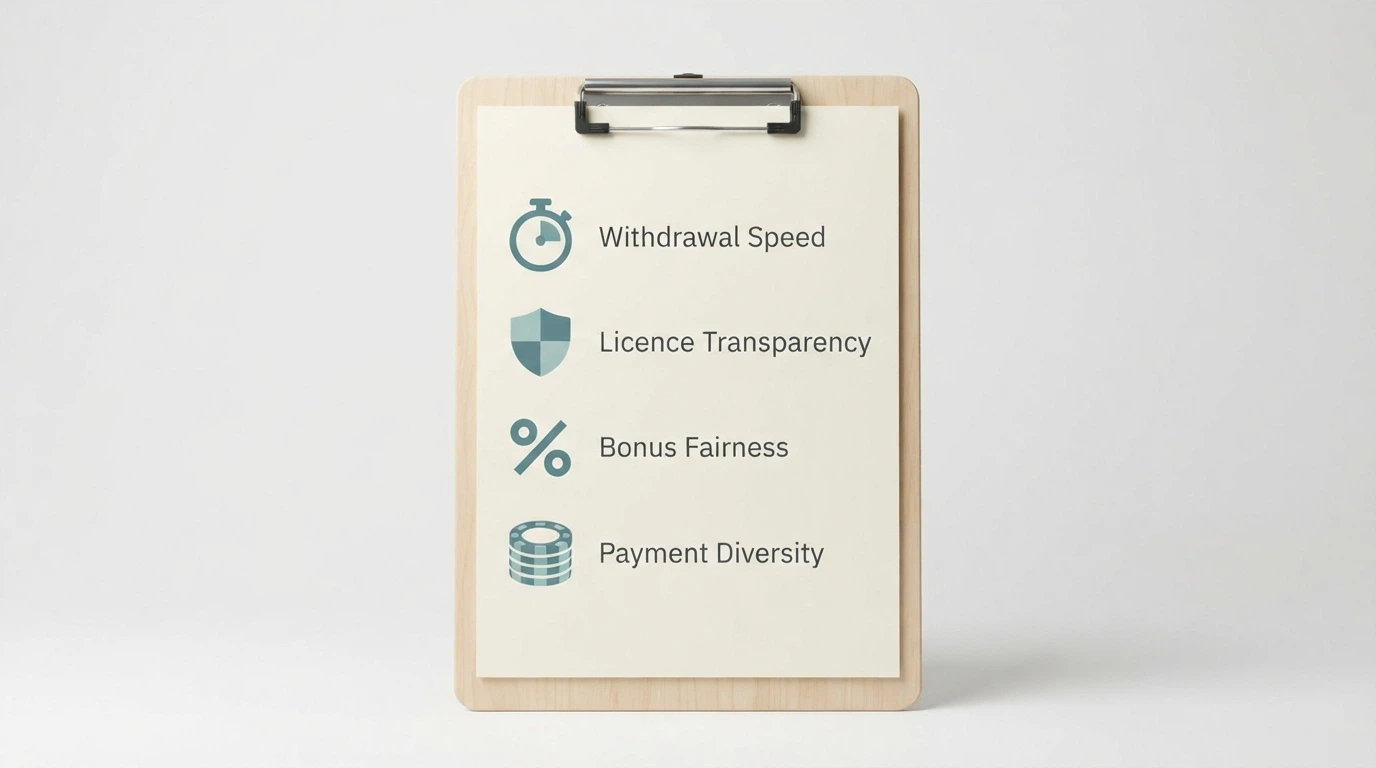
The operator set was constrained by data availability. Royal Reels, Scream Casino, Stake, WinSpirit, and FairGO were considered and excluded because their bonus or withdrawal data did not surface in this round of research at the depth required to rank them responsibly. King Billy’s dual MGA and GCA licence was verified against the listed registries; the other nine operators’ Curacao licences were confirmed via the regulator’s own database entries where available. No operator on this list holds an Australian licence — there is no such licence to hold — and the legal status is stated clearly in every entry.
The fundamental limitation of this ranking is the same as the fundamental limitation of every offshore-casino comparison: tested speeds reflect a snapshot. A casino that pays crypto in ten minutes today may pay in three hours next month after a payment-processor change, a staffing shift, or a regulatory event in its licence jurisdiction. The numbers in this page are accurate as of 22 November 2026 and the audit period that produced them; they are not a guarantee of future performance.
Is a Quick-Withdrawal Casino Worth the Trade-Off?
The honest answer sits on two sides and the reader has to weigh them.

The case for fast payouts at offshore casinos is straightforward. Tested crypto withdrawals at Neospin, SkyCrown, and BitStarz land in five to fifteen minutes — a speed that licensed Australian wagering operators do not match and that the Australian banking system does not deliver. For a crypto-native player who already holds USDT or Bitcoin, the combination of fast settlement and AUD-equivalent access is a real convenience. For a regular real-money player who values separating winnings from playing balance, the ability to withdraw inside the hour is a useful feature. The bonus offers at the top of this ranking — Neospin’s A$11,000 package, SkyCrown’s A$8,000 — are larger than anything available on the licensed Australian market, which does not offer online casino at all. The pure speed and bonus story is real.
The case against offshore play is also real, and it has more teeth. The player gives up every Australian consumer protection: no complaints body (ACMA cannot recover a player’s money from an offshore operator), no BetStop coverage, no recourse if the operator refuses a withdrawal, and the standing risk that the site is blocked at any time with a balance still inside. From 1 January 2027, banks gain express authority to block transactions to illegal gambling operators — which will affect the deposit and withdrawal rails available to Australians playing offshore. PayID and BPAY, because they run through Australian banks, are the rails most exposed; crypto, by running outside the banking system, is the rail least exposed. The player is also funding a market the regulator is actively trying to shut down — 1,788 sites blocked, AU$29.24 million in court penalties, and an enforcement posture that has only tightened since 2017.
The reader’s decision is not which side is right; it is whether the speed and bonus value outweigh the protection gap. A player who treats casino play as a closed entertainment transaction, sets a deposit limit they do not exceed, verifies the casino’s withdrawal pipeline with a small first withdrawal before committing larger amounts, and reads the bonus terms before claiming — that player will likely find the speed valuable. A player who is chasing losses, gambling with money they cannot afford to lose, or counting on Australian consumer protections to back them up in a dispute — that player should not be at an offshore casino, and the speed is irrelevant to the deeper problem.
Fast payouts are real. The protection gap is real too. The decision sits with the reader.
Frequently Asked Questions About Quick-Withdrawal Casinos in Australia
What is the minimum withdrawal amount at fast payout casinos?
Minimum withdrawals across the featured operators run between A$10 and A$20, with PlayAmo setting the floor at A$17 and most others in the same range. The minimum is the easier of the two limits — the ceiling (per-transaction, daily, weekly, or monthly) is the number that bites larger withdrawals. A player withdrawing in small increments pays more in relative fees than a player accumulating balance inside the casino.
Why does KYC delay my casino withdrawal?
Know Your Customer verification is the single biggest cause of delayed payouts. Anti-money-laundering law in nearly every licensing jurisdiction requires the casino to verify the customer’s identity, address, and source of funds before processing a withdrawal — and the check happens on the operator’s side, not the player’s. The fastest way through KYC is to submit documents proactively before requesting the first withdrawal.
Can I use PayID to withdraw from an online casino in Australia?
PayID clears through the New Payments Platform and is one of the fastest AUD-native rails — withdrawals typically land in one to sixty minutes after casino approval. PayID is not universally offered by offshore casinos, and from 1 January 2027 banks gain express authority to block PayID transactions to illegal gambling operators, so availability may narrow after that date.
What happens if an offshore casino refuses my withdrawal?
The ACMA cannot recover a player’s money from an offshore operator, and there is no Australian complaints body with that authority. A player whose withdrawal is refused is dependent on the casino’s own internal escalation and the regulator in the casino’s licence jurisdiction (Curacao, Malta, or the GCA). The strongest protection is to test the withdrawal pipeline with a small first withdrawal before committing a larger bankroll.
Do I have to pay tax on online casino winnings in Australia?
Betting and gambling winnings are not assessable income under section 6-5 of the ITAA 1997, and losses are not deductible under section 8-1, unless the person is carrying on a business of betting or gambling. The ordinary Australian punter who plays casino games recreationally does not declare winnings as income and cannot claim losses against other income. The wagering operator pays tax where the customer is, not the punter.
How does BetStop protect me if I play at an offshore casino?
BetStop does not protect a player who plays at an offshore casino. The National Self-Exclusion Register binds Australian-licensed wagering services only; an offshore casino is not connected to BetStop and will continue accepting a self-excluded person’s money. A player who has registered with BetStop and is gambling offshore needs additional measures (banking-side blocks, account closure with the offshore operator) to enforce the exclusion. The National Gambling Helpline at 1800 858 858 and Gambling Help Online are available regardless of where a person gambles.