
How Much a Low-Deposit Casino Actually Costs You in 2026
A ten-dollar note is the practical entry price for an Australian who wants to spin a real-money pokie online. Below that line, no honest fiat option exists for players in this country. Above it, every site on offer is hosted offshore, sits outside Australian law, and is bound by terms the ACMA cannot enforce. The arithmetic between those two points — what you actually pay to start, what the welcome bonus actually costs to clear, and which consumer protections stop the moment your deposit leaves an Australian bank account — is what this page lays out.
Data current as of 22 November 2026; verified against ACMA enforcement data and the operator terms pages cited below.
Table of Contents
- What You Actually Pay to Get Started at an Online Casino
- The Australian Low-Deposit Casino Landscape in 2026
- Real-Money Pokies and Casino Games at Minimum Stake
- Best Low-Deposit Casinos for Australians — Ranked and Compared
- Payment Methods That Accept a Small Deposit at Australian Online Casinos
- Why Your Small-Deposit Bonus Is Smaller Than the Advertised Number
- Is It Legal? What Australian Law Says About Offshore Casinos
- Staying in Control: Safer Gambling at Low Stakes
- How We Selected and Ranked These Low-Deposit Casinos
- What to Do With This Information — Your Next Move
- Frequently Asked Questions
What You Actually Pay to Get Started at an Online Casino
The deposit screen is where the marketing meets the maths. “Low deposit” gets used to mean almost anything in this market — anything from a dollar claimed in a headline to thirty dollars in practice, with crypto lowering the floor to a few cents in theory and fees erasing the advantage in practice. For an Australian player in 2026, the genuine fiat floor sits at A$10, set by the smallest Neosurf voucher denomination and reinforced by PayID’s anti-fraud thresholds and the per-transaction economics of card processing. Below that line, what is being advertised is a slogan, not a cashier.
The number on the deposit page is one thing; the number that actually clears your bank account is another. A PayID transfer settles in seconds through Osko and clears at A$5 to A$10 at most operators; a Neosurf voucher pins the floor at A$10 by the denomination printed on the card itself; a card deposit sits at A$10 to A$20 because processors charge per transaction and small amounts become uneconomic at scale; a Bitcoin deposit can hit A$0.10 at one Curaçao-licensed operator, but the network fee and the conversion spread inflate the true cost of moving that fraction of a cent into a usable balance. The minimums you see on screen are not arbitrary — they are the floor at which each rail stops losing the operator money.
That floor has a structural explanation, not a marketing one. Neosurf sells vouchers in fixed denominations; the smallest one printed for the Australian market is A$10, and any operator accepting a smaller amount would be subsidising the round-trip from the player’s wallet to its own balance sheet. PayID sits above its own anti-fraud thresholds — the A$5-to-A$10 band is where the banks’ monitoring systems stop flagging micro-transactions as suspicious. Card processors charge flat fees per transaction plus a percentage, which makes a A$5 deposit uneconomic at scale and pushes the floor toward A$10 to A$20. The A$5 fiat casino that headlines claim is, in the words of one industry review site, “a search engine listing, not a real product.”
The Dollar Threshold That Defines a Low-Deposit Site
The industry draws its lines in four bands, and each band unlocks a different shape of casino. A$1 is the headline tier — only four of 32 AU-facing sites tested in 2026 accepted a true A$1 minimum, and two of those were crypto-only. A$5 widens the field to 18 sites, almost all of them through PayID or crypto rails. A$10 is where the market actually opens: 28 of those 32 sites unlocked their full game libraries at this level, with Neosurf and card payments both clearing the threshold. A$20 to A$30 is the bonus-qualifying band, where the welcome package enters the picture — Skycrown’s first-deposit minimum is A$30, Bizzo’s is A$20, Royal Reels sits at A$10 for play but A$30 to claim the bonus.
Each tier trades one thing for another. The A$1 sites narrow the player’s choice of game and choice of payment; the A$10 sites unlock the full library; the A$30 sites unlock the bonus on top of the library. None of these are bad choices for the player they suit, but they are not the same choice, and treating them as one product is what makes most review pages in this space feel like a list rather than analysis. The headline “A$1 deposit casino” almost always means “A$1 deposit, crypto, on two specific sites” — and a player who lands on the page expecting a third option has been misled by the SEO, not the operator.
How a Low-Deposit Casino Differs from No-Deposit and Standard-Rate Sites
The spectrum runs in three bands, and the differences between them matter more than the deposit figure suggests. A no-deposit site gives the player a free chip or free spins on signup, with tight cashout caps and high wagering — Royal Reels runs an A$10 no-deposit free chip with 30x wagering and a maximum cashout cap stated on activation. A low-deposit site demands a small amount of real money — A$10 to A$20 — to enter the cashier, with or without a bonus. A standard-rate site sits at A$20 to A$30 and unlocks the full welcome package on top of the full library. The three are different products even when they sit on the same domain.
The trap is the gap between the play minimum and the bonus-qualifying minimum. Eight of 15 AU-facing brands surveyed in 2026 enforce a higher minimum for welcome-bonus eligibility than they do for play — a Royal Reels player can deposit A$10 and access the games, but the 100% match only triggers at A$30, which means a A$10 deposit collects no bonus at all. A reader who sees “100% up to A$500” and assumes it starts at A$10 has just missed the actual price of admission, and the marketing page will not draw their attention to it. The bonus is a separate product from the deposit, and the second product has its own price tag.
Free spins tell the same story at a smaller scale. A “100 free spins” headline at an AU-facing casino typically credits spins at A$0.10 to A$0.20 each, which puts the headline value at A$10 to A$20 in raw spin cost — and that is before the wagering on winnings, the maximum cashout, and the 5-day validity window that almost always accompanies them. The spin value is real, but it is rarely the value the headline suggests, and the wagering on spin winnings often runs at 35x to 40x, which puts the effective value of those 100 spins well below the A$10 to A$20 sticker.
The Australian Low-Deposit Casino Landscape in 2026
Every casino on this page is an offshore operation. This is the single most important fact about the Australian low-deposit market and the one that almost no review page in this space names plainly. The Interactive Gambling Act 2001, as amended in 2017, prohibits the supply of online casino games, online pokies and in-play betting to a person physically in Australia — and no licence for these products exists anywhere in the country, federally or in any state or territory. What an Australian player can access is the offshore market that has grown up to fill the gap, and that gap is not closing; it is widening.

The shape of that market is defined by what the regulator has done about it. Since its first blocking request in November 2019, the ACMA has had 1,564 illegal gambling and affiliate websites blocked by Australian ISPs, and more than 225 illegal services have withdrawn from the Australian market since enforcement was strengthened in 2017. The players on this page are reaching sites the regulator is actively trying to take offline, and the protections that apply to a licensed Australian wagering operator — Australian consumer law, an accessible complaints body, BetStop coverage, deposit limits enforced by the operator — stop at the border. The deposits keep flowing because the demand is real and the operators are outside the regime, not because the regulator has decided to look away.
The licensed side of Australian wagering is small by design. SportsBet, the state TABs, Bet365, Ladbrokes, PointsBet, Neds, Betr, Picklebet and Betfair are licensed for pre-event race and sports wagering only. None of them offers online pokies or table games in its licensed form; some carry casino products through offshore sister sites, but those products sit outside the licence. A reader searching for an online pokie in Australia is, by definition, looking at an unlicensed product, and the comparison between “licensed” and “low-deposit” is a comparison between two different markets that do not overlap on the casino side at all.
Australian-Facing Operators: Who Takes Aussie Players at Low Deposits
The brand list that surfaces for an Australian player is dominated by Curaçao-licensed and Anjouan-licensed operators, with a handful of operators whose licence jurisdiction did not surface in the public-facing data. Rocket Play, Skycrown, Royal Reels, WinSpirit, Stake, Rainbet, Fair Go Casino, Bizzo Casino, Scream Casino and Rocket Casino — those are the operators that rank highest by AU market visibility, and every one of them is hosted outside the country. None of them appears on an ACMA register, because the ACMA does not maintain a register of offshore operators; what the ACMA publishes is a list of blocked sites, and a reader can check whether their chosen casino is on it.
The payment rails these operators use to reach Australian players are themselves a signal. The Interactive Gambling Amendment (Credit and Other Measures) Act 2023 banned credit cards, credit-related products and digital currency as payment for online wagering from 11 June 2024, with penalties of up to A$247,500 for non-compliance. An Australian player who can deposit with a credit card or with Bitcoin is being served by a site operating outside the Australian rules — the credit-card and crypto acceptance is itself a marker that the operator is not bound by the regime the licensed wagering industry lives under. The same rail that makes the deposit convenient also confirms the operator’s status.
What survives is PayID, bank transfer, Neosurf and a handful of e-wallets. PayID handles deposits from A$5 to A$10 at most operators; Neosurf pins the floor at A$10 by the voucher’s printed denominations; cards sit at A$10 to A$20; crypto at A$15 to A$30 equivalent once network fees are netted. These are the rails that carry a low-deposit player into an offshore casino from an Australian bank account, and they are also the rails that will be reshaped when the 1 January 2027 bank-blocking powers come into force. A reader choosing a payment method in 2026 is making a choice about how exposed they want to be when those powers activate.
Real-Money Sites That Accept Australian Players at Low Stakes
Playing for real money at A$10 to A$20 looks almost identical to playing at A$200, with two exceptions. The first is library access: 28 of 32 sites tested in 2026 unlock their full game libraries at A$10, which means the small deposit does not lock a player out of any title — every featured pokie, every live-dealer table, every progressive jackpot is on the table at the same minimum spin. The second is the bonus: a deposit below the bonus-qualifying threshold means no welcome package, no free spins, no match — and the player is paying real money for raw spins with no marketing buffer between them and the house edge. The math is identical; the marketing is missing.
The RTP on the games does not change with the deposit. Online pokies sit in the 94% to 97% RTP band regardless of whether the player funded with A$10 or A$1,000 — the math is the math, and the games pay out the same percentage to every player. The library scale does change: Bizzo Casino carries 8,000-plus titles from more than 70 providers, while a smaller operator may offer a few hundred — but the games inside any one of those libraries pay the same return at minimum spin as at maximum. A low-deposit player is not getting worse odds; they are getting less runway, which is a different problem and one the player can solve with a budget rather than a different site.
The thing a small deposit does change is the runway. A A$0.20 spin at a 96% RTP eats about A$0.008 per spin in expected house edge — a player with A$10 has roughly 50 spins before the math says the balance should be at zero, and 5 of those 50 will on average return more than the spin cost, but the long-run drift is toward zero. That is the house edge doing its job, and it does not pause for the size of the deposit. A player who treats A$10 as the cost of a session rather than the seed of a winning streak is treating the deposit the way the operator’s pricing model assumes they will.
Low-Deposit Pokies on Mobile: Apps, Browsers and What Works
Every offshore casino in this space runs in a mobile browser. There is no native app distribution through the Australian App Store or Google Play storefront — Apple and Google both enforce content policies that exclude unlicensed real-money casino apps, so the Australian player reaches these sites through Safari, Chrome or a third-party browser. The mobile experience at minimum stakes is indistinguishable from the desktop experience at minimum stakes: the same games, the same cashier, the same deposit floor, the same bonus terms.
The trade-off is around browser choice rather than device choice. Some operators run progressive web apps that load faster and remember login state; others run straight HTML5 and rely on the device’s cache. A player who deposits from a phone should expect the deposit floor to match the desktop floor exactly — there is no mobile premium or discount on the minimum. What changes between mobile and desktop is rarely the maths; it is the ergonomics of seeing a pokie screen at five inches.
The minimum spin moves with the screen, not the operator. A A$0.10 spin on Gates of Olympus fits comfortably on a phone screen, and the spin button, balance display and bet adjuster all remain tappable at minimum size. The one place the mobile experience shifts is at the cashier — PayID through a mobile banking app is faster than entering card details on a phone keyboard, and Neosurf requires the player to type a 16-character voucher code that is unforgiving of typos. A player depositing A$10 from a phone should budget the typing time as part of the deposit cost.
Real-Money Pokies and Casino Games at Minimum Stake
A ten-dollar deposit does not restrict the player to one game. At minimum spin — typically A$0.10 to A$0.20 on the pokies most Australians actually play — a A$10 balance buys 50 to 100 spins on a single title, and the same balance unlocks the full library at most operators. The games available at this deposit level are the games available at any deposit level, with two practical differences: bonus eligibility and time at the table. The first is a marketing question; the second is a budget question. Neither changes the math on the reels.
The titles Australians actually spin are dominated by Pragmatic Play and a handful of other studios with proven mechanics and high visibility in the AU-facing SERPs. Sweet Bonanza 1000 was the most-played AU pokie in 2026; Gates of Olympus, Big Bass Bonanza and Wolf Gold round out the Pragmatic quartet that shows up across almost every featured operator. Big Time Gaming contributes Bonanza Megaways for the cascading-reels crowd, Play’n GO brings Book of Dead for the expanding-symbol holdovers, and BGaming rounds out the list with Wild Cash x9990 — a high-volatility title that sits in the same RTP band as the rest. These are not obscure picks; they are the titles a player will recognise from the lobby before they have deposited a cent.
What changes at minimum stake is the bet size, not the game. A pokie at A$0.10 per spin behaves mechanically the same as the same pokie at A$10 per spin — the reels spin at the same speed, the bonus features trigger on the same combinations, and the RTP sits at the same figure. The only thing the lower bet changes is the size of the payouts and the speed at which the balance moves; the RTP does not vary with the stake. That is a structural property of certified random number generators, not a marketing promise.
The Pokies You Can Spin at Minimum Stake — and Their RTPs
The seven titles below are the AU-facing pokies with verified return-to-player figures and a stable presence in the offshore lobby. The volatility column is filled only where research surfaced an explicit classification; for the rest, the row carries the article-language no-data marker rather than an inferred figure.
| Pokie | Provider | RTP | Volatility |
|---|---|---|---|
| Gates of Olympus | Pragmatic Play | 96.5% | High |
| Sweet Bonanza 1000 | Pragmatic Play | 96.48% | — |
| Big Bass Bonanza | Pragmatic Play | 96.71% | High |
| Wolf Gold | Pragmatic Play | 96.01% | Medium |
| Bonanza Megaways | Big Time Gaming | 96.0% | — |
| Wild Cash x9990 | BGaming | 96.01% | High |
| Book of Dead | Play’n GO | 96.21% | High |
Six of the seven titles cluster between 96.0% and 96.71% RTP — a 0.71-percentage-point band that is tight enough that the choice between them is mostly about volatility preference and feature design, not expected return. Sweet Bonanza 1000’s 96.48% is essentially identical to Bonanza Megaways’ 96.0% for any practical purpose, and the gap between Big Bass Bonanza at 96.71% and Gates of Olympus at 96.5% is half a percentage point — real money over thousands of spins, but not the deciding factor between two titles a player might enjoy the same.
The volatility split matters more for budget planning than the RTP does. A high-volatility pokie — Gates of Olympus, Big Bass Bonanza, Wild Cash x9990, Book of Dead — returns less of its payout in small, frequent wins and more of it in large, infrequent features. On a A$10 balance at minimum spin, that pattern shows up as long dry spells punctuated by the occasional bonus round; the balance moves in steps, not gradients. A medium-volatility pokie like Wolf Gold smooths that curve out — smaller features, more frequent, and a balance that drifts downward in a more predictable line. Neither pattern is kinder to the bankroll; they just feel different while the math grinds.
Table Games and Live-Dealer Tables at Low Stakes
Below the pokies, the offshore casino lobby expands into table games and live-dealer tables, and the bonus terms shape which of those games a small-deposit player can actually play through their bonus. Pokies typically contribute 100% of each bet toward wagering; table games often contribute 10% to 20%; live-dealer games sit somewhere between. A player clearing a A$700 wagering requirement on roulette at 20% weighting has to bet A$3,500 to clear the same requirement, and the expected loss on that A$3,500 is several times the loss on the equivalent slot play. The bonus pushes a low-deposit player toward pokies whether they would otherwise choose them or not.
The live-dealer floor itself does not gate by deposit size. A A$10 deposit unlocks the same live blackjack, live roulette and game-show tables as a A$1,000 deposit — what gates access is the table minimum, which is set by the studio rather than the casino. A live roulette table at A$0.50 per spin is playable on a small balance; a live baccarat table at A$5 per hand consumes the same A$10 in two hands. The deposit floor is the entry price; the table minimum is the per-hand price; a player needs both numbers before they sit down.
What research did not surface for this run is the per-title table minimum across the featured set, which is why no table appears in this section with concrete figures. The structural point stands without them: live-dealer access at minimum stake is real, but the cost per hand varies widely by table, and a player who loads a A$10 deposit into a A$5 baccarat table has bought two hands of decision-making, not a session. The deposit unlocks the room; the table minimum dictates how long the player stays.
Why a Ten-Dollar Deposit Opens More Than One Pokie Title
There are two minimums in a casino, and most players only see one. The first is the deposit floor — A$10 at most featured operators for the AU-facing fiat rails. The second is the per-game minimum, which on the pokies sits at A$0.10 to A$0.20 per spin. A player who treats the deposit floor as the only barrier sees one number; a player who treats the per-game minimum as the only barrier sees another; and the difference between those two numbers is the size of the lobby they can actually access.
The deposit floor determines library access; the per-game minimum determines play length. A A$10 deposit at an operator that unlocks the full library at A$10 — and 28 of 32 sites tested in 2026 do — gives the player every pokie, every table game, every live-dealer table, and every progressive jackpot the casino carries. The only restriction is the per-spin or per-hand minimum, and on most pokies that minimum is A$0.10 to A$0.20. A A$10 deposit at A$0.10 per spin is 100 spins; a A$10 deposit at A$0.20 per spin is 50 spins. The math is the same math the deposit floor sits above.
What the structural floor prevents is a genuinely A$5 fiat deposit reaching the full library. Of the four sites that accept a true A$1 minimum, two are crypto-only; of the 18 that accept A$5, most expose a restricted lobby with fewer providers and fewer features. The economics of running a full library with A$5 deposits do not work for the operator — the per-transaction cost of processing a PayID transfer eats into a margin that small balances cannot support. The A$10 floor is where the full product opens up, and the 28-of-32 figure is the empirical evidence of where the market has settled.
Best Low-Deposit Casinos for Australians — Ranked and Compared
The table below ranks ten offshore operators by their position in the AU-facing market, with the legal standing, welcome bonus, wagering requirement and free-spin count filled where research surfaced specific values. Every operator carries the same flag: offshore, unlicensed in Australia, and bound by terms the ACMA cannot enforce. The ranking is a map of what Australian players encounter, not a recommendation of where to play.
| Operator | Legal standing in Australia | Welcome bonus — first deposit | Wagering requirement | Free spins — count |
|---|---|---|---|---|
| Rocket Play | Offshore (unlicensed in AU) | 100% up to A$1,000 | 30x–40x bonus only | 100 on 1st dep |
| Skycrown | Offshore (Curaçao) | 120% up to A$1,200 | 40x bonus only | 125 on 1st dep |
| Royal Reels | Offshore (unlicensed in AU) | 100% up to A$500 | 35x bonus only | 50 |
| WinSpirit | Offshore (Curaçao) | — | 40x bonus only | — |
| Stake | Offshore (Curaçao) | — | — | — |
| Rainbet | Offshore (Anjouan) | 100% up to A$500 | 30x bonus+deposit | 100 (headline) |
| Scream Casino | Offshore (unlicensed in AU) | — | — | — |
| Fair Go Casino | Offshore (unlicensed in AU; RTG-powered) | 100% up to A$200 per dep | 30x deposit+bonus | — |
| Bizzo Casino | Offshore (unlicensed in AU) | 50%–125% tiered | 40x | 50–125 on 1st dep |
| Rocket Casino | Offshore (unlicensed in AU) | — | — | — |
Three things stand out from the columns. The legal-standing column is identical across all ten rows — there is no Australian licence for any of these products, and any operator claiming otherwise is misrepresenting its status. The wagering column, where filled, sits between 30x and 40x on the bonus, and the bonus model splits between bonus-only and deposit-plus-bonus — the second of which roughly doubles the effective playthrough at the same multiple. The free-spins count, where filled, ranges from 50 to 125 on the first deposit alone, with the headline package extending across multiple deposits for the larger welcome totals.
What the table does not show is the bonus-qualifying minimum, the bonus validity window, the maximum cashout from bonus winnings, or the game-weighting rules. Those numbers live in the write-ups below, and they reshape the comparison materially. A 100% up to A$1,000 match means A$25 to a player depositing A$25, not A$1,000; a 30x wagering requirement on a A$25 bonus means A$750 in turnover, not A$30,000; a 5-day bonus clock means the player has 120 hours to clear that turnover or the bonus expires. The headline is one thing; the terms are another.
Rocket Play
Rocket Play leads the AU-facing market by share and runs the most visible welcome package on this list — up to A$6,000 plus 300 free spins across multiple deposits, with the first deposit offering a 100% match up to A$1,000 plus 100 free spins. The minimum deposit sits at A$25 to A$30 depending on the current campaign, the wagering requirement runs at 30x to 40x on the bonus amount only, and the free spins are credited on Aztec Magic by BGaming — 20 on the first day, then 20 per day for four days after that, with winnings capped at A$300 and a 5-day validity on the bonus itself.
The two numbers that reshape the headline are the maximum bet and the bonus expiry. While the bonus is active, the maximum bet is A$7.50 — a player spinning at A$0.20 is well clear of that ceiling, but a player used to A$5 bets on a high-roller pokie will have to scale back to keep the bonus alive. The bonus expiry of 5 days is the harder constraint: a player depositing A$25 to claim the match must clear A$750 to A$1,000 in turnover inside 120 hours, which at A$0.20 per spin is 3,750 to 5,000 spins, or roughly 5 to 7 hours of continuous play. The bonus is generous on the ceiling and tight on the clock.
The maximum win from the bonus sits at A$5,000 — a cap that almost never bites on a A$25 deposit but rules out the five-figure outcome the headline A$6,000 figure might suggest. Rocket Play is the market-share leader for a reason: the brand visibility is real, the welcome package is competitive at the top tier, and the deposit floor sits in the band an Australian player actually pays. This package suits the player capable of clearing the 30x to 40x wagering requirement within the five-day limit; those who cannot will find the headline figure effectively out of reach.
Skycrown
Skycrown advertises the largest headline package on this list — 450% up to A$8,000 plus 400 free spins across four deposits, with the first deposit offering 120% up to A$1,200 plus 125 free spins on Wolf Treasure by IGTech. The minimum deposit sits at A$30 on the first deposit, A$40 on the third, A$50 on the fourth, and A$100 on the high-roller track. The wagering requirement is 40x on the bonus only, the bonus validity runs 14 days on the regular track and 5 days on the high-roller track, and the maximum bonus-to-cash conversion is capped at A$5,000 per welcome bonus.
The first-deposit minimum of A$30 is the highest on this list, and it is the number that excludes the smallest deposits. A player depositing A$10 to A$20 will reach the cashier, fund the account, and see the welcome package sitting above their head — they will not be inside it. Skycrown is the choice for a player willing to commit A$30 to A$50 on the first deposit, not the choice for a player testing the waters at A$10. The free spins on Wolf Treasure by IGTech carry no published RTP in the surfaced terms, which means a player claiming the 125 spins is buying into a game without verified return-to-player data — a small flag in a market where most competitors publish the figure.
The bonus validity window is the structural feature. Fourteen days on the regular track is generous against Rocket Play’s five; a player who deposits A$30 and claims the 120% match has A$3,600 to clear inside two weeks, which at A$0.20 per spin is 18,000 spins, or roughly 25 hours of play at the 5-second interval. The clock is workable but not loose. Skycrown presents the largest bonus ceiling on this list, making it an attractive option for players prepared to commit at least A$30 to their first deposit; the advertised A$8,000 package is genuine, though realistically out of reach for smaller depositors.
Royal Reels
Royal Reels sets the lowest fiat-deposit threshold among the featured operators at A$10 — the genuine entry point for an Australian player on a small balance. The welcome bonus is a 100% match up to A$500 plus 50 free spins on the first deposit, with the package extending to A$2,500 across three deposits. The wagering requirement is 35x on the bonus only, and the bonus only triggers at a A$30 minimum — the same play-versus-bonus gap that defines this market. A player depositing A$10 gets the games; a player depositing A$30 gets the games and the bonus.
The no-deposit offer sits alongside the welcome package: a A$10 free chip on signup, 30x wagering, with a maximum cashout cap shown on activation. That cap is the term a player should read before claiming — a no-deposit chip with a tight cashout ceiling can turn a winning streak into a withdrawal you cannot make, and the exact cap is not in the surfaced data. Royal Reels’s headline structure is the most generous at the bottom of the deposit range, but the gap between A$10 and A$30 is where most readers will land, and the gap is unbonused.
For a player depositing A$30, Royal Reels delivers a A$30 bonus requiring A$1,050 in turnover at 35x bonus-only — at A$0.20 per spin, that is 5,250 spins or roughly 7 hours of continuous play, with no max-bet pressure at that stake and no high-roller timer closing the window. Royal Reels appeals to those seeking the lowest fiat entry point, provided they are willing to commit the A$30 required to trigger the welcome bonus — anything less merely provides access to the games without the extra funds.
WinSpirit
WinSpirit runs an A$10 minimum deposit and 40x wagering on the bonus portion, sitting as a Curaçao-licensed offshore operator. The bonus specifics did not surface in this run — the welcome package terms, free-spin allocation, and bonus validity are not in the public-facing data the research pulled. The minimum is confirmed, the licence is confirmed, and the wagering model is confirmed; the rest is a gap a player should fill by reading the cashier terms before funding.
That gap matters more for WinSpirit than for an operator with a published welcome package. A player who lands on WinSpirit’s homepage sees the A$10 floor and the Curaçao licence; what they do not see is the size of the bonus they would claim, the games the free spins run on, or the time they have to clear the playthrough. The 40x bonus-only wagering is a moderate-to-steep figure against the 30x to 35x range other operators use, and the absence of free-spin data means a player cannot compare the headline packages across operators without leaving the page.
WinSpirit is a viable option for players who value a low deposit floor and a published wagering multiple, though the absence of specific welcome-package data on the operator’s public-facing site requires a direct visit to verify the full terms.
Stake
Stake sets the effective minimum below a dollar — roughly A$0.10 in BTC equivalent, the lowest deposit floor on this list by a factor of a hundred. The operator is Curaçao-licensed and crypto-only; the welcome bonus and free-spin structure for an Australian low-deposit context did not surface in this run. The deposit floor is real; the bonus picture is not in the data, and a player choosing Stake at low deposit is choosing the floor, not the welcome.
The crypto-only constraint reshapes what Stake is and what it is not. A player with Bitcoin, Ethereum or Litecoin in a self-custody wallet can deposit at a fraction of a cent; a player who needs to convert Australian dollars into crypto first pays the exchange spread, the network fee, and the time-to-confirmation. The headline A$0.10 minimum is genuinely true at the cashier; the cost of arriving at that cashier from an Australian bank account is several dollars and an hour or two of waiting. The minimum is real; the floor is not where it looks.
What the low floor unlocks is volume testing. A player who wants to evaluate a casino’s game performance, payout processing and customer support without committing more than a few cents has no better option on this list than Stake; the A$0.10 deposit is enough to spin the reels and enough to test the cashier, but not enough to clear any welcome package that might exist. The 2024 credit-card and crypto ban makes Stake, like every crypto-accepting offshore operator in this space, a marker of operating outside the Australian licensed regime. A player choosing Stake is choosing convenience over coverage, and the choice is theirs to make.
Rainbet
Rainbet runs a 100% welcome match up to A$500 plus 100 free spins on the headline path, with a VIP code path that reduces the free spins to 60. The wagering requirement is 30x on the bonus plus deposit — the deposit-plus-bonus model that roughly doubles the effective playthrough at the same multiple. The maximum cashout from the bonus is A$200, the lowest ceiling on this list, and the deposit cap under both the Wager Lock and No Wager Lock paths is A$700. The operator is Anjouan-licensed offshore.
The A$200 maximum cashout is the figure that defines Rainbet for a low-deposit player. A player depositing A$20 to claim the 100% match produces a A$20 bonus requiring A$1,200 in turnover at 30x deposit-plus-bonus — at A$0.20 per spin, that is 6,000 spins or roughly 8 hours of play. The expected loss on that turnover sits in the A$40 to A$50 range at a 96% RTP; the maximum cashout on the resulting balance is A$200. A player who hits a hot streak and turns the A$20 bonus into A$500 cannot withdraw the full amount; the ceiling is A$200, and the rest is forfeited. The welcome package is real; the upside is capped lower than at any other featured operator.
The dual structure — Wager Lock at 40x or No Wager Lock with gradual release — adds a layer of choice that does not exist at most competitors. The Wager Lock path holds the bonus until the playthrough is complete; the No Wager Lock path releases small amounts as the player wagers. Both paths cap deposits at A$700, which means Rainbet is not the operator for a player planning to fund a larger balance. Rainbet caters to players looking for a small-deposit bonus with a capped upside, accepting the Anjouan licence over the more common Curaçao alternatives.
Scream Casino
Scream Casino appears in the AU-facing SERPs and ranks on the visibility data, but the bonus specifics, minimum deposit, and wagering terms did not surface in the research for this run. The operator is offshore and not licensed in Australia; everything else is a gap a player would need to fill by visiting the site directly. The position in this ranking reflects market visibility, not a verified offer.
For a reader comparing operators, the absence of data is itself information. Scream Casino ranks tenth on visibility but offers no verifiable welcome package, no published minimum deposit, and no surfaced wagering requirement in the data the research could confirm. A player who chooses Scream on visibility alone is choosing a brand they cannot fully evaluate against the alternatives — and at this rank, the alternatives include operators with every term on the page. The choice is legitimate if the player is willing to visit the site and read the terms themselves; the choice is risky if they are not.
What can be said is the legal-status flag: Scream Casino is offshore, outside the Australian licensed regime, and bound by terms the ACMA cannot enforce. The same applies to every operator on this list. What differs is the depth of the public-facing data, and Scream Casino is the thinnest of the ten featured brands on that measure.
Fair Go Casino
Fair Go Casino is an RTG-powered operator with a rare trait in this market — no maximum cashout on deposit bonuses. The welcome package offers a 100% match up to A$200 per deposit across five deposits, taking the total to A$1,000; an alternate listing on a separate review site shows a 300% match up to A$3,000 plus 50 free spins, which is the same bonus under a different marketing wrapper. The minimum deposit sits at A$20, the wagering requirement is 30x on the deposit plus bonus — the deposit-plus-bonus model — and the absence of a maximum cashout on the bonus is the structural reason a player might choose Fair Go over the larger-headline alternatives.
The no-max-cashout term is genuinely rare in this market. Most featured operators cap bonus-to-cash conversion at A$5,000 or lower; Rainbet caps at A$200; some cap at the bonus amount itself. Fair Go’s structure lets a hot streak on the bonus pay out at its actual size, which is the feature a player chasing a meaningful win from a small deposit needs. The 30x deposit-plus-bonus wagering is moderate against the 40x bonus-only model Skycrown uses — the effective playthrough on a A$20 deposit with a A$20 bonus is A$1,200, comparable to Royal Reels’s A$1,050 on bonus-only at 35x. The cost is similar; the ceiling is not.
Fair Go appeals to players depositing A$20 to A$200 who value the absence of a maximum cashout cap over the size of the headline offer. The five-deposit structure rewards repeat play in a way single-deposit bonuses do not, and the no-cashout-cap term turns the bonus into a genuine extension of the deposit rather than a marketing prop with a ceiling. For a player who plans to come back, Fair Go is a competitive choice; for a player chasing the largest first-deposit headline, it may look smaller than the alternatives.
Bizzo Casino
Bizzo Casino runs the largest game library on this list — 8,000-plus titles from more than 70 providers — and a tiered first-deposit welcome bonus that rewards larger deposits with higher match percentages. The headline package reaches up to A$7,250 plus 175 free spins across four deposits; the first deposit itself is tiered, with A$20 to A$50 earning a 50% match plus 50 free spins and A$250+ earning a 125% match plus 125 free spins. The minimum deposit sits at A$20, the wagering requirement is 40x, and the bonus structure scales the reward with the risk.
The tiered structure is the feature and the trap. A player depositing A$20 — the minimum — earns a 50% match up to A$10 plus 50 free spins, which is a modest welcome against the 100% matches Royal Reels and Rocket Play run on their first deposits. A player depositing A$250 earns a 125% match up to A$312.50 plus 125 free spins, which is one of the larger first-deposit packages on the list. The structure rewards the player who commits more and gives the minimum-deposit player a smaller bonus than the marketing headline implies. The 40x wagering requirement is the steepest of the standard bonus models; combined with the deposit-plus-bonus model some operators use, the effective playthrough on a small deposit at 40x is roughly double that of a 35x bonus-only model.
Bizzo offers the largest game library featured here, rewarding those willing to deposit A$100 or more with the most competitive bonus tiers. For a player depositing A$20, the bonus is real but unremarkable; the library is the draw, not the welcome. The choice between Bizzo and a smaller-library competitor with a flatter bonus structure depends on whether the player values game variety or bonus size.
Rocket Casino
Rocket Casino is distinct from Rocket Play — a lower-profile operator with a PayID minimum of A$15 that puts it above Rocket Play’s A$25-to-A$30 welcome floor and below the A$10 entry that Royal Reels and WinSpirit offer. The bonus specifics and wagering terms did not surface in the research for this run, which is why the comparison table above carries em dashes rather than numbers for this operator. The PayID minimum is verified; the welcome package is not.
For a reader evaluating Rocket Casino against Rocket Play, the names are the only thing they share. Rocket Play runs a 100% match up to A$1,000 plus 100 free spins at a A$25-to-A$30 minimum with 30x-to-40x wagering; Rocket Casino runs a A$15 PayID minimum with no surfaced welcome. The lower entry price is a real feature for a player who values the floor over the welcome, but the absence of bonus data means a player cannot compare the headline packages without visiting the site. Rocket Casino ranks tenth because the surfaced data is the thinnest of the featured set after Scream Casino.
What can be said is the PayID minimum, which sits above the A$5-to-A$10 band most operators use and below the A$30 Skycrown charges. A player depositing A$15 has a higher entry price than a Royal Reels or WinSpirit player and a lower entry price than a Skycrown or Rocket Play player, with no published welcome package to anchor the comparison. The choice is legitimate if the player is willing to read the cashier terms; the choice is incomplete if they are not.
Payment Methods That Accept a Small Deposit at Australian Online Casinos
Three rails carry a low deposit from an Australian bank account to an offshore casino, and each rail imposes its own floor. PayID and bank transfer set the lowest fiat entry at A$5 to A$10; Neosurf and cards pin the floor at A$10 to A$20 by the denomination or the processing economics; crypto can drop lower in theory and land higher in practice once network fees and conversion spreads apply. Below A$10 in fiat, the rails stop moving — and the operators stop accepting.
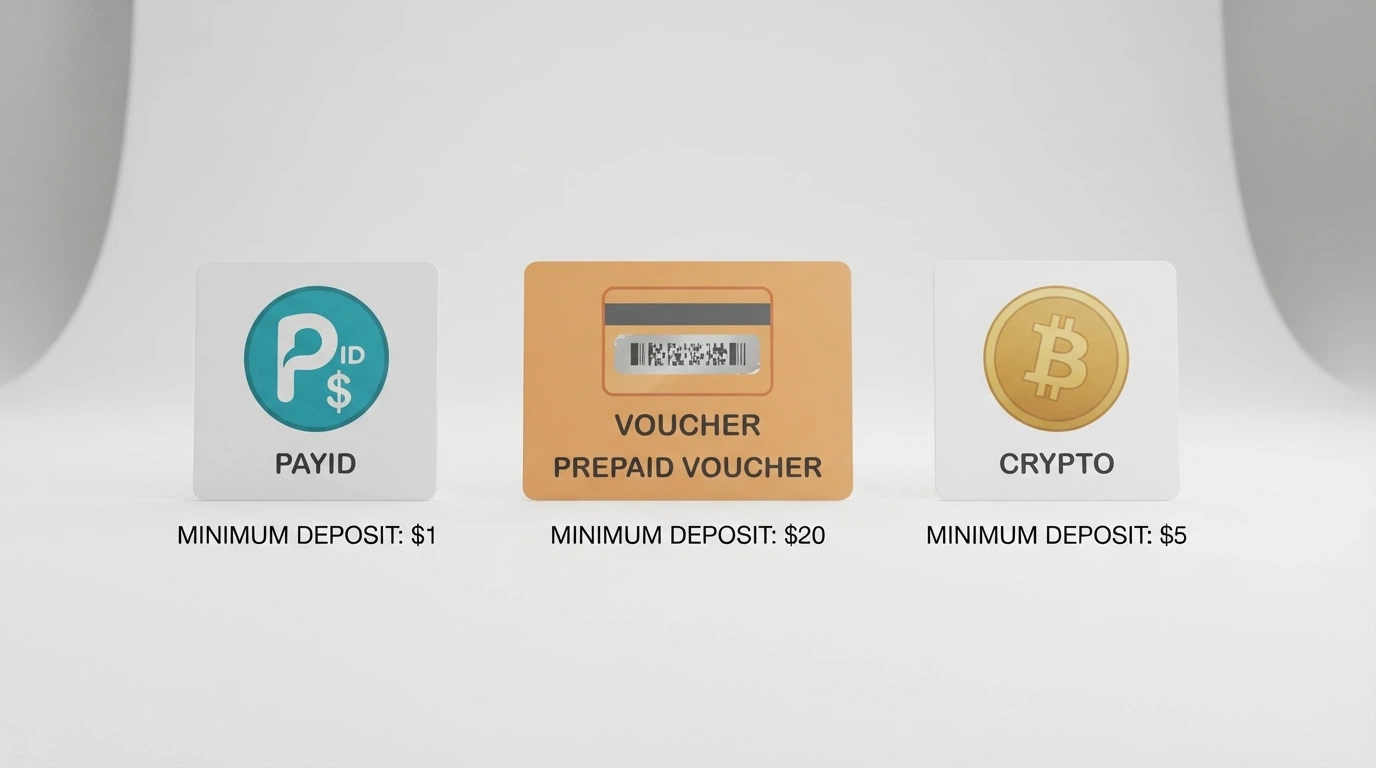
The structural reason no A$5 fiat option exists is not a marketing choice. Neosurf prints vouchers in fixed denominations, with A$10 as the smallest voucher sold in Australia; PayID sits above its own anti-fraud thresholds, where micro-transactions start triggering bank monitoring; card processors charge per-transaction fees that make sub-A$10 deposits uneconomic. The floor is set by the rails, not by the operators, and a player who sees an A$5 fiat casino advertised should read the cashier before they believe the headline. The A$10 number is the empirical answer to “what is the lowest deposit I can make,” and the rails explain why.
The June 2024 ban reshaped which rails survive. Credit cards, credit-related products and crypto are banned as payment for online wagering by any Australian-licensed operator; the same ban covers credit-related digital products. An Australian player who can deposit with a credit card or with Bitcoin at an offshore casino is being served by an operator outside the licensed regime — the rail that makes the deposit possible is the rail that confirms the operator’s status. From 1 January 2027, banks and payment providers gain express authority to block transactions to illegal operators, which will reshape which rails survive for AU-facing offshore play in the year that follows.
PayID and Bank Transfer: The Lowest Fiat Rail for Australians
PayID is the cheapest fiat deposit method for AU players, with most operators clearing PayID transfers at A$5 to A$10 and settling them in seconds through Osko. The rail is fast, the floor is low, and the anti-fraud thresholds that keep it above A$5 are the same thresholds that would flag a casino for suspicious activity if it accepted smaller deposits. PayID sits at the bottom of the fiat stack because it sits at the bottom of the bank’s tolerance for micro-transactions, and the tolerance is what limits the floor.
A player using PayID at a Royal Reels or WinSpirit account clears at A$10; at Rocket Casino, the same rail clears at A$15; at Skycrown, the A$30 first-deposit minimum applies regardless of rail. The PayID minimum does not move with the bonus-qualifying minimum — a player depositing A$10 via PayID at Royal Reels gets the games, while the same A$10 via PayID at Skycrown does not even reach the deposit threshold. PayID unlocks the casino; the casino’s own minimums unlock the bonus. The two are different prices.
The 1 January 2027 bank-blocking powers change the picture materially. Banks and payment providers gain express authority to block transactions to illegal gambling operators, which means PayID transfers to offshore casinos may be declined at the bank level rather than at the cashier. The rail survives in 2026; whether the rail survives in 2027 depends on the bank’s interpretation of which operators are “illegal” under the new powers. A player choosing PayID in 2026 is making a choice about a rail that may not work in the same way a year later.
Neosurf and Cards: The A$10 Fiat Floor
Neosurf vouchers set the genuine fiat floor — A$10 by the denomination printed on the card itself, sold at newsagents and convenience stores across Australia. The voucher is a fixed-value token; the player buys a A$10 or A$20 or A$50 voucher, enters the 16-character code at the casino cashier, and the balance is credited. There is no card processing fee, no bank monitoring threshold, and no foreign-exchange spread — what is on the voucher is what hits the account. The floor is the floor because the voucher is the voucher.
Card deposits sit at A$10 to A$20 because processors charge per transaction, and the percentage fee plus the flat fee makes smaller deposits uneconomic at scale. A player depositing A$5 by Visa or Mastercard pays a flat fee that consumes most of the deposit; the operator eats the rest. The market has settled on A$10 as the floor because the operator needs at least A$10 of cleared funds per transaction to make the math work, and the banks will not approve a card processor that subsidises sub-floor deposits. The A$10 figure is not a marketing choice; it is a per-transaction breakeven.
The structural reason no A$5 fiat option exists is the combination of the three rails. Neosurf cannot go below A$10 by voucher denomination; cards cannot go below A$10 by processing economics; PayID cannot go below A$5 to A$10 by anti-fraud thresholds. Below A$10, no rail moves the deposit from a player’s wallet to the casino’s balance sheet at a cost the operator can absorb. The floor is structural; the marketing that suggests otherwise is misleading.
Crypto Deposits: Lower Minimums, Different Risks
Crypto deposits can go below a dollar in theory and they do — Stake accepts roughly A$0.10 in BTC equivalent, the lowest minimum on this list. The floor is set by the Bitcoin network’s dust limit rather than by the casino, and a player with a self-custody wallet can move a fraction of a cent into a casino account in a single transaction. The headline number is real; the cost of arriving at that headline from an Australian bank account is several dollars in exchange spread plus a network fee that varies with congestion.
The conversion spread is the hidden cost. A player buying Bitcoin on a local Australian exchange, transferring it to a self-custody wallet, and depositing at Stake pays the exchange’s buy-spread (typically 1% to 2% on retail platforms), the Bitcoin network fee (variable, often A$2 to A$10 during congestion), and the casino’s own conversion rate from BTC to AUD if the games are denominated in fiat. The A$0.10 deposit at Stake becomes a A$15 to A$30 commitment once the rails are netted. The headline is genuine; the all-in cost is not what the headline suggests.
The 11 June 2024 ban makes crypto acceptance at an offshore casino a marker of operating outside the licensed regime. Any Australian-licensed operator must refuse crypto deposits; an offshore operator that accepts them is, by definition, outside the rules. The penalty for non-compliance under the Interactive Gambling Amendment (Credit and Other Measures) Act 2023 is up to A$247,500 — a figure that confirms the seriousness of the ban and the marker that crypto acceptance represents. A player depositing with Bitcoin is depositing through a rail that the licensed side of the market has explicitly rejected, at an operator that has accepted the legal exposure of taking it.
Why Your Small-Deposit Bonus Is Smaller Than the Advertised Number
The headline figure is the ceiling, and a low-deposit player never reaches it. A “100% up to A$1,000” welcome bonus on a A$25 deposit is A$25, not A$1,000; a “450% up to A$8,000” package on a A$30 deposit is A$135, not A$8,000. The advertised maximum is the figure a player would earn by depositing the maximum qualifying amount, which is almost always higher than the deposit floor. The smaller the deposit, the smaller the bonus; the headline does not move with the deposit size, but the bonus does.

The terms shrink the bonus further. A 40x wagering requirement on a A$25 bonus means A$1,000 in turnover before withdrawal; a 5-day bonus clock means the player has 120 hours to clear that turnover; a maximum bet of A$7.50 means the player cannot accelerate the playthrough with high-stake spins. A bonus that looks like A$25 in headline value costs the player A$25 plus the expected house edge across A$1,000 of turnover before it converts to withdrawable cash, and the expected house edge on a 96% RTP pokie is 4% of turnover — A$40 in expected loss on a A$25 bonus. The bonus is negative expected value at the time of the deposit, and the player should claim it with that understanding.
What the terms deliver, in the order they bite, is: the deposit floor that excludes the smallest players, the wagering multiple that turns the bonus into a clearance task, the bonus clock that limits the time to clear it, the maximum bet that prevents high-stake acceleration, the maximum cashout that caps the upside, and the game weighting that channels play toward high-house-edge pokies. Every term shrinks the bonus relative to the headline; together, they shrink it by more than the headline suggests. The marketing is not lying; it is just not telling the whole story.
How Deposit-Match Offers Work When You Put In Less
A deposit match is a percentage of the deposit amount, capped at a maximum. The “100% up to A$500” headline means: the casino matches the deposit dollar-for-dollar, up to A$500 in bonus funds. A player depositing A$500 receives A$500 in bonus, for a total balance of A$1,000; a player depositing A$30 receives A$30 in bonus, for a total balance of A$60; a player depositing A$10 receives nothing, because the bonus trigger sits above A$10. The headline scales linearly with the deposit until it hits the ceiling, and the ceiling is rarely reached at minimum deposit.
Royal Reels is the cleanest illustration. The advertised package is 100% up to A$500 on the first deposit, with 50 free spins on top. A player depositing A$30 — the bonus-qualifying minimum — earns A$30 in bonus, plus the 50 free spins, for a total bonus value of roughly A$30 plus A$10 in spin value at A$0.20 each. A player depositing A$500 earns A$500 in bonus plus the same 50 free spins. The headline stays at “up to A$500 + 50 free spins” in both cases; the actual bonus scales with the deposit. A reader who reads the headline and assumes the A$500 is the floor has misread the offer.
The structural reason the bonus scales this way is that the casino’s exposure is capped. A 100% match with no ceiling would let a player depositing A$10,000 walk away with A$10,000 in bonus funds plus whatever the wagering produced; the ceiling is the casino’s hedge against a player who funds heavily and clears quickly. The same hedge is what excludes the smallest players — a casino that offers a 100% match with no minimum is offering free money to anyone who funds A$1 and clears the wagering. The bonus-qualifying minimum and the ceiling are two sides of the same risk-management structure, and both shrink the bonus relative to the headline for low-deposit players.
Playthrough Multipliers, Time Pressure and the Higher Bonus Trigger
Three terms combine to shrink a small-deposit bonus: the wagering multiple, the bonus validity window, and the maximum-bet cap. A fourth term — the game-weighting rule — shapes how the player can clear the playthrough. None of these are unique to offshore operators, and none of them are hidden in the terms; they sit in the bonus terms page that most players do not read. The cost of not reading them is the gap between the headline bonus and the realised bonus, which is the largest gap on the page.
The wagering multiple is the dominant cost. A 35x bonus-only playthrough on a A$20 bonus means A$700 in turnover; a 40x bonus-only playthrough on a A$30 bonus means A$1,200 in turnover; a 30x deposit-plus-bonus playthrough on a A$20 deposit earning a A$20 bonus means A$1,200 in turnover. The lower the multiple, the smaller the cost; the deposit-plus-bonus model at a lower multiple roughly doubles the effective playthrough versus the bonus-only model at the same multiple. Skycrown’s 40x bonus-only wagering on a A$30 deposit earning A$36 in bonus requires A$1,440 in turnover; Fair Go’s 30x deposit-plus-bonus on a A$20 deposit earning A$20 requires A$1,200 in turnover. The numbers are similar; the models are not.
The bonus validity window is the second constraint. Rocket Play’s 5-day expiry on the welcome bonus means a player depositing A$25 must clear A$750 to A$1,000 in turnover inside 120 hours, which at A$0.20 per spin is 3,750 to 5,000 spins or roughly 5 to 7 hours of continuous play. Skycrown’s 14-day regular validity is more generous against the same workload. The maximum-bet cap — A$7.50 at Rocket Play and Skycrown’s regular track, A$10 at Skycrown’s high-roller track — prevents a player from accelerating the playthrough by raising the stakes. A player spinning at A$7.50 at 5-second intervals would clear A$1,000 in turnover in roughly 19 minutes; the cap exists to prevent exactly that.
The bonus-qualifying minimum is the fourth constraint, and it is the one that excludes the smallest deposits. Eight of fifteen AU-facing brands surveyed in 2026 enforce a higher minimum for welcome-bonus eligibility than for play — Royal Reels’s A$10 play minimum and A$30 bonus trigger is the cleanest example. A player who reads the homepage and assumes “100% up to A$500” applies to their A$10 deposit has missed the bonus entirely. The headline does not advertise this gap; the cashier terms do.
The Real Cost of Clearing a Welcome Bonus
The arithmetic of clearing a small-deposit bonus is straightforward once the inputs are fixed. The Royal Reels welcome offer is a 100% match on a A$20 deposit, producing a A$20 bonus subject to 35x wagering on the bonus only — the model research confirms as one of the two standards in this market. Assuming only the bonus amount is wagered and the play runs on pokies in the 96% RTP band, the required turnover is A$700, and the expected loss on that turnover at a 4% house edge is roughly A$28.
That is the price of the bonus. The A$20 bonus is worth A$20 in headline value, but it costs A$28 in expected loss to clear — a negative expected value of A$8 before any max-bet cap, game-weighting restriction, or bonus-validity pressure is layered on. A player who hits the wagering target and converts the bonus to cash walks away with less than they would have walked away with by skipping the bonus and spinning the A$20 deposit directly. The bonus is a marketing wrapper, not a value-add, for a player who plays the math.
The 5-day bonus validity at Rocket Play and the 14-day window at Skycrown tighten this further. A player who does not clear the turnover inside the validity window forfeits the bonus and the winnings — a real outcome for any player who underestimates the workload. The math says roughly 5 to 7 hours of continuous play to clear A$750 to A$1,000 at A$0.20 per spin; the clock says 120 hours at Rocket Play, 336 hours at Skycrown regular. The arithmetic is generous in time; the discipline required to actually clear it is not.
The same calculation on a Fair Go 30x deposit-plus-bonus model tells a different story. A A$20 deposit earning a A$20 bonus requires A$1,200 in turnover at 30x, with expected loss at roughly A$48 on a 96% RTP pokie. The no-max-cashout term at Fair Go means the upside is uncapped, but the cost is higher — the player pays A$48 in expected loss to clear a bonus that is worth A$20 in headline value, a steeper negative-expected-value gap than the Royal Reels structure. The two models offer different prices for the same shape of bonus, and a player who reads only the headline cannot see which is cheaper.
Is It Legal? What Australian Law Says About Offshore Casinos
The honest answer is the short one. Online casino games and online pokies are prohibited in Australia; no licence for them exists anywhere in the country; every site offering them to Australians is operating outside Australian law. The Interactive Gambling Act 2001, as amended in 2017, makes it an offence to supply these products to a person physically in Australia, and the ACMA enforces the prohibition through civil penalty proceedings, ISP blocking, and referrals to the Commonwealth Director of Public Prosecutions. A player depositing at an offshore casino is using a product the regulator is actively trying to take offline.

The player is not the target of the law. The IGA targets the provider, not the individual user; there is no prosecution pathway against an Australian who deposits and plays at an offshore casino. That fact is genuine and it is the reason the offshore market persists — the demand is real, the supply is offshore, and the enforcement is on the supply side. A reader who understands the legal picture should also understand that the regulator’s silence about individual players is not the same as the regulator endorsing the product. The ACMA’s enforcement is the clearest signal about the product’s status under Australian law.
What the player gives up is the protection. No Australian consumer law applies to a dispute with an offshore casino; no Australian complaints body has jurisdiction to mediate a refused withdrawal or a voided bonus; BetStop does not cover offshore operators; ACMA cannot recover funds a player has lost at an unlicensed site. The deposit that leaves an Australian bank account crosses a border that Australian consumer protection does not follow, and the player is on the other side alone.
The Interactive Gambling Act and the Online Casino Prohibition
The Interactive Gambling Act 2001 prohibits the supply of online casino games, online pokies and in-play betting to a person in Australia. The 2017 amendments strengthened the prohibition, expanded the ACMA’s enforcement powers, and added the civil penalty regime that now drives the blocking-list activity. There is no licence for online casino anywhere in Australia — not federally, not in any state or territory. The licensed products are pre-event race and sports wagering, lotteries, and keno, through operators licensed by a state or territory (with the Northern Territory Racing and Wagering Commission through Licensing NT acting as the de facto national licensor for online wagering).
The ACMA enforces the prohibition through three mechanisms. First, civil penalty proceedings against providers, with penalties reaching the hundreds of thousands of dollars for ongoing breaches. Second, formal directions to Australian ISPs to block illegal services, with 1,564 websites blocked since November 2019 as of March 2026. Third, formal warnings and infringement notices that have prompted 225-plus services to withdraw from the Australian market since 2017. The enforcement is real, the volume is large, and the direction of travel is toward more blocking rather than less.
The credit-card and crypto ban that took effect on 11 June 2024 sharpens the picture. The Interactive Gambling Amendment (Credit and Other Measures) Act 2023 made it an offence for any Australian-licensed operator to accept credit cards, credit-related products or digital currency as payment for online wagering, with penalties of up to A$247,500 for non-compliance. An offshore casino that accepts credit cards or crypto from Australians is, by definition, operating outside the licensed regime — the rail that enables the deposit is the rail the licensed regime has explicitly forbidden. The ban is a marker; the operator’s response to the marker is informative.
What You Forgo When You Play at an Offshore Casino
The protections an Australian consumer takes for granted stop at the border. There is no Australian consumer law covering a dispute with an offshore casino; no Australian complaints body has jurisdiction; no Australian court has a straightforward pathway to enforce a judgment against an operator hosted in Curaçao or Anjouan. The deposit that leaves an Australian bank account crosses into a jurisdiction the ACMA can flag but cannot police, and the player who has a problem at the cashier has no Australian remedy.
BetStop does not cover offshore casinos. The National Self-Exclusion Register binds Australian-licensed wagering services only — an offshore operator is not connected to the register, and a self-excluded Australian can still open an account, deposit, and play. The BetStop coverage gap is the structural reason offshore casinos are a particular risk for players managing gambling harm: the exclusion that stops a player at SportsBet or the TAB does not stop them at Royal Reels or Skycrown. As of 31 July 2026, 41,290 active exclusions were on the register; none of them reach the operators on this page.
The site itself can be blocked while the player’s balance is on it. ACMA has directed ISPs to block 1,564 illegal gambling websites since November 2019, and the blocking list grows monthly. A player who holds a balance at an operator that is added to the blocklist loses access to the site from an Australian IP address, and the ACMA cannot recover the balance — the regulator can block the site, not refund the player. The risk is structural, not hypothetical: 1,564 sites have already been blocked, and there is no reason to think the next one will not be the operator a player is using.
The 2026 Gambling Reform — What Changes and When
The Interactive Gambling Amendment (Gambling Reform) Bill 2026 passed Parliament on 19 August 2026, and its substantive measures commence on 1 January 2027. The reform reshapes the licensed side of the market and tightens the noose on the offshore side through four mechanisms: AdStop, inducement bans, advertising restrictions, and bank-blocking powers. The reform does not legalise online casino; it strengthens the prohibition and adds tools to enforce it.
AdStop is the national wagering advertising opt-out register, administered by the ACMA. Australians who do not want to see wagering advertising can register, and licensed operators must suppress advertising to registered individuals. The register does not reach offshore operators — the operators on this page are not licensed and not bound by Australian advertising rules — but it does reduce the licensed-side advertising footprint that drives some players toward offshore alternatives in the first place. The marketing pressure on the licensed side is set to ease.
The inducement bans are the sharper tool. From 1 January 2027, licensed operators cannot market inducements to a customer for 14 days after signup, for 90 days after the customer deregisters from BetStop, and indefinitely for customers identified as at risk. The bans target the bonus-driven acquisition model the licensed wagering industry uses, and they apply to licensed operators only. Offshore operators are not bound by the inducement bans, which is why their welcome packages will continue to advertise “100% up to A$1,000” while the licensed side cannot.
The bank-blocking powers are the mechanism that affects every player directly. From 1 January 2027, banks and payment providers gain express authority to block transactions to illegal gambling operators, which means a PayID transfer to an offshore casino may be declined at the bank level rather than at the cashier. The reform does not specify which operators are “illegal” for the purpose of the blocking power — that determination sits with the banks and the ACMA — but the direction of travel is clear: the rails that carry an Australian deposit to an offshore casino are set to narrow. A player choosing PayID or card in 2026 is choosing rails that may not work the same way in 2027.
Staying in Control: Safer Gambling at Low Stakes
A small deposit does not automatically mean a small risk. The math on a A$10 deposit at 96% RTP says the balance should drift toward zero over 50 to 100 spins, and that drift is the same whether the player set a budget or not — the difference is whether the player stops when the budget is gone or continues until the bankroll is. The harm-minimisation tools that exist for Australian players are partial: BetStop covers licensed wagering only; deposit limits on offshore casinos are operator-set and not always enforced; the National Gambling Helpline is free, confidential, and 24/7 for anyone who needs it.
The 2022 prevalence data tells the underlying story. About 2.1% of Australian adults — roughly 430,000 people — experience problem gambling; the AIHW put high-risk gambling at 1.8% in 2022; 11% of Australians had gambled online in the previous six months, up from 8% in 2020. Australians lose approximately A$25 billion on legal forms of gambling each year, and 46% of those who gambled were classified as being at some risk of harm on the Problem Gambling Severity Index. The numbers are not about offshore casinos specifically; they are about the population that gambles, and that population is the population the offshore market reaches.
The tools that work best are the ones the player sets before they deposit. A budget decided at the kitchen table holds when the cashier does not; a time limit set on a phone alarm stops the session when the impulse to continue does not. The National Consumer Protection Framework for Online Wagering includes deposit limits, monthly activity statements, easy account closing, and BetStop — all measures that apply to licensed wagering. Offshore casinos are not obliged to offer these tools, and the player cannot assume they will.
Deposit Limits, Budgeting and the GambleAware Guidelines
GambleAware NSW recommends three concrete guidelines: spend no more than 2% of take-home pay on gambling; gamble no more than once a week; engage with no more than 2 types of gambling. The 2% figure is a budgeting anchor, not a withdrawal-rate target — a player who earns A$1,000 a week after tax and spends A$20 a week on gambling is at the recommended ceiling; a player who earns the same and spends A$50 is two-and-a-half times over it. The numbers are conservative on purpose, and they apply whether the gambling is licensed or not.
Setting a deposit limit on an offshore casino account is operator-specific, not industry-standard. Some featured operators offer deposit limits at the account level; others do not; none of them are bound by the National Consumer Protection Framework measures that apply to Australian-licensed wagering. A player who sets a A$20 weekly deposit limit at a casino that does not enforce the limit has set a personal budget rather than a platform-enforced cap. The distinction matters because the personal budget relies on the player’s own discipline; the platform cap relies on the operator’s compliance.
The activity-statement gap is similar. The National Consumer Protection Framework requires monthly activity statements from licensed operators, showing the player their deposit, withdrawal, and net position over the month. Offshore casinos are not required to issue these statements; some do, most do not. A player who wants to know what they spent last month at an offshore casino is asking the operator for data the operator is not obliged to provide. The player who keeps their own records — a spreadsheet, a notebook, a banking-app notification — has the data the offshore operator does not have to give them.
BetStop, Self-Exclusion and Where to Get Help
BetStop is Australia’s national self-exclusion register, administered by the ACMA. It went live in August 2023 and had 67,480 registrations by mid-2026, with 41,290 exclusions still active as of 31 July 2026. The minimum exclusion period is 3 months; the maximum is lifetime; 38% of registrants chose lifetime exclusion; 78% of registrants were under 40. The register binds Australian-licensed wagering services only — every operator on this page is outside the regime and not connected to BetStop.
The gap is the structural risk for players managing gambling harm. A player who registers with BetStop stops themselves from accessing SportsBet, the TABs, Bet365, Ladbrokes and the rest of the licensed field. The same player can still open an account at Royal Reels, deposit via Neosurf, and spin pokies for as long as the offshore operator accepts them. BetStop closes the licensed door; the offshore door is open. The 41,290 active exclusions represent 41,290 players who wanted to stop, and the offshore market is where some of them will land if the offshore gap is not addressed.
The National Gambling Helpline is 1800 858 858 — free, confidential, available 24/7, with online chat through Gambling Help Online. The helpline covers all forms of gambling harm, licensed and unlicensed; the counsellors are trained to work with players, families, and financial counsellors. Financial counselling services for gambling-related financial difficulty have expanded under the 2026 reform and remain free through state-based organisations. The help exists; the question is whether the player reaches for it before the bankroll does.
The most damning statistic on this page is the help-seeking rate. Only 6.6% of moderate-risk gamblers and 44.2% of people experiencing problem gambling reported ever seeking help, either professional or informal. The majority of players who reach the threshold of problem gambling never call the helpline, never register with BetStop, never see a counsellor — and the offshore market, which sits outside all three referral pathways, is where some of them end up. A reader who recognises themselves in any of the prevalence numbers should call the helpline before they deposit, not after.
How We Selected and Ranked These Low-Deposit Casinos
The ranking is a market-visibility map, not a quality judgment. The ten operators featured here were drawn from the AU market-share data filtered for casino and pokies products, then checked against the ACMA’s enforcement record and the public-facing operator terms pages. Every operator on this list is offshore; every operator sits outside the Australian licensed regime; the ranking reflects where Australian players actually encounter brands in this space, not a recommendation about where to play.
The evaluation criteria were four: minimum deposit accessibility, bonus-term transparency, wagering fairness, and data completeness. Minimum-deposit accessibility was measured by the lowest deposit accepted via fiat rails accessible to Australian players, with Neosurf and PayID weighted over crypto for accessibility. Bonus-term transparency was measured by whether the welcome package terms — match percentage, maximum, wagering multiple, validity window, max bet, max cashout — were available on the public-facing operator pages without an account login. Wagering fairness was measured by the effective playthrough on a minimum-deposit bonus, comparing bonus-only and deposit-plus-bonus models. Data completeness was measured by whether the surfaced terms covered the criteria a player would need to compare offers head-to-head.
The legal-status check is the most important filter. Every operator on this list was confirmed offshore and unlicensed in Australia; none was excluded on that basis because no AU-licensed online casino product exists. The ranking necessarily covers offshore operators because the licensed alternative is not a casino product — it is a wagering product, and the two are not interchangeable. A reader who wants a licensed alternative for casino-style gaming does not have one to choose.
The data gaps are real and they are named. WinSpirit, Stake, Scream Casino and Rocket Casino had limited bonus-specific data surfaced in this run; the table above marks the missing fields with em dashes rather than omitting the operator or fabricating the figures. The same applies to specific titles and providers where research returned no RTP figure. The ranking prefers operators with full data over operators with sparse data on a tie; the ranking does not invent terms to fill the gaps.
What to Do With This Information — Your Next Move
The page has shown four things: every low-deposit casino available to an Australian player is offshore; the fiat floor is A$10; bonuses carry a real cost that the marketing does not advertise; and consumer protections do not travel with the deposit. What a player does with those facts is their own decision, and the decision should be made before the deposit, not after.
A player who chooses to deposit at an offshore casino should do three things first. Read the bonus terms page before funding the account, especially the wagering multiple, the validity window, the maximum bet, and the bonus-qualifying minimum — the gap between the play minimum and the bonus trigger is where most players lose the bonus. Set a personal deposit limit the casino does not enforce for them, and treat that limit as a hard ceiling rather than a target. Check whether the operator is on the ACMA blocklist, and treat a positive match as a reason to choose a different operator before the balance is at risk.
A player who is not sure whether they should be depositing at all should call the National Gambling Helpline on 1800 858 858 before they fund the account. The call is free, confidential, and 24/7. A 10-minute conversation with a counsellor costs the player nothing and may give them a clearer picture of whether the A$10 deposit they are about to make is entertainment, habit, or something else. The 6.6% help-seeking rate among moderate-risk gamblers is the statistic that justifies the suggestion; the helpline is the mechanism that delivers it.
The licensed side of Australian gambling does not offer what an offshore casino offers. SportsBet, the TABs, Bet365 and the rest offer pre-event race and sports wagering, lotteries, and keno — no pokies, no table games, no live-dealer tables. A player who wants those products has chosen the offshore market by the act of wanting them, and the choice is theirs to make with full information. The information is what this page has tried to deliver.
Frequently Asked Questions
What is the lowest deposit I can make at an online casino in Australia?
The genuine fiat floor for Australian players is about A$10, set by Neosurf voucher denominations and reinforced by PayID anti-fraud thresholds. PayID accepts A$5 to A$10 at some operators; crypto can drop lower in theory — Stake takes roughly A$0.10 in BTC equivalent — but network fees and conversion spreads erode the advantage fast. Below A$10 in fiat, no honest Australian-facing casino exists.
Are $1 deposit casinos real or a marketing trick in Australia?
Of 32 AU-facing sites tested in 2026, only 4 accepted a true A$1 deposit, and 2 of those were crypto-only. The realistic fiat floor is A$10 via Neosurf, with PayID at A$5 to A$10 and cards from A$10 upwards. A$1 casino offers are a marketing headline, not a product category, and the gap between the claim and the cashier is structural rather than accidental.
What happens to my money if an offshore casino blocks Australian players?
Since November 2019, ACMA has had 1,564 illegal gambling websites blocked by Australian ISPs, with 225 more services withdrawing entirely since 2017. If an offshore casino is added to the blocklist while the player’s account holds a balance, their access disappears with it. ACMA cannot recover player funds from unlicensed operators; once the site is blocked, the balance is effectively stranded with no Australian remedy.
Is BetStop connected to the offshore casino I am using?
No. BetStop — the National Self-Exclusion Register — binds Australian-licensed wagering services only. Offshore casinos are not connected to the register, so a self-excluded Australian can still open an account, deposit, and play at any offshore site. As of 31 July 2026, 41,290 exclusions were active on the register; none of them reach the operators featured on this page.
How do wagering requirements work on a small deposit bonus?
A wagering requirement is the multiple of the bonus that must be bet before withdrawing. On a A$20 deposit earning a A$20 bonus, a 35x bonus-only playthrough means A$700 in total bets. At a 96% pokie RTP, the expected cost of clearing the bonus is roughly A$28 — that is the realistic price of the bonus before any maximum-bet cap or game-weighting rule applies. The bonus is a clearance task with a cost, not free money.