
A$10 PayID Casinos for Australian Players in 2026
 Available in AU
Data current as of 22 October 2026, cross-checked against the ACMA register and each operator’s published terms.
There is no such thing as a licensed A$10 no-deposit PayID casino in Australia. Online casino is prohibited under the Interactive Gambling Act 2001 — no Australian licence exists for online pokies, online casino games or in-play betting. Every operator offering this product to Australian players is an offshore entity, operating outside Australian law and outside every Australian consumer protection that licensing brings. This page sets out what those offers actually contain, how PayID functions in this context, and what it costs the player to convert a A$10 bonus into withdrawable cash.

Table of Contents
- What a $10 No-Deposit PayID Casino Actually Is
- How PayID Works at Australian Online Casinos — and Why Withdrawals Are Different
- The $10 No-Deposit Bonus — What You Actually Get
- The Best $10 PayID Casinos for Australian Players in 2026
- Why Every $10 PayID Casino Is Offshore — and What That Means for Your Money
- Staying Safe When the Safety Net Doesn’t Cover You
- How We Selected and Ranked These Casinos
- Is a $10 No-Deposit PayID Bonus Worth Claiming?
- Frequently Asked Questions
What a $10 No-Deposit PayID Casino Actually Is
Online casino is banned in Australia. The Interactive Gambling Act 2001 (the IGA) prohibits online pokies, online casino games and in-play betting — no licence exists for any of it, federally or in any state or territory. The rest of this section works through what an A$10 no-deposit PayID casino actually is, given that starting point.
The Legal Reality — Online Casino Is Prohibited in Australia
The IGA is the controlling federal statute. Online casino games, online pokies and in-play sports betting are all covered. What is licensed is narrower: wagering on racing and sport placed before the event, lotteries and keno, through operators licensed by a state or territory regulator. In practice the bulk of online wagering licences are issued by the Northern Territory Racing and Wagering Commission through Licensing NT — but every one of those licences is for wagering, never for casino. More than 150 online and phone interactive gambling providers are licensed in Australia for wagering. None for casino.
The Interactive Gambling Amendment Act 2017 closed the loopholes earlier offshore operators had been using to argue they fell outside Australian jurisdiction. It also gave the Australian Communications and Media Authority (the ACMA) the powers it now exercises: investigation, formal warnings, civil penalty orders and ISP-level site blocking. The 2024 credit-card and crypto ban extended the reach into the payment stack.
The IGA targets the provider, not the player. An Australian punter placing a bet at an offshore casino is not prosecuted. The cost of using an unlicensed operator is not legal — it is structural. Every Australian consumer protection that flows from licensing (BetStop coverage, ACMA complaints handling, deposit limits enforced at platform level, fund-segregation guarantees) is missing.
How a No-Deposit Bonus Works — and Why the $10 Matters
A no-deposit bonus is credit the casino issues to a new account without a deposit. The punter registers, the casino credits the account with bonus funds or free spins, and play begins without funding the account. The “no deposit” wording is the marketing hook. The cost of converting the bonus into withdrawable cash sits in the fine print: wagering requirements, maximum cashout caps, expiry windows and game restrictions.
The A$10 figure matters because it sits in the typical minimum payout band — enough to look like real money but small enough that the operator can afford to be generous with the headline. At typical wagering of 35x to 45x on the bonus amount, a A$10 no-deposit bonus requires A$350 to A$450 of qualifying turnover before any winnings become withdrawable — and then only up to the maximum cashout cap, which usually runs A$50 to A$200. The bonus is closer to a paid trial than a gift.
How PayID Works at Australian Online Casinos — and Why Withdrawals Are Different
PayID is a deposit rail most Australian players already have in their banking app. The casino generates a PayID identifier, the player sends money from their own banking app, and the funds appear in the casino account almost instantly. No card details are shared. No third-party wallet is needed.
What PayID does not do, at most of these offshore operators, is come back the other way. The deposit is easy. The withdrawal is where the offshore architecture shows.
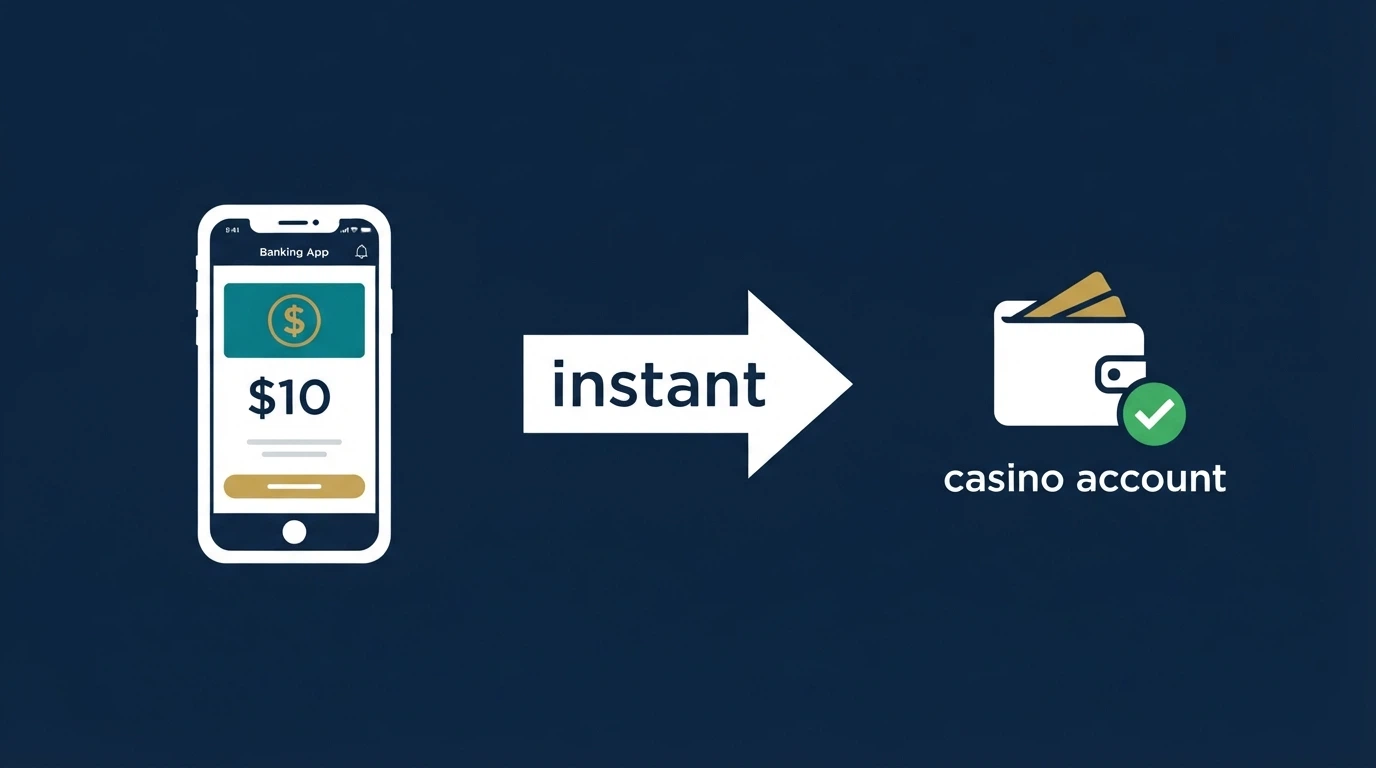
How to Deposit $10 via PayID at an Online Casino
The flow is straightforward. The player registers, navigates to the deposit screen and selects PayID. The casino displays its PayID — usually a phone number, email or account identifier — and the deposit amount. The player opens their banking app, enters the PayID and the amount, and confirms the transfer. Osko, the real-time payment layer that runs on PayID through the New Payments Platform, settles the funds within seconds.
No card details are shared with the casino. That is one of the reasons PayID has become the preferred low-friction deposit method at Australian-facing offshore sites. The transaction appears in the player’s bank statement with the casino’s name or PayID identifier — which is also the only paper trail if a dispute arises, and disputes with offshore operators rarely resolve in the player’s favour.
The $10 Minimum Deposit — Which Casinos Actually Honour It
There are two minimums worth distinguishing. The technical minimum is the smallest amount the casino will accept as a deposit. The bonus-eligible minimum is the smallest amount that activates the welcome offer. They are not always the same.
Among the operators reviewed on this page, NeoSpin is the only one where a A$10 deposit confirmed triggers the welcome bonus across all payment methods including PayID. A A$10 deposit there activates the first tranche of a 400% match welcome offer, adding A$40 in bonus credit for a total play balance of A$50. Other operators in the ranked list accept A$10 as a deposit but require A$20 or A$30 to unlock the headline bonus — the technical and bonus-eligible minimums diverge by enough to invalidate the offer for those brands.
For a player specifically after a A$10 PayID casino with a working welcome bonus, the distinction matters more than any bonus percentage. An offer that activates at A$30 is not a A$10 offer, no matter how generous the marketing sounds.
PayID Pokies — Funding Your Play with a $10 Deposit
PayID is built for deposits, and pokies are built to absorb any deposit size. Once the funds land in the casino account, the player can move into any pokies title the operator carries and play at whatever stake the bankroll supports. A A$10 balance will not last long at A$5 per spin. At A$0.20, it stretches across fifty spins — enough to feel out a game.
Where the bonus terms intrude is the wagering contribution. Pokies typically contribute 100% of every wagered dollar toward clearing the bonus. Table games and live dealer titles contribute far less, sometimes 10–20%, and are sometimes excluded entirely. The A$10 deposit is only useful as bonus play if it lands on eligible games. Spending it on a single blackjack hand wastes the wagering contribution that the same dollar would have earned on a pokies spin.
PayID Withdrawals — The Catch Most Reviews Skip
Depositing with PayID at an offshore casino is easy. Withdrawing via PayID often is not.
Many of the operators reviewed here support PayID for deposits only. When the player requests a withdrawal, the funds are redirected to bank transfer, an e-wallet or, in some cases, a crypto wallet. The processing time stretches from “instant” to several business days. The redirect happens silently — there is no warning at deposit time that PayID will not be honoured on the way out.
Identity verification (KYC) is also standard before the first withdrawal. The operator typically requires a government-issued photo ID, proof of address and sometimes a selfie holding the ID. The verification process can take 24 to 72 hours, during which the withdrawal is held. Once approved, the chosen withdrawal method — PayID if supported, otherwise the redirect method — processes the funds.
When a $10 Deposit Meets a No-Deposit Bonus
The combination — A$10 deposit plus a no-deposit bonus — is rare. The marketing logic of a no-deposit offer is to let the player try the casino without funding the account. Asking for a deposit and a no-deposit bonus in the same breath is unusual because the no-deposit credit is the alternative to the deposit.
What some operators do is layer both: a small no-deposit credit on registration, followed by a deposit-gated welcome offer on the first deposit. The total bonus potential is higher, but so is the total wagering requirement. A A$10 no-deposit credit at 40x wagering carries A$400 of turnover on its own, separate from any turnover obligation the deposit bonus adds. Players who accept both offers often end up wagering more than they realised.
Among the operators reviewed here, the deposit-gated welcome bonus at NeoSpin is the closest match to the terms. It is not a no-deposit bonus. It is a deposit bonus with a A$10 activation threshold — a different offer with similar marketing language.
The $10 No-Deposit Bonus — What You Actually Get
A A$10 no-deposit bonus looks like free money in the marketing email. The bonus terms are where the cost sits. The typical restrictions at AU-facing offshore casinos are:
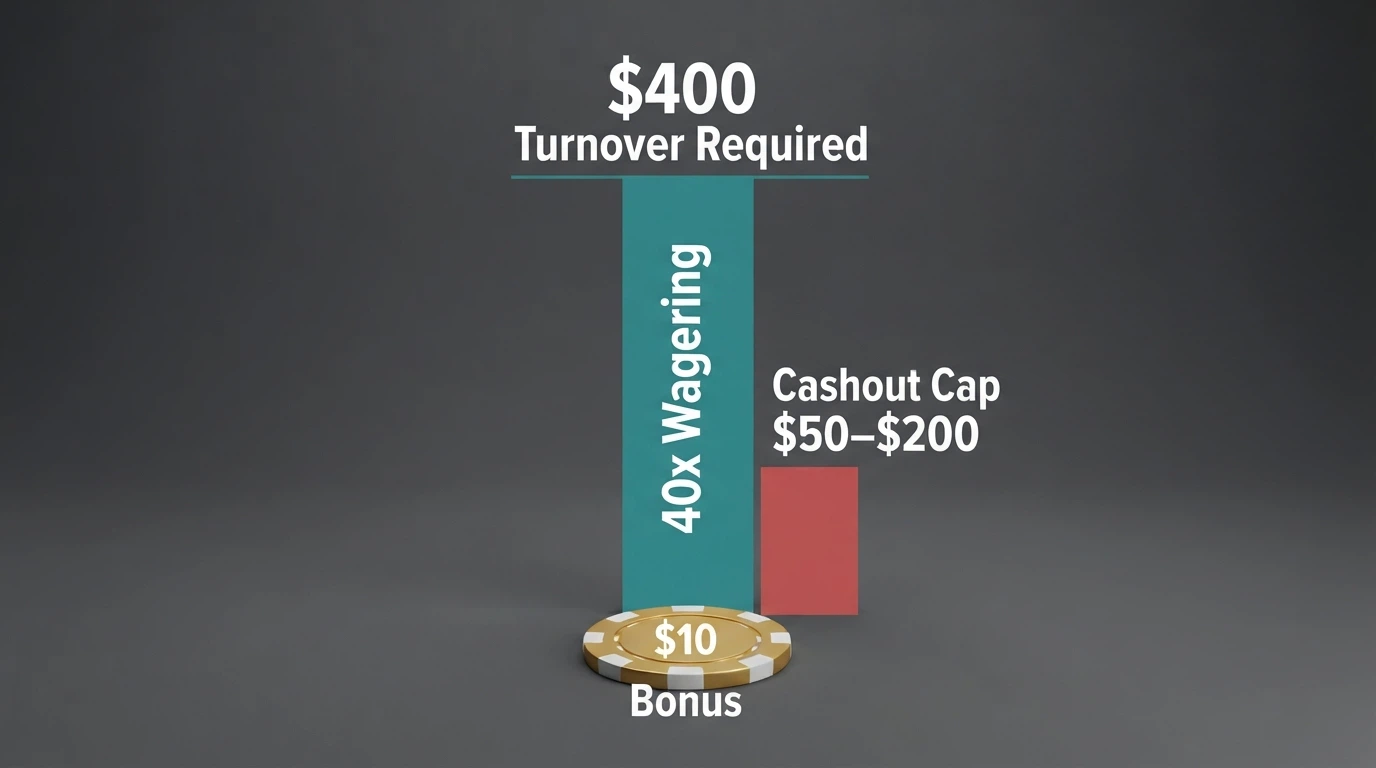
| Restriction | Typical Range (AU) |
|---|---|
| Wagering requirement | 35x–45x |
| Maximum cashout | A$50–A$200 |
| Bonus expiry | 7–14 days |
| Maximum bet during wagering | A$5–A$8 |
These are not arbitrary numbers. They are the levers the operator uses to keep the bonus payable while looking generous. Wagering forces the player to keep playing through the bonus amount many times over. The maximum cashout caps any winnings the player manages to convert. The expiry forces the player to clear the bonus within a short window. The maximum bet stops the player from clearing the bonus in two large wagers on a volatile game.
A punter who claims a A$10 no-deposit bonus signs up to clear A$350 to A$450 of turnover within a week or two, on pokies that contribute 100% to wagering, betting no more than A$5 to A$8 per spin. The expected return on that turnover, after the house edge, sits well below the nominal bonus value once the cashout cap is applied. The “free A$10” is closer to a paid trial than a gift.
No-Deposit Bonus Mechanics — Free $10, Real Strings
The mechanics start at account creation. The player registers, the casino credits the account with the bonus amount (or the equivalent in free spins), and play begins. No deposit is required to claim. The wagering requirement is set against the bonus amount; the maximum bet cap is enforced from the first wagered spin; the cashout cap is set against any winnings the player clears.
The expiry clock starts at claim. At 7 to 14 days, the player has a tight window to clear the bonus or lose it. Most players do not clear the bonus — they play a few sessions, run out of bonus funds or hit the cashout cap with the bonus partially cleared, and either withdraw what they can or let the bonus expire.
The maths is straightforward. At 40x wagering on A$10, the player needs A$400 in qualifying bets before any winnings are withdrawable. With an average pokies RTP in the mid-90s, the expected loss on that turnover is somewhere around A$20 — the casino’s expected take from the bonus. The player’s expected return sits well below the A$10 headline value once the cashout cap is applied.
Sign-Up and Welcome Bonuses — The First-Deposit Trade-Off
A no-deposit bonus skips the deposit. A welcome bonus multiplies it. The trade-off is structural: a no-deposit offer is smaller in headline value and carries wagering on a small base; a deposit-gated welcome offer is larger in headline value but requires the player to fund the account first and wager both the deposit and the bonus.
The match percentage is the headline figure. A 100% match doubles the deposit. A 200% match triples it. A 400% match — the figure carried by NeoSpin among the operators reviewed here — multiplies a A$10 deposit into a A$50 total play balance on the first tranche. That headline number is the marketing’s friend. The arithmetic the player actually cares about is the wagering requirement, which scales with the bonus amount, not the deposit.
Deposit Match and Percentage Bonuses — Beyond the No-Deposit Offer
A deposit match bonus is the operator adding bonus credit as a percentage of the deposit. The punter’s real cost is the wagering requirement attached to that bonus credit. NeoSpin’s 400% welcome offer, on a A$10 first deposit, adds A$40 in bonus credit to a A$10 cash deposit for a total play balance of A$50. The 50x wagering requirement applies to the bonus amount: A$40 × 50 = A$2,000 in qualifying turnover before the bonus portion of the balance becomes withdrawable.
The NeoSpin first-tranche bonus works out to about 2 hours 47 minutes of continuous play. A$2,000 of qualifying turnover at a conservative A$1 stake per spin is 2,000 spins, and 2,000 spins at five seconds per spin runs 2 hours 47 minutes — assuming the player wagers only the bonus amount and not the deposit alongside it. That figure is a statistical estimate; actual outcomes vary with every spin.
The same arithmetic applies to every deposit-match offer at this scale. A 200% match at 40x wagering on a A$30 deposit — a common bonus-eligible minimum at AU-facing offshore sites — requires A$600 of turnover on A$60 of bonus credit, with the play time scaling proportionally. The headline bonus value is not the player’s expected return. The wagering requirement is.
Real-Money Play vs Free-Play Credits — What the $10 Actually Buys
Not every A$10 credit is the same. Real-money bonus credit is withdrawable after the wagering requirement is cleared. Free-play credit may be play-only, with winnings capped at the maximum cashout amount and not added to the cash balance for further wagering.
The cashout cap is the tell. A A$10 no-deposit bonus with a A$50 maximum cashout is almost certainly free-play credit — the operator is telling the player that the winnings, however large, are capped at A$50 even after wagering is complete. A bonus that credits winnings directly to the cash balance as withdrawable funds (subject to wagering) is real-money bonus credit. The distinction matters because the player who clears the wagering on free-play credit and lands a A$500 win walks away with A$50, not A$500.
Pokies and Slots — Where the Bonus Actually Works
The A$10 no-deposit bonus is designed for pokies. The wagering contribution table at every offshore casino reviewed puts pokies at 100% — every A$1 wagered counts as A$1 toward clearing the bonus. Table games often contribute 10–20% (a A$1 blackjack wager might count as A$0.10 or A$0.20 toward wagering) and live dealer titles are frequently excluded entirely.
The structure is not accidental. Pokies carry a higher house edge than most table games at typical payout rates. Clearing a bonus on pokies costs the casino more than clearing it on blackjack, so the operator offsets that cost by limiting the cashout, capping the bet size and forcing a short expiry. The player who runs the bonus through table games to preserve bankroll will find the wagering contribution barely moves and the bonus expires unused.
The practical approach is to play pokies only, at the maximum allowed bet (to clear the bonus fastest) or at a smaller stake (to extend play time within the expiry window), and to stop wagering once the requirement is met rather than playing on with the cleared bonus.
The Best $10 PayID Casinos for Australian Players in 2026
Every operator below is offshore, unlicensed in Australia, and outside the BetStop register. The ranking reflects what the research was able to confirm: licence transparency, bonus terms where known, and PayID support. Where specifics are not confirmed this run, the operator’s own site is the place to verify them.

| Operator | Licence | BetStop Connected |
|---|---|---|
| Rocket Play | Curaçao (unverified) | No |
| Skycrown | Curaçao (unverified) | No |
| Royal Reels | Unconfirmed | No |
| NeoSpin | Curaçao | No |
| FairGO | Unconfirmed | No |
| Stake | Curaçao (unverified) | No |
| Rainbet | Unconfirmed | No |
| WinSpirit | Unconfirmed | No |
| Bizzo Casino | Curaçao (unverified) | No |
| Rocket Casino | Unconfirmed | No |
The licence column is where the only material difference sits. Curaçao-licensed operators are operating under a regulator that issues remote-gambling licences but does not enforce Australian consumer law. Operators with unconfirmed licences sit one rung further from any regulatory framework at all. The same value down the BetStop column carries the most important information on the table: every operator listed will keep taking a self-excluded person’s money.
Rocket Play
Rocket Play presents itself as a Curaçao-licensed online casino serving Australian players. The licence claim appears on the operator’s site but was not independently confirmed this run — players should verify the licence number on the Curaçao Gaming Control Board’s register before depositing.
Specific bonus terms for the welcome offer were not confirmed. Like most operators in this category, Rocket Play accepts PayID for deposits; PayID withdrawal support was not confirmed, and the default offshore pattern is deposit-only PayID with withdrawal redirected to bank transfer or e-wallet. The Curaçao licence is the standard regulatory wrapper for AU-facing offshore casinos — it is not an Australian licence and does not carry Australian consumer protections.
Rocket Play sits in the unverified-Curaçao band. Verify the licence on the register before depositing, and treat it as offshore regardless. It is one of several viable options for a punter who has accepted the trade-offs, and not a fit for someone who needs Australian regulation (because none exists for online casino).
Skycrown
Skycrown runs a similar profile to Rocket Play: a Curaçao-claimed offshore operator with a slot-heavy lobby, a A$10 deposit threshold on most payment methods, and the standard offshore cashier. Bonus terms for the welcome offer were not confirmed this run.
The licence claim should be verified directly on the operator’s site and on the Curaçao register where possible. A licence number that does not resolve on the regulator’s published list is not a licence.
Australian players after a A$10 no-deposit offer specifically will not find one confirmed at Skycrown — the welcome offer requires a deposit, and the bonus-eligible minimum may sit above A$10 on some payment methods. The brand sits in the same offshore tier as the rest of the table. The closing question is what the operator’s site shows when the punter checks.
Royal Reels
Royal Reels is an Australian-facing brand whose licence status was not confirmed this run. Without a verifiable regulator — Curaçao, Malta, Isle of Man or otherwise — Royal Reels sits in the category that Australian players should treat with extra caution: the operator’s terms may apply, but there is no third party enforcing them.
PayID support and bonus specifics were not confirmed. The A$10 deposit threshold may or may not apply; the welcome offer may or may not activate at A$10. Players should verify both on the operator’s site before committing funds.
Brand recognition, but no confirmed anchor. A punter who needs any regulatory assurance has better choices in the table — the difference between an unverified operator and a verified one is rarely worth the saving.
NeoSpin
NeoSpin is the operator in this ranked list with the most complete set of confirmed specifics — and the only one where a A$10 deposit confirmed triggers the welcome bonus across all payment methods including PayID. That single fact makes it the closest match to the offer on this page.
The welcome offer is a 400% match up to A$10,000, with a 50x wagering requirement on the bonus amount. A A$10 deposit activates the first tranche, adding A$40 in bonus credit for a total play balance of A$50. PayID deposits are instant at the A$10 minimum. PayID withdrawals were not confirmed this run, and the offshore norm for withdrawals here is most likely a redirect to bank transfer or e-wallet.
NeoSpin holds a Curaçao licence — the offshore standard rather than a step up. That licence is not Australian; no Australian licence exists for online casino; BetStop does not apply. The bonus math at A$10 is the cleanest on this page, and that is the standout. The offshore caveats remain.
FairGO
FairGO is an Australian-facing offshore brand with no confirmed licence this run. The name suggests an Australian orientation, but the operator sits in the same offshore tier as every other brand in this table — outside Australian regulation, outside BetStop, and outside the Australian consumer protection framework.
Bonus terms, PayID support and the A$10 deposit threshold were not confirmed. The operator’s own promotions page is the place to verify current specifics before depositing.
Players who recognise the FairGO name from past offshore reviews may stay for the brand familiarity; new players have no specific reason to start here over the licensed-claimed alternatives. The lack of a confirmed licence is the deciding factor for cautious players.
Stake
Stake is a large global crypto-friendly casino with a Curaçao licence claim, accepting Australian players through its offshore operation. The brand’s footprint is wider than most in this table — global player base, large betting volume, mainstream recognition — but the Australian regulatory status is the same as every other entry: offshore, unlicensed in Australia, no BetStop coverage.
Stake’s deposit and bonus architecture tends to favour crypto and e-wallet over PayID; PayID support at this operator was not confirmed. Welcome bonus terms for the Australian-facing offer were not confirmed either.
A different fit from the rest of the table. Global brand, broad product, but a cashier not built around PayID. Players comfortable with Stake’s broader offering will find the same protections caveats as elsewhere. Australian players specifically looking for a PayID-first experience will find a better match elsewhere in the table.
Rainbet
Rainbet is an offshore casino with no confirmed licence this run, accepting Australian players. The operator’s profile is similar to other AU-facing brands in the lower-confidence tier: slot-heavy lobby, PayID deposit support likely but unverified, bonus terms unconfirmed.
The lack of a confirmed licence is the standout feature. Without a regulator — even a Curaçao licence that did not verify — the player has only the operator’s own terms to rely on. The practical test is whether the operator can be trusted to honour withdrawals when the cashout hits. There is no Australian body to escalate a dispute to, no ACMA complaint pathway, and no BetStop safety net.
No licence, no regulatory anchor, no Australian recourse. Players comfortable with the offshore caveat can use it; players who need any of those things should not. The choice is the player’s, made with eyes open.
WinSpirit
WinSpirit is an offshore casino with no confirmed licence this run, accepting Australian players. Like the other unconfirmed-licence operators in this table, the regulatory status is the deciding factor — without a verifiable licence, the operator sits outside every framework that might enforce its terms.
PayID deposit support and bonus specifics were not confirmed. Welcome offer details, wagering requirements and the A$10 minimum deposit threshold all need to be checked directly on the operator’s site.
WinSpirit is one of several offshore brands competing for the same Australian cohort, with no specific differentiator from the rest. The lack of a confirmed licence is the reason to look elsewhere unless the brand has some specific appeal.
Bizzo Casino
Bizzo Casino is a Curaçao-claimed offshore operator accepting Australian players. The licence claim appears on the operator’s site but was not independently confirmed this run — players should verify the licence on the Curaçao register.
The welcome offer and bonus terms for the AU-facing product were not confirmed this run. PayID support was not confirmed. The same verification advice applies as for the other Curaçao-claimed brands in the table.
A standard Curaçao-claimed offshore brand — the licence should be verified, but the broader profile is similar to the rest of the table. Not a fit for a player who needs Australian regulation; a reasonable option for one who has decided offshore play is acceptable.
Rocket Casino
Rocket Casino is an offshore casino with no confirmed licence this run, accepting Australian players. The brand name is close to Rocket Play, which makes the two easy to confuse — they are different operators, and the licence status of each should be verified separately.
Bonus terms, PayID support and the A$10 deposit threshold were not confirmed. Players should check the operator’s site directly for current specifics.
Lowest-confidence tier in this table. No confirmed licence, and a name easy to confuse with Rocket Play. Not the right starting point for a player new to the offshore landscape.
Why Every $10 PayID Casino Is Offshore — and What That Means for Your Money
There is no Australian licence for online casino, online pokies or in-play betting. The Interactive Gambling Act 2001 prohibits it, and the 2017 amendment closed the loopholes that earlier offshore operators had used to argue they fell outside Australian jurisdiction. The result is a clean legal picture: any operator offering these products to Australian players is breaking Australian law, and any Australian player using those products is using an unlicensed service.
The next four subsections spell out what that means for the money sitting on the account.

The Interactive Gambling Act 2001 — What It Actually Prohibits
The framework was set in the opening section: online casino, online pokies and in-play betting prohibited, no Australian licence, provider-targeted enforcement. What this subsection covers is what the prohibition means in practice for an Australian punter transacting with an offshore operator — and the answer is that the prohibition’s existence is precisely what makes those transactions unprotected.
Australia’s licensed perimeter covers a narrower product set than the licensed markets of comparable countries. Wagering on racing and sport placed before the event, lotteries and keno, through operators licensed by a state or territory. There is no casino licence to apply for, anywhere in the country, because the federal prohibition overrides the state-level licensing regime. More than 150 online and phone wagering providers are licensed in Australia — every one for wagering, none for casino.
The practical consequence: an operator serving Australian players with online pokies is not licensed in Australia. Betting with them is legal in the narrow sense that the player is not prosecuted. Every protection a player might expect from a licensed operator — dispute resolution, fund segregation, responsible-gambling enforcement at the platform level, BetStop integration — is missing.
ACMA Enforcement — Site Blocks, Withdrawals and the 1,564 Sites Already Blocked
The ACMA has enforcement teeth. It investigates complaints, issues formal warnings, seeks civil penalty orders, refers matters for criminal prosecution, and directs Australian ISPs to block illegal services. Since the first blocking request in November 2019, the ACMA has had 1,564 illegal gambling and affiliate websites blocked by Australian ISPs (as of March 2026). More than 225 illegal services have withdrawn from the Australian market since the 2017 amendment strengthened enforcement.
For an Australian punter, the consequences are concrete. A site that is blocked at the ISP level becomes inaccessible from a normal Australian internet connection. The player’s account, balance and any pending withdrawal sit on a service the punter can no longer reach. The offshore operator’s terms usually say withdrawals can be refused if the player is in a restricted jurisdiction, and Australia is typically on that list.
The ACMA cannot recover player funds. The regulator’s role is to disrupt the operator, not to compensate the consumer. A punter whose offshore casino is blocked mid-play has no Australian body to escalate to and no Australian court that will hear a consumer complaint against an unlicensed offshore operator.
What Australian Players Forfeit — No BetStop, No Recourse, No Refund
The list of protections a player gives up by using an offshore operator:
- No BetStop coverage. BetStop is the National Self-Exclusion Register, launched 21 August 2023. One registration excludes a person from every Australian-licensed online and phone wagering service. It binds licensed operators only. An offshore casino is not connected, will not check the register, and will keep accepting deposits from a self-excluded person.
- No ACMA recourse. The ACMA handles complaints about Australian-licensed operators. For an offshore casino there is no regulator to escalate to and no formal complaints pathway.
- No Australian consumer protection. The Australian Consumer Law covers goods and services supplied in Australia or to Australian consumers by Australian businesses. An offshore operator’s terms govern the relationship, and those terms are usually drafted to favour the operator.
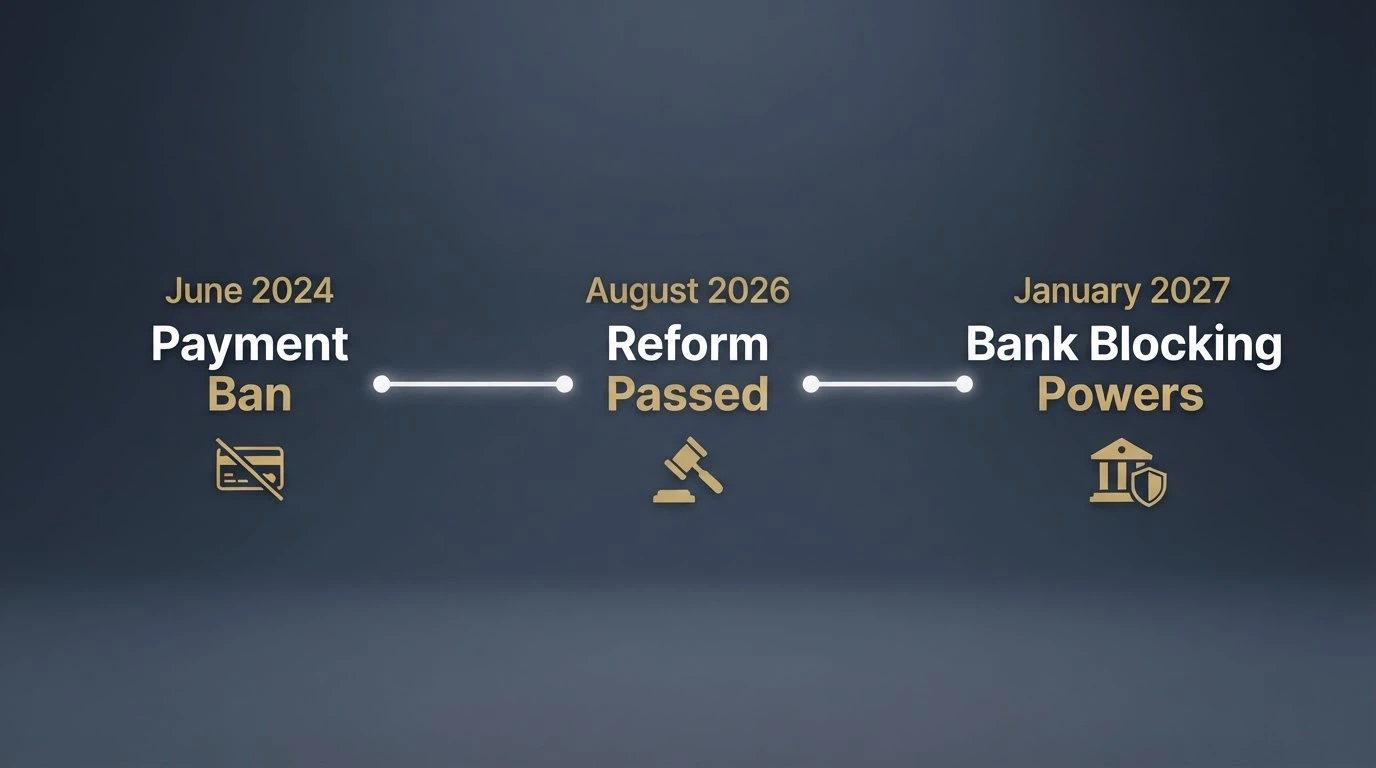
- No guarantee funds will be returned. If the site is blocked, the operator withdraws from the market, or the operator voids a withdrawal request, the player has no practical remedy. The credit-card and crypto ban in force since 11 June 2024 means an offshore operator asking for either is operating outside Australian rules — the payment method is itself a tell.
- No enforced deposit limits. Licensed operators must offer customer-set deposit limits, activity statements and reality checks. Offshore operators offer these tools if they choose to. Many do not.
The 2026 Gambling Reform — What Changes on 1 January 2027
The Interactive Gambling Amendment (Gambling Reform) Bill 2026 passed Parliament on 19 August 2026. Its measures commence on 1 January 2027. They are not yet in force.
The headline change for offshore casino access: from 1 January 2027, banks and payment providers gain express authority to block transactions to illegal gambling operators. A PayID deposit to an offshore casino — currently a frictionless transfer through the player’s banking app — can be declined at the bank’s discretion once the bank knows the destination is an illegal gambling operator. The detection layer sits with the banks, not with the ACMA.
The advertising and inducement restrictions are separate but interlocking. From the same commencement date, no more than three wagering ads per hour between 6:00 am and 8:30 pm, with a live-sport blackout from 15 minutes before a live event until 5 minutes after. Broadcasting sporting odds is banned outright. Online wagering ads may be shown only to a user who is logged in, confirmed over 18 and offered an opt-out. Direct marketing of inducements is prohibited for 14 days after sign-up, for three months after a person deregisters from BetStop, and indefinitely for customers identified as at risk of gambling-related harm.
The reform does not legalise online casino in Australia. The IGA prohibition remains in place. What it does is add a payment-side and advertising-side enforcement layer to the existing prohibition — closing some of the practical routes by which offshore operators have reached Australian players.
Staying Safe When the Safety Net Doesn’t Cover You
Offshore casinos sit outside every Australian protection. The safety infrastructure that exists — BetStop, ACMA complaints handling, licensed-operator deposit limits — does not extend to them. What a player can still control is the decision to use them, the choice of operator, and the harm-minimisation tools they bring themselves.
BetStop — What It Protects and What It Does Not
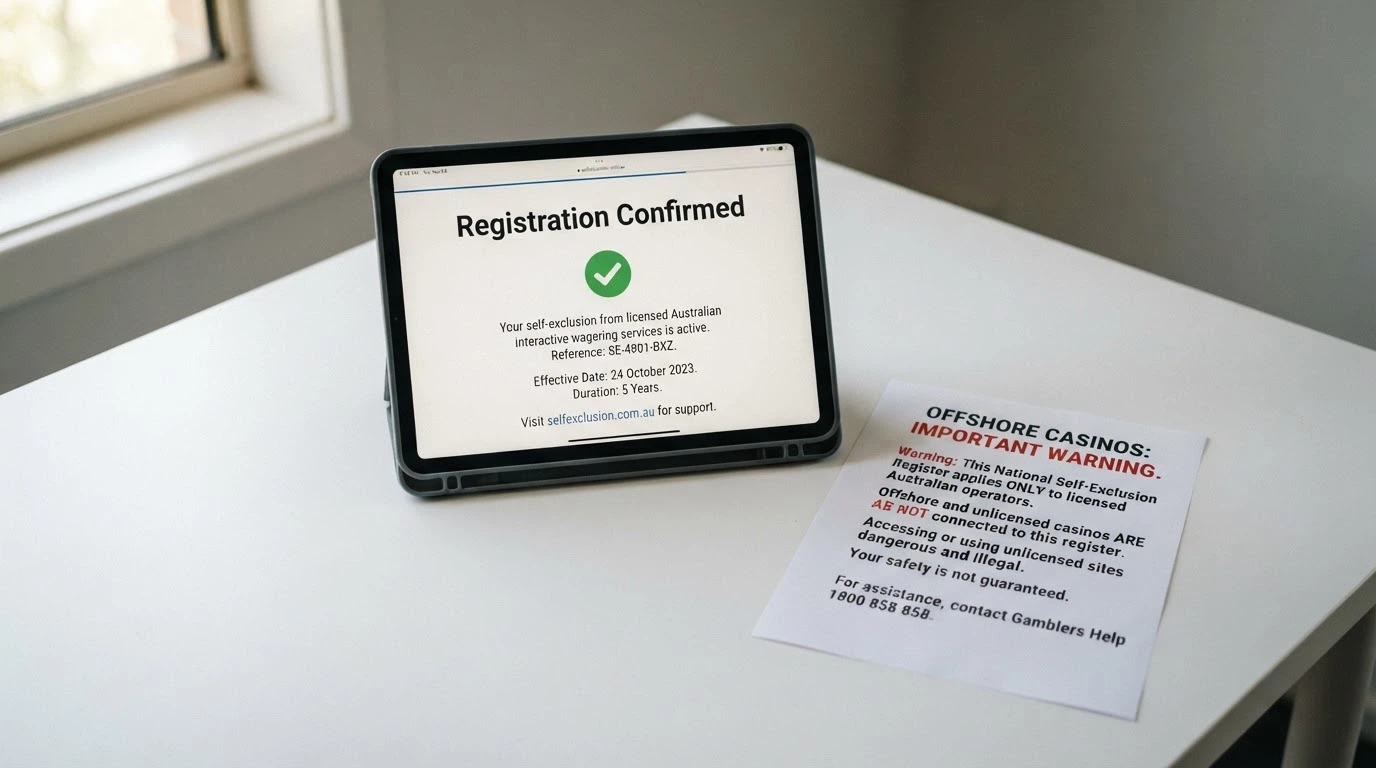
BetStop is the National Self-Exclusion Register, launched 21 August 2023 and operated by the ACMA. One registration excludes a person from every Australian-licensed online and phone wagering service. The registration can be for a fixed period (three months or one year) or for lifetime. The system is opt-in, free, and binding on every licensed Australian wagering operator.
The numbers as of 31 July 2026: 67,480 total registrations, 41,290 active exclusions. 78% of registrants are aged under 40. 38% chose lifetime exclusion. The early outcome data is strong: 77% of registrants reported better overall quality of life, 79% improved mental health, 69% better personal relationships. 96% said they had either completely stopped betting (81%) or decreased their betting (15%).
The gap: BetStop binds licensed wagering services only. An offshore casino is not licensed in Australia, is not connected to the register, and will keep taking a self-excluded person’s money. The same punter who has registered with BetStop can walk into an offshore casino without any friction, and will not be flagged by the operator. The ACMA has established a BetStop Taskforce to progress recommendations from an independent review of the service, but the offshore coverage gap is structural. It does not close without a change to the IGA, which the 2026 reform does not make.
Gambling Harm in Australia — The Numbers Behind the Risk
Gambling harm in Australia is widespread. The Roy Morgan Gambling Harm Index (March 2026) puts 15.1% of Australian adults — roughly 3.32 million people — experiencing some form of gambling harm, with 13.0% (2.857 million) harmed by their own gambling behaviours. The Journal of Gambling Studies modelling estimates 1,970,000 Australian adults at-risk or problem gambling, with another 1,381,000 adults affected by another person’s gambling. The annual health loss associated with gambling-related harm in Australian adults is estimated at over 400,000 Years Lived with Disability.
The figures are not abstract. Harm runs from financial stress (lost savings, debt, hardship) through relationship damage (conflict, breakdown, family impact) to mental health consequences (anxiety, depression, suicidality). The licensed system attempts to mitigate these through deposit limits, activity statements, BetStop, and platform-level intervention. The offshore system does not apply any of them.
The minimum gambling age in Australia is 18. Operators that accept underage players are breaking Australian law in addition to the IGA prohibition. Players should verify age requirements on any operator they consider, and walk away from any operator that does not enforce them.
Where to Get Help — Helplines, Counselling and Self-Exclusion
Free, confidential help is available:
- National Gambling Helpline: 1800 858 858 — free, confidential, staffed 24 hours a day, 7 days a week
- Gambling Help Online: gamblinghelponline.org.au — online chat and counselling
- BetStop: the National Self-Exclusion Register at betstop.gov.au — one registration excludes from every Australian-licensed wagering service. Does not cover offshore casinos.
- Financial counselling: free, confidential advice through the National Debt Helpline on 1800 007 007 and through state-based financial counselling services
The data on BetStop outcomes is the strongest case for using the registered system where it applies. 77% of registrants report better quality of life. 96% either stopped or decreased their betting. The self-exclusion tool works — but only against operators it covers. Offshore casinos are not on that list.
How We Selected and Ranked These Casinos
The evaluation was built around four criteria: bonus accessibility at the A$10 deposit threshold, PayID support (deposit and withdrawal), licence transparency, and wagering fairness where the terms were available.
The operator set came from competitor analysis — the brands that Australian players actually see when they search for “A$10 PayID casino no deposit bonus Australia”. The list is not exhaustive. It is the cohort of operators that surfaced repeatedly in the competitor pages and that accepted Australian registrations during the review window.
The legal benchmark was the Interactive Gambling Act 2001 as the controlling statute, and the ACMA register (including the blocked-sites list and the BetStop statistics) as the regulatory context. Operators were not excluded for being offshore — by definition, every operator in this category is offshore — but licence claims were verified where possible, and unverified licences were flagged.
Limitations: most of the operator-level specifics (current bonus amounts, wagering multipliers, expiry windows, PayID withdrawal support) were not confirmed this run. Where that is the case, the operator’s own promotions page is the source to check before depositing. The research did not deposit funds at any operator, did not play through any welcome offer, and did not test withdrawal flows. The page is built on what the operators publish and what the regulators enforce, not on live testing.
Is a $10 No-Deposit PayID Bonus Worth Claiming?
The A$10 is real. The wagering is steep. The protections are zero. Those three facts frame the choice.
A punter who claims a A$10 no-deposit bonus takes on, on average, A$350 to A$450 of qualifying turnover obligation, a cashout cap of A$50 to A$200, an expiry of 7 to 14 days, and a maximum bet cap of A$5 to A$8 during wagering. The expected return on that turnover, after the house edge, sits well below the nominal bonus value once the cashout cap is applied. The bonus is closer to a paid trial than a gift — the operator is paying for the chance to acquire a depositing customer, and the trial cost sits on the player through the expected loss.

The offshore reality makes the cost asymmetric. If the operator refuses a withdrawal, voids a win, or simply disappears behind an ACMA site block, the player has no Australian body to escalate to. BetStop does not apply, ACMA does not handle offshore disputes, and the offshore operator’s terms govern. The same A$10 of bonus value that would be a low-stakes trial at a regulated operator becomes a balance sitting on a service the player cannot reach when the ACMA blocks the domain.
The 2027 reform narrows the route further. From 1 January 2027, banks can decline PayID transfers to illegal gambling operators. The deposit flow that today is frictionless becomes filtered — not banned, but subject to the bank’s discretion. Players who have already moved their banking to offshore-friendly rails (crypto, e-wallet) will be less affected; players using PayID from a standard Australian bank account will feel the change.
The practical verdict, offered as analysis rather than recommendation: the A$10 no-deposit PayID bonus is a low-stakes way to look at offshore casino software, not a meaningful money-making opportunity. The wagering requirement and cashout cap crush the expected value. The offshore architecture means the player carries every risk. The 2027 reform will narrow the route further. For a punter who is curious and accepts those terms, NeoSpin stands out for the A$10 bonus-eligible minimum; the rest of the field requires either a larger deposit to activate the welcome offer or unverified terms. The Australian-licensed alternative does not exist — by law, it cannot.
Frequently Asked Questions
What are the wagering requirements for a $10 no-deposit bonus in Australia?
Wagering requirements at AU-facing offshore casinos typically run 35x to 45x the bonus amount, with some offers going higher. A A$10 no-deposit bonus at 40x requires A$400 of qualifying turnover before any winnings become withdrawable. Pokies usually contribute 100% toward wagering, while table games and live dealer titles contribute less or are excluded. Check the specific offer terms on the operator’s promotions page before claiming.
What is the maximum I can cash out from a $10 no-deposit bonus?
The maximum cashout from a A$10 no-deposit bonus at AU-facing offshore casinos typically ranges from A$50 to A$200, regardless of how much is won during wagering. The cap is set in the bonus terms and applies after the wagering requirement is cleared. Verify the current cap on the specific offer before playing, as the figure varies by promotion and by operator.
How long does a $10 no-deposit bonus stay valid after I claim it?
Typical bonus expiry is 7 to 14 days from the moment the bonus is credited to the account. The wagering requirement must be cleared within that window or the bonus and any winnings from it are forfeited. Some operators offer shorter or longer windows; the specific expiry is set in the bonus terms. The expiry clock is the most commonly missed condition on no-deposit offers.
Do I need a bonus code to claim a $10 no-deposit offer?
It depends on the operator and the promotion. Some no-deposit offers auto-credit on registration; others require a code entered at the cashier, a link from an affiliate page, or contact with customer support. Where a code is required and is not entered correctly, the bonus does not activate. Check the operator’s current promotions page before registering to confirm whether a code is required and where to enter it.
What happens to my money if an offshore casino is blocked by the ACMA?
If the ACMA directs Australian ISPs to block an offshore casino, the site becomes inaccessible from a normal Australian internet connection. Any balance on the account, plus any pending withdrawal, sits with an offshore operator the player can no longer reach. The ACMA does not recover player funds. The offshore operator’s terms usually allow it to refuse withdrawals to players in restricted jurisdictions — Australia is typically on that list. There is no Australian body to escalate to and no guarantee of recovery.
Can I register with BetStop if I only play at offshore casinos?
Yes. BetStop registration is free and available to any Australian, regardless of where they currently gamble. One registration excludes a person from every Australian-licensed online and phone wagering service. However, BetStop does not cover offshore casinos — an offshore operator is not connected to the register and will keep accepting deposits from a self-excluded person. BetStop is a strong tool for licensed wagering; it does not, on its own, stop offshore play. A self-excluded person who wants to stop gambling at offshore casinos needs additional barriers.
Prepared by the Best Casino Sydney editorial staff.