
The Best-Paying Online Pokies in Australia for $2026 — and What “Best Paying” Really Costs You
A pokie’s return-to-player percentage is the single number on its paytable most worth knowing — and the single number most likely to mislead you if you stop reading at it. Two pokies can both claim 96.5% and behave nothing like each other across a session. Two pokies can claim the same title at different casinos and return different percentages to the player. The maths is honest. The marketing around it usually is not.

This page ranks the highest-RTP online pokies available to Australian players right now, breaks down what each one actually does across a session, and lays out the casino side — withdrawal speeds, wagering requirements, licence status — that decides how much of that theoretical return ever lands in a bank account. One reality runs through the whole thing: online casino games are prohibited under the Interactive Gambling Act 2001, and every operator on this page is offshore and unlicensed in Australia. The numbers below are real. The legal framework around them is also real, and a reader who skips it is making a decision with half the information.
Data current as of $3 November 2026, verified against the ACMA register and operator terms pages.
Table of Contents
- Why Your $2026 Pokie’s Payout Rate Is Only Half the Story
- The Highest-RTP Online Pokies You Can Actually Play in $2026
- How Fast Your Pokie Winnings Actually Land in Your Account
- Where to Play the Best-Paying Pokies: 10 Offshore Casinos Compared
- The Legal Reality: Why Every Online Casino You Play At Is Offshore
- Playing Safely When the Usual Safety Nets Don’t Reach
- How We Ranked the Best-Paying Online Pokies for Australian Players
- Before You Spin: The Three Checks Every Australian Pokie Player Should Make
- Frequently Asked Questions
Why Your $2026 Pokie’s Payout Rate Is Only Half the Story
What “Best Paying” Actually Means: RTP, House Edge and the Long Run
Return to player, or RTP, is the percentage of all wagered money a pokie returns to players across millions of spins. A 96% RTP pokie keeps $4 of every $100 wagered across that long run and returns $96 in winnings. Over millions of spins, the figure holds with mathematical certainty. Across the 200 spins in a typical evening session, it tells you almost nothing about what will happen on any individual spin — or any individual evening.
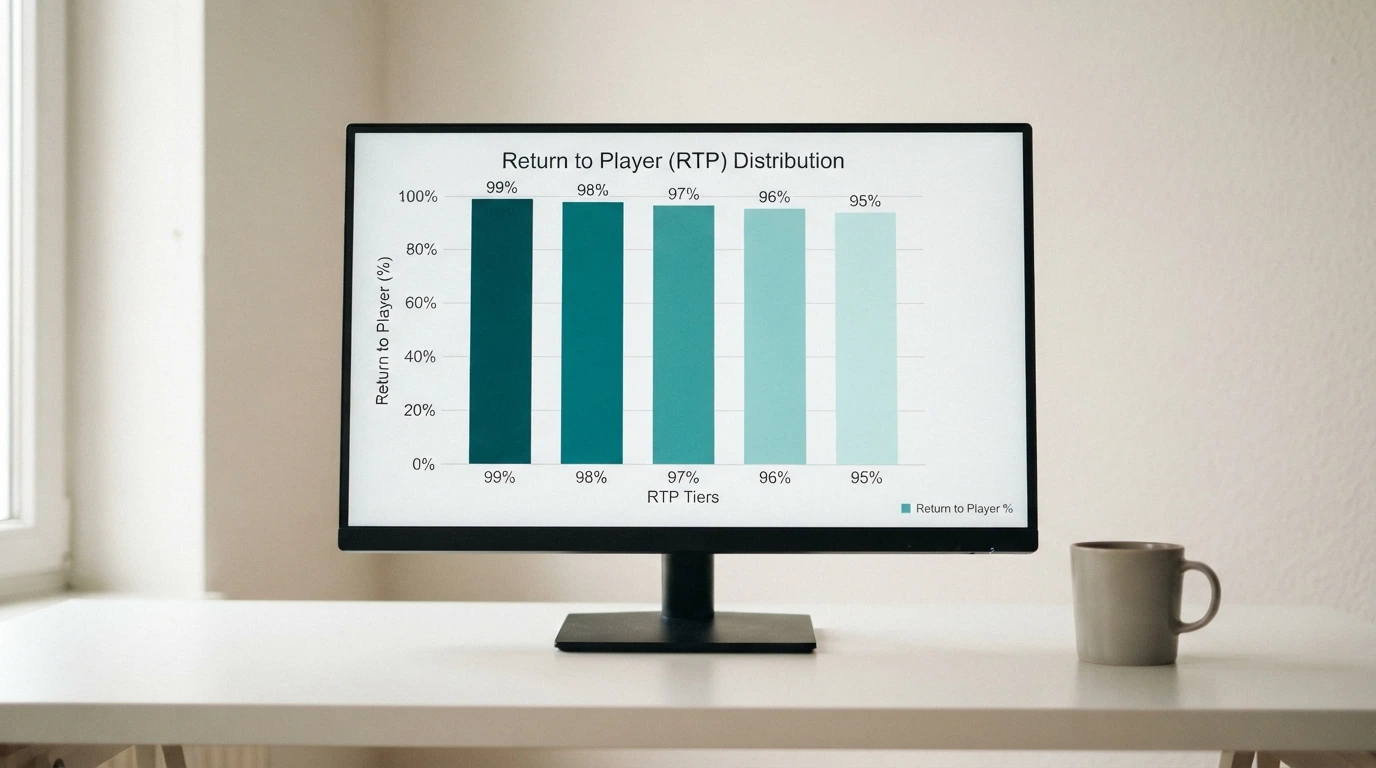
The house edge is the flip side: 100% minus the RTP. On a 96% pokie the house edge is 4%. On a 99% pokie, 1%. The difference sounds small. Over 10,000 spins at $1 each, the 4% edge costs $400; the 1% edge costs $100. Over a year of regular play, that gap is the difference between a manageable loss and a serious one.
RTP is a certified, audited figure — the studio submits the game to a testing lab, the lab runs billions of simulated spins, and the published RTP is what comes back. What the paytable shows and what the certified file contains are the same number in a well-run setup. But the certified number is not the only one the studio can ship. That is where the trap starts.
Real-Money vs Free-Play: Why the Payout Rate Only Matters With Cash on the Line
Demo mode runs the same RNG, the same reels, the same bonus features as the real-money version. What it does not run is a stake. The return percentage is calculated against money wagered. With zero wagered, the return is undefined, and any “win” in demo mode is a demonstration of the game’s mechanics, not a prediction of what the real-money version will do.

Demo mode is a testing tool, and a useful one. It lets you learn whether a pokie’s bonus round triggers often enough to keep you engaged, whether the base game moves quickly enough to hold your attention, and whether the volatility — the pattern of payouts, not just their average size — suits your patience. Rocket Play and Rainbet both offer demo mode. Most operators in the comparison table do not confirm it either way, which is worth knowing before you sign up: an operator that hides its demo mode is an operator that wants you depositing before you know what the game actually feels like.
The payout rate only means something when real money is on the line. Until then, it is a number on a page.
Mobile vs Desktop: Your Device Doesn’t Change the RTP
The maths is the same on every screen. The RTP is server-side — the game logic, the RNG, the symbol weighting, the bonus triggers all run on the operator’s servers and stream to whatever device you happen to be holding. A spin on a phone is identical to a spin on a desktop. No evidence exists that any operator serves a different RTP to mobile players, and the architecture of the system makes it impractical: the certified game file is one file, loaded once.
What changes between devices is the experience. Touch controls on a phone make rapid-fire autoplay easier; portrait mode cuts the reels but loses the animation; data use climbs faster on cellular than on Wi-Fi. None of that alters the return. The thing to watch on mobile is the same thing to watch on desktop: which RTP version is actually loaded, and whether the operator’s stated figure matches what the game is paying out.
The Highest-RTP Online Pokies You Can Actually Play in $2026
Every Title Above 96%: The Complete RTP Ranking
The table below ranks 20 of the highest-returning online pokies currently available to Australian players. RTP figures are the standard published versions; the actual return at any given casino may be lower, depending on which configuration the operator has licensed. Volatility and max win are drawn from the same sources; where a figure is not published, the cell carries an em dash rather than a guess.
| Title | RTP | Provider | Volatility | Max Win |
|---|---|---|---|---|
| Mega Joker | 99.00% | NetEnt | Medium | 2,000x |
| Book of 99 | 99.00% | Relax Gaming | High | 12,075x |
| Jackpot 6000 | 98.86% | NetEnt | Medium | 2,000x |
| 1429 Uncharted Seas | 98.60% | Thunderkick | Low | 670x |
| Blood Suckers | 98.00% | NetEnt | Low | 900x |
| Starmania | 97.87% | NextGen Gaming | Low–Medium | 1,250x |
| White Rabbit Megaways | 97.72–97.77% | Big Time Gaming | High | 13,029x |
| Immortal Romance | 96.86% | Games Global | — | — |
| Big Bass Bonanza | 96.71% | Pragmatic Play / Reel Kingdom | Medium–High | 2,100x |
| Trigger Happy | 96.58% | Big Time Gaming | High | 50,000x |
| Razor Returns | 96.55% | Push Gaming | High | 100,000x |
| Bubble Up | 96.52% | Pragmatic Play | Medium | 10,000x |
| Sweet Bonanza | 96.51% | Pragmatic Play | — | — |
| Gates of Olympus | 96.50% | Pragmatic Play | Extreme / High | 5,000x |
| Gates of Olympus 1000 | 96.50% | Pragmatic Play | High | 15,000x |
| Sleeping Dragon Ultra Dark | 96.50% | Pragmatic Play | High | 20,000x |
| Wanted Dead or a Wild | 96.38% | Hacksaw Gaming | Very High | 12,500x |
| Book of Dead | 96.21% | Play’n GO | High | 5,000x |
| Money Train 4 | 96.10% | Relax Gaming | — | 150,000x |
| Wolf Gold | 96.01% | Pragmatic Play | Medium | 5,000x |
Six pokies break the 97% mark. The two at the top — Mega Joker and Book of 99 — both return 99% in their headline configuration, and both are old enough to have earned their numbers across years of play rather than a marketing push. Mega Joker is the rarer of the two in AU-facing lobbies because it requires Supermeter mode play to hit its 99% figure; outside that mode the return drops to around 76.9%, which is one of the widest RTP gaps between headline and reality anywhere on this list. Book of 99 has no such catch — its 99% is the 99% you get.
Blood Suckers and 1429 Uncharted Seas are the low-volatility picks at the top of the table: frequent wins, smaller payouts, longer sessions per dollar bankroll. The high-volatility titles — Razor Returns, Money Train 4, Trigger Happy — promise max wins in the 50,000x to 150,000x range but pay out rarely enough that a $100 bankroll can vanish in 50 spins. Same 96% RTP, completely different sessions.
High-Volatility vs Low-Volatility: What the Payout Pattern Means for Your Bankroll
Volatility is the shape of the payout distribution, not its average. Two pokies can both have a 96.5% RTP and behave nothing like each other across a session. A low-volatility pokie — Blood Suckers, 1429 Uncharted Seas, Starmania — pays out small wins frequently. A $100 bankroll might last 500 spins with steady $1 to $5 returns. A high-volatility pokie — Razor Returns, Money Train 4, Wanted Dead or a Wild — pays out rarely, and the payouts when they come can be enormous. The same $100 bankroll might vanish in 50 spins with nothing to show, then a bonus round triggers and returns $4,000.
The trade-off is bankroll demand against payout size. Low-volatility titles suit players who want longer sessions, who measure their fun in minutes rather than dollars, and who would rather take a steady drip than chase a single big hit. High-volatility titles suit players with a bankroll large enough to absorb the dry spells — typically 200x to 300x the base stake as a working budget — and the patience to wait for the bonus round that pays out. Very high volatility, like Wanted Dead or a Wild, demands even more: the long dry spells can be brutal, and the average punter’s bankroll is not sized for them.
Matching volatility to bankroll is more important than matching volatility to personality. A player who loves the idea of a 150,000x hit on Money Train 4 but has a $50 budget will not experience the 150,000x hit. They will experience the empty bankroll.
The Hidden RTP Trap: Why the Same Pokie Pays Differently at Different Casinos
Pragmatic Play and Play’n GO ship multiple certified RTP configurations of the same title. The studio certifies the standard version — 96.50% on Gates of Olympus, 96.51% on Sweet Bonanza, 96.21% on Book of Dead — and one or more reduced versions. The operator licenses one configuration, loads it into the game, and that is what spins on the site. Two players can both be playing Gates of Olympus on the same afternoon and be playing mathematically different games: one at 96.50%, the other at 94.5%.
The spread on Play’n GO’s Stompin’ Gold is the most extreme example documented: five tiers, ranging from 96.2% at the top down to 84.2% at the bottom. A 12-point gap between the highest and lowest configuration. Sweet Bonanza ships in four versions — 96.51%, 95.45%, 94.51%, 91.51% — and Immortal Romance drops from a standard 96.86% to a reduced 92.10%. Gates of Olympus has at least three: the standard 96.50%, plus 95.51% and 94.5%. Book of Dead runs at 96.21% or 94.25%.
The real-world cost of a lower configuration is straightforward arithmetic. A 96.5% pokie returns $96.50 per $100 wagered; a 94.5% pokie returns $94.50. That $2 gap compounds across every session, every spin, every wager. Over 10,000 spins at $1, the difference is $200 in expected return. Over a year of regular play, it is the difference between a manageable loss and one that stings.
To check which version is running, open the game’s information or paytable screen. Most pokies display the active RTP somewhere in the help menu, usually marked as “RTP” or “Return to Player.” If the figure shown is lower than the studio’s published standard, the operator has loaded a reduced configuration. The honest operators will tell you. The dishonest ones will not, which is one more reason the offshore licensing regime matters: there is no regulator to force the disclosure.
Provider Spotlight: The Studios Behind Australia’s Best-Paying Pokies
NetEnt builds the 98%+ outliers — Mega Joker, Jackpot 6000, Blood Suckers — and has done so for years, making it the studio with the deepest back catalogue of high-RTP classics. Relax Gaming’s Book of 99 stands alone at the top of the table alongside Mega Joker, with the highest max win of any title in the 99% tier. Thunderkick’s 1429 Uncharted Seas is the rare low-volatility pokie with a 98.6% RTP, and the rarest pokie in this ranking to see in an AU-facing lobby because it is old enough that some operators have quietly dropped it.
The volume leaders are different studios. Aristocrat, Pragmatic Play, Nolimit City and Relax Gaming lead the real-money Aussie pokies market — Aristocrat because it dominates the land-based market and Pragmatic Play because it ships the most games, fastest, across every configuration tier the operators ask for. Big Time Gaming invented the Megaways engine and licenses it to other studios, which is why Megaways titles show up across providers. Push Gaming and Hacksaw Gaming are the high-volatility specialists: their titles cap at five-figure max wins and demand bankrolls sized accordingly.
The provider list at a casino is a proxy for its RTP range. A casino that lists NetEnt, Thunderkick and Relax Gaming alongside Pragmatic Play will have the 98%+ outliers in its lobby. A casino that lists only Pragmatic Play and Hacksaw Gaming will have the 96% floor and below.
New for $2026: The Latest High-RTP Releases
Five new pokies landed in $2026 with competitive RTPs and max wins that reset the ceiling.
Gates of Olympus 1000 (Pragmatic Play, $2026) sits at 96.50% RTP with a 15,000x max win — the original Gates of Olympus capped at 5,000x, so the 1000 version triples the ceiling on the same engine. Sleeping Dragon Ultra Dark (Pragmatic Play, released 23 July $2026) matches the 96.50% RTP and pushes the max win to 20,000x, with a hit frequency of 33.78% that puts it on the more active end of the high-volatility spectrum. Bubble Up (Pragmatic Play, released 24 August $2026) is the medium-volatility entry at 96.52% RTP and 10,000x max win, on a 6-reel, 40-payline grid that breaks from Pragmatic’s usual 5×3 or Megaways templates.
Trigger Happy (Big Time Gaming) is the cluster-pays outlier: 96.58% RTP, high volatility, and a 50,000x max win. The cluster-pays mechanic drops the paylines entirely and pays whenever a group of matching symbols lands adjacent, which changes the rhythm of the base game. Stompin’ Gold (Play’n GO, releasing 6 August $2026) is the configuration-trap story of the year: five RTP tiers from 96.2% down to 84.2%. The operator’s choice on this title decides whether the player has a 96% game or an 84% game, and the difference is a 12-point spread that swallows bankrolls in a hurry.
How Fast Your Pokie Winnings Actually Land in Your Account
Payout Speed by Method: Crypto, PayID, E-Wallets and Bank Transfers Compared
Tested median and worst-case withdrawal times at offshore casinos serving AU players, drawn from published payout-speed audits.
| Method | Median Time | Worst Case |
|---|---|---|
| Crypto | 42 minutes | 4 hours |
| PayID | 2 hours | 8 hours |
| E-wallets | 6 hours | 18 hours |
| Visa / Mastercard | 2 working days | 5 working days |
| Bank transfer | 3 working days | 7 working days |
Crypto is the fastest once a payout is approved, but it is also the payment method the law bans. PayID is the fastest AUD-native route. E-wallets sit in the middle. Cards and bank transfers trail badly — not because the operators are slow, but because the banking system itself runs on multi-day settlement.
SkyCrown was tested with a 1 hour 44 minute crypto withdrawal on a A$100 first cash-out from Gates of Olympus — close to the median for crypto, slower than the best case but well inside the worst-case range.
Why Your First Withdrawal Is Always the Slowest
No casino is truly instant. Every legitimate operator runs account verification — KYC — before a first withdrawal. The documents typically required are government-issued photo ID, proof of address dated within the last three months, and proof of ownership for the payment method used. The verification can take 24 to 72 hours; many operators complete it faster when documents are submitted proactively at sign-up rather than reactively at cash-out.
The biggest cause of a slow payout is unfinished KYC, not the casino’s processing system. A player who waits until their first withdrawal to upload documents will see their cash-out held in verification for days. A player who uploads at registration will see their first payout clear in the median time for their payment method.
An operator that does not ask for KYC is not a faster operator. It is an operator skipping the checks Australian law requires of licensed services — and since none of the operators on this page hold an Australian licence, that is the regulatory gap the offshore market lives inside.
The Payment Method the Law Bans: Credit Cards and Crypto
Since 11 June 2024, credit cards, credit-related products and digital currency have been banned as payment for online wagering in Australia under the Interactive Gambling Amendment (Credit and Other Measures) Act 2023. Penalties for non-compliance reach A$247,500 — but only against operators the law can reach, which means licensed Australian operators and not a single one on this page.
The legal deposit routes for licensed wagering are debit card, bank transfer, PayID / Osko, and BPAY. An offshore casino asking for crypto or a credit card is operating outside Australian rules, and the player has no regulatory protection when something goes wrong. The speed advantage of crypto at offshore casinos is real — the table above shows it — but it is paid for in legal exposure and in the absence of any Australian complaints body if the operator refuses the withdrawal.
From 1 January 2027, banks and payment providers gain express authority to block transactions to illegal gambling operators. The 2024 ban on credit cards and crypto for wagering has been enforceable against licensed operators since it passed; the 2027 reform gives the banking system the tool to enforce it against the offshore market too.
Where to Play the Best-Paying Pokies: 10 Offshore Casinos Compared
A side-by-side comparison of the 10 operators in this ranking. Every one is offshore, and the differences are in licence, bonus terms, game count and wagering.
| Operator | Licence | Welcome Bonus | Wagering | Slot Count |
|---|---|---|---|---|
| SkyCrown | Curaçao (8048/JAZ2019-015) | Up to A$4,000 + 400 FS across 5 deposits | 40x | 300+ |
| Rainbet | Anjouan | 250% up to $1,750 + 60 FS across 3 deposits | 40x or no-wager | 7,000+ |
| Rocket Play | Curaçao | Deposit match + free spins | x40 | 3,000+ |
| Royal Reels | Curaçao | 100% up to AUD 500 + AUD 10 no-deposit | 30–40x | 2,000+ |
| Bizzo Casino | — | 10–25 free spins via promotions | 40x on spin winnings | 4,000+ |
| FairGO | — | 100% up to A$200 ×5 = A$1,000 total | 30x deposit+bonus | 280+ |
| Stake | Curaçao | Rakeback / reload model (no traditional welcome) | — | — |
| WinSpirit | — | — | 40x | — |
| Scream Casino | — | — | — | — |
| Rocket Casino | — | — | — | — |
Em dashes mark cells where research carries no value. Four of the ten operators — WinSpirit, Scream Casino, Rocket Casino, and Bizzo Casino — have gaps in the data beyond their licence, bonus or wagering. Three of those four have gaps across most columns. Where the cell is empty, the figure could not be confirmed against the operator’s own terms page or a reputable review this run.
No operator on this list holds an Australian licence for online casino games, because no such licence exists. The IGA prohibits the product. Every operator is licensed by an offshore jurisdiction — Curaçao, Anjouan — that sets its own consumer-protection standards, which are not Australian standards.
SkyCrown: A$4,000 in Bonuses With a Verified 1h44m Crypto Cashout
SkyCrown runs the largest welcome package in the featured set: a 100% match up to A$300 plus 100 free spins on the first deposit, followed by 75% up to A$500 + 75 FS, 50% up to A$700 + 75 FS, 50% up to A$1,000 + 75 FS, and 25% up to A$1,500 + 75 FS on deposits two through five — totalling up to A$4,000 and 400 free spins. The wagering multiplier is 40x on bonus funds.
The licensed framework is Curaçao (8048/JAZ2019-015), the most common offshore licence in this set. E-wallets clear in 0–1 hours, crypto is described as instant, bank transfers take three days. SkyCrown was tested with a 1 hour 44 minute crypto withdrawal on a A$100 first cash-out — inside the crypto median of 42 minutes by roughly an hour, and well inside the worst case of 4 hours. The maximum withdrawal ceiling is A$7,500.
The catch is the wagering. A full A$4,000 bonus at 40x means A$160,000 of required turnover before the bonus converts to withdrawable cash — and that is on top of the deposit amount, depending on whether the multiplier is bonus-only or deposit-plus-bonus. At a typical A$1 spin on a 96.5% pokie, the expected loss during clearing is roughly A$5,600. A player who treats the bonus as free money is treating it wrong; the bonus is the hook, and the wagering is the cost. SkyCrown suits a player with a large bankroll who wants the largest bonus and is willing to clear the turnover.
Rainbet: Anjouan-Licensed With a No-Wager Bonus Path
Rainbet is the only Anjouan-licensed operator in the featured set — the other nine sit under Curaçao or have no confirmed licence. The welcome package is 250% up to $1,750 across the first three deposits plus 60 free spins (20 per stage on Sweet Bonanza). The wagering multiplier is 40x — but the player has a second option: a no-wager gradual-release alternative where bonus funds unlock in tranches as they are wagered, rather than requiring the full turnover up front.
The 7,000+ game library is the largest in the featured set, including 14 provably fair Originals. The minimum deposit is $30, with a $700 cap per tier. Bonus validity is 7 days from activation — tighter than the 30-day windows some competitors offer. Demo mode is available.
The no-wager option is the unusual feature. A 40x bonus on a $1,750 maximum means $70,000 of required turnover at standard terms; the gradual-release path trades that single obligation for a slower unlock that happens as the player wagers anyway. The player with a smaller bankroll and a longer patience is better served here than at a 40x operator where the full turnover sits in front of them.
Royal Reels: The Only No-Deposit Bonus in This Comparison
Royal Reels is the only operator in the featured set with a no-deposit bonus — AUD 10 credited at sign-up, before any deposit is made. The headline deposit offer is a 100% match up to AUD 500. The wagering multiplier is 30–40x, with slots contributing 100% toward clearing. The Curaçao licence is confirmed; the licence number and permit date are not.
The game library is 2,000+ titles from 30+ providers, including Pragmatic Play, Evolution Gaming, Yggdrasil and Hacksaw Gaming — a stronger provider mix than most operators on this page. The AUD 10 no-deposit is the only risk-free entry point in the comparison: a player can test the platform, see a few pokies, and decide whether to deposit without committing bankroll. The 30x wagering floor on the deposit match is the lowest in the featured set when the multiplier sits at the floor rather than the ceiling.
The player who wants to test before committing and prefers Curaçao-licensed platforms is best served here. The reader who needs a confirmed licence number will need to check Royal Reels’ own site for the current permit details, which research could not surface this run.
FairGO: RTG-Only Pokies With the Lowest Wagering Multiplier
FairGO runs a Spin Logic / RTG-only library — 280+ pokies from a single provider, which means the breadth of titles is narrower than multi-provider operators but the focus on RTG’s catalogue has its own appeal for players who know the studio’s output. The operator has been active since 2017, which is older than most of the featured set.
The welcome bonus is 100% up to A$200, redeemable five times across the first five deposits for a total of up to A$1,000. The wagering multiplier is 30x on deposit plus bonus — the lowest in the featured set. There is no maximum cashout limit on deposit bonuses, which is rare among offshore operators and worth noting against the wider market’s habit of capping bonus-derived withdrawals.
The minimum deposit is A$20 (A$5 via Lightning Bitcoin). The weekly withdrawal limit is A$7,500. The licence is not confirmed this run, and the no-max-cashout term on bonuses sits alongside an unverified regulatory framework — a player who values the licence confirmation above all else will not find it here.
Rocket Play: 3,000+ Games and a Curaçao Licence
Rocket Play runs a 3,000+ game library spanning Pragmatic Play, Evolution Gaming and other providers — the second-largest in the featured set after Rainbet. The welcome package is a deposit match plus free spins across the early deposits; the exact current amount changes weekly and the reader should check the operator’s site for the figure active at the moment of sign-up.
The wagering multiplier is x40 on bonus funds. The bonus validity window is 7–30 days depending on the offer. The Curaçao licence is confirmed; the permit date is not. Demo mode is available — a useful feature for testing the library before committing bankroll.
A player who wants the breadth of a 3,000+ library with demo mode and a Curaçao licence is best served here. The bonus amount shifts often enough that a player who is comparing on bonus size alone will find the figure stale by the time they deposit.
Bizzo Casino: 4,000+ Games With No-Deposit Free Spins
Bizzo Casino is a multi-provider aggregator with 4,000+ titles spanning Yggdrasil, Quickspin, ELK Studios and Thunderkick. The standout feature is the regular no-deposit free-spin offers — 10 to 25 free spins per promotion, with Free Spin Mondays as a recurring calendar event and daily slot races layered on top. Wagering on spin winnings is 40x.
The gap is the licence. Bizzo Casino’s regulatory status could not be verified this run, and a player who treats licence confirmation as a prerequisite for depositing should check the operator’s current licence before committing. The 4,000-title library and the regular no-deposit free-spin calendar are concrete features; the framework around them is unconfirmed.
Stake: The Rakeback Model That Replaces a Traditional Welcome Bonus
Stake does not run a traditional welcome package in the deposit-match-plus-free-spins sense. The model is rakeback: the player earns a percentage of their wagered volume back, regardless of whether the session is a win or a loss. The mechanism rewards volume rather than a single large deposit, and it changes the economics of what “playing here” looks like compared to a bonus-driven operator.
The Curaçao licence is confirmed. The slot count, the provider list, the wagering multiplier and the bonus validity window are not — gaps that reflect Stake’s different model rather than missing data on a conventional structure. The reader comparing bonus terms head-to-head will not find a head-to-head match here, because Stake is not competing on those terms.
WinSpirit: What We Can Verify About a Limited-Data Operator
WinSpirit is a 40x wagering operator — that single figure is confirmed through review context. The licence, the provider list, the welcome bonus amount, the free spin count, the slot count, the demo mode and the bonus validity are not confirmed this run. A reader who needs more than the wagering multiplier to make a comparison will find those gaps blocking the decision.
The honest framing is to state what is known and flag what is not. WinSpirit is in the comparison because it appears in AU traffic data and carries a confirmed 40x wagering multiplier. The reader who places a deposit here should verify the current licence and bonus terms on the operator’s own site before signing up.
Scream Casino: Limited Public Data
Almost no verified data exists for Scream Casino in the current research window. The licence, the game providers, the welcome bonus, the free spins, the wagering multiplier, the slot count, the demo mode and the bonus validity are all unconfirmed. The operator could not be assessed against the same criteria as the rest of the featured set.
A reader comparing options will read this section and conclude that Scream Casino does not have the public footprint to be ranked alongside SkyCrown, Rainbet or Royal Reels on the criteria this page uses. That is the honest conclusion.
Rocket Casino: Limited Public Data
Almost no verified data exists for Rocket Casino in the current research window either. The same gaps apply — licence, providers, welcome bonus, free spins, wagering, slot count, demo mode and bonus validity are all unconfirmed. The operator could not be assessed against the same criteria as the rest of the featured set.
The name overlaps with Rocket Play, which sits higher in the comparison. They are separate operators; Rocket Casino’s data footprint is the thinner of the two.
The Legal Reality: Why Every Online Casino You Play At Is Offshore
The Interactive Gambling Act: Why There Is No Such Thing as a Licensed Online Casino in Australia
Online casino games, online pokies and in-play sports betting are prohibited under the Interactive Gambling Act 2001. The 2017 amendment strengthened the prohibition, closed the loopholes offshore operators had used, and gave the Australian Communications and Media Authority its enforcement and blocking powers. No state or territory issues a licence for online casino games, not federally and not locally. There is no such thing as a licensed online casino in Australia, because the product those casinos would offer is banned.
What is permitted and licensable is pre-event wagering on sport and racing, plus lotteries and keno, through operators licensed by a state or territory. The Northern Territory Racing and Wagering Commission, administered through Licensing NT, is the de facto national licensor for online wagering — but the licence covers wagering, not casino games. A bookmaker licensed in the Northern Territory cannot legally offer online pokies to Australian players. The minimum age for all commercial gambling is 18.
A page about the best licensed online casinos in Australia is describing something that does not exist. Every operator on this page is offshore, licensed by Curaçao, Anjouan or an unverified jurisdiction, and operating outside Australian rules. The licensed reference point is wagering — TAB, Sportsbet, Ladbrokes — and even those operators are restricted to pre-event bets.
ACMA Enforcement: 1,564 Blocked Sites and the $2026 Reform
Since its first blocking request in November 2019, the ACMA has had 1,564 illegal gambling and affiliate websites blocked by Australian ISPs. More than 225 illegal services have withdrawn from the Australian market since enforcement was strengthened in 2017. The blocking is DNS-level: the ISP stops resolving the site’s domain, and Australian users cannot reach it without a workaround. A blocked site can reappear under a new domain, which is why the count keeps climbing — blocking is not a permanent takedown.
The Interactive Gambling Amendment (Gambling Reform) Bill $2026 passed Parliament on 19 August $2026, with its measures commencing 1 January 2027. The reform gives banks and payment providers express authority to block transactions to illegal gambling operators — the enforcement tool the 2024 payment-method ban lacked against the offshore market. It does not change the underlying prohibition: online pokies remain illegal, and no Australian licence for online casino games is created.
What the $2026 Advertising Reform Changes — and What It Doesn’t
The $2026 reform restricts wagering advertising. From 1 January 2027, no more than three wagering ads per hour can air between 6:00 am and 8:30 pm on television. Live-sport broadcasts carry a blackout window from 15 minutes before the event to 5 minutes after. Radio ads are barred during school-commute times. Broadcasting odds is banned. Athletes, celebrities and influencers are barred from promoting wagering products. Online ads are restricted to logged-in, age-verified users with an opt-out.
The reform also restricts inducements. Direct marketing of welcome bonuses, free bets and similar inducements is banned for 14 days after a customer signs up, for 3 months after deregistering from BetStop, and indefinitely for customers flagged as at-risk.
The critical point is what the reform does not do. It does not make online pokies legal. It does not create an Australian licence for online casino games. An offshore casino advertising a welcome bonus to Australian players is breaking the prohibition itself, not merely an advertising rule. The reform tightens the advertising environment around licensed wagering; the offshore casino market sits outside it entirely.
Player Tax: Why Your Pokie Winnings Stay in Your Pocket
Betting and gambling winnings are not assessable income under section 6-5 of the ITAA 1997, and gambling losses are not deductible under section 8-1. The ordinary punter pays no tax on pokie winnings and gets no deduction on pokie losses. The exception is the person carrying on a business of betting or gambling, which the ATO interprets narrowly — consistent staking patterns, professional-grade record-keeping, and a profit motive that looks like a business rather than a hobby.
On the operator side, the Northern Territory levies a 5% wagering tax on wagers minus payouts plus a 0.05% racing levy. Each state sets its own point-of-consumption tax, typically 10–15% of net wagering revenue. These taxes apply to licensed wagering operators — not to offshore casinos, which sit outside the Australian tax framework and pay whatever their licensing jurisdiction requires.
Playing Safely When the Usual Safety Nets Don’t Reach
BetStop and the Offshore Gap: Why Self-Exclusion Doesn’t Reach Every Casino
BetStop is the National Self-Exclusion Register, live since August 2023. One registration excludes a person from every Australian-licensed online and phone wagering service. As at 31 July $2026, 67,480 people had registered, and 41,290 exclusions were still active — more than 60% of everyone who had ever signed up. 78% of registrants were under 40. 38% chose lifetime exclusion.

BetStop binds Australian-licensed wagering services only. An offshore casino is not connected to the register and will keep taking a self-excluded person’s money. A player who self-excludes through BetStop can still deposit and play at every operator in the comparison table on this page. The strongest self-exclusion tool Australia has does not reach a single operator ranked here.
The practical consequence is that self-exclusion at an offshore casino is a manual process — the player contacts each operator individually, requests exclusion, and hopes the operator honours it. There is no register to enforce the request. There is no Australian regulator to complain to if the operator ignores it.
Where to Get Help: Helplines, Counselling and the Warning Signs
- National Gambling Helpline: 1800 858 858 — free, confidential, 24 hours a day, 7 days a week.
- Gambling Help Online: gamblinghelponline.org.au — free 24/7 chat and email counselling.
- BetStop: betstop.gov.au — the National Self-Exclusion Register, covering Australian-licensed wagering services only.
About 2.1% of Australian adults — roughly 430,000 people — experience problem gambling. The Australian Institute of Health and Welfare put high-risk gambling at 1.8% in 2022. The $2026 reform adds specialised financial counselling services for people experiencing gambling-related financial difficulty, through the Department of Social Services.
The warning signs are not subtle when they appear: chasing losses with larger deposits, hiding gambling activity from family or partners, gambling interfering with work or sleep, and a sense that stopping requires more willpower than is available. The helpline is the first call. It is free, it is confidential, and it does not require the caller to have stopped gambling to be worth ringing.
How We Ranked the Best-Paying Online Pokies for Australian Players
The sources used to build the RTP table and the operator comparison are the ACMA register for licence and enforcement data, provider-published RTP figures from NetEnt, Pragmatic Play, Play’n GO, Big Time Gaming, Relax Gaming, Push Gaming, Thunderkick, Hacksaw Gaming and Games Global, independent slot-review databases including Ausslots.com, SlotArk and PayoutVerdict, and the operators’ own terms pages for bonus and wagering data. Player-protection data came from ACMA publications and the AIHW.
The criteria: verified RTP as the primary measure, with provider reputation, operator licence status and bonus terms as secondary filters. The ranking of operators is by fit to the pokies and payout topic, not by market share, not by brand preference and not by affiliate economics. The operator set is the ten offshore casinos that appear in AU traffic data.
The limits of the ranking are real. RTP figures are the standard published versions — the actual RTP at any given operator depends on which configuration is loaded, and the configuration is not always disclosed. Operator terms change weekly, and the welcome bonus amount or wagering multiplier in force at the moment of reading may differ from the figure carried here. The reader should always check the operator’s own site for current terms before depositing, and should always check the game’s information screen for the active RTP before spinning.
Before You Spin: The Three Checks Every Australian Pokie Player Should Make
The three checks are not complicated. They are also not optional, because every operator on this page is offshore and unlicensed in Australia, and the difference between a manageable session and a bad one is usually a check that happened before the first spin.

Check the RTP. The single number on the paytable that tells you what the game actually returns. And check whether the version you are playing is the standard one or a reduced configuration — a 96.5% Gates of Olympus is a different proposition from a 94.5% one, and the game’s information screen will tell you which is loaded. The 12-point spread on Play’n GO’s Stompin’ Gold is the most extreme example, but the pattern is industry-wide on Pragmatic Play and Play’n GO titles.
Check the licence. An offshore licence is not Australian regulation. Curaçao and Anjouan set their own consumer-protection standards, dispute resolution procedures and audit requirements. Those standards are not the standards the ACMA enforces on licensed Australian wagering operators, and the difference shows up when a withdrawal is delayed, when a bonus term is disputed, or when an account is closed without explanation.
Check the terms. A 40x wagering requirement on a bonus turns a A$300 match into A$12,000 of required turnover before the bonus converts to withdrawable cash. At a typical $1 spin on a 96.5% pokie, the expected loss during clearing is roughly A$420. Run the numbers before claiming the offer. The expected-loss arithmetic is this: turnover of A$12,000 multiplied by the house edge of 3.5% (1 minus the 96.5% RTP) gives an expected loss of A$420 during the clearing period. That is the real cost of a bonus that the marketing calls “free.”
The closing argument is short. The highest-RTP pokie in the world is a worse deal on a platform with no regulatory protection than a 96% title on a service the law actually reaches. No such service exists for online pokies in Australia, because the product is prohibited. The player’s only protection is knowing what they are walking into — the RTP version loaded, the licence behind the operator, the wagering cost of the bonus — before the first spin lands.
Frequently Asked Questions
How do I check which RTP version of a pokie is running at my casino?
Open the game’s information or paytable screen — usually marked with an “i” or a menu icon. The active RTP is displayed somewhere in the help text, often labelled “Return to Player” or “RTP.” If the figure matches the studio’s published standard (96.50% for Gates of Olympus, 96.51% for Sweet Bonanza), the operator has loaded the standard configuration. If it is lower, the operator has loaded a reduced version. Pragmatic Play and Play’n GO titles ship in multiple certified RTP tiers, and the operator chooses which one runs on their platform.
Does BetStop cover offshore online casinos that Australians use?
No. BetStop — the National Self-Exclusion Register — binds Australian-licensed wagering services only. Offshore casinos are not connected to the register and are not required to honour a BetStop exclusion. A player who self-excludes through BetStop can still deposit and play at every operator in the comparison table on this page. Self-exclusion at an offshore casino is a manual process — the player contacts each operator individually to request exclusion.
What happens if an offshore casino refuses to pay out my winnings?
There is no Australian regulator to complain to, no Australian consumer-protection body to escalate to, and no BetStop coverage. The dispute resolution available is whatever the operator’s licensing jurisdiction provides — Curaçao and Anjouan each have their own complaint processes, and they are not equivalent to ACMA enforcement. The practical protection is choosing operators with a long track record of paying out and reading withdrawal terms before depositing, because once a dispute starts the offshore framework offers limited recourse.
Can I use PayID or crypto to deposit at online casinos in Australia?
Crypto is banned as a payment method for online wagering in Australia since 11 June 2024 under the Interactive Gambling Amendment (Credit and Other Measures) Act 2023. PayID is not banned — it is one of the legal deposit routes for licensed Australian wagering operators, alongside debit card, bank transfer and BPAY. An offshore casino asking for crypto is operating outside Australian rules, and a player depositing via crypto has no Australian regulatory protection if a dispute arises.
Are online pokies legal in Australia and can I play them for real money?
Online casino games and online pokies are prohibited under the Interactive Gambling Act 2001. No Australian licence for online casino games exists — not federally, not in any state or territory. Every operator offering online pokies to Australian players is offshore and unlicensed in Australia. The individual player is not prosecuted under the IGA, which targets the provider, but the player has no Australian consumer protection, no complaints body and no BetStop coverage at any of these operators.
Which Australian casinos pay out the fastest and what withdrawal methods work best?
Among offshore casinos serving Australian players, crypto is the fastest withdrawal method at a median of 42 minutes once approved, though crypto is banned for licensed Australian wagering. PayID is the fastest AUD-native route at a median of 2 hours. E-wallets clear in around 6 hours. Visa and Mastercard withdrawals take a median of 2 working days, and bank transfers take 3. The biggest cause of a slow first payout is unfinished KYC verification, not the casino’s processing speed — submitting identity documents at registration rather than at first cash-out keeps the payout inside the median time for the chosen method.
Megaways, Hold and Win and Cluster Pays: Do Fancier Mechanics Pay More?
Modern reel mechanics are an arms race. Megaways engines vary the number of symbols per reel on every spin, producing thousands of possible ways to win. Hold and Win locks bonus symbols in place across respins, building toward a jackpot payout. Cluster Pays replaces paylines with adjacent-symbol groups, often paired with cascading reels that clear winning clusters and drop new symbols into the gaps. Progressive jackpots pool a fraction of every wager into a prize that grows until it pays out.
Megaways, Hold and Win, high-volatility jackpots and cluster-pay titles are the most popular pokies categories in Australia for real money. The mechanics dominate the AU-facing market because they produce the moments players remember — a 100,000x hit on Razor Returns, a full-screen cascade on a Megaways title — and operators know those moments drive engagement.
What they do not do is change the RTP. The mechanic is the engine; the return is a separate dial the studio sets in the game’s math file. A Megaways pokie with a 96% RTP pays back $96 per $100 in exactly the same way a classic five-reel pokie with a 96% RTP does — the variance pattern is different, the maximum prize ceiling is different, but the long-run return is set independently. High-volatility titles now often cap max wins between 5,000x and 100,000x+ the bet, which is a marketing line that sounds impressive but tells you nothing about how often the cap is hit. The honest framing is: bigger ceiling, longer odds, same long-run return.