
$10 Minimum Deposit Pokies in Australia: Where the Money Goes and What the Law Says
A ten-dollar deposit on online pokies in Australia sounds harmless. It is also the entry point to a market the country has banned. Every online pokies site accessible from an Australian IP operates from outside Australian licensing, and the Interactive Gambling Act 2001 targets the provider, not the player — which leaves the player’s protection in the operator’s hands. This page walks through what the $10 floor actually buys, what the IGA says about it, and how to weigh the convenience of a small deposit against the absence of any Australian safety net.

Data is current as of 22 October 2026, verified against the Australian Communications and Media Authority (ACMA) register and state and territory wagering licensing records.
Table of Contents
- What a $10 Minimum Deposit on Pokies Actually Means in Australia
- The Offshore Reality — Where Every $10 Pokies Deposit Actually Goes
- Your $10 Deposit Route — Which Payment Methods Work and Which the Law Blocks
- Where Australians Are Depositing $10 on Pokies in 2026
- Why Your $10 Pokies Bonus Looks Bigger Than It Actually Is
- Mobile $10 Pokies Deposits — The Same Sites, a Smaller Screen
- Free Pokies — Playing Without Spending a Cent of Your $10
- Staying in Control — Responsible Gambling When the Deposit Floor Is $10
- How We Assessed Every $10 Deposit Pokies Site
- Is a $10 Pokies Deposit Worth It — What the Numbers Say
- Frequently Asked Questions
What a $10 Minimum Deposit on Pokies Actually Means in Australia
The phrase “$10 minimum deposit pokies Australia” pulls in two ideas that do not sit easily together. The first is a marketing floor — the smallest amount an operator will let a new customer fund an account with. The second is a legal question — what Australia actually lets its residents do with that $10 once it has been deposited. The floor is real, it is in Australian dollars, and it is offered by sites that take Australian customers. The legal context is the one that reshapes the question, because the product the $10 buys — online pokies — is the one thing an Australian licence cannot be issued for.
For most of the past two decades, the federal position has held steady. The Interactive Gambling Act 2001 makes it an offence to provide online casino games, online pokies (slots) or in-play betting on a sporting event once it has started to a person who is physically in Australia. There is no online casino licence anywhere in the country — not federally, not in any state or territory. The market Australians find when they search for a $10 pokies deposit is therefore not a regulated Australian market. It is an offshore one that has chosen to accept Australian customers anyway.
The reason a $10 minimum exists at all comes back to that offshore position. Operators set their own deposit floors; the Australian government does not set a minimum, because setting one would imply the product is permitted. What a $10 deposit buys is access to the game library of an offshore casino, the welcome offer that operator chooses to attach to it, and the small chance of a withdrawable win. What it does not buy is any of the protections an Australian-licensed wagering account comes with: identity-verified accounts, dispute resolution through an Australian regulator, or the National Self-Exclusion Register known as BetStop.
The distinction matters because the deposit floor is pitched as a benefit. “From just $10” is the marketing word. The arithmetic of what that $10 then has to do — the wagering requirements on the matched bonus, the house edge on the spins, the offshore operator’s terms on withdrawals — is where the floor stops being friendly.
The $10 Deposit Floor — What It Is and What It Isn’t
The $10 minimum is a commercial choice by the operator, not a limit set by Australian law. There is no federal deposit ceiling because the product those ceilings would govern is banned outright — a regulator does not need to set a maximum stake on a slot machine when it cannot issue the licence the slot machine sits behind. A minimum deposit, by contrast, is a pricing decision: how low the operator is willing to go to attract a new account.
What a punter gets for A$10 depends entirely on the site. Most offshore casinos structure their welcome offers around a percentage match — often the full 100% of the first deposit, sometimes less — and the matched amount is the bonus that the wagering requirement attaches to. A $10 deposit at a 100% match site doubles the playable balance to $20, but the bonus component carries the playthrough. Some sites pair the deposit with a small bundle of free spins at a fixed stake per spin; others run no-deposit offers, where the bonus is awarded for opening the account rather than for funding it. The mechanics differ; the pattern is the same — a small deposit unlocks a small playable bonus, and the terms behind it decide whether any of it can ever be withdrawn.
What a $10 deposit does not buy is the licensed-operator safety net. The deposit is processed by an offshore entity, on the operator’s own terms, with the operator’s own dispute procedure. If a withdrawal is refused, a bonus is voided, or an account is closed, the punter has no Australian regulator to appeal to. The Australian Communications and Media Authority can investigate the operator, but it cannot force an offshore entity to pay out.
How the $10 Minimum Fits the Australian Online Gambling Landscape
The Australian online gambling landscape is unusual in a way that catches first-time players out. The country permits wagering on sport and racing before the event starts, lotteries, and keno — all licensable through state and territory regulators. It does not permit online casinos or online pokies, and the prohibition has been sharpened over time. The Interactive Gambling Amendment Act 2017 closed loopholes offshore operators had been using to reach Australian customers and gave the ACMA formal enforcement and blocking powers.
What this means in practice is that the Australian online gambling market is split in two. On one side sits the licensed wagering market — SportsBet, Tab, Bet365, Ladbrokes and others — holding state or territory licences, verifying customer identities, connecting accounts to BetStop, and paying the point-of-consumption tax each state imposes. On the other side sits a much larger group of offshore casinos accepting Australian deposits: Rocket Play, Skycrown, Royal Reels, Stake, FairGO, Bizzo Casino and many more. None holds an Australian licence. All offer the product the Australian law prohibits.
The $10 minimum fits this landscape because it sits at a price point offshore casinos use to look approachable. Australians looking for the lowest-commitment entry to online pokies find the $10 floor everywhere — because every offshore site offering pokies is competing on the same headline. The licensed wagering market is not competing for those players at all, because it does not offer the product they are searching for. The choice an Australian punter makes is therefore not between two versions of the same thing. It is between the licensed, regulated product Australia does permit and the unlicensed, prohibited product Australia does not.
The Offshore Reality — Where Every $10 Pokies Deposit Actually Goes
The shortest accurate statement about online pokies and Australia is this: providing the service is banned in terms. The Interactive Gambling Act 2001 makes the supply an offence. There is no licence to obtain, no application to file, no regulator to satisfy. The offshore reality is what fills the gap that prohibition leaves.

An offshore pokies site operates under a licence issued by another jurisdiction — Curaçao, Malta, the Isle of Man, the Philippines, or one of several smaller regulators. The licence is real in the sense that it is a permission to operate from that jurisdiction. It is not a permission to offer online casino games to Australians. The site’s terms usually say as much, in the small print: the service is not directed at residents of countries where online gambling is prohibited, and the player is responsible for ensuring their access is legal. The site then accepts Australian deposits anyway, in Australian dollars, with PayID-friendly cashier pages, and the contradiction is the business model.
What Australians lose on the offshore route is the part of the wagering experience that looks invisible until something goes wrong. There is no Australian regulator to lodge a complaint with when a withdrawal is delayed or refused. There is no BetStop coverage, because BetStop binds Australian-licensed services only. There is no Australian consumer protection, no AUSTRAC-supervised anti-money-laundering scrutiny on the cashier, and no statutory recourse if a bonus is voided on a technicality. The site may still pay out promptly and resolve disputes fairly — many do — but “may” is the operative word, and it sits on the operator’s terms, not on an Australian statute.
The enforcement picture is the other half of the offshore reality. The ACMA has, since November 2019, had 1,564 illegal gambling and affiliate websites blocked at the Australian ISP level. More than 225 illegal services have withdrawn from the Australian market since the 2017 amendment strengthened enforcement. A withdrawal is not a prosecution; the service typically closes Australian accounts and reopens under a different domain a few weeks later. The blocking regime cuts off the easy route in but does not eliminate the offshore sites themselves.
Licensed and Regulated — What Australian Law Actually Permits
The licensed wagering market in Australia is the part of the landscape that does have a regulator’s hand on the tiller. Wagering on races and sport placed before the event, lotteries and keno are licensable through state and territory regulators. Licensing NT, sitting inside the Northern Territory Racing and Wagering Commission, has become the de facto national licensor for online wagering: the largest Australian-facing bookmakers — SportsBet, Bet365, Ladbrokes and others — hold NT licences, typically for terms of up to twenty years.
A licensed wagering operator must verify the customer’s identity before the account is opened and can be used for real-money play. Funds move through the legal routes the regulation names: debit card, bank transfer, PayID and Osko, and BPAY. The account is connected to BetStop, which means a person who has registered for self-exclusion cannot open a new account, deposit, or place a bet with any licensed operator. Each state levies a point-of-consumption tax on net wagering revenue — typically in the 10 to 15% range — and the Northern Territory itself levies a 5% wagering tax on wagers minus payouts plus a 0.05% racing levy. The tax flow is what funds the regulator’s enforcement of the rest of the market.
The licensed wagering market is the only legal route to online gambling in Australia. It is also the only route that does not offer the product most searchers of “$10 minimum deposit pokies” are looking for. Sports and race wagering are not pokies, and no amount of licence-holder goodwill changes that. The licensed market is the safe route; it is not the pokies route.
The ACMA and the Blocking Regime — How Australia Polices the Offshore Sector
The Australian Communications and Media Authority is the federal regulator responsible for enforcing the online prohibition. Its powers were sharpened by the Interactive Gambling Amendment Act 2017, which closed the loopholes offshore operators had been using and gave the ACMA formal authority to direct internet service providers to block illegal sites at the DNS level.
The blocking regime is the visible edge of the enforcement picture. Since the ACMA’s first blocking request in November 2019, 1,564 illegal gambling and affiliate websites have been blocked by Australian ISPs. The number covers both the casino sites themselves and the affiliate pages that funnel traffic to them — a recognition that the marketing layer is as much a part of the prohibited supply as the casino. The withdrawals tell the other half of the story: more than 225 illegal services have chosen to pull out of the Australian market since 2017 rather than face ongoing enforcement, with operators typically closing Australian accounts, refunding balances, and re-emerging under different branding.
The blocking regime is not a complete solution. A blocked site can reappear at a new domain within days, and Australian customers with a Virtual Private Network can reach the original site regardless. What the regime does achieve is friction: the casual searcher who finds a site through Google and tries to load it directly is far more likely to encounter a block page than the dedicated offshore customer who already knows where to go. That friction is also why Australian-facing affiliate marketing has shifted toward search-engine optimisation rather than display — getting the site name into the search result before the block is in place.
The 2026 Reform — What Changes on 1 January 2027
The Interactive Gambling Amendment (Gambling Reform) Bill 2026 passed Parliament on 19 August 2026, with the operative provisions commencing on 1 January 2027. This is passed law with a commencement date, not a consultation paper or a draft bill. Three changes matter most for the $10-deposit pokies landscape.
The first is advertising. From 1 January 2027, no more than three wagering ads per hour may be shown between 6:00 am and 8:30 pm, and a live-sport blackout will run from 15 minutes before a live sporting event until 5 minutes after it ends. Athletes, celebrities and influencers are banned from promoting wagering products, wagering ads will not be broadcast during school drop-off and pick-up windows, sporting odds will not be broadcast outright, and there will be no wagering advertising inside sports venues or on player and official uniforms. Online wagering ads will be shown only to users who are logged in, confirmed over 18, and offered an opt-out.
The second is inducement marketing. Direct marketing of inducements will be prohibited for 14 days after a customer signs up with a licensed operator, for three months after a person deregisters from BetStop, and indefinitely for customers identified as at risk of gambling-related harm. The inducement ban closes the gap where licensed operators can still send “come back” offers to people who have just closed their accounts.
The third is bank and payment-provider authority. From 1 January 2027, banks and other payment providers gain express authority to block transactions to illegal gambling operators. The credit-card and crypto ban that came in on 11 June 2024 stopped the payment method at the licensed end; the 2027 reform gives banks the explicit authority to refuse the transaction at the offshore end too.
The reform does not legalise online pokies. It tightens the existing prohibition and gives the existing enforcement regime more tools. For an Australian depositing $10 at an offshore pokies site, the practical effect is that the cashier may start failing on Australian-issued cards more often, the affiliate link may stop loading more often, and the marketing-driven nudge to deposit may arrive less often in the first place. The game library, the wagering requirements, and the absence of Australian protection do not change.
Your $10 Deposit Route — Which Payment Methods Work and Which the Law Blocks
The payment methods a $10 deposit can use divide cleanly into two groups. On one side sit the routes an Australian bank can lawfully process for licensed wagering: debit cards, bank transfers, PayID and Osko, and BPAY. On the other side sit the routes the Interactive Gambling Amendment (Credit and Other Measures) Act 2023 banned from 11 June 2024: credit cards, credit-related products, and digital currency, including cryptocurrency. An Australian who is asked for a credit card or a crypto deposit by a gambling site is being served by someone outside the Australian rules, and the payment method is itself a tell.
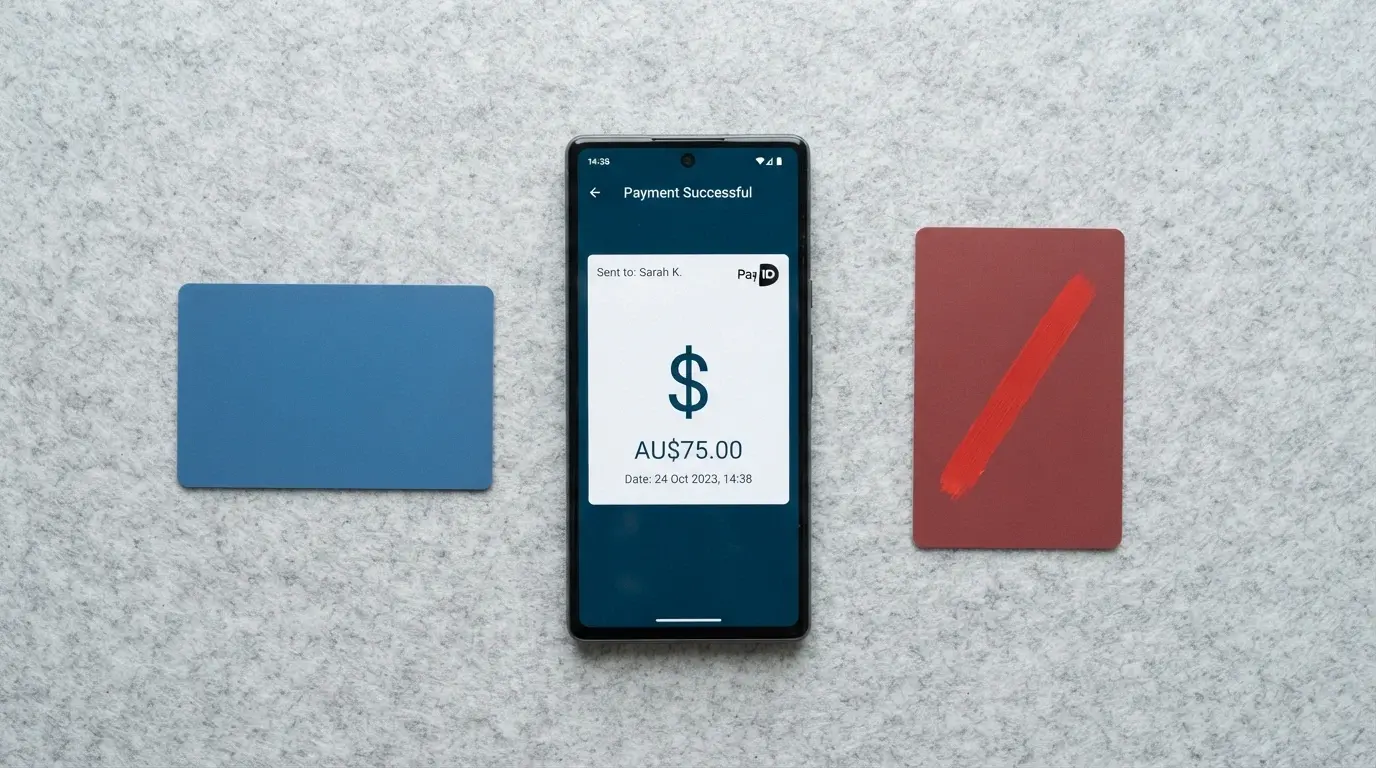
The ban carries real teeth. An operator that fails to enforce the credit-card and crypto prohibition faces penalties of up to $247,500. The figure is per-breach exposure for licensed operators; offshore operators are outside the Australian jurisdiction and so are not directly fined by it, but the ban shapes what licensed operators can offer and what the banking system processes on the Australian end. From 1 January 2027, the bank and payment-provider authority to block transactions to illegal gambling operators extends that effect further: a transaction from an Australian-issued card to an offshore casino can be refused by the issuing bank.
For a $10 deposit, the choice of payment method is therefore the cleanest single indicator of which side of the line the deposit is on. A debit-card or PayID deposit routes through a normal Australian banking channel; a credit-card or crypto deposit routes through a channel that, for an Australian player, the law treats as closed.
PayID and Osko — The Fast Route at the $10 Floor
PayID is the Australian banking system’s real-time identifier service: instead of a BSB and account number, the payer uses a mobile number, email address or ABN linked to the receiving account. Osko is the underlying real-time settlement layer operated by BPAY. Together they make near-instant transfers between Australian bank accounts possible at any hour, including weekends and public holidays.
For a $10 pokies deposit, PayID has two practical advantages. First, the minimum that fits the system is the operator’s own floor — PayID itself does not impose a $10 minimum, and $10 transfers clear without friction. Second, the transfer reaches an Australian bank account in seconds rather than the days a card deposit can sometimes take, which matters more at the small-deposit end where a punter wants to see the playable balance before the welcome offer timer expires. Whether a particular offshore casino accessible from Australia accepts PayID at the $10 floor varies by brand and is not separately verified for each operator here; PayID is the payment method most Australian-facing deposit pages default to in their cashier, and the Australian-banking advantage is that it works the same way at the casino cashier as it does at a friend’s bank account.
PayID and Osko are also the legal deposit route. The regulation names them as one of the four lawful channels for Australian wagering, alongside debit card, bank transfer and BPAY. A punter who deposits through PayID at a licensed Australian wagering operator is using a method the Australian regulator has blessed; a punter who deposits through PayID at an offshore casino is using the same method to reach an unlicensed operator, and the protection at that end is whatever the offshore operator chooses to offer.
Debit Cards and Bank Transfers — The Steady Options
Debit cards issued by Australian banks are the other steady deposit route. Visa and Mastercard debit cards are accepted at most offshore casinos’ cashier pages, and the transaction settles against the bank account rather than as credit. The card’s own limit — typically a daily debit cap — sets the practical ceiling on a single deposit, and the $10 minimum sits well inside that ceiling. Processing time is usually instant at the casino end, with the funds appearing in the playable balance within seconds of the cashier confirming the transaction.
Bank transfer is the slower, more deliberate option. A direct transfer from an Australian bank account to the offshore casino’s nominated account — typically held in an Australian-facing bank — takes longer to clear, sometimes one to three business days, and the minimum deposit is often higher than at the card or PayID cashier. For a $10 deposit, the bank-transfer route is rarely the cheapest or the fastest; it is the option a punter picks when the other methods are unavailable or when they want a paper trail the casino cannot refuse. BPAY sits in the same family — a slow, auditable, Australian-banking-native route, suited to larger deposits than to a $10 floor.
The debit-card and bank-transfer routes are the legal deposit channels the Australian regulation names alongside PayID and Osko. For a licensed Australian wagering operator, identity verification is required before any of these methods can be used to fund the account — a step that does not exist on the offshore side. At an offshore casino, a debit-card deposit from an Australian-issued card typically reaches the playable balance within minutes, with no identity check beyond what the casino’s own anti-fraud system applies.
Credit Cards and Crypto — What the Law Says About These Payment Methods
The Interactive Gambling Amendment (Credit and Other Measures) Act 2023 made it an offence for an Australian-licensed wagering operator to accept credit cards, credit-related products or digital currency (including cryptocurrency) as a deposit method, with the prohibition commencing on 11 June 2024. The penalty for an operator that fails to enforce the ban is up to $247,500.
The wording of the ban is broad. “Credit-related products” catches buy-now-pay-later services and any other product where the funds are not the customer’s own at the moment of the transaction. “Digital currency” covers crypto in all its forms — Bitcoin, Ethereum, stablecoins and the rest. The ban is on the operator’s acceptance of these methods; it is not a ban on an individual Australian holding a credit card or owning crypto. The legal exposure falls on the licensed operator, which is why the credit-card and crypto options disappear from the cashier page at any Australian-licensed wagering site.
The offshore side of the market looks different. Many of the offshore casinos that accept Australian customers continue to advertise credit-card and crypto deposit options, both because they sit outside the Australian jurisdiction and because crypto deposits in particular bypass the Australian banking system entirely. For an Australian punter, this is the diagnostic the regulation points to: a gambling site asking for a credit card or a crypto deposit is being served by someone outside the Australian rules, and the payment method is itself a tell. The offshore route is not illegal for the player — the IGA targets the provider, not the player — but it is a clear signal that the protections the ban was designed to deliver do not apply.
AUD Handling and the $10 Minimum — What the Currency Means
The offshore casinos that take Australian customers tend to accept the deposit in Australian dollars. The cashier page shows the balance in AUD, the welcome offer is denominated in AUD, and the wagering requirement is read off the AUD balance. For an Australian punter, this avoids the most obvious cost of the offshore route: the foreign-exchange fee a bank or card issuer would charge on a non-AUD deposit, plus the unfavourable rate the casino’s own conversion would apply at the cashier.
The $10 AUD floor sits low enough that the conversion question rarely matters at the deposit stage. Where it can matter is at the withdrawal stage. Some offshore casinos settle withdrawals in a different currency than the deposit, or route the withdrawal through an intermediary that takes its own cut, and the AUD balance the punter sees is not the AUD amount that lands in the Australian bank account. The fee is small in absolute terms — a few dollars on a $50 withdrawal, a few dollars on a $200 withdrawal — but it is a fee the licensed wagering route does not impose, because the licensed route settles directly in AUD through an Australian bank.
The deeper currency point is the one the offshore route hides: the product the $10 buys is denominated in AUD, but the operator that takes the $10 is not. The balance is Australian; the entity behind it is not.
Where Australians Are Depositing $10 on Pokies in 2026
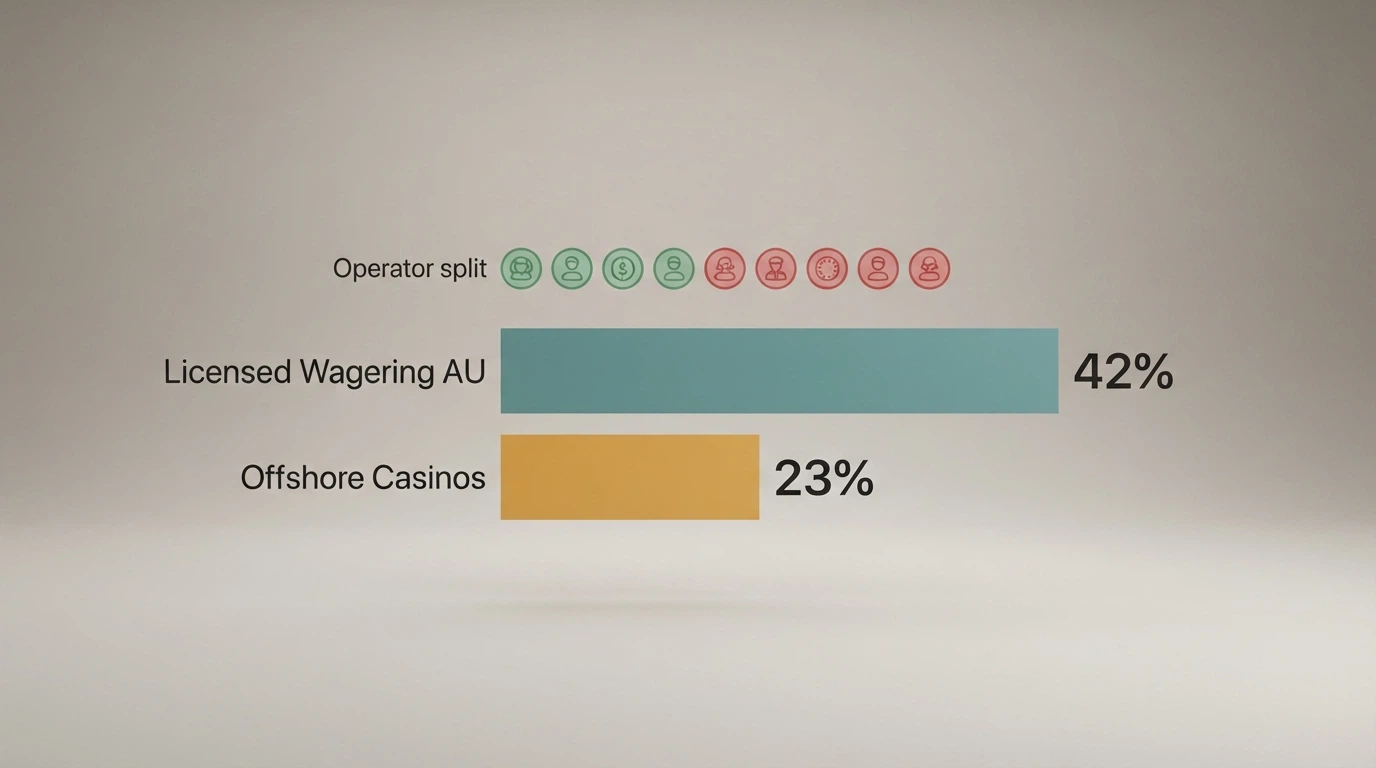
Four operators in the top ten are licensed by an Australian state or territory; six are not. None of the four licensed operators offers online pokies. Every dollar of the six offshore brands sits on the prohibited side of the IGA. The split is the central fact of the operator landscape an Australian punter meets in 2026, and the table below sets it out by Australian-market share.
| Operator | Licence Status in Australia | Product Type | AU Market Share |
|---|---|---|---|
| SportsBet | NT wagering licence | Sports and race wagering | 19.57% |
| Tab | State wagering licence | Racing and sport wagering | 11.54% |
| Rocket Play | Not licensed in Australia | Online casino / pokies | 9.40% |
| Skycrown | Not licensed in Australia | Online casino / pokies | 8.55% |
| Bet365 | NT wagering licence | Sports and race wagering | 6.56% |
| Ladbrokes | NT wagering licence | Sports and race wagering | 4.53% |
| Royal Reels | Not licensed in Australia | Online casino / pokies | 2.51% |
| Stake | Not licensed in Australia | Online casino / pokies | 1.28% |
| FairGO | Not licensed in Australia | Online casino / pokies | 0.80% |
| Bizzo Casino | Not licensed in Australia | Online casino / pokies | 0.57% |
The first thing the spread shows is what is missing. The four licensed wagering brands together hold 42.20% of the Australian market by share — SportsBet alone is bigger than the six offshore casinos on the table combined. None of them offers online pokies. The six offshore casinos together hold 23.11%, every dollar of which sits on the prohibited side of the IGA. The market the punter is searching for exists; the licensed market Australia permits does not serve it.
The second thing the spread shows is what it does not say. Market share is a measure of how much revenue the operator takes from Australian customers, not a measure of how safely that revenue is handled. Revenue scale tells the reader how big the operator is; the licence column tells the reader which side of the law the operator is on. The two columns are not correlated. The biggest Australian-facing operator by share is the licensed one; the biggest offshore casino is the third-largest operator in the ranking. Scale and protection move in opposite directions here, and the punter choosing on share alone would choose the largest operator and end up at the one the law has banned.
SportsBet — Australia’s Biggest Wagering Brand (No Pokies)
SportsBet sits at the top of the Australian online gambling market with 19.57% share and revenue of $1.13B. It holds an NT wagering licence and offers sports and race wagering only — there is no online pokies product, no online casino, and no in-play betting on events that have already started, because all three are prohibited under the IGA. For a punter searching for $10 minimum deposit pokies, SportsBet is not the destination. It is the Australian market’s largest licensed operator and a useful comparison point for what an Australian-licensed product actually looks like.
SportsBet is the answer to the question “what would a $10 deposit at a licensed Australian wagering operator look like?” — a small fixed-odds wager, a multi-leg bet on the weekend’s racing, a deposit that sits in an AUD-denominated account tied to a verified identity and connected to BetStop. The product is not pokies. The protection is. The 19.57% market share says most Australian online gambling spend happens at this kind of operator; the punter who wants pokies is in the other 80%.
Tab — The Iconic Australian Bookmaker (Wagering Only)
Tab is the legacy Australian brand — the state-owned and later privatised bookmaker with a footprint in every capital city’s pub and a tote-based product that pre-dates the internet. It holds a state wagering licence and ranks second in the Australian online gambling market at 11.54% market share, with revenue of $414.11M. Like SportsBet, Tab offers racing and sport wagering only; it does not offer online pokies.
The punter looking for a $10 deposit at Tab will find racing and sport markets, AUD-denominated accounts, identity verification at sign-up, and a connection to BetStop. Tab’s relevance to the $10-pokies page is the same as SportsBet’s: it is what the licensed Australian market looks like, and it is the part of the search result that the prohibition rules out. The market position Tab holds is a useful reminder that the offline Australian bookmaker has not been displaced by the offshore casino — it has been displaced by the licensed online bookmaker, with the offshore casino sitting alongside rather than instead.
Rocket Play — Australia’s Largest Offshore Casino
Rocket Play is the largest offshore casino serving Australian customers, with 9.4% market share and revenue of $632.69M. It operates offshore without an Australian licence and provides online pokies, a product Australian law prohibits. The market share figure tells the reader that one in every eleven dollars Australian online gamblers spend goes through Rocket Play — a level of penetration that puts the brand ahead of every licensed Australian wagering operator except SportsBet.
For a punter searching for $10 minimum deposit pokies, Rocket Play is closer to the answer the search implies. The site accepts AUD deposits at the $10 floor, runs welcome offers aimed at new accounts, and offers the pokies product the licensed Australian market does not. What it does not offer is an Australian licence, an Australian regulator for disputes, or a connection to BetStop. The 9.4% market share says the offshore route is not a niche — it is the second-largest segment of the Australian online gambling market, sitting just behind SportsBet and well ahead of every other licensed brand in the ranking.
Skycrown — Another Offshore Heavyweight
Skycrown captures an 8.55% share of the Australian online gambling market, with revenue reaching $436.07M. As with Rocket Play, it is an offshore operator providing online pokies. Skycrown sits at #4 in the Australian market, just behind Rocket Play and well ahead of the licensed wagering brands that follow it.
The Skycrown profile is structurally similar to Rocket Play’s: an offshore operator, an AUD deposit cashier, a welcome offer aimed at the $10 floor, and a pokies product the licensed Australian market cannot match. The two brands together hold 17.95% of the Australian online gambling market — more than Tab and Bet365 combined. The scale tells the reader the offshore casino segment is not a fringe: it is the third-largest channel for Australian online gambling spend, after SportsBet and the rest of the licensed wagering market.
Bet365 — A Global Wagering Giant with an NT Licence
Bet365 is one of the world’s largest online wagering brands and the fifth-largest operator in the Australian market at 6.56% share. It holds an NT wagering licence and offers sports and race wagering — no online pokies to Australian customers, because the IGA prohibits the product and the NT licence does not cover it.
Bet365 is the clearest illustration of what an NT-licensed global bookmaker looks like in Australia. The wagering product is comprehensive — international sport, Australian racing, in-play markets where the wager is placed before the event starts. The deposit methods are the legal four. The account is identity-verified and BetStop-connected. For a punter whose priority actually stops at wagering, Bet365 is one of the largest options. For a punter whose priority is $10 minimum deposit pokies, Bet365 is not the answer.
Ladbrokes — Licensed Wagering Under the NT Framework
Ladbrokes holds an NT wagering licence and ranks sixth in the Australian online gambling market at 4.53% share. It offers sports and race wagering and does not offer online pokies to Australian customers. The product range is similar to Bet365’s and SportsBet’s: an AUD-denominated wagering account, identity verification at sign-up, deposit through the legal four methods, BetStop connection, and a wagering product that is sports and racing only.
Ladbrokes is the fourth of the licensed wagering brands in the featured set, and its relevance to the $10-pokies search is the same as SportsBet, Tab and Bet365’s: it is what the legal Australian online gambling market looks like, and it is the part of the search result the IGA’s prohibition rules out. The licensed Australian wagering market is not absent from the search — it is present, but it does not sell the product the punter is searching for.
Royal Reels — Offshore Casino Targeting Australian Players
Royal Reels holds a 2.51% share of the Australian online gambling market, with $243.99M in revenue. It operates offshore and provides online pokies. Royal Reels is the third offshore casino in the featured set, sitting at #9 in the Australian market behind six licensed wagering operators and two larger offshore casinos.
The pattern is consistent: an AUD-denominated cashier, a welcome offer at the $10 floor, an offshore licence in another jurisdiction, no Australian regulator for disputes, no BetStop connection. Royal Reels’ market position tells the reader the offshore casino segment stretches from the very large down through mid-sized operators that still hold meaningful share of the Australian market. The 2.51% figure is the same order of magnitude as some licensed brands further down the top twenty; the absence of an Australian licence is the structural difference.
Stake — Offshore Casino with a Growing Australian Footprint
Stake commands a 1.28% share of the Australian online gambling market, with $115.67M in revenue. It is an offshore casino platform. Stake is best known internationally as a crypto-friendly sports and casino operator, and its Australian footprint sits at #12 in the market.
Stake is the operator in the ranking most associated with crypto deposits, and the credit-card-and-crypto ban that came in on 11 June 2024 is most directly relevant to its Australian business model. A punter landing at Stake from an Australian IP is being asked for a deposit method the Australian regulation has closed for licensed wagering — credit card or crypto. The payment method is the tell, and Stake is the operator that most clearly illustrates the diagnostic. The site is real, the games are real, the Australian licence is not.
FairGO — Offshore Casino Specifically Targeting Australians
FairGO maintains a 0.8% share of the Australian online gambling market, with $69.11M in revenue. It is an offshore operator that specifically targets Australian players — the brand, the cashier in AUD, the pokies-heavy game library all signal an Australian focus, and FairGO is the operator in the ranking with the most explicit Australian targeting.
The targeting is the thing to read carefully. FairGO is offshore and unlicensed in Australia, but the marketing and product design treat Australia as the home market. This is the operator that most directly exposes the gap in the Australian regulatory regime: the offshore route is not an accident of search results, it is a deliberate business model aimed at a market that has banned the supply. The 0.8% share is small in absolute terms — FairGO is the third-smallest operator in the ranking — but the targeting matters because it tells the reader the offshore casino market for Australian pokies is curated, not incidental.
Bizzo Casino — The Smallest Offshore Casino in the Featured Set
Bizzo Casino takes a 0.57% share of the Australian online gambling market, generating $51.38M. It is an offshore entity providing online pokies. Bizzo is the smallest of the six offshore casinos in the ranking, sitting at #19 in the Australian market behind thirteen licensed wagering operators and five larger offshore brands.
Bizzo’s relevance is the lower bound: even at 0.57% of the Australian market, an offshore casino can sustain an Australian-facing product with AUD cashier, pokies library, and welcome offers aimed at the $10 floor. The combined offshore casino share in the featured set is 23.11% — meaningful as a category, with a long tail that includes brands smaller than Bizzo still serving Australian customers. The ranking shows the named operators; the long tail is the rest of the segment.
Why Your $10 Pokies Bonus Looks Bigger Than It Actually Is
The welcome bonus is the marketing word the offshore pokies site leads with. “100% match up to A$500” sounds like free money; “A$10 deposit + 50 free spins” sounds like a bargain. The arithmetic behind the offer is where the bonus stops looking like a gift and starts looking like an obligation. The structure of the segment, by bonus type and what each requires of a $10 deposit, is set out below.

| Bonus Type | What a $10 Deposit Triggers | Typical Wagering Obligation | What It Means for Your $10 |
|---|---|---|---|
| Matched deposit (100%) | $10 deposit becomes $20 playable, with a $10 bonus component | 30x–50x the bonus amount, applied to the bonus alone or to deposit + bonus | $10 bonus × 35x wagering = $350 of turnover before the bonus converts to withdrawable cash |
| Free spins on deposit | 20–100 free spins at a fixed stake (often $0.10–$0.20) | Winnings from free spins carry their own wagering multiple (often 30x–40x) | Spin winnings are paid as bonus balance; the $10 deposit is preserved for separate play |
| No-deposit bonus | Small bonus ($5–$25 equivalent) for opening the account, no funding required | High wagering multiple (often 50x–60x) and a maximum cashout cap | $10 no-deposit bonus × 55x = $550 of turnover, often with a $50 ceiling on what can actually be withdrawn |
The gap between the headline figure and the realised value is the point of every bonus structure an Australian punter encounters at the $10 floor. The marketing word is the deposit match; the actual cost is the turnover the match imposes; the realised value to the punter is what survives the wagering requirement, the max-cashout cap, and the house edge on the spins played with the bonus balance.
Bonus terms — wagering multiples, free-spin counts, bonus validity, and maximum cashout figures — vary across operators and are not stated per operator here. The mechanics described in the section are the ones the segment typically applies, drawn from the kinds of offers Australian-facing offshore casinos structure around a $10 first deposit. The pattern holds across the segment: a small deposit unlocks a small bonus, the bonus carries a wagering requirement measured in tens of times the bonus amount, and the realised value of the bonus after wagering is a fraction of the headline figure.
First-Deposit and New-Player Offers — What a $10 Deposit Unlocks
The standard welcome structure at an offshore pokies site is a percentage match on the first deposit, sometimes paired with a bundle of free spins. A 100% match on a $10 deposit gives the punter a $20 playable balance: $10 of the punter’s own money and $10 of bonus money. The bonus component is what carries the wagering requirement — a multiple (often 30x to 50x) of the bonus amount, applied either to the bonus alone or to the deposit-plus-bonus total.
Free-spin offers work differently. The punter deposits $10 and receives a bundle of free spins — often 20 to 100 spins at a fixed stake per spin, typically on a single named game. The free spins are played at the casino’s stake, not the punter’s, and the winnings from the free spins are paid as bonus money. The bonus balance from the free spins carries its own wagering requirement, often in the 30x to 40x range. The free-spin offer looks free; the wagering requirement on the winnings is where the cost sits.
No-deposit bonuses sit at the other end of the spectrum. The casino credits a small bonus — typically $5 to $25 — for opening the account, with no deposit required. The bonus carries a high wagering multiple (often 50x to 60x) and a maximum cashout cap that limits what can actually be withdrawn from the bonus. A $10 no-deposit bonus at 55x wagering with a $50 cashout cap is, in practice, a $50 cap on the realised value of $550 of required play. The bonus is real; the ceiling is the same.
Deposit-Matching on a $10 Stake — The Arithmetic That Eats Your Bonus
The deposit-match mechanics on a $10 stake play out at a scale that exposes the wagering requirement. A 100% match on $10 gives the punter $20 to play with, but the $10 bonus component carries the playthrough. At a 35x wagering multiple applied to the bonus, the punter must turn over $10 multiplied by 35 — $350 — before the bonus balance is withdrawable. At a 50x multiple — within the typical range — the required turnover rises to $500.
The turnover is volume, not loss, but the volume carries a cost. A punter who plays through $350 of stakes on a pokie with a 96% return-to-player will, on average, lose about 4% of the turnover to the house edge. The realised value of the bonus after wagering is a fraction of the $10 headline: the bonus has not multiplied the punter’s money, it has merely converted a portion of it to withdrawable form at the cost of an expected loss on the wagering volume. The free spins work the same way at smaller scale — a $0.10 spin played 50 times yields roughly $5 of bonus winnings, and that $5 carries its own 30x-to-40x playthrough before it can be withdrawn.
The time cost is the other half of the deposit-match arithmetic. A typical online pokie spin takes around five seconds; $350 of turnover at a $0.20 stake is 1,750 spins, which at five seconds a spin is about two and a half hours of continuous play. The arithmetic assumes only the bonus amount is wagered; once the punter tops up the balance with their own money to keep playing through a losing streak, the time and the turnover both climb. The bonus is the reason to play; the playthrough is the price of converting it to cash.
Mobile $10 Pokies Deposits — The Same Sites, a Smaller Screen
The mobile experience at an offshore pokies site is not a different product from the desktop experience. It is the same offshore casino, the same licence (or absence of one), the same game library, and the same cashier — accessed through a mobile browser rather than a desktop. The deposit floor, the welcome offer, the wagering requirements, and the absence of Australian consumer protection all travel intact to the smaller screen.
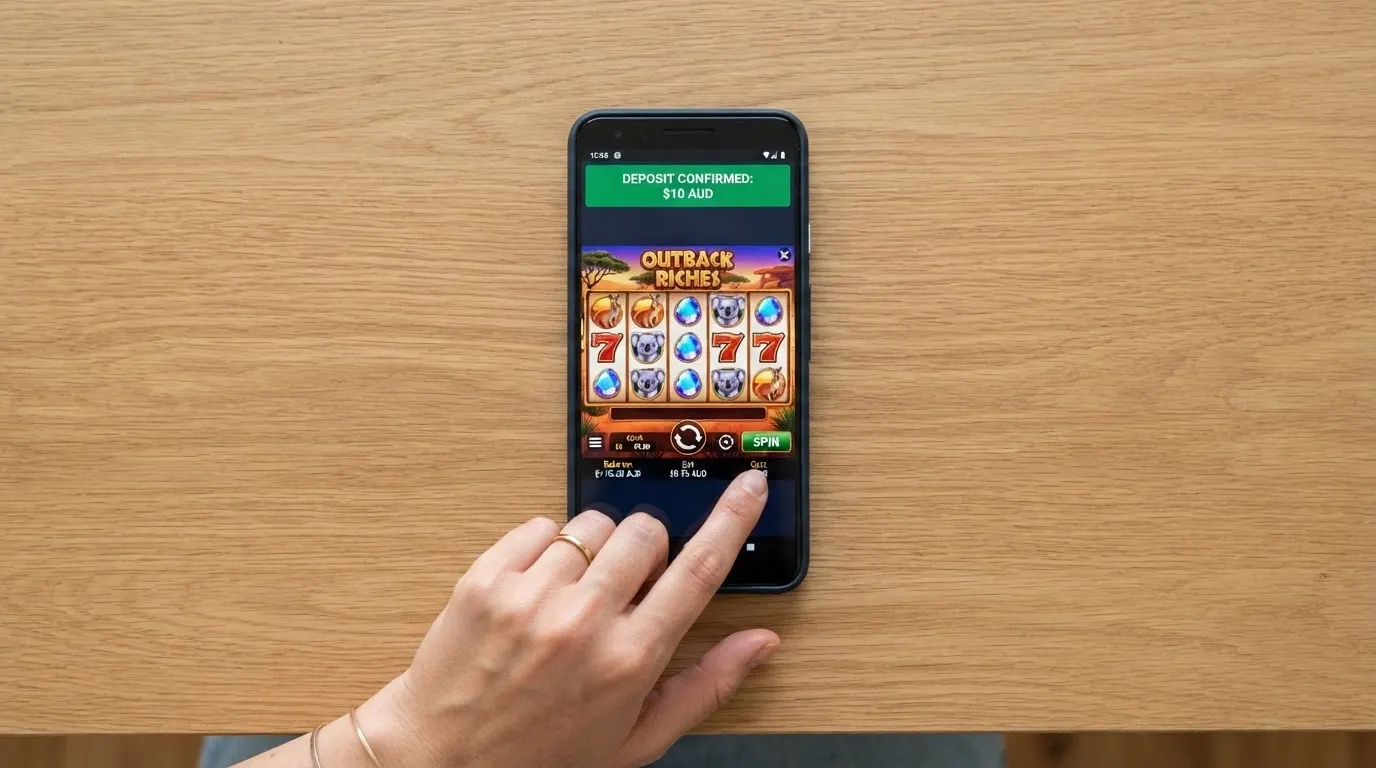
For an Australian punter, what mobile does change is the friction. A $10 deposit from a phone happens in the same flow as a $10 deposit from a laptop — open the cashier, pick the payment method, enter the amount, confirm. PayID on mobile is one tap from the phone’s banking app; debit cards are autofilled from the device’s wallet; the deposit confirmation arrives in seconds. The punter who would never sit down at a desktop to deposit $10 will deposit $10 from the phone without thinking about it, which is the convenience the offshore casino is built around.
The legal position does not change because the screen is smaller. The IGA targets the provider, not the device; the credit-card and crypto ban applies to the payment method, not the form factor; BetStop applies to the operator, not the platform. The offshore route on mobile is the same offshore route on desktop, with the same protections — none from the Australian regulator — and the same exposure to ACMA blocking if the operator is added to the list.
Mobile-Optimised Pokies Sites — What Works on a Phone
Most offshore casino platforms are built mobile-first or mobile-responsive: the cashier, the game lobby, the welcome offer banner, and the customer-service chat all render in a phone browser without a separate app. Game providers typically develop pokies in HTML5, which runs in a mobile browser without a plug-in; the same games available on desktop are available on phone, with touch-screen controls substituted for mouse clicks.
The Australian-facing offshore casino market has converged on a mobile-friendly experience because the mobile channel is the primary acquisition path. The $10 deposit is more often placed from a phone than from a desktop, the welcome offer is more often claimed on a phone, and the punter who plays a few spins between other activities on the phone is the typical customer profile. The game library does not shrink on mobile; the deposit flow does not get harder; the bonus terms do not change. The product is the same product.
The few points where mobile diverges from desktop are practical. Game load times depend on the connection; pokies with elaborate 3D graphics can stutter on a slow mobile network in a way they do not on a wired desktop. Live-dealer games, where the offshore casino streams a real table, are more data-intensive and may not be playable on a metered mobile connection. For the punter whose play is mostly pokies — the $10-deposit pokies audience — these are minor concerns.
Depositing $10 from Your Phone — The Payment Flow on Mobile
A $10 deposit on mobile follows the same four steps as on desktop: open the cashier, pick the payment method, enter $10, confirm. The PayID flow is the most phone-native option. The punter opens the casino’s cashier, picks PayID, sees the casino’s PayID (a phone number, email, or ABN), enters $10 in their banking app, and the deposit appears in the playable balance within seconds. The debit-card flow is similarly short: the card is autofilled from the device wallet, the $10 is entered, and the deposit confirms.
The screen does not change the deposit floor. The $10 minimum is the $10 minimum on mobile and on desktop, because it is the operator’s commercial choice, not a function of the device. The welcome offer is the same welcome offer — the matched deposit, the free spins, the wagering requirement — because it is the operator’s commercial offer, not a device-specific promotion. The punter who deposits $10 from the phone is making the same wager as the punter who deposits from a desktop, with the same game library and the same terms.
What mobile does add is impulse. A deposit that takes one tap on the phone is a deposit more likely to happen, more often, in smaller amounts. The $10 floor combined with the mobile cashier is the offshore casino’s lowest-friction acquisition channel, and the 2026 reform’s inducement-marketing restrictions — the 14-day post-signup ban on direct marketing — are aimed in part at dampening the follow-up nudge the mobile channel enables.
Free Pokies — Playing Without Spending a Cent of Your $10
Every offshore pokies site offers a demo mode on the majority of its games. The demo balance is play money, the spins are real spins against the game’s random-number generator, and the winnings are not withdrawable. The punters who want to test a game before committing a $10 deposit can do so without an account, without a deposit, and without any risk to their bankroll.

Demo mode is the cleanest way to evaluate a pokie. The paytable, the bonus features, the volatility pattern, and the hit frequency are all visible in demo play, and a punter can run a few hundred spins to see whether a game suits their style without spending a cent. The catch is that the winnings are not real — there is no path from a demo balance to a withdrawal, because the demo balance has no monetary value. Demo play answers the question “is this game worth my $10?”; it does not answer the question “can I win money on this game?”, which only real-money play can.
The free-pokies alternative is the no-deposit bonus — the small bonus credited for opening an account, with no deposit required. The no-deposit bonus carries a wagering requirement and a maximum cashout cap, both of which limit its realised value, but it does give the punter a chance to convert a small bonus balance into a small withdrawable win without funding an account. The no-deposit bonus is closer to real-money play than demo mode, at the cost of opening an account at an offshore casino and accepting its terms.
For a punter whose $10 is hard to spare, demo mode is the safest first step. The $10 is preserved until the punter has decided which game to play; the offshore casino’s wagering requirements, max-cashout caps, and withdrawal friction are encountered only when real money is on the cashier. The free-pokies option does not address the legal or regulatory question of whether to play at an offshore casino; it gives the punter the chance to make a more informed decision once they have decided to play.
Staying in Control — Responsible Gambling When the Deposit Floor Is $10
The $10 floor is pitched as the lowest-commitment way to play. The same property makes it attractive to people for whom a $10 commitment is not low at all. Responsible gambling on a $10 floor is the same set of considerations as responsible gambling at any stake — limits, self-exclusion, help lines — with the additional difficulty that the offshore route bypasses some of the tools Australia has built.
The Australian support infrastructure is built around the licensed wagering market. BetStop, the National Self-Exclusion Register, went live in August 2023 and one registration excludes a person from every Australian-licensed online and phone wagering service in a single step. As at 31 July 2026, BetStop had 67,480 registrations, of which 41,290 exclusions were still active; 78% of registrants were under 40, and 38% chose lifetime exclusion. The National Gambling Helpline is free, confidential, and staffed 24 hours a day, seven days a week, with online chat and counselling through Gambling Help Online. The prevalence data sits behind these tools: about 2.1% of Australian adults — roughly 430,000 people — experience problem gambling, and the Australian Institute of Health and Welfare put high-risk gambling at 1.8% in 2022.
These numbers sit behind a structural gap. BetStop binds Australian-licensed services only; an offshore casino is not licensed in Australia, is not connected to the register, and will keep taking a self-excluded person’s money. This is the most concrete single harm of the offshore route — the registered self-excluder who, having taken the step to exclude from every Australian-licensed operator, can still open an account at an offshore casino and deposit $10 without the registration being checked.
Setting Limits on a $10 Deposit — Tools That Actually Work
The limit-setting tools available at a licensed Australian wagering operator are statutory: deposit limits, session limits, take-a-break tools, and exclusion through BetStop. The licensed operator is required to offer these tools, to honour the limits the punter sets, and to enforce the exclusion across every other licensed operator the punter might be tempted to try.
The offshore route’s limit-setting is voluntary. Most offshore casinos offer deposit limits, session timers, and self-exclusion within their own platform — and many honour them, at least until the punter’s balance is involved. The limits are not connected to BetStop, are not enforced across other offshore casinos, and are not backed by an Australian regulator. A punter who has self-excluded at an Australian-licensed operator and then self-excludes at an offshore casino is protected by the offshore casino’s own processes, for as long as those processes hold. A punter who has self-excluded at one offshore casino and not at another is not protected at the second.
For a punter deciding whether to use the offshore route at all, the limit-setting question is the one to settle first. A punter who can set a deposit limit and stick to it — at $10, or $50, or any amount — and who can walk away when the limit is reached, does not need BetStop to control their play. A punter who cannot, and who is also outside the BetStop coverage of the licensed market, is the punter for whom the offshore route is most dangerous.
Where to Get Help — The Australian Support Infrastructure
- National Gambling Helpline: 1800 858 858 — free, confidential, 24 hours a day, 7 days a week.
- Gambling Help Online: gamblinghelponline.org.au — online chat and counselling.
- BetStop — National Self-Exclusion Register: one registration excludes from every Australian-licensed online and phone wagering service.
- Your doctor or a mental-health professional: for ongoing support with gambling-related harm.
These services are free, confidential, and Australian. They do not require the punter to be a customer of any operator, and they do not require the punter to stop gambling before reaching out. The helpline is the single number every Australian punter should save, regardless of where they play.
How We Assessed Every $10 Deposit Pokies Site
The ranking in this article is built on three inputs. The first is the Australian regulatory position: the Interactive Gambling Act 2001 prohibits online casino games and online pokies, and no licence exists for those products anywhere in the country. The second is the BLASK BRANDS AU market-share dataset, which provides the order in which Australian-facing operators appear in this article. The third is licence verification against the ACMA register, the Northern Territory Racing and Wagering Commission register, and the state and territory wagering licensing registers.
The split between licensed wagering operators and offshore casinos is the central organising fact of the ranking. Each operator’s licence status was checked against the appropriate Australian register. The NT wagering licences held by SportsBet, Bet365 and Ladbrokes, and the state wagering licence held by Tab, are recorded against the relevant state or territory regulator. The offshore casinos — Rocket Play, Skycrown, Royal Reels, Stake, FairGO, Bizzo Casino — were checked against the ACMA’s list of operators it has investigated or blocked, and none holds an Australian licence for any product.
Per-operator bonus terms — wagering multiples, free-spin counts, bonus validity, and maximum cashout figures — vary across the segment and are not stated per operator here. The bonus and deposit sections therefore describe industry-typical mechanics; the operator ranking and licence status are based on the regulation and operator sources verified for this comparison.
The criterion the ranking applies is straightforward: an operator is placed by its Australian-market share, with its licence status stated explicitly. The licensed wagering operators are placed alongside the offshore casinos, because both appear in the same search results for $10 minimum deposit pokies Australia. The licence status is the column a reader should read first, because the licence determines what protections the operator is bound by — and which the operator is not.
Is a $10 Pokies Deposit Worth It — What the Numbers Say
A $10 deposit at an offshore pokies site buys the game library, the welcome offer, and the chance of a withdrawable win. It does not buy any of the protections the licensed Australian wagering route offers: identity-verified accounts, BetStop coverage, ACMA-supervised dispute resolution, or the bank-and-payment-provider checks that come with a regulated cashier. The offshore route is also the route the Interactive Gambling Act 2001 prohibits at the provider end, and the route the ACMA has been blocking at the ISP level since 2019. The 2026 reform, commencing 1 January 2027, gives Australian banks express authority to refuse transactions to illegal gambling operators — a measure that will tighten the offshore route further, not legalise it.
The licensed wagering route offers none of the product the search is for. SportsBet, Tab, Bet365 and Ladbrokes are licensed, regulated, BetStop-connected, and prohibited from offering online pokies. A punter who chooses a licensed wagering operator is choosing safety at the cost of the product they searched for; a punter who chooses an offshore casino is choosing the product at the cost of the safety net. The page cannot resolve that trade for the reader, because the trade is the reader’s — the licensed market is closed on the pokies side, the offshore market is closed on the protection side, and the choice between them is the choice the IGA’s prohibition creates.
The wagering arithmetic on the welcome bonus, which the bonus section walks through, is the other side of the value question. The matched deposit at a $10 stake gives a $20 playable balance and a turnover obligation measured in tens of times the bonus amount; the realised value of the bonus after the wagering requirement and the house edge is close to the $10 headline, not above it. The free spins, the no-deposit bonus — each comes with a ceiling, a wagering multiple, or a maximum cashout cap that brings the realised value back to a small fraction of the marketing word. The house always has an edge, and the bonus terms are how that edge gets priced into the headline offer.
The honest verdict is that a $10 pokies deposit at an offshore casino is a discretionary entertainment spend in a market Australia has banned, with a bonus structure that returns a fraction of its headline value, with no Australian recourse if something goes wrong, and with self-exclusion tools that do not reach the offshore route. For a punter who can set a $10 limit and walk away when it is spent, the offshore route is a low-stakes entertainment option; for a punter who cannot, the offshore route is the one place the Australian regulatory regime cannot help. The 2027 reform does not change the legal position — it adds more friction at the bank and the affiliate level. The licensed wagering route does not change either — it is the safe route to a different product. The $10 deposit the punter came for is real; the rest of the trade is what this page is about.
Frequently Asked Questions
Is it legal to play online pokies with a $10 deposit in Australia?
Online pokies are prohibited in Australia under the Interactive Gambling Act 2001. Every pokies site accessible from Australia operates offshore, holds no Australian licence, and falls outside the ACMA’s regulatory reach. The IGA targets the provider of the prohibited service, not the individual player — players are not prosecuted. The legal exposure sits with the offshore operator, not with the punter placing the $10 deposit.
Can I get a welcome bonus when I deposit $10 at an online pokies site?
Most offshore pokies sites offer a welcome bonus on the first deposit, typically a percentage match (often 100%) and sometimes a bundle of free spins. The bonus carries a wagering requirement — commonly 30x to 50x the bonus amount — and a maximum cashout cap, both of which limit the realised value. Terms vary across operators; the mechanics described in the bonus section are the ones the segment typically applies.
Are $10 minimum deposit pokies sites connected to BetStop self-exclusion?
No. BetStop, the National Self-Exclusion Register, binds Australian-licensed wagering services only. An offshore pokies site is not licensed in Australia, is not connected to the register, and is not required to honour a BetStop registration. A punter registered with BetStop can still open an account at an offshore casino and deposit $10; the offshore casino’s own voluntary self-exclusion is the only protection that applies on the offshore side.
What are the risks of playing at offshore pokies sites that accept Australian players?
The offshore route carries no Australian consumer protection: no ACMA dispute resolution, no AUSTRAC-supervised cashier, no BetStop coverage, and no statutory recourse if a withdrawal is refused or a bonus is voided. The 2026 reform, commencing 1 January 2027, gives Australian banks express authority to block transactions to illegal gambling operators, which adds friction at the deposit and withdrawal stages. The ACMA has blocked 1,564 illegal gambling and affiliate websites since November 2019.
Do $10 deposit pokies sites work on mobile phones in Australia?
Yes. Offshore pokies sites are typically mobile-optimised, with the cashier, the game lobby, and the welcome offer rendering in a phone browser. PayID on mobile is one tap from the phone’s banking app; debit-card deposits autofill from the device wallet. The mobile experience does not change the offshore route’s regulatory position — the operator is the same operator, on the same licence, with the same absence of Australian consumer protection.
Are my winnings from online pokies taxable in Australia?
No. Betting and gambling winnings are not assessable income under section 6-5 of the ITAA 1997, and gambling losses are not deductible under section 8-1, unless the person is carrying on a business of betting or gambling. The typical recreational punter does not owe tax on a $10-deposit pokies win and cannot claim the loss against other income.