
Anonymous Crypto Casinos in Australia: The Full Picture for 2026
 Available in AU
The phrase “Australian anonymous crypto casino” is a contradiction the moment you write it down. Online casino games are prohibited to provide in Australia under the Interactive Gambling Act 2001. There is no online casino licence anywhere in the country — not federally, not in any state or territory. The Interactive Gambling Amendment (Credit and Other Measures) Act 2023 then added a second wall: from 11 June 2024, no Australian-licensed wagering operator can accept credit cards or digital currency as a payment method. So an “Australian” anonymous crypto casino cannot, by definition, be Australian. It is offshore. The casino sits in Curaçao or Anjouan, the licence belongs to a company registered there, and the player is an Australian depositing Bitcoin from a kitchen table in Brisbane.

What “anonymous” actually means in this market is narrower than the marketing suggests. It means email-only registration with no identity documents at sign-up. It means no bank details, no credit card, no upload of a driver’s licence to create an account. It does not mean invisible. The casino sees the wallet address, the exchange sees the fiat on-ramp and off-ramp, the blockchain keeps a permanent record of every transaction, and the moment withdrawals cross the operator’s threshold — usually somewhere between A$1,000 and A$2,200 cumulative — the casino asks for ID anyway. Anonymity in this market is a delay, not an absence. The right question is how long the delay lasts and what it costs when it ends.
This page ranks the ten offshore operators Australian players actually use, on the basis of what each one demands before it asks for your name, and on the bonus terms and withdrawal speed the page has verified against operator terms and independent testing. Every operator here is offshore and unlicensed in Australia, because every anonymous crypto casino has to be. The page covers the Australian legal framework so the reader understands the structural reason for that, then the bonus math that determines what each headline offer is actually worth, then the withdrawal speeds and the AUSTRAC and ATO rules that catch the player at the other end. It closes with the player-protection gap that opens the moment the casino does not know who you are.
Current as of 22 October 2026, against the ACMA licence register, AUSTRAC reporting rules and operator terms pages as published at the time of review.
Table of Contents
- Why an Australian “Anonymous Crypto Casino” Is Already Offshore
- The 10 Anonymous Crypto Casinos Australian Players Use — and Where Each One Draws the Line
- Why Australia Has No Licensed Online Casino — and What That Means for You
- Why Your Anonymous Casino Bonus Is Smaller Than It Looks
- Crypto Withdrawals: The Four-Minute Promise and the KYC Trap
- Playing Without a Safety Net — What You Lose When the Casino Does Not Know Who You Are
- How We Selected and Ranked These Operators
- What You Should Actually Do Next
- Frequently Asked Questions
Why an Australian “Anonymous Crypto Casino” Is Already Offshore
The term is a marketing claim, not a legal status. No Australian entity holds an online casino licence, and no offshore operator accepting crypto from Australian players has any standing in Australian consumer law. The Interactive Gambling Act 2001 makes the provision of online casino games, online pokies and in-play sports betting an offence. The Act targets the provider, not the player, which is why no Australian has been prosecuted for using an offshore casino. The 2024 credit-and-crypto ban closed the remaining loophole: from 11 June 2024, even a licensed wagering operator that wanted to take your Bitcoin cannot. Penalties for an operator that does reach A$247,500 per breach.
What that produces in the market is a segment of offshore brands reaching Australian players through search results, affiliate sites and crypto communities. They market themselves as “Australian-friendly” because they accept AUD, process Australian-dollar deposits, and pay out in Bitcoin to a Sydney IP. The friendliness is operational. The legality is not. Each operator listed in the ranking below is unlicensed in Australia for the product it offers. The label “Australian” on any of them is a marketing word, not a regulatory one.
Email-Only Registration — How Far It Gets You Before KYC Is Triggered
The registration flow at every operator on this list is the same: an email address, a password, sometimes a username, and a checkbox accepting the terms. No driver’s licence, no passport, no proof of address. A wallet can be connected and a deposit made within minutes. From the operator’s perspective, that flow is fast and conversion-friendly. From a player-protection perspective, it means the casino has no idea who its customers are, and the only verification checkpoint is the one that happens when the player tries to take money out.
That checkpoint is the KYC trigger, and it is the line that defines what “anonymous” actually means in this market. Across the operators tested, the standard trigger sits between A$1,000 and A$2,200 in cumulative withdrawals — below that, withdrawals process without identity verification. Cloudbet extends that ceiling higher, to A$2,200 per day, which is the broadest no-KYC window on the list. BC.Game triggers earlier, at roughly A$1,000 cumulative. Verification requests also commonly appear once withdrawals exceed A$2,000 to A$5,000 or after a sequence of early cash-out attempts, even at operators that nominally advertise “no KYC” at sign-up. The pattern is consistent enough that forum reports describe the same surprise: a player deposits, plays, requests a cashout, and finds the operator asking for a utility bill and a photo of the card used to fund the exchange account.
What an operator actually collects at that point is also more than the marketing suggests. Standard checks include government-issued ID, proof of address, and source-of-funds documentation for larger amounts. For a player who set up the account specifically to avoid that step, the moment the threshold is crossed is the moment the “anonymous” label stops being true. The casino does not need to ask at sign-up because the practical checkpoint is the cashout, and most players do not plan around it.
The Crypto Payment Chain — Where Anonymity Lives and Where It Breaks
The most important thing to understand about crypto-funded gambling is that the transactions are pseudonymous, not anonymous. A Bitcoin address is not tied to a name on the blockchain itself — every transaction is publicly visible, permanently recorded, and traceable. The privacy comes from the absence of a name on the public ledger. The traceability comes from the fact that every participant in the chain sees a different slice of the picture.
The casino sees the wallet address that deposited and the wallet address that withdrew. It can flag addresses it considers high-risk — known exchange wallets, mixing services, addresses linked to darknet markets in chain-analysis databases. The exchange sees the player’s fiat on-ramp: the bank transfer, the PayID deposit, the BPAY transfer that bought the Bitcoin in the first place. The bank sees the transfer to the exchange. None of those three sees the full picture, but a subpoena or an AUSTRAC request stitches them together. The A$10,000 threshold transaction report is the formal mechanism. Any transfer of physical currency or e-currency of A$10,000 or more triggers a TTR to AUSTRAC, and deliberately splitting a payment to stay under the threshold — structuring — is an offence under the AML/CTF Act.
For most players the threshold is academic, because the deposit and withdrawal sizes at a crypto casino are typically well under A$10,000. For a player who hits a large win, the picture changes. A Bitcoin withdrawal worth A$15,000 in market value at the time of transfer is reported. A player who tries to keep the value under the threshold by splitting withdrawals into A$9,000 chunks has committed the offence the threshold was designed to catch. The chain is private from other players. It is not private from the regulators that matter.
Playing Anonymously on Mobile — Browser vs App
The mobile experience at an anonymous crypto casino is built for the browser, not the app store. Every operator on this list is accessible through a mobile browser at a URL the player types or follows from an affiliate link. There is no dedicated anonymous casino app in the Australian App Store or Google Play Store, because Apple’s and Google’s identity-verification rules for app distribution would defeat the point. The browser route keeps the email-only registration intact and lets the player connect a wallet from the same device.
The practical mobile experience is therefore the same as the desktop experience, scaled to a phone. Crypto deposits and withdrawals work through the same wallet integrations. KYC requests, when they come, appear in the same account menu. The mobile flow does not introduce a separate identity step at the platform level, and a player who switches between phone and laptop does not need to reverify on either. What it does not give the player is the offline cache and the push-notification reliability of a native app, and the ACMA can still block the URL at the DNS level the same way it does on a desktop browser. The browser is the right format for the anonymity model. It is also the format most exposed to a site block.
The 10 Anonymous Crypto Casinos Australian Players Use — and Where Each One Draws the Line
Every operator on this list is offshore and unlicensed in Australia. There is no Australian-licensed online casino to rank against. The ranking turns on how little identity each operator demands at sign-up and how much it delivers in return — the breadth of crypto support, the KYC threshold, the speed of the withdrawal, the size of the welcome bonus and the honesty of the terms. The table below is the summary; the operator blocks beneath it carry the detail.
| Operator | Licence / Legal Status | Welcome Bonus | Wagering Requirement | Free Spins |
|---|---|---|---|---|
| BC.Game | Offshore (Curaçao); unlicensed in AU | 360% over 4 deposits | — | — |
| Stake.com | NTRC-sublicensed AU entity + Curaçao parent; casino product offshore, unlicensed in AU for casino | None (rakeback model) | — | None |
| Cloudbet | Offshore (Curaçao 8048/JAZ); unlicensed in AU | 100% up to 5 BTC | — | — |
| Lucky Block | Offshore; unlicensed in AU | 200% up to A$10,000 AUD equivalent | 35x | 50 FS |
| SkyCrown | Offshore; unlicensed in AU | Up to A$8,000 + 400 FS across 4 deposits | 40x bonus / 30x FS | 75–150 FS per tier |
| Rocket Play | Offshore; unlicensed in AU | 100% up to A$1,000 + 100 FS | 40x on bonus | 100 FS (20/day for 5 days) |
| Rainbet | Offshore; unlicensed in AU | 250% up to A$2,100 + 60 FS across 3 deposits | 40x on deposit + bonus (or gradual release) | 60 FS on Sweet Bonanza |
| Fair Go Casino | Offshore (RTG-powered); unlicensed in AU | 300% up to A$3,000 + 50 FS on Cash Bandits 2 | 30x on deposit + bonus; 60x on no-deposit | 50 FS on Cash Bandits 2 |
| Royal Reels | Offshore; unlicensed in AU | 100% up to A$500 + 50 FS | 30x on bonus | 50 FS + A$10 no-deposit chip |
| Shuffle | Offshore; unlicensed in AU; classified “grey-zone” | — | — | — |
The empty cells are honest gaps. Research confirmed bonus, wagering or free-spin terms for some operators and not others, and the table does not invent the missing figures. BC.Game’s 360% headline is the largest match percentage on the list, but research did not confirm the wagering requirement, free-spin allocation or per-tier cap from the current run; a player considering BC.Game should check the operator’s own bonus page for the current terms before depositing. Shuffle’s bonus and game-provider details were not published at review time — ChainBankroll classifies it as grey-zone for Australian access, and the ranking is based on its KYC profile rather than its promotional offering.
The two operators that stand out on KYC severity are BC.Game at 2.5 out of 10 and Cloudbet, which sets its no-KYC ceiling at A$2,200 in daily withdrawals. Both extend the anonymous window further than the rest of the list, and both carry the additional advantage of broad crypto support and tested fast withdrawal speeds. The trade-off is jurisdiction: both are Curaçao, both are outside any Australian consumer-protection framework, and both can change their terms at any time.
BC.Game — The Lowest-KYC Operator Tested for Australian Players
ChainBankroll rates BC.Game at 2.5 out of 10 for KYC severity, the lowest figure on this list. The trigger sits at roughly A$1,000 in cumulative withdrawals, which is tighter than Cloudbet’s A$2,200-a-day ceiling but lower than the A$1,500 to A$2,000 range that defines the middle of the segment. The headline offer is a 360% welcome bonus spread across four deposits, the largest match percentage on the list. The game library is the broadest in the segment at 8,400-plus titles. The fastest raw on-chain withdrawal tested from a Sydney IP was 3 minutes 47 seconds on a Saturday — the kind of number that only happens on a quiet blockchain with no mempool backlog.
The trade-off is that research did not confirm the wagering requirement, the per-tier cap, or the free-spin allocation in this run, and the operator’s own bonus page is the only source that resolves those details. A player who wants the largest match and the lowest KYC ceiling accepts a brand whose promotional terms have to be re-checked at deposit. For a player with a small bankroll, the low KYC threshold is the more important of the two — the bonus terms are public, the KYC threshold is the structural feature.
Cloudbet — Widest Crypto Support and Lightning Network Withdrawals
Cloudbet holds a Curaçao licence (8048/JAZ) and accepts more than 35 cryptocurrencies, the broadest crypto support range among the featured operators. The no-KYC window extends to A$2,200 in withdrawals per day, which is the most generous ceiling on the list and the most useful single fact for a player who plans to withdraw regularly in smaller amounts. The welcome bonus is a 100% deposit match up to 5 BTC with a 0.001 BTC minimum deposit, the largest bitcoin-denominated ceiling on the list. The fastest raw payout tested from a Sydney IP was 4 minutes 11 seconds via Lightning Network on 14 March 2026, the lowest of the figures published.
The trade-off is the standard withdrawal processing time. Cloudbet quotes approximately 24 hours for standard processing, which means the Lightning Network speed is the upper bound rather than the median. A player who values the breadth of crypto support and the high no-KYC ceiling pays for it in a queue that the smaller operators do not run. This generous threshold makes Cloudbet a top choice for players who prioritise smaller, frequent withdrawals over headline bonus figures.
Stake.com — The Rakeback Model With an Australian Entity
Stake is the only operator on this list with a formal Australian presence. The Curaçao parent runs the casino product, and an entity sublicensed by the Northern Territory Racing and Wagering Commission handles the Australian-facing operation. The catch is that the Australian entity requires an Australian phone number at sign-up, which is the first identity checkpoint on this list to appear at registration rather than at withdrawal. The casino product itself remains offshore, and the IGA prohibition on the provision of online casino games still applies.
There is no welcome bonus. Stake runs a rakeback model — a percentage of house edge returned to the player over time, rather than a deposit match at the door. KYC severity is rated 3.0 out of 10 with a trigger at roughly A$1,500 in cumulative withdrawals. The fastest tested withdrawal was 8 minutes 22 seconds. Players who prefer ongoing rakeback rewards over a one-time welcome bonus may find the trade-off worthwhile, despite the initial identity check.
Lucky Block — Ultra-Low Minimum Deposit and Sub-Five-Minute Withdrawals
Lucky Block’s minimum deposit is A$1 in AUD-equivalent crypto, the lowest on the list and a useful feature for a player who wants to test the operator with a tiny first deposit before committing. The welcome bonus is a 200% match up to A$10,000 AUD equivalent plus 50 free spins, with 35x wagering. The game library is 2,700-plus titles. Registration is email-only, and the operator’s published withdrawal ceiling is up to 5 minutes, the fastest published figure on the list.
The trade-off is the wagering multiple. 35x sits between Rocket Play’s and SkyCrown’s 40x and Fair Go’s and Royal Reels’ 30x — neither the tightest nor the most generous. For a player who values the low entry point and the published fast withdrawal, the math is the more important variable. The bonus is a credit on the deposit; the wagering multiple is what determines how much of the winnings convert to a withdrawal. Both are public, both are the same on day one and day thirty, and the player can decide whether the 35x is worth the A$1 entry.
SkyCrown — The Largest Welcome Package on the List
The headline on SkyCrown is up to A$8,000 in bonus funds plus 400 free spins across four deposit tiers, the largest package by total headline value on the list. The first deposit is 100% up to A$500 plus 100 free spins on Book of Dead. Wagering is 40x on the bonus amount and 30x on free-spin winnings. Bonus validity is 14 days per tier. The minimum deposit is A$20. A USDT TRC-20 withdrawal tested on 24 June 2026 cleared in 12 minutes with a A$0.90 network fee.
The trade-off is in the four-tier structure. The advertised A$8,000 and 400 free spins are the maximum across all four deposits, not the first-deposit headline. A player who deposits once and plays the first tier sees 100% up to A$500 and 100 free spins, which is a smaller package than Rainbet’s first deposit at 100% up to A$700. The 14-day validity per tier is also shorter than it sounds — each tier has its own clock, and the player who deposits the second and third tiers after a busy week may find the validity already running. The 30x wagering on free-spin winnings is the lowest free-spin wagering on the list and the one genuinely generous term in the package.
Rocket Play — Straightforward AU-Dollar Bonus With a Tight Five-Day Window
Rocket Play’s first deposit is 100% up to A$1,000 plus 100 free spins at 20 per day for five days, with 40x wagering on the bonus amount, a five-day bonus validity, a A$7.50 maximum bet during wagering, and a A$30 minimum deposit. The offer is plain, in AUD, and easy to read. The second deposit is 200% up to A$1,000, which raises the headline on a second visit but carries the same 40x and the same five-day window.
The five-day validity is the shortest on the list and the most common way players lose the bonus without converting it. A A$1,000 bonus at 40x wagering means A$40,000 in required turnover in five days — A$8,000 a day at consistent play. The A$7.50 maximum bet during wagering is also the lowest explicit cap on the list, and breaching it voids the bonus. The wagering math is below in the bonus section. Provided you can consistently commit the time, the terms are straightforward and transparent.
Rainbet — The Dual-Path Bonus With a Wager-Free Escape Route
Rainbet is the only operator on the list that offers a no-wager alternative to the standard wagering requirement. The welcome package is 250% up to A$2,100 plus 60 free spins across three deposits at 100%, 50% and 100%, with a maximum of A$700 per tier. The wagering path is 40x on deposit plus bonus with a seven-day validity, a 2%-of-deposit maximum bet, and slots with RTP above 97.4% excluded while the bonus is active. The no-wager path is a gradual-release structure that unlocks 1% of the bonus for every 1% of the deposit wagered, multiplied by 20% — a slow unlock that avoids the rollover entirely.
The two paths suit different players. The wager path is the standard bonus-as-credit model, with the 97.4% RTP exclusion as the main restriction — popular high-RTP slots are off the table while the bonus is active. The gradual path is for a player who plans to play through the deposit anyway and is happy to unlock the bonus in proportion to play rather than chasing a single rollover number. The 2% maximum bet is calculated against the deposit, so a A$100 deposit caps bets at A$2 during wagering. The free spins are on Sweet Bonanza, a Pragmatic Play title at 96.51% RTP.
Fair Go Casino — AUD-Friendly With the Biggest Match Percentage
Fair Go runs on RTG software, accepts Australian-dollar deposits directly, and posts a 300% welcome match up to A$3,000 plus 50 free spins on Cash Bandits 2. Wagering is 30x on deposit plus bonus, which is the lowest standard wagering on the list. The no-deposit offer is a A$50 free chip with 60x wagering and a A$180 maximum cashout cap, which is the only substantial no-deposit offer in the segment.
The trade-off is the no-deposit terms. A A$50 free chip with 60x wagering means A$3,000 in required turnover, and a A$180 maximum cashout cap means the most a player can withdraw from a no-deposit chip is A$180 regardless of the win size. The 300% match is also deposit-plus-bonus in the wagering calculation, so a A$1,000 deposit at 300% gives a A$3,000 bonus, with 30x applied to the A$4,000 combined. Depositing in AUD is hassle-free here, though the no-deposit offer’s ceiling makes it less lucrative than it first appears.
Royal Reels — One of Two Operators With a Genuine No-Deposit Offer
Royal Reels is one of two operators on the list with a true no-deposit bonus. The free chip is A$10 with 30x wagering and no deposit required. The welcome match is 100% up to A$500 plus 50 free spins, with 30x wagering on the bonus amount and a A$30 minimum deposit. The no-deposit cashout cap is shown at activation and was not confirmed in this run, so a player claiming the free chip should read the cap before playing.
The A$10 free chip is small in headline terms but unusually clean in structure. 30x on a A$10 chip is A$300 in required turnover — modest in absolute terms and achievable in a single session. The welcome match is unremarkable: 100% up to A$500 with 30x wagering is a standard bonus in this segment, neither the highest match nor the lowest wagering. This low-risk entry makes it an ideal platform for players testing the waters before moving on to larger, more complex packages.
Shuffle — The Grey-Zone Operator With Thin Public Detail
Shuffle is the operator on the list with the least public detail. KYC severity is rated 3.5 out of 10 with a trigger at approximately A$2,000 in cumulative withdrawals, mid-tier on both counts. ChainBankroll classifies Australian access as grey-zone, which is the only operator on the list to carry that label. Bonus terms, game providers, and the full KYC document list were not published at review time.
A player considering Shuffle should check the operator’s own site for current offers and the current Australian-access status before depositing. The grey-zone classification means Australian access may be restricted, may be tolerated, or may be in the process of being restricted. The ranking position reflects the KYC profile rather than the promotional offering, because the promotional offering is not on the public record. The honest statement is that the data is not in the table because the data was not in the research.
Why Australia Has No Licensed Online Casino — and What That Means for You
The Interactive Gambling Act 2001 prohibits the provision of online casino games, online pokies and in-play sports betting to a person in Australia. There is no licence for an online casino anywhere in the country — not federally, not in any state or territory. The Act targets the provider, not the player; no Australian has been prosecuted for using an offshore casino, and the enforcement framework is designed to target operators and advertising rather than individual punters. What Australia does license is wagering on races and sport placed before the event begins, plus lotteries and keno, through state and territory licensees — the Northern Territory Racing and Wagering Commission is the de facto national licensor for online wagering.

What is licensed is not what the marketing for this segment sells. The phrase “Australian online casino” describes a product that does not exist under Australian law. Every operator on this list is offshore. The legal status matters for two reasons. The first is the practical one: there is no Australian complaints body, no Australian consumer protection, and no Australian regulator that can recover a player’s money if an offshore operator refuses to pay. The second is the structural one: the 2024 credit-and-crypto ban made it illegal for any licensed Australian wagering operator to accept digital currency, which is the reason the entire anonymous crypto casino segment sits offshore rather than inside the regulated framework.
The 2024 Crypto Payment Ban — Why No Licensed Operator Takes Your Bitcoin
The Interactive Gambling Amendment (Credit and Other Measures) Act 2023 commenced on 11 June 2024. The amendment bans credit cards, credit-related products and digital currency as payment methods for online wagering by licensed operators. An operator that fails to enforce the ban faces penalties of up to A$247,500 per breach. The result is that no Australian-licensed wagering operator can take a Bitcoin deposit, and no operator that does take one is operating inside the Australian licensed framework.
This is the structural reason the anonymous crypto casino segment exists offshore. A player who wants to deposit crypto at a casino does not have a licensed Australian option to choose. The choice is between an offshore operator and no crypto play. The amendment does not make crypto deposits by Australian players illegal — the IGA targets the provider, not the player — but it makes them unavailable inside the regulated system. The ACMA enforces the ban at the operator end. The player’s end of the transaction is not the enforcement target.
Not Illegal for You — Not the Same as Safe
No Australian player has been prosecuted under the IGA for using an offshore casino. This is a deliberate design choice in the legislation: the Act targets providers and advertising rather than individual punters, on the practical grounds that prosecuting players is politically and operationally untenable. The result is a market in which the player is free to use an offshore operator without legal consequence, but free without recourse.
“Not illegal” in this context does not mean “protected.” There is no Australian consumer protection framework that reaches an offshore casino, no Australian complaints body that can mediate a dispute, and no Australian regulator that can order an offshore operator to pay a player’s winnings. The ACMA can block the site at the DNS level, but blocking does not pay out a balance. A completed crypto deposit is a completed blockchain transaction — there is no chargeback mechanism, no payment processor to dispute with, and no escrow that holds the funds while a complaint is investigated. The casino’s own complaints process is the only complaints process, and the casino controls it. “Not illegal for you” is the start of a calculation, not the end of one.
ACMA Enforcement — Site Blocking, the Polymarket Precedent and the Reform
The ACMA had 1,564 illegal gambling and affiliate websites blocked by Australian ISPs as of March 2026, with 133 sites blocked in the October to December 2025 reporting period alone. Blocking is DNS-level, and operators respond by spinning up mirror domains — a blocked URL can be replaced within hours. The ACMA’s enforcement target is the operator, not the player.
In July 2025 the ACMA extended its enforcement reach beyond traditional online casinos. The regulator investigated Polymarket, a cryptocurrency-based prediction market, found it to be providing a prohibited interactive gambling service and an unlicensed regulated interactive gambling service in contravention of the IGA, and issued a formal warning on 2 July 2025. The Polymarket action matters because it shows the ACMA treating crypto-native platforms as falling within the IGA’s scope. A prediction market is not a casino. The IGA still applied. The same logic reaches any crypto-funded product that meets the definition of a prohibited interactive gambling service.
From 1 January 2027, banks and payment providers gain express authority to block transactions to illegal gambling operators under the Interactive Gambling Amendment (Gambling Reform) Bill 2026, which passed Parliament on 19 August 2026. The current-year reform also caps TV gambling advertising at three ads per hour between 6:00 am and 8:30 pm, bars athletes and influencers from promoting wagering products, and prohibits direct marketing of inducements to new customers for 14 days after signup. None of these reforms reach an offshore crypto casino sitting outside the Australian payment system — but the bank-blocking authority is the part that narrows the on-ramp. A player using an Australian bank account to fund a crypto deposit may find the bank declining the transfer to the exchange. The exchange itself, not the casino, is where the block lands.
KYC at Cashout — Where Anonymity Breaks Down
Most operators on this list trigger KYC at the withdrawal, not at the sign-up. The threshold is consistent across the segment — somewhere between A$1,000 and A$2,200 in cumulative withdrawals. Cloudbet extends its no-KYC ceiling to A$2,200 per day. BC.Game triggers at roughly A$1,000 cumulative. Verification requests also commonly appear once withdrawals exceed A$2,000 to A$5,000, or after a sequence of early cash-out attempts at operators that nominally advertise no KYC.
The forum-documented pattern is consistent. A player deposits, plays, requests a cashout, and the operator asks for a government-issued ID, a proof of address, and — for larger amounts — source-of-funds documentation. The account is frozen pending verification. The player who set up the account to avoid that step finds the operator executing the very check the registration flow was designed to defer. The risk is not that the verification fails — for a player with valid documents it usually passes — but that a player without the documents the operator wants, or unwilling to supply them, has a balance they cannot withdraw. The “anonymous” label is true at the sign-up and stops being true at the cashout. The line is the line.
Why Your Anonymous Casino Bonus Is Smaller Than It Looks
A 100% match, a 250% match, a 360% match — the headline numbers are what the marketing leads with. The bonus is a credit on the deposit. The wagering multiple is what determines how much of the credit converts to a withdrawal. The validity window is what determines whether the player has time to clear it. The maximum bet and the game exclusions are what determine whether the player can clear it at all. The gap between the headline and the real value is the gap between the match percentage and what reaches the player’s withdrawal balance after the terms are satisfied.
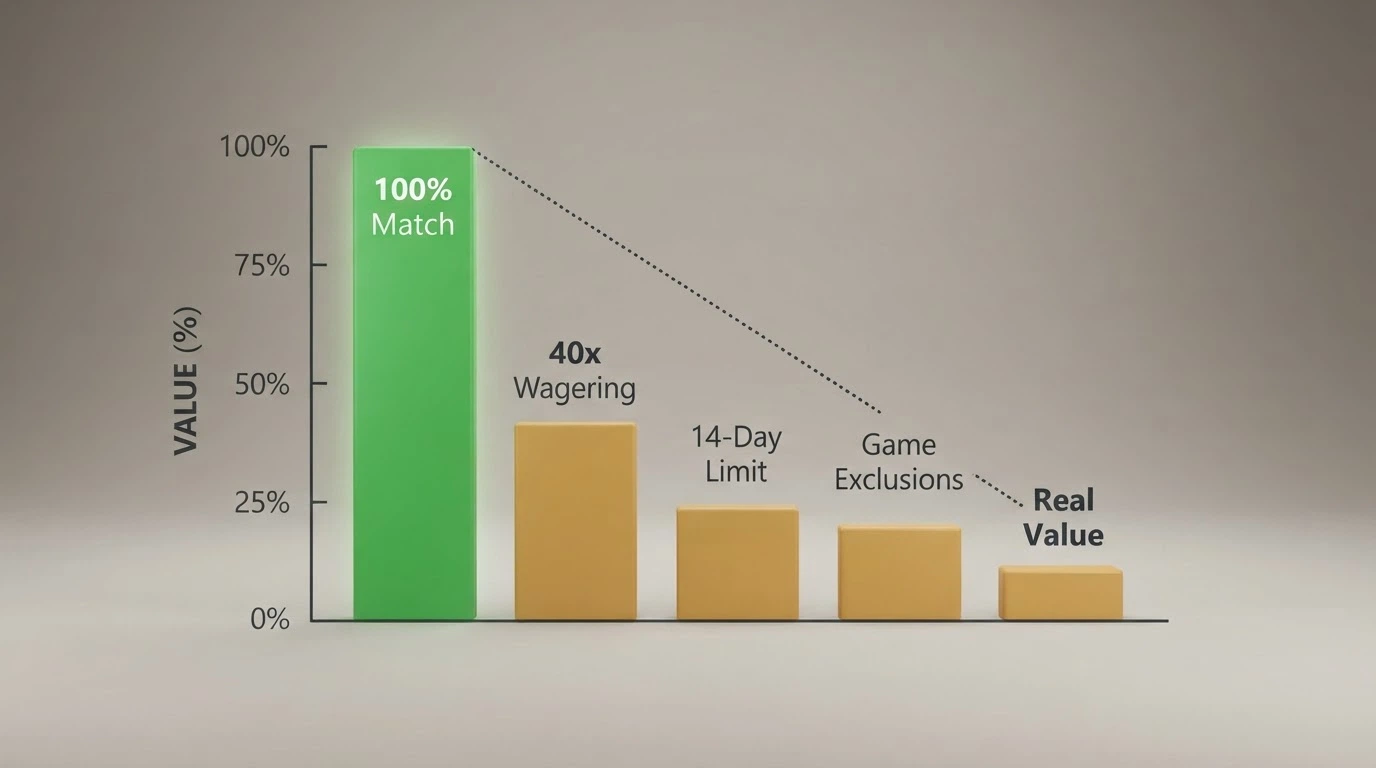
Across the featured operators, the wagering multiples run from 30x to 40x. Rocket Play, SkyCrown’s bonus (40x), and Rainbet’s wager-lock path all sit at 40x. Fair Go’s deposit-plus-bonus wager is 30x. Royal Reels’ bonus wager is 30x. Lucky Block’s bonus wager is 35x. Cloudbet’s wagering multiple was not confirmed in this run and a player considering the 5 BTC ceiling should check the operator’s current terms. BC.Game’s wagering was also not confirmed. The multiples look similar in the abstract. They are not similar in the turnover they demand.
The Two No-Deposit Offers Actually Available — and Their Fine Print
Only two operators on the list carry a genuine no-deposit bonus. Royal Reels offers a A$10 free chip with 30x wagering and no deposit required. Fair Go Casino offers a A$50 free chip with 60x wagering and a A$180 maximum cashout cap. No other featured operator carries a no-deposit offer. The A$10 chip at Royal Reels is the most accessible entry point on the list; the A$50 chip at Fair Go has the higher headline and the harder terms.
The cashout cap is what makes a no-deposit offer work as a marketing tool. A player who hits a large win on a A$50 free chip at Fair Go cannot withdraw more than A$180 regardless of the win size — the cap converts what would be a meaningful win into a fixed ceiling. A player who hits the same win on the A$10 chip at Royal Reels faces a cashout cap shown at activation, the specific value of which was not confirmed in this run. The 60x wagering on Fair Go’s chip is also the highest in the segment and means A$3,000 in required turnover on a A$50 bonus. The wagering is achievable in a single session. The cashout cap is the part that limits the upside.
Welcome Match Bonuses — From 100% to 360% Across the Featured Set
The headline match percentages range from 100% to 360% across the featured operators. The 360% is BC.Game’s headline, spread across four deposits — research did not confirm the per-tier cap or the wagering in this run. Fair Go’s 300% to A$3,000 is the next highest, with 30x wagering on deposit plus bonus. Rainbet’s 250% to A$2,100 carries 40x wagering with a gradual-release alternative. Lucky Block’s 200% to A$10,000 AUD equivalent is the highest AUD-denominated single-deposit cap, with 35x wagering. The 100% tier holds Cloudbet at 100% to 5 BTC, SkyCrown’s first deposit at 100% to A$500, Rocket Play at 100% to A$1,000, and Royal Reels at 100% to A$500. Stake offers no welcome bonus at all.
The interesting comparison is between percentages and absolute caps. A 300% match at Fair Go to A$3,000 means a A$1,000 deposit captures the full bonus. A 200% match at Lucky Block to A$10,000 means a A$5,000 deposit captures the full bonus. A 100% match at Cloudbet to 5 BTC means the cap is denominated in Bitcoin and moves with the market — at the time of writing 5 BTC is several hundred thousand AUD. The percentage is what the marketing shows. The cap is what determines what the player actually receives, and the wagering is what determines what the player keeps. BC.Game’s 360% is the largest match in percentage terms and the operator whose full bonus terms need to be checked at the source.
Free Spins — Which Games They Land On and What the RTP Means for Their Value
Free spins are attached to specific slot titles, and the RTP of the title determines the expected return before the wagering even starts. Pragmatic Play supplies most of the titles attached to anonymous-casino welcome bonuses, and the same provider’s games can run at different RTP configurations at different operators. A 96.50% game at one casino can be a 94.00% game at another, and the player has no way to know from the bonus page alone.
| Slot Title | RTP | Provider | Volatility | Max Win |
|---|---|---|---|---|
| Gates of Olympus | 96.50% | Pragmatic Play | High | 5,000x stake |
| Sweet Bonanza | 96.51% | Pragmatic Play | High | 21,175x stake |
| Big Bass Bonanza | 96.71% | Pragmatic Play | Medium | 2,100x stake |
| Book of Dead | — | Play’n GO | — | 5,000x stake |
The table covers the four titles most commonly attached to welcome free spins. Three of the four are Pragmatic Play, and the same provider’s slot catalogue can run at reduced RTP at the operator’s discretion. The fourth, Book of Dead, is Play’n GO, attached to SkyCrown’s first-deposit free spins — the RTP for Book of Dead was not confirmed in this run, only the 5,000x maximum win and the expanding-symbols free-spin mechanic. Sweet Bonanza carries the highest maximum win at 21,175x stake, a figure that reflects the multiplier-bomb mechanic rather than the typical session return. Big Bass Bonanza’s medium volatility is the most player-friendly of the four. Gates of Olympus and Sweet Bonanza are high-volatility, meaning longer losing runs punctuated by larger hits — a profile that converts the wagering requirement slowly.
The wagering on free-spin winnings is what determines the realised value. SkyCrown’s 30x on free-spin winnings is the lowest in the segment. Rainbet attaches 60 free spins to Sweet Bonanza at 40x on the bonus, and the free-spin winnings feed into the bonus balance under the same terms. Where the free-spin wagering is not stated, the standard 40x on the bonus applies. The free spins are the bonus; the wagering is the cost.
Wagering, Validity and the Fine Print That Changes the Deal
A 40x wagering requirement on a A$1,000 bonus means A$40,000 in turnover before withdrawal. At a 30x wagering on deposit plus bonus — the structure at Fair Go — a A$1,000 deposit at 300% gives a A$3,000 bonus and a A$4,000 combined base, with 30x producing A$120,000 in turnover. The numbers escalate fast. The validity window determines whether the player has time to clear them.
Rocket Play’s five-day validity at 40x on a A$1,000 bonus means A$8,000 of turnover per day. SkyCrown’s 14-day validity at 40x on the same bonus means A$2,857 per day. The difference between the two windows is the difference between a bonus that requires a focused week of play and one that allows a casual pace. The maximum bet rules — A$7.50 at Rocket Play, 2% of deposit at Rainbet, A$7.50 or similar at most operators — are the lines the player cannot cross. Breaching the bet cap voids the bonus, and the turnover spent reaching that point is forfeit.
The most restrictive single term in the segment is Rainbet’s exclusion of slots with RTP above 97.4% while the bonus is active. The exclusion is designed to prevent play on high-RTP games that would clear the wagering quickly at low house edge, and it cuts the catalogue the player can use during the bonus. The gradual-release alternative at Rainbet — 1% of bets × 20% unlock — is the no-wager escape route, and it is the only one on the list. For a player who values the wagering path, the exclusion is the constraint. For a player who values the alternative, the bonus is a different product.
The expected cost of clearing a bonus is the calculation the marketing pages do not run. Take Rocket Play’s structure: a A$1,000 bonus with 40x wagering means A$40,000 in required turnover, played at 96.50% RTP — the figure for Gates of Olympus as a representative high-volatility Pragmatic Play title, with the caveat that Pragmatic Play operators can configure RTP below the published maximum. Expected loss on A$40,000 in turnover at a 3.50% house edge is A$1,400. The headline bonus is A$1,000. The expected cost of clearing it is A$1,400. The bonus is real value only if the winnings during the wagering period exceed the expected house edge by more than the bonus — and on a high-volatility slot at standard RTP, that is a run that depends on the variance, not the average.
Crypto Withdrawals: The Four-Minute Promise and the KYC Trap
The fastest raw crypto payouts tested from a Sydney IP are 4 minutes 11 seconds via Lightning Network at Cloudbet and 3 minutes 47 seconds on-chain at BC.Game on a Saturday. SkyCrown’s USDT TRC-20 withdrawal tested on 24 June 2026 cleared in 12 minutes with a A$0.90 network fee. Most legitimate crypto casinos on the operator lists process withdrawals within 10 to 60 minutes on the casino side, before network confirmation. Crypto end-to-end is 5 to 20 times faster than PayID-only operators for Australian players, where PayID and Osko are the instant-AUD payment rails that the licensed Australian wagering operators use.
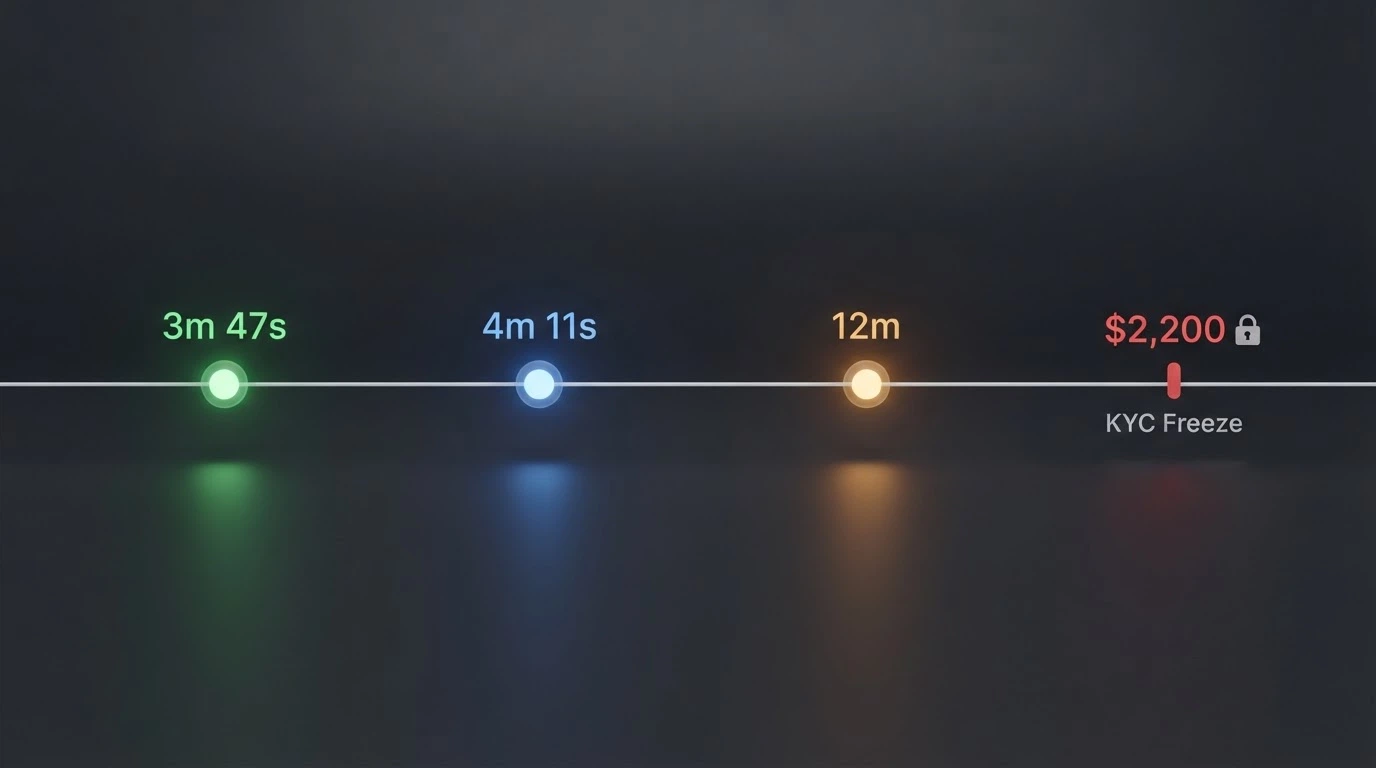
The KYC trap is the part the speed numbers do not show. Every withdrawal at the segment’s threshold — A$1,000 to A$2,200 cumulative at most operators — triggers an identity check. The speed of the blockchain does not change the fact that the casino’s own system pauses the withdrawal when the threshold is crossed. A player who plans to deposit, play, and cash out small amounts regularly can stay under the threshold and use the speed. A player who hits a large win on a single session crosses the threshold at the moment they try to withdraw it, and the four-minute blockchain becomes a verification queue.
How Fast Crypto Withdrawals Actually Clear — Tested Speeds From Australian IPs
The Cloudbet Lightning figure of 4 minutes 11 seconds was tested from a Sydney IP on 14 March 2026. The BC.Game on-chain figure of 3 minutes 47 seconds was tested on a Saturday, when the Bitcoin mempool is typically at its quietest. SkyCrown’s 12-minute USDT TRC-20 was tested on 24 June 2026 with a A$0.90 network fee. BitStarz’s published speed range is 0.2 to 2 hours, and Stake’s is 1 to 4 hours — both longer than the headline figures on this list, but both within the segment’s normal processing window.
The casino-side processing time is the floor underneath the network speed. A withdrawal approved by the casino in 10 minutes and confirmed on-chain in 4 minutes is 14 minutes end-to-end. A withdrawal approved by the casino in 60 minutes and confirmed on-chain in 4 minutes is 64 minutes end-to-end. The variance comes from the operator, not the blockchain. Crypto is faster than PayID because the PayID rail settles in near-real-time to the bank but the licensed wagering operator’s internal processing can add hours. Offshore crypto casinos tend to run leaner approval queues than licensed operators, which is the structural reason for the speed difference.
The AU$10,000 AUSTRAC Threshold — What It Means for Crypto Casino Players
AUSTRAC requires reporting entities to submit a threshold transaction report for any transfer of physical currency or e-currency of A$10,000 or more. The threshold applies to e-currency — including cryptocurrency transfers through an Australian exchange or remittance provider. A Bitcoin withdrawal worth A$10,000 or more in market value at the time of transfer is reportable. Structuring — deliberately splitting a transfer into sub-A$10,000 chunks to avoid the report — is an offence under the AML/CTF Act.
The threshold is rarely the binding constraint for a player at the welcome-bonus level, where deposits and withdrawals are typically well under A$10,000. The threshold matters at the upper end of the segment: a player who hits a win worth A$15,000 in Bitcoin is in the reportable range, and the exchange or remitter that handles the off-ramp submits the TTR. A player who tries to keep withdrawals under the threshold by splitting them has crossed from “evading a report” into “committing a structuring offence.” The exchange’s compliance team does the rest. For a player who plans to play at the high end of the segment, the threshold is part of the decision, not a footnote.
Crypto Winnings and Tax — What the ATO Says
The ATO’s framework treats gambling winnings as not assessable income under section 6-5 of the ITAA 1997, and gambling losses as not deductible under section 8-1 — unless the person is carrying on a business of betting or gambling. The default position for a recreational player is that winnings are tax-free and losses are not deductible. Disposing of crypto won through gambling, however, may trigger a capital gains tax event. The ATO’s view is that crypto received as a gambling prize is an asset, and that asset is subject to CGT on disposal.
The cost base for CGT is the market value of the crypto at the time it was received. A player who wins 0.1 BTC at a casino, holds it for six months while the price moves, and sells at a higher value has a capital gain on the disposal. The gain is the difference between the market value at receipt and the sale price. The ATO’s guidance covers this scenario specifically in its crypto-asset-prizes documentation, and the ATO’s enforcement reach is the standard one — data matching with Australian exchanges. The Northern Territory’s 5% wagering tax and the state point-of-consumption taxes of 10% to 15% apply to licensed operators, not to players, and are not a player-level concern.
The position is technical enough that a player with a meaningful crypto position from gambling should seek professional tax advice. The ATO’s framework is consistent and the rules are public; the application to a specific case is not. Gambling winnings themselves are not taxable. The appreciation of crypto after the win is.
Playing Without a Safety Net — What You Lose When the Casino Does Not Know Who You Are
The Australian player-protection framework — BetStop, customer-set deposit limits, activity statements, take-a-break tools, harm monitoring — applies to Australian-licensed wagering operators. None of it reaches an offshore anonymous crypto casino. The casino is not connected to BetStop, does not enforce Australian deposit limits, does not issue activity statements, and does not offer take-a-break tools mandated by Australian regulators. A self-excluded Australian can sign up with an email address and a crypto wallet. The framework that exists for licensed play is absent here, and the player carries the entire monitoring burden alone.
The National Gambling Helpline at 1800 858 858 is the one resource that works regardless of where a player chooses to play. The helpline is free, confidential, and staffed 24 hours a day, seven days a week, with online chat and counselling available through Gambling Help Online. About 2.1% of Australian adults — roughly 430,000 people — experience problem gambling, and the helpline is the escalation path that does not depend on the casino’s cooperation. The framework is imperfect. It is the one that exists.
BetStop Cannot Reach Offshore — The Self-Exclusion Gap
BetStop, the National Self-Exclusion Register, has had 67,480 registrations in three years of operation as at 31 July 2026, of which 41,290 exclusions were still active. Seventy-eight percent of registrants were under 40, and 38% chose lifetime exclusion. A single registration with BetStop excludes a person from every Australian-licensed online and phone wagering service. The mechanism works for the licensed framework. It does not work for the offshore one.
An offshore casino is not connected to BetStop and has no obligation to check the register. A person who has self-excluded from Australian-licensed wagering can sign up with an email address and a crypto wallet at any of the operators on this list and deposit the same day. BetStop’s reach is bounded by the licensing regime that creates it. The gap is structural, not a failure of implementation: there is no mechanism by which an offshore operator can be required to honour an Australian self-exclusion list. A self-excluded player is protected from the licensed market and unprotected from the rest.
The Australian Help Resources That Work Regardless of Where You Play
The National Gambling Helpline is 1800 858 858. The line is free, confidential, and staffed 24 hours a day, seven days a week, Australia-wide. Gambling Help Online, at gamblinghelponline.org.au, provides online chat and counselling for players who prefer text-based or out-of-hours support. Both services are run by the Australian Government and are available regardless of whether the player uses a licensed or offshore operator.
The helpline is the only safety rail that follows the player across operators. A player who chooses to use an offshore anonymous crypto casino cannot be protected from that choice by BetStop, but can still reach the helpline. The decision to play anonymously does not foreclose the decision to ask for help. The reverse is not true: the decision to self-exclude through BetStop does not foreclose the decision to use an offshore operator, which is the gap the helpline exists to address.
Recognising Problem Play When the Casino Is Not Watching
Licensed Australian operators are required to monitor player behaviour for signs of harm under state and territory licence conditions. Activity statements are issued. Customer-set deposit limits are enforced. Take-a-break tools are available. The offshore anonymous operator has none of these obligations. The monitoring is the player’s, and the signs are the standard ones: deposits increasing in size, sessions running longer than planned, losses chased rather than accepted, time and money spent on gambling that displaces other commitments. A player who is using an offshore operator should self-monitor these signs with the same rigour the licensed framework would apply on their behalf.
The practical version of self-monitoring is bookkeeping: a separate record of deposits, withdrawals, and session time, kept outside the casino’s own transaction history. The casino’s history shows what was played. The player’s record shows what was deposited, what was withdrawn, and what the net cost was. The two together give a picture neither gives alone. The helpline number is for the moment the bookkeeping reveals a pattern the player wants to change. A player who has not yet reached that point can still call.
How We Selected and Ranked These Operators
Every operator on this list was checked against the ACMA licence register, evaluated for KYC thresholds through published testing data, and assessed on bonus terms current at review. None holds an Australian casino licence, because no online casino licence can exist in Australia under the Interactive Gambling Act 2001. The ranking is ordered by relevance to the page’s subject — anonymous crypto play for Australian players — and the criteria that determine the position are the KYC severity rating, the withdrawal reliability evidence, the bonus transparency, and the breadth of crypto support.
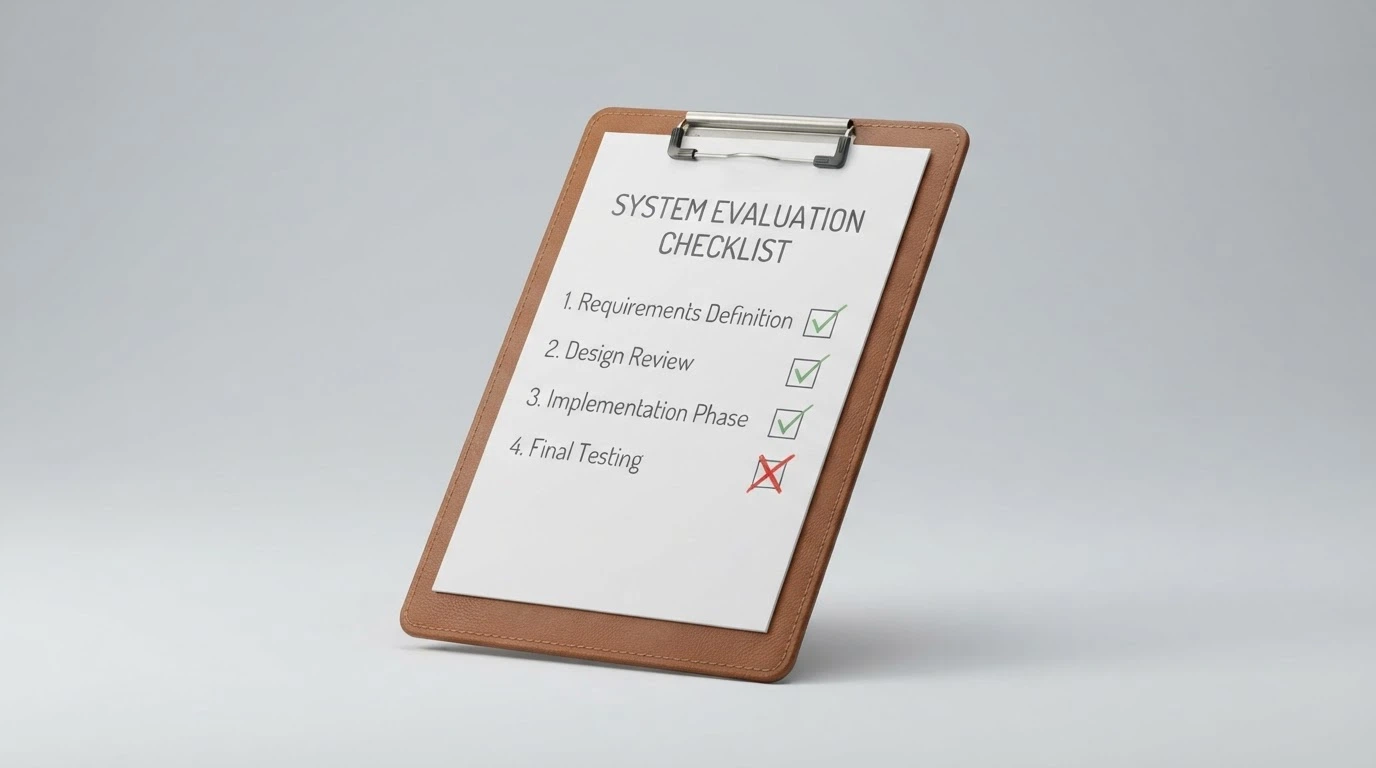
The sources used were operator terms pages (Rocketplay.com, Playwithskycrown.com, Rainbet.com), independent testing data (Bitcoincasinoz.net, Casinosjungle.com, Chainbankroll.com, Betsquare.org, Casinoshub.com, Clearcasinos.com, Bitcoincasinos.com), and the ACMA’s published blocking data and enforcement actions. Where the operator’s own terms page and the independent review differed, the operator’s terms page took precedence on bonus and KYC specifics, and the independent testing data took precedence on withdrawal speed. Where neither source confirmed a value, the page records the gap rather than invent a figure.
The evaluation does not include a hands-on playthrough. The KYC thresholds are taken from published testing data and the bonus terms from the operator’s own pages. The withdrawal speeds are taken from the same published tests. A player who wants to verify any figure should check the operator’s current terms page at the time of deposit, because terms change. The page is current as of the date stamp at the top; operators update terms without notice, and the bonus on the operator’s page at the moment of deposit is the one that applies.
What You Should Actually Do Next
The decision is a real one. The anonymous crypto casino market offers email-only registration, fast withdrawals, and a privacy model that the licensed Australian framework does not provide for online casino games. The same market offers no BetStop coverage, no Australian consumer protection, no regulatory recourse if a withdrawal is refused, and a tax position on the crypto appreciation that requires professional advice. The trade-off is structural: a player gets the privacy of crypto play at the cost of the protections that come with a licensed framework. The licensed framework does not offer online casino games, so the choice is not between an Australian-licensed crypto casino and an offshore one. It is between offshore crypto play and not playing at all.

The one action that applies to every reader regardless of which side of that trade-off they land on is to save the National Gambling Helpline number: 1800 858 858. Free, confidential, 24 hours a day, seven days a week. The number is for the moment a player decides the play is no longer what they want it to be. That moment can come on either side of the decision, and the helpline is the one resource that follows the player across both.
A player who proceeds should check the operator’s own site for the current KYC threshold and the current bonus terms before depositing. The figures on this page are current as of the date stamp; the operator’s terms are the ones that apply at the time of the deposit. A player who decides the trade is not worth it has the cleanest outcome available. The page is not a recommendation to play and it is not a recommendation to abstain. It is a description of the market as it is, the protections it does and does not provide, and the costs the player carries in either case. The call is yours.
Frequently Asked Questions
Are anonymous crypto casinos legal in Australia?
Online casino games are prohibited to provide in Australia under the Interactive Gambling Act 2001, and the 2024 credit-and-crypto ban prevents any licensed operator from accepting digital currency. Every anonymous crypto casino is therefore offshore and unlicensed in Australia. The IGA targets the provider, not the player, and no Australian has been prosecuted for using an offshore casino — but “not illegal for you” carries no consumer protection, no complaints body and no recourse against an operator that refuses to pay.
What does “no KYC” mean at a crypto casino for Australian players?
“No KYC” means email-only registration with no identity documents required at sign-up. The label is accurate at registration. It stops being accurate at withdrawal: most operators in this segment trigger identity verification at cumulative withdrawals of A$1,000 to A$2,200, with Cloudbet extending the no-KYC window to A$2,200 per day. A player who plans to withdraw regularly in small amounts can stay under the threshold. A player who hits a large win crosses it on the first cashout.
Can Australian banks block crypto casino deposits?
From 1 January 2027, Australian banks and payment providers gain express authority to block transactions to illegal gambling operators under the Interactive Gambling Amendment (Gambling Reform) Bill 2026. The block lands at the on-ramp — the bank-to-exchange transfer — not at the casino. Until then, banks can decline suspicious transfers at their discretion but have no express mandate to do so. A player funding a crypto deposit through an Australian bank should expect the bank’s compliance team to flag the transaction.
What is the minimum deposit at an anonymous crypto casino in Australia?
Minimum deposits across the featured operators range from A$1 in AUD-equivalent crypto at Lucky Block to A$30 at Rocket Play and Royal Reels, with SkyCrown at A$20 and Cloudbet at 0.001 BTC. Lucky Block’s A$1 minimum is the lowest published figure on the list and is the most useful single fact for a player who wants to test an operator with a small first deposit. The minimum is a ceiling on the operator’s side, not a recommendation on the player’s.
How fast are crypto withdrawals from anonymous casinos in Australia?
The fastest tested raw crypto payouts from a Sydney IP are 3 minutes 47 seconds on-chain at BC.Game on a Saturday and 4 minutes 11 seconds via Lightning Network at Cloudbet. SkyCrown’s USDT TRC-20 tested at 12 minutes with a A$0.90 network fee. Most legitimate operators process withdrawals within 10 to 60 minutes on the casino side, and crypto end-to-end is 5 to 20 times faster than PayID-only operators. KYC verification can freeze any payout the moment cumulative withdrawals cross the operator’s threshold.
Does BetStop cover anonymous offshore crypto casinos?
No. BetStop binds Australian-licensed wagering services only. An offshore casino is not connected to the register and has no obligation to check it. A self-excluded Australian can sign up with an email address and a crypto wallet at any offshore operator and deposit the same day. The self-exclusion gap is structural, not a failure of implementation. The National Gambling Helpline at 1800 858 858 is the resource that follows the player across both licensed and offshore operators.
Are anonymous crypto casino winnings taxable in Australia?
Gambling winnings are not assessable income under section 6-5 of the ITAA 1997, and gambling losses are not deductible under section 8-1, unless the person is carrying on a business of betting or gambling. Disposing of crypto won through gambling, however, may trigger a capital gains tax event, with the cost base set at the market value at the time of receipt. A player with a meaningful crypto position from gambling should seek professional tax advice, because the application of the ATO’s framework to a specific case is technical and worth getting right.
What happens if an anonymous crypto casino refuses to pay out?
There is no Australian regulator that can order an offshore operator to pay. There is no Australian complaints body that can mediate a dispute. A completed crypto deposit is a completed blockchain transaction with no chargeback mechanism. The casino’s own complaints process is the only complaints process, and the casino controls it. A player who hits a large win and a withdrawal stall has, in practice, no escalation path beyond the operator’s own support team. This is the cost of the offshore privacy model in its sharpest form.
Do anonymous crypto casinos accept Australian dollars?
Some do and some do not. Fair Go Casino accepts AUD deposits directly and runs on RTG software. Lucky Block, Cloudbet, BC.Game and others process in crypto with AUD-equivalent deposit amounts shown on the deposit page. Stake.com requires an Australian phone number at sign-up and processes in crypto. A player who wants to deposit in AUD without an exchange step has the narrower list; a player who is comfortable converting AUD to Bitcoin has the wider one.
Which cryptocurrencies can Australian players use at anonymous casinos?
Cloudbet accepts more than 35 cryptocurrencies, the broadest range on the list. BC.Game accepts BTC, ETH and others, with the full list available on the deposit page. Most operators on the list accept BTC, ETH, LTC, USDT (TRC-20 and ERC-20) and a selection of major altcoins. LuckyDreams, a non-featured reference point, supports BTC, ETH, USDT, LTC, BCH, DOGE, XRP and TON — the broadest published range across the segment. A player who holds a specific coin should check the deposit page before signing up.
New vs Established Anonymous Operators — Does Track Record Matter?
The anonymous crypto casino market is fluid. New brands appear, run aggressive welcome bonuses to attract a deposit base, and either establish a reputation or disappear. Over 225 illegal services have withdrawn from the Australian market since the ACMA began enforcing new rules in 2017, and that number understates the churn because it counts exits the regulator noticed. The operator a player signs up with today may not be operating under the same name in eighteen months. The mirror-domain strategy — the same operator resurfacing under a new URL after an ACMA block — makes continuity even harder to read from the outside.
The trade-off is structural. New operators compete on bonus size: a 360% welcome package or a 200% match to a high AUD ceiling is the lever a brand with no reputation pulls to win its first deposit base. Established operators compete on withdrawal reliability: track record of paying out, a licence register entry, and a support team that responds when a withdrawal stalls. The player who chases the largest headline bonus is taking the larger of the two risks, because the bonus is the marketing spend a new operator uses to compensate for the reputation it has not yet earned. The player who picks a brand with three years of paid withdrawals and accepts a smaller bonus is buying a different thing, and it is worth saying which one is which.
What “established” means in this market is also worth defining plainly. None of the operators on this list holds an Australian licence, because none can. “Established” in the offshore segment means a brand that has processed a meaningful volume of withdrawals, has a Curaçao or Anjouan licence that can be looked up, and has not had a public collapse of funds held in player balances. That is a much lower bar than “regulated by an Australian authority.” It is the only bar this market offers.
Prepared by the Best Casino Sydney editorial staff.