
What “Best Casino App for Android Australia” Really Means in 2026
 Available in AU
Searching for “best casino app for Android Australia” brings up the same handful of names — Rocket Play, Skycrown, Bizzo, Wild Fortune, and many others. It is a common search, but it can be misleading. No real-money casino app is listed on the Australian Google Play Store, and no operator listed on this page holds an Australian casino licence. The “best” options in this search are offshore sites serving Australians, not licensed products. This guide explains the gap between what the search results promise and the reality of the offshore market.

Current as of 22 October 2026 — verified against the ACMA prohibited-services register and the Northern Territory Racing and Wagering Commission (NTRWC) licence register via Licensing NT.
Table of Contents
- What a “casino app” actually means on Android in Australia
- Australia’s online casino ban means every Android app you find sits offshore
- You can’t download from Google Play — here is how casino apps actually reach your Android
- Real-money play on Android: what you can win (and lose)
- Why pokies dominate every Android casino app (and what you are actually playing)
- Live dealer on Android brings the casino floor to your screen — but not every table is worth your money
- Bonuses on Android: why the headline number is rarely the full story
- Getting money in and out: payments on Android
- Is it legal? The Australian reality
- Staying in control: responsible gambling on Android
- How we chose and ranked these apps
- Your move: what to actually do about Android casino apps in Australia
- Frequently asked questions about Android casino apps in Australia
What a “casino app” actually means on Android in Australia
The term “casino app” carries two meanings on Android in Australia, and they are not interchangeable. The first is a downloadable application distributed through Google Play — the kind of file a user installs and finds in their app drawer. The second is a mobile-optimised website that behaves like an app once added to the phone’s home screen. In Australia, only the second exists for real-money casino gaming.
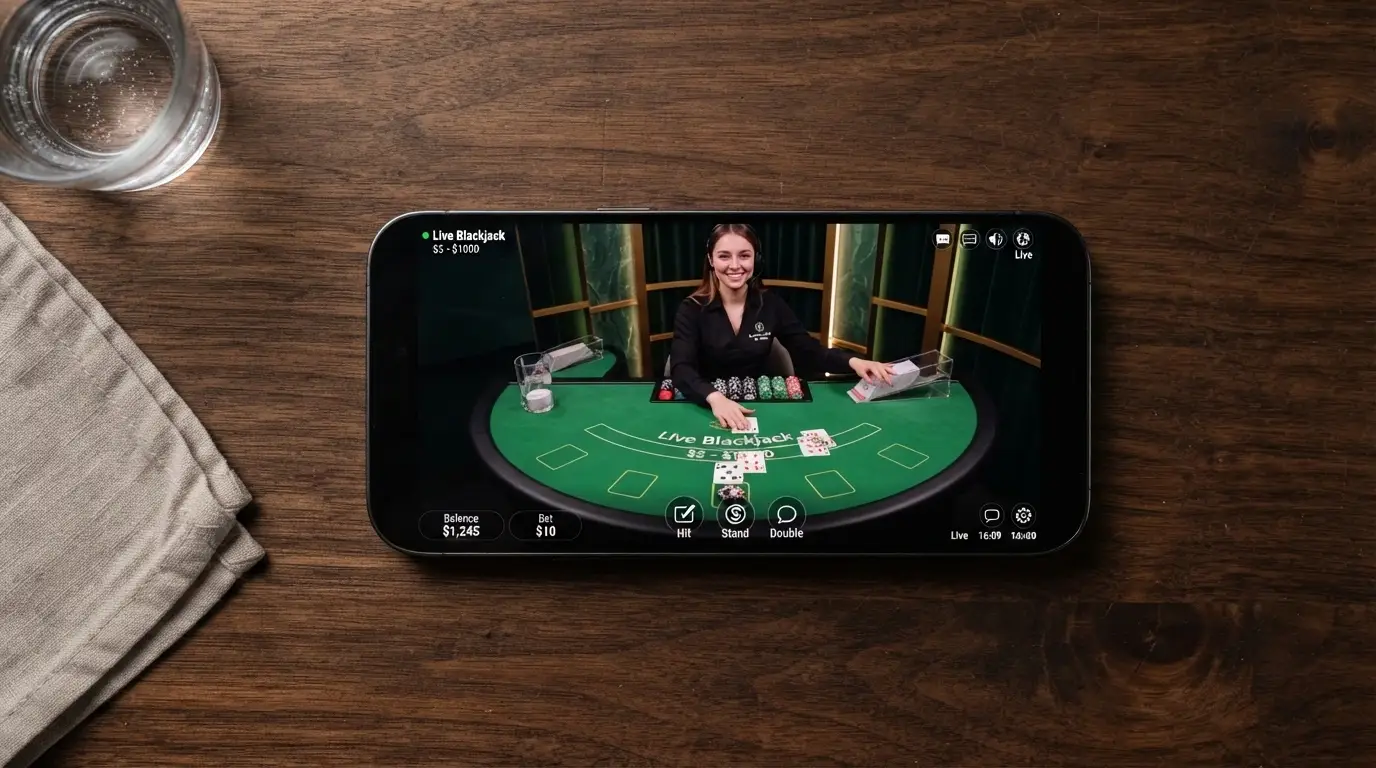
Under the Interactive Gambling Act 2001 (Cth), real-money casino apps cannot be listed in the AU Apple App Store or Google Play. The App Store gates block every operator that wants to offer paid casino games to Australian accounts. Every “Aussie pokies app” a player finds online is therefore a mobile-optimised website — built to look, feel and behave like a native app, without the App Store gatekeeping. The distinction matters because the deliverable, the security model, the update path and the recourse if the operator misbehaves all differ between the two.
Google Play still carries casino-style apps in Australia, but they are not real-money. The top three by AU Google Play ranking in May 2026 were Lightning Link Casino Slots, Cashman Casino Slots and Slots: Heart of Vegas Casino — all free-to-play social casino products run by Aristocrat-adjacent publisher Product Madness and similar studios. They take coins, not AUD. They pay out nothing. They exist to entertain, not to gamble.
A player who wants to play for real money on Android in Australia therefore has two installation paths, both of which bypass Google Play: a Progressive Web App (PWA) added from a mobile browser, or an APK sideloaded directly from an operator’s website. Both paths land the player on the same kind of product — an offshore casino running on a Curaçao, Anjouan or MGA licence, serving Australians illegally. The mechanics are covered later in the section on installation paths. The point to carry through this section is simpler: the question “what is the best casino app for Android in Australia” can only be answered for the offshore product, because no other product exists.
Australia’s online casino ban means every Android app you find sits offshore
Online casino gaming is prohibited in Australia under the Interactive Gambling Act 2001. The Act makes it an offence to provide online casino games, online pokies and in-play sports betting to a person physically in Australia. There is no online casino licence anywhere in the country — not federally, not in any state or territory. The Northern Territory Racing and Wagering Commission (NTRWC) licences wagering only, for terms up to 20 years; online casino is outside its remit. The individual player is not prosecuted under the IGA — the Act targets the provider. That asymmetry explains why AU-facing casino apps exist at all: the operator takes the legal risk, the player does not, and the operators have decided the revenue is worth it.
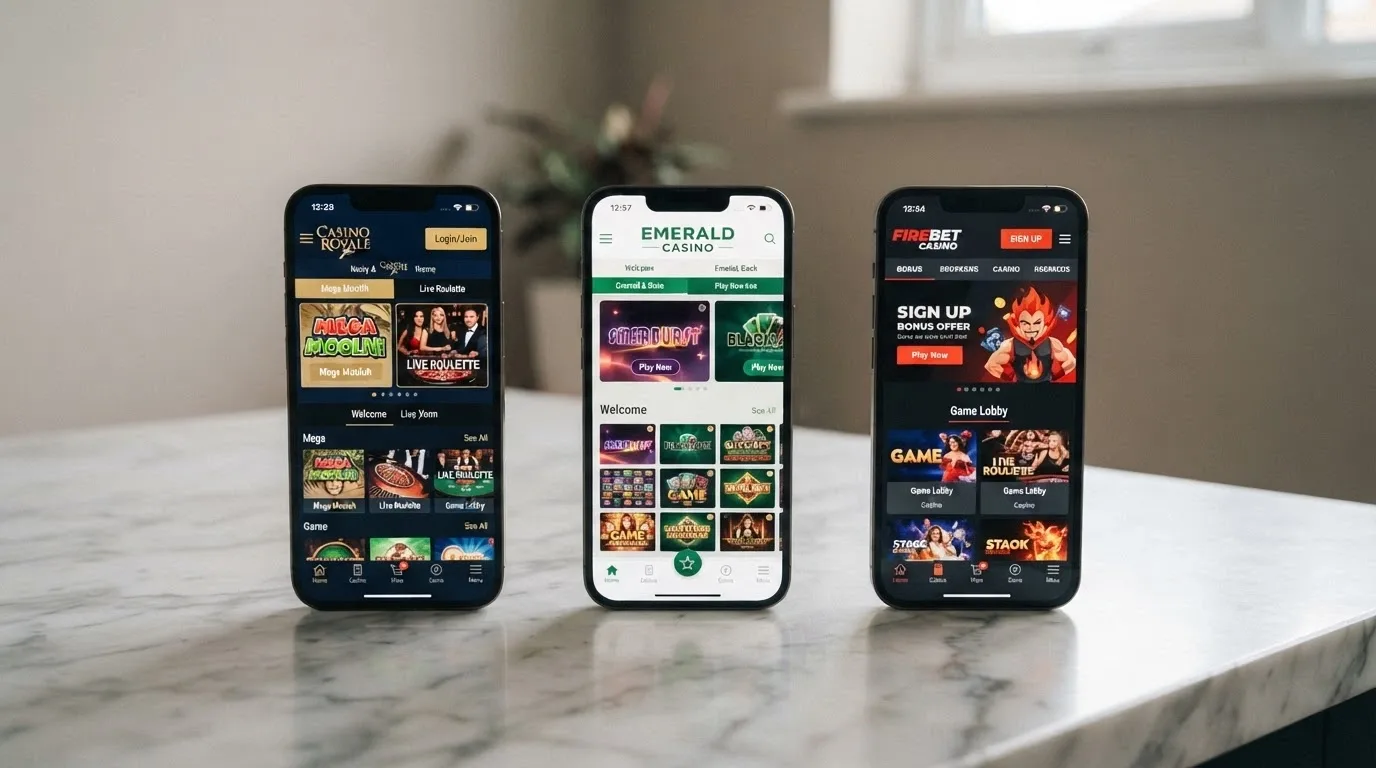
What follows is a ranking of the offshore brands Australians are actually using on Android. The ranking is built on market share and revenue from the tracked set, not on regulatory standing — every operator below is unlicensed in Australia by structural necessity. None of them can be licensed for casino. The ranking measures traffic.
| Operator | Market share (%) | Revenue (A$M) |
|---|---|---|
| Rocket Play | 9.4 | 632.69 |
| Skycrown | 8.55 | 436.07 |
| Royal Reels | 2.51 | 243.99 |
| WinSpirit | 1.55 | 110.3 |
| Stake | 1.28 | 115.67 |
| Rainbet | 1.28 | 83.13 |
| Scream Casino | 0.99 | 94.87 |
| FairGO | 0.80 | 69.11 |
| Bizzo Casino | 0.57 | 51.38 |
| Wild Fortune | — | — |
The headline shape of this table is a long tail. The top two brands — Rocket Play and Skycrown — sit well clear of the field, together holding close to 18% of the market and pulling in more than a billion AUD in revenue between them. The third name, Royal Reels, runs at less than a third of Skycrown’s share. After that the distribution flattens: six operators sit between 0.5% and 1.6% market share, with revenues that overlap rather than step down. Wild Fortune is on this list because its bonus and cashout profile is documented in the tracked sources; its traffic rank sits outside the top 20. The drop from first to second place is the most striking single feature of the table.
Rocket Play
Rocket Play holds 9.4% of the AU-facing offshore casino market and A$632.69M in revenue — the largest single share among the tracked operators and nearly 50% more revenue than the runner-up. The gap says something about how AU Android players behave: a meaningful share of them have settled on one brand, and that brand’s revenue suggests it keeps them depositing rather than churning. For a player who wants the operator the most Australians already use, Rocket Play is the answer the data gives. The licence it runs on is offshore; the players it serves are Australians; the legal exposure sits with the provider, not the customer. A reader who chooses Rocket Play is choosing the brand with the most peer traffic in the country, on a product that no Australian regulator can sanction.
Skycrown
Skycrown holds 8.55% of the market and A$436.07M in revenue, putting it a clear second to Rocket Play and a clear first of everyone else. The gap to the third-placed brand (Royal Reels at 2.51%) is roughly 3.4× — Skycrown is functionally the only brand contesting Rocket Play for AU market leadership. Like Rocket Play, it operates from offshore and serves Australians illegally. The verdict is the same as Rocket Play’s, scaled down: Skycrown is the brand for a player who wants the second-largest peer base, on the same offshore terms. The reader decision between Rocket Play and Skycrown is a near-tie.
Royal Reels
Royal Reels sits at 2.51% market share and A$243.99M revenue — less than a third of Skycrown’s share but still the third-largest in the tracked set. The drop from second to third is the steepest in the ranking. Royal Reels is a brand for a player who specifically wants a name outside the top two, and who is comfortable taking the smaller community of users as part of the trade. Offshore status applies, as it does to every operator on this page.
WinSpirit
WinSpirit holds 1.55% market share and A$110.3M revenue. It sits in the middle of the long tail — past the leaders, but well above the smallest operators in the tracked set. Mid-pack traffic on an offshore casino is a position that suits a player who has not yet picked a brand and wants a representative example of what an AU-facing casino looks like at the median, rather than the head. The verdict for WinSpirit is balance: it is neither a market leader nor a niche pick.
Stake
Stake is the only globally recognised brand on this list, and that recognition does not translate into the Australian Android traffic its international profile might suggest. AU market share sits at 1.28%, with revenue at A$115.67M — almost identical revenue to WinSpirit despite a smaller share, which suggests a higher average spend per player. Stake is a known name because it sponsors sport at the top level and runs a high-visibility crypto-led product. For an AU player who wants the brand their sports-mad mate has heard of, Stake is the obvious pick. The trade-off is that the AU-specific market share is modest compared with the more locally entrenched offshore brands higher up the table.
Rainbet
Rainbet ties Stake on market share at 1.28%, but its revenue is A$83.13M — roughly 28% below Stake’s. The tied share with a different revenue base is the interesting datum: Rainbet and Stake reach similar numbers of AU Android users, but Rainbet’s players deposit less per head. The reason matters more than the figure itself — Rainbet may be reaching a broader, lighter-deposit audience where Stake concentrates on heavier players. For a low-stakes player who wants a brand near the median of the AU market, Rainbet is the data-supported choice. For a high-stakes player, Stake’s revenue-per-share advantage is the better signal.
Scream Casino
Scream Casino runs at 0.99% market share and A$94.87M revenue — slightly less reach than Rainbet but noticeably higher revenue per share. The implication is similar to Stake’s: smaller audience, heavier deposits. A player who chooses Scream Casino is choosing an operator with fewer peers but a higher spend-per-user signature. Offshore status, as ever, applies. The brand for a player who values revenue concentration over community size.
FairGO
FairGO is the brand in the ranking whose name most directly courts the Australian market — the “GO” reads as a localism. That positioning does not translate into dominance: 0.80% market share and A$69.11M revenue place it second from the bottom of the tracked set. The brand does what the name suggests (positions for AU players) and the player base responds, just not at scale. FairGO is the pick for a player who prefers a brand that wears its Australia-facing intent on its sleeve, accepting the smaller community as the price of the positioning. Offshore status applies.
Bizzo Casino
Bizzo Casino is the only operator in the ranking with a confirmed game-library count: 2,500+ mobile-optimised games, 100+ table games and 50+ live dealer games, all browser-based with no native app. The mobile-game volume is the headline feature. For a player whose primary criterion is the breadth of what they can play on Android, Bizzo carries the deepest catalogue in the tracked set. The market position (0.57% share, A$51.38M revenue) is the smallest in the ranking, which means the largest library sits at the bottom of the traffic order. A reader who chooses Bizzo is choosing catalogue over community, accepting that fewer peers have arrived at the same conclusion.
Wild Fortune
Wild Fortune, Ritzo, and Allstar all feature documented welcome bonuses in the tracked sources, though Wild Fortune is the only operator with a documented and tested cashout speed. The welcome offer at Wild Fortune is a 225% match up to A$7,500 plus 250 free spins with zero wagering on the spins; the minimum deposit is A$10, and a test withdrawal of A$847 cleared in 2 hours 11 minutes. The operator also claims an overall RTP of 97.1% — a figure to treat as the operator’s marketing claim rather than as an independent audit. Wild Fortune sits outside the top 20 in the tracked traffic set, which means the bonus profile is documented where the peer base is thin. The verdict for Wild Fortune is mechanics: the offer structure, the zero-wagering free spins and the cashout speed are concrete and verifiable; the traffic rank is not. A reader who values documented bonus terms over peer community lands here.
You can’t download from Google Play — here is how casino apps actually reach your Android
Because Google Play cannot list real-money casino apps serving Australians, two paths carry every casino app on an Android phone in this country. Neither goes through the Play Store.
PWA and Add to Home Screen — the dominant path
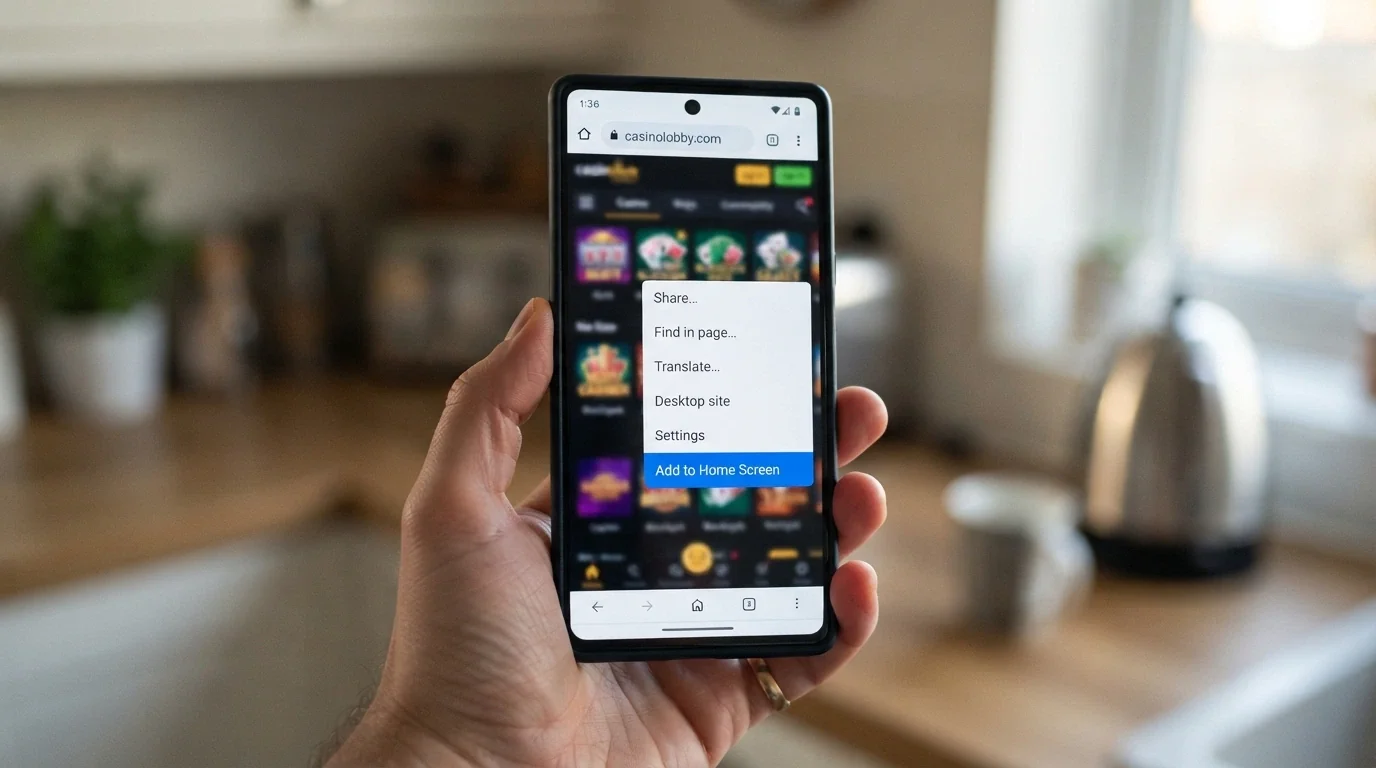
The dominant installation route is the Progressive Web App — a mobile website engineered to behave like a native app once the user adds it to the home screen. The workflow is short. The player opens the casino site in Chrome (or another Android browser), accepts the cookies, navigates to the lobby or login page, and pulls up the browser menu. The “Add to Home Screen” or “Install App” option drops a launcher icon onto the phone. Tapping the icon opens the casino in a full-screen browser shell with no URL bar — visually indistinguishable from a downloaded APK. Bizzo Casino is an example of a featured operator on this browser-based path.
The PWA path has trade-offs the player should know. Updates roll out silently because there is no Play Store version to push. Push notifications, when supported, depend on the browser’s permission. Offline play is limited or absent. Storage sits in the browser cache, not a dedicated sandbox. None of these are deal-breakers for casino play, which depends on a live connection to the lobby, but they are real differences from a Play Store install. The path is fast (under a minute from URL to home-screen icon), it requires no permission outside the browser’s own, and the install can be removed by deleting the icon or clearing site data — no uninstall dialog.
APK sideloading — the direct-download route and its risks
The second route is the Android Package Kit, sideloaded from an operator’s website. Some offshore casinos distribute their Android clients as APK files the user downloads and opens manually. The benchmark in the tracked sources is the AUS55 app, which supports devices running Android 8.0 (Oreo) or above and covers Samsung, Google Pixel, OnePlus, Oppo and Xiaomi hardware.
Sideloading carries real device-security trade-offs. Google Play scans every listed app through Play Protect, and sideloaded APKs skip that scan. The user is trusting the operator’s own distribution. A malicious APK can request broad permissions (SMS access, contact list, accessibility services) and a casual tap through the install prompt grants them. Even a clean APK from a legitimate operator lacks the rolling Play Protect telemetry that flags a compromised build. The “Install unknown apps” permission in Android settings exists for this reason — it makes the user opt in to a trust decision Google would otherwise make for them.
The practical split between the two paths is this: PWA for the operator that wants the lightest install footprint and the broadest compatibility; APK for the operator that wants tighter integration with Android services (biometric login, push notifications, native widgets) and is willing to spend the trust capital to get it. Players who cannot or will not sideload should stick to browser-based PWAs. Players who sideload should do it from the operator’s own verified domain, not from a third-party mirror.
Real-money play on Android: what you can win (and lose)
The real-money Android casino product in Australia is, in practice, a mobile browser running an offshore operator’s full lobby. What a player can actually do once they are in depends on the operator’s catalogue — but the structural facts apply to all of them.
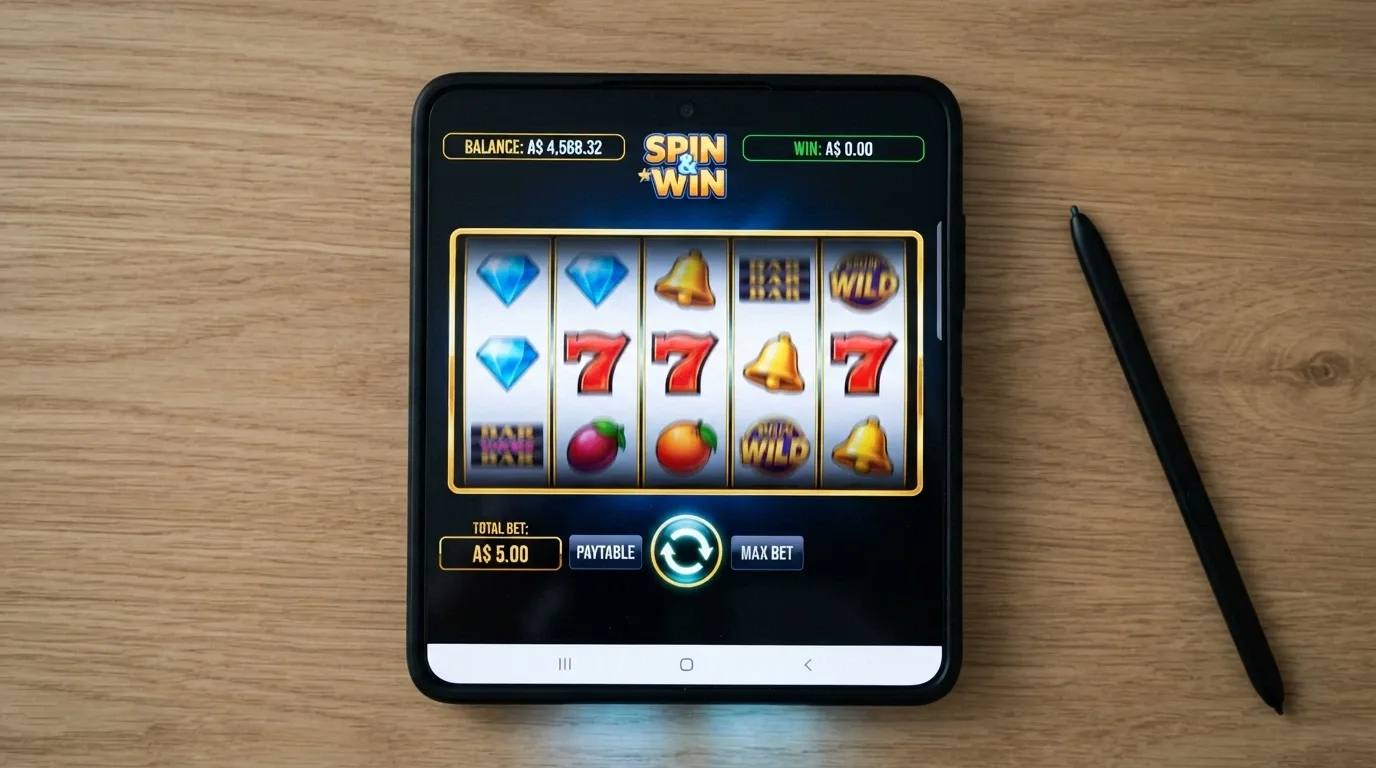
Real-money pokies dominate the catalogue. Bizzo Casino’s 2,500+ mobile-optimised games are mostly slots and pokies, with 100+ tables and 50+ live dealer games sitting alongside. Bitkingz Casino, used as a benchmark in the tracked sources, runs 2,000+ slots, 100+ tables and 100+ live dealer games on mobile — a comparable shape, with a heavier live-dealer count. What these numbers describe is a real-money product that goes well past pokies: table games (blackjack, roulette, baccarat and a long tail of variants) and live dealer rooms are part of the standard offering, not an afterthought.
The distinction between real-money mobile sites and the free-to-play apps on Google Play is absolute. Google Play’s top three casino-style apps in Australia — Lightning Link Casino Slots, Cashman Casino Slots and Slots: Heart of Vegas Casino — are social casino products. They use virtual coins, sell additional coins for AUD, and pay out nothing. They look like a casino. They feel like a casino. They are not a casino. A player who installs them expecting real-money play has installed the wrong product.
The pokie experience on a real-money mobile site is close to the venue experience but not identical. Touchscreen reels respond faster than the physical buttons of a poker machine; bonus rounds render at full-screen on modern Android hardware; autoplay, quick-spin and turbo modes are common. The difference is the venue context: there is no chair, no neighbouring player, no loyalty card swiped by a floor attendant — and there is no Australian regulator inspecting the game’s return-to-player figure. The RTP claims are operator-supplied, which is covered in detail in the section on pokies below.
Why pokies dominate every Android casino app (and what you are actually playing)
Pokies are the gravitational centre of the AU Android casino experience, and they are also the most visible thing on every offshore casino’s mobile lobby. The dominance is structural: pokies are the simplest casino game to render on a touchscreen, they run the widest range of stakes, and they are the format Australians have played in physical venues for decades. A mobile casino that did not lead with pokies would be ignoring where its market already lives.

Australian pokies on Android — the real-money side
Real-money pokies on Android run the same provider catalogue the offshore casino uses for desktop: typically a mix of studio output from Pragmatic Play, NetEnt, Microgaming, Play’n GO, Yggdrasil and a long tail of smaller studios. What an Australian player encounters is a library that runs into thousands of titles — Bizzo’s 2,500+ figure is on the higher end of the tracked range, but it is the order of magnitude a player should expect at a well-stocked offshore casino.
RTP figures on these games are operator-supplied. The benchmark figure across the tracked shortlist is an average RTP of 96.8% — meaning the game returns A$96.80 to the player for every A$100 wagered, over the long run. The figure is an average, not a per-game guarantee. Wild Fortune claims an overall RTP of 97.1%, which sits a touch above the benchmark. Both figures are claims; neither has been independently audited for the AU-serving product. A player who treats the 96.8% figure as a contract is treating a marketing claim as a fact.
What separates a real-money pokie session on Android from a venue session is mostly the inputs. The venue gives a player a chair, a printed ticket, a loyalty card. The phone gives a player a stake slider, an autoplay counter and a session timer (if the operator bothers to surface one). The game itself — the reels, the bonus feature, the sound design — is built to read the same on a 6.7-inch OLED as it does on a poker machine cabinet. The experience transfer is real, and so is the risk transfer: the house edge is the same on the phone as it is in the venue, because the random number generator runs the same way.
Free-play and demo mode — playing without spending a cent
Free play on Android splits into two categories. The first is the free-to-play apps on Google Play — Lightning Link, Cashman Casino and Heart of Vegas. These are full apps, distributed through Google Play, with virtual-coin economies. They are not real money, and they cannot be converted to real money. The second is the demo mode at most real-money mobile casinos: every slot in the catalogue typically runs in demo mode without a deposit, allowing the player to test the gameplay, the bonus frequency and the visual feel before committing cash.
Demo mode is the cheapest way to find out whether a pokie is worth a real-money session. It is also the most misleading, because demo play usually runs at a higher hit rate than real-money play (operators tune the demo to feel generous) and because the absence of a stake removes the psychological layer that defines a real session. What demo play does well is mechanics — does the bonus round trigger often enough to keep the player interested, do the free spins land a meaningful win, does the volatility match the player’s tolerance for dry spells. It cannot tell the player whether the game is “due” a payout, because the RNG does not work that way.
Live dealer on Android brings the casino floor to your screen — but not every table is worth your money
Live dealer is the part of an Android casino that most closely resembles the venue floor. The browser opens a video stream from a studio (or a real casino floor, depending on the provider), a real dealer runs the game in real time, and the player places bets through the on-screen interface. The experience is bandwidth-dependent — a stable 4G or 5G connection keeps the stream smooth; a weak signal produces the buffering and lag that breaks the rhythm of the game.
Live dealer availability on Android is strong at the operators with confirmed counts. Bizzo Casino runs 50+ live dealer games on mobile; Bitkingz, used as a benchmark, runs 100+. For the rest of the featured operators the per-operator live-dealer count is not confirmed, so a player should expect the standard range (30-100 tables) without a precise figure. The game mix is consistent across the segment: blackjack, roulette and baccarat form the core, with game-show formats (Dream Catcher, Monopoly Live, Crazy Time and similar) making up the tail.
What a player should check before sitting at a live dealer table on Android is not the catalogue but the table limits and the operator’s payout speed. Live dealer bets resolve in seconds; the cashout speed on the operator side is the slower variable. Wild Fortune’s tested 2-hour-11-minute cashout is the benchmark in the tracked sources, and a player who values fast withdrawals should weight that figure against any operator with a slower published processing time. The other check is the bet sizing: live dealer minimums are typically higher than slot minimums, which makes live tables the wrong format for a small bankroll looking for a long session.
Bonuses on Android: why the headline number is rarely the full story
Welcome bonuses at the featured operators are designed to read large. The headline figure is the percentage match — 225% at Wild Fortune, for example, which translates to A$7,500 in bonus funds on a maximum deposit. The percentage is the part the marketing leads with; it is also the part that costs the operator the least, because the real cost sits in the wagering requirement, the maximum cashout and the game-weighting rules.

The benchmark documented offer in the tracked sources is Wild Fortune’s 225% up to A$7,500 + 250 free spins with zero wagering on the free spins. Zero wagering on the free spins is the meaningful clause: any winnings from those 250 spins are withdrawable as cash, not as bonus funds. The 225% match portion sits on standard wagering terms — the research does not record the exact multiplier for Wild Fortune, so the player should expect to read the bonus terms page before claiming. The minimum deposit is A$10.
The combined no-wagering free-spin pool across three tracked operators — Wild Fortune, Ritzo and Allstar — runs to 700 spins. These are the offers worth comparing on actual value, because free spins with wagering attached convert to a fraction of their headline worth once the playthrough is applied. Free spins with zero wagering are a different product: the winnings are real cash the moment the spins land.
Welcome bonuses, no-deposit offers and free spins — what the numbers mean
No-deposit bonuses at the featured operators are not confirmed in the tracked sources, which is itself a signal. Most AU-facing offshore casinos have moved away from no-deposit offers because they attract bonus-abuse traffic; the offers that remain tend to be deposit-gated packages with high match percentages and moderate-to-heavy wagering. A player who sees a no-deposit bonus at an offshore casino should read the maximum-cashout clause carefully — many no-deposit offers cap withdrawable winnings at a small multiple of the bonus amount, which converts a generous headline into a small real-money ceiling.
Welcome-bonus eligibility on mobile is the other hidden clause. Some operators exclude mobile-browser players from certain bonuses or run a separate (usually smaller) mobile-only welcome. The featured operators’ mobile terms are not documented in the tracked sources, so the player should expect to confirm eligibility at the cashier before depositing.
The 2026 reform adds a separate angle on bonuses. From 1 January 2027, the reform bans direct marketing of wagering inducements for 14 days after a customer signs up, for three months after a person deregisters from BetStop, and indefinitely for customers identified as at-risk of gambling harm. The ban applies to licensed wagering, not to offshore casino apps — the offshore operators are outside the Australian rules and will keep running the same bonus marketing regardless. The reform matters because it is the direction the licensed market is moving; it does not bind the offshore product.
Getting money in and out: payments on Android
The payment layer is where the Australian ban intersects most directly with what an offshore casino offers. Licensed Australian wagering has a closed list of payment methods: debit card, bank transfer, PayID/Osko and BPAY. Credit cards and cryptocurrency were banned as payment methods for licensed online wagering on 11 June 2024 under the Interactive Gambling Amendment (Credit and Other Measures) Act 2023, with penalties for non-compliance of up to A$247,500. Offshore casino apps sit outside that regime, which means the payment method itself is a signal: an operator asking for a credit card or a crypto deposit is one that is not playing by Australian rules.
| Payment method | Legal for AU-licensed wagering? | Accepted by offshore casino apps? | What to watch for |
|---|---|---|---|
| Debit card | Yes | Yes (sometimes) | Currency-conversion fees if billed in EUR/USD |
| Credit card | No (banned 11 Jun 2024) | Yes | A red flag that the operator sits outside AU rules |
| PayID / Osko | Yes | Yes (most AUD-accepting apps) | Near-instant clearing, often under a minute |
| Bank transfer / BPAY | Yes | Sometimes | Slower (hours to days), but universal |
| Cryptocurrency | No (banned 11 Jun 2024) | Yes | No recourse if the site withholds funds |
| Neosurf (voucher) | N/A | Yes | Prepaid; useful for budget control |
From 1 January 2027, banks and payment providers gain express authority to block transactions to illegal gambling operators — a structural change that adds friction to every payment route in the table except the ones an Australian bank is willing to process. The offshore operators may respond by steering players towards methods banks cannot easily block (crypto, vouchers, alternative rails), which is itself a signal about where the regulatory pressure is landing.
PayID, bank transfer and fiat methods
PayID and Osko are the fastest AUD-native deposit routes an Australian player can use at an offshore casino. Most AUD-accepting offshore casinos process PayID deposits in under a minute, because PayID settles through the New Payments Platform (NPP) and the casino’s payment processor handles the AUD leg without currency conversion. The deposit limit and per-transaction cap depend on the operator and on the player’s bank; the AU-licensed ceiling on a single PayID transaction is typically A$5,000, and offshore casinos do not enforce that ceiling.
Bank transfer and BPAY are slower but universal. A bank transfer to an offshore casino typically clears in one to three business days, depending on the banks and the currency corridor. BPAY is less commonly available at offshore casinos than PayID, but where it is offered the deposit is usually processed within 24 hours. Neosurf — a prepaid voucher available at Australian newsagents and convenience stores — works as a budget-control method: the player buys a voucher, enters the code at the cashier and the deposit clears against the prepaid balance. The minimum deposit at most offshore casinos on PayID or voucher is A$10 — the figure confirmed at AUS55 in the tracked sources.
Crypto and Bitcoin — the payment method the law blocked but offshore apps still accept
Crypto deposits at offshore casino apps sit in a legal grey zone the Australian ban does not reach. The 11 June 2024 ban on digital currency as a payment for licensed wagering is enforceable against Australian-licensed operators; it has no jurisdiction over a Curaçao-licensed casino running its cashier in BTC. An offshore operator that asks for a Bitcoin deposit is asking for the one payment method the Australian regulator has explicitly outlawed — which is the clearest tell that the operator is sitting outside Australian rules.
The trade-off crypto offers is speed and a different kind of anonymity. A Bitcoin deposit can clear in minutes; a withdrawal in BTC bypasses the Australian banking system entirely, which means no bank can block the payment under the new 2027 authority and no bank statement will show the casino. The risk is structural: if the offshore site refuses a withdrawal, the player has no Australian consumer protection, no ACMA recourse and no payment-provider chargeback path — because the payment left the regulated system before the dispute arose. Crypto at an offshore casino is therefore the payment method that maximises both the speed of the transaction and the isolation of the player from any Australian safety net.
Is it legal? The Australian reality
The legal shape of casino apps for Australian Android users is unusual because the prohibition is structural, not regulatory. No online casino licence exists in Australia. The Interactive Gambling Act 2001 (Cth) makes it an offence to provide online casino games, online pokies and in-play sports betting to a person in Australia — covering online casino, online poker and the in-play segment of sports wagering. Online keno “pocket pokies” and foreign-matched lotteries are added to the prohibition by the 2026 reform. The Act targets the provider, not the player: an individual using an offshore casino app is not prosecuted. That is why the product exists — operators take the legal risk, players do not.
The Interactive Gambling Act and the prohibition
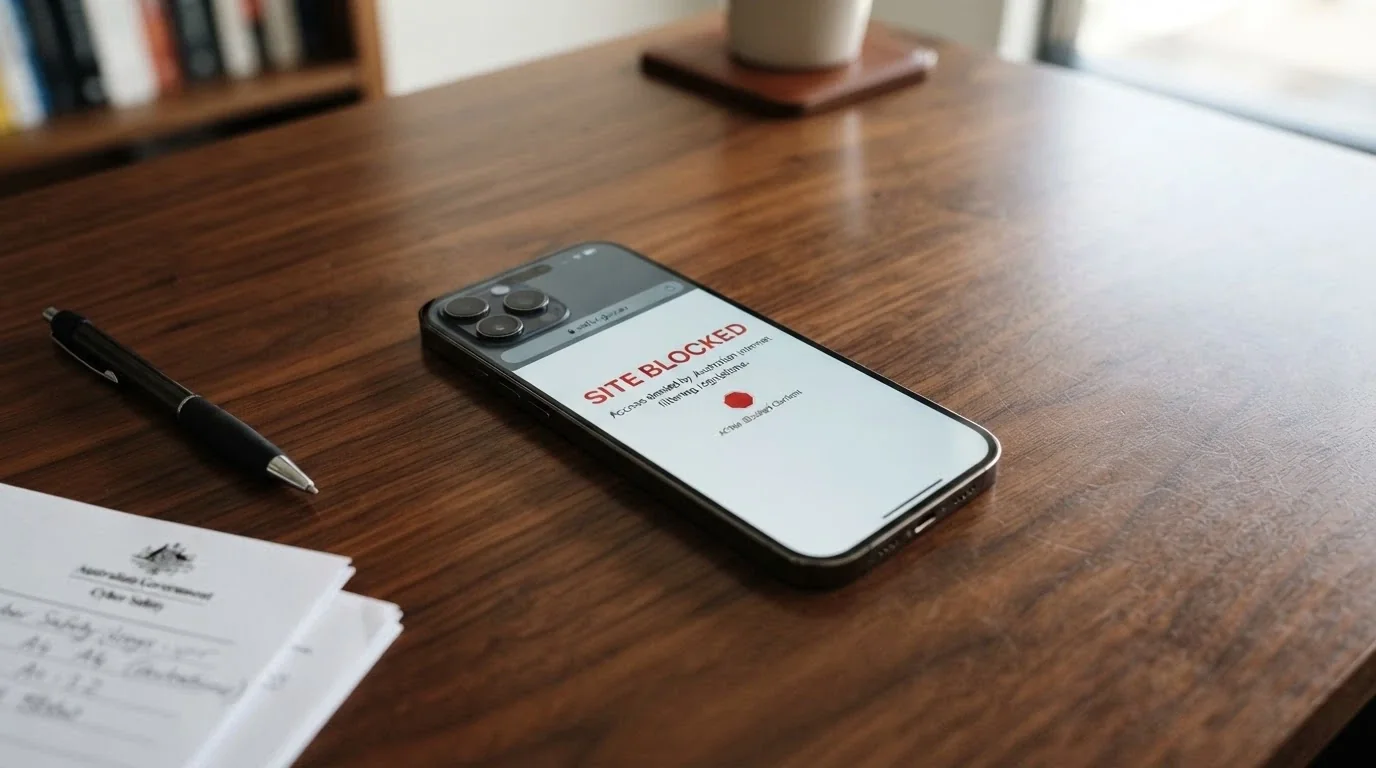
The IGA 2001 is the federal statute that closes the door on online casino in Australia. The prohibition covers online casino games (slots, table games, live dealer), online poker, and in-play sports betting. The Northern Territory Racing and Wagering Commission (NTRWC) licences online wagering only — the “internet gaming licence” the NT issues can be used to offer gaming products to customers outside Australia, but not to Australians. State and territory regulators issue wagering and lottery licences within their own jurisdiction. None of them issues an online casino licence.
The enforcement sits with the Australian Communications and Media Authority (ACMA). The ACMA investigates complaints, issues formal warnings, runs civil penalty proceedings and directs Australian ISPs to block illegal services. Since November 2019 the ACMA has had 1,564 illegal gambling and affiliate websites blocked. More than 225 illegal services have withdrawn from the Australian market since enforcement strengthened in 2017. The blocked categories include online casino services, in-play online sports betting, online betting services without an Australian licence, and betting on the outcome of a lottery.
The structural shape of the law explains why every operator on this page is offshore. There is no licensed Australian online casino to anchor a ranking to. The closest analogue — Sportsbet, TAB, Bet365, Ladbrokes, TABtouch, PointsBet, Neds, Betr, Picklebet, Betfair — offers wagering only, not casino games. An Australian player who wants casino gaming on Android is therefore reaching outside the Australian regulatory perimeter by definition.
The 2026 gambling reform — what changes on 1 January $$CY+1$$
The Interactive Gambling Amendment (Gambling Reform) Bill 2026 passed Parliament on 19 August 2026, and its substantive measures commence on 1 January $$CY+1$$. The reform does not legalise online casino — it tightens the rules around licensed wagering and gives regulators new tools against the illegal offshore market. The headline changes:
- Advertising restrictions. Wagering ads on TV are capped at three per hour between 6:00 am and 8:30 pm. A live-sport blackout runs from 15 minutes before kick-off to 5 minutes after the event. Athletes, celebrities and influencers are banned from promoting wagering products. Broadcasting sporting odds is prohibited. Radio wagering ads are banned during school-commute hours. Online wagering ads can only be served to logged-in accounts verified to be over 18 and where the user has not opted out.
- AdStop register. A national opt-out register administered by the ACMA, funded by a cost-recovery levy on licensed wagering providers, lets a consumer suppress wagering advertising across all channels. The register is not expected to be operational by 1 January $$CY+1$$ and will likely commence on a later date fixed by proclamation.
- Inducement marketing bans. Direct marketing of wagering inducements is banned for 14 days after a customer signs up, for three months after a person deregisters from BetStop, and indefinitely for customers identified as at-risk of gambling harm.
- Strengthened BetStop. The reform tightens BetStop’s operation, with the three-month post-deregistration inducement ban as one of the operational changes.
- Bank payment-blocking authority. From 1 January $$CY+1$$, banks and payment providers gain express statutory authority to block transactions to illegal gambling operators. The change does not require the bank to act — it authorises the bank to act.
- Online keno and foreign-lottery ban. Online keno “pocket pokies” and foreign-matched lotteries are added to the prohibited categories.
- Cost-recovery levy. The Interactive Gambling (Cost Recovery Levy) Bill 2026 allows the ACMA to recover its enforcement costs via a levy on licensed interactive wagering service providers.
- Statutory review. The advertising measures face a statutory review after three years of operation.
The reform is law with a start date. None of these changes bind an offshore casino app serving Australians — the offshore operators are outside the Australian regulatory perimeter, and the reform’s enforcement tools (the advertising rules, the inducement bans, the AdStop register) target licensed wagering providers, not offshore brands. The reform matters to an offshore player in two ways: it tightens the licensed side, which is the only Australian-anchored alternative to offshore; and it gives Australian banks the explicit authority to block payments to offshore operators, which adds friction to the deposit and withdrawal layer at offshore apps.
Offshore operators — what you actually risk when you play
An offshore casino app is not illegal for an Australian player to use — the IGA targets the provider — but it carries a structural set of risks that no licensed wagering service does. The player should know what they are accepting when they sign up:
- No Australian consumer protection. The Australian Consumer Law, the ePayments Code and the licensed wagering consumer protection framework do not reach offshore operators. There is no Australian ombudsman, no AU regulator to complain to, no Australian court with reliable jurisdiction over a Curaçao- or Anjouan-licensed entity.
- No BetStop coverage. BetStop binds Australian-licensed wagering services only. An offshore casino is not connected to the National Self-Exclusion Register, which means a self-excluded Australian can still deposit and play on an offshore site. The 41,290 active exclusions on BetStop do not reach the offshore apps on this page.
- No ACMA recourse for withheld funds. The ACMA can block an illegal site but cannot compel a payout. A player whose offshore operator refuses a withdrawal has no Australian regulator to escalate to.
- Site blocking with a balance on it. A blocked site can render a player unable to log in, with funds remaining on the account. More than 225 illegal services have withdrawn from the Australian market since 2017 — the operator a player signs up with today may not be reachable tomorrow.
- The payment method as a red flag. An operator that asks for a credit card or a crypto deposit is one that is not playing by Australian rules. The payment method is itself a tell.
The risks are not theoretical. They are the structural consequence of using a product that sits outside the Australian regulatory perimeter.
Staying in control: responsible gambling on Android
Responsible-gambling tools in the licensed Australian wagering market are part of the National Consumer Protection Framework — ten measures covering no line of credit, no payday lending for gambling, strong identity and age verification, restricted incentives and sign-up offers, easy account closing, deposit limits, monthly activity statements, consistent risk messaging, trained staff and the National Self-Exclusion Register. The framework is mandatory for licensed wagering operators. It does not reach offshore casino apps.
Tools, limits and where to get help
The player-protection tools an Australian Android user has at an offshore casino depend on what that operator chooses to offer — and the tracked sources do not confirm per-operator deposit-limit, time-out or self-exclusion availability for the featured set. The structural reality is that an offshore operator has no obligation to offer any of these tools, and the player cannot assume they will. The tools that do exist universally in Australia are the ones that sit outside the offshore product.
BetStop — the National Self-Exclusion Register — has been live since August 2023 and allows one registration to exclude a person from every Australian-licensed online and phone wagering service. As at 31 July 2026, BetStop had 67,480 registrations, of which 41,290 exclusions were still active — more than 60% of everyone who ever registered. 78% of registrants were under 40 and 38% chose lifetime exclusion. BetStop binds licensed wagering services only — it does not reach offshore casino apps. For an Australian trying to stop gambling, registering on BetStop is necessary but not sufficient if the offshore product remains in play.
The National Gambling Helpline is 1800 858 858 — free, confidential and staffed around the clock. The helpline routes to Gambling Help Online, which provides web chat, self-help tools and counselling for people in Australia affected by problem gambling, plus support for families. The prevalence figures put the risk in perspective: about 2.1% of Australian adults — roughly 430,000 people — experience problem gambling. The Australian Institute of Health and Welfare put high-risk gambling at 1.8% in 2022. These are the figures the responsible-gambling infrastructure is built around, and they are the reason the framework exists in its current shape.
For a player using an offshore casino app, the Australian framework is reachable through BetStop and the helpline, but the offshore product sits outside it. The structural gap is one of the reasons the choice to use an offshore app carries the weight it does.
How we chose and ranked these apps
The ranking on this page is built on market share and revenue from the tracked set — the operators Australians are actually reaching on Android. No ranking could rank on regulatory standing, because no operator holds an Australian casino licence. No operator below can hold one.
The official registers checked during research were the ACMA prohibited-services register and the NTRWC licence register via Licensing NT. Neither returned an Australian-licensed online casino. The licence type the NTRWC issues is a wagering licence, for terms up to 20 years, and covers racing and sport only. Every operator below sits outside the Australian regulatory perimeter.
The ranking criteria, in order of weight, were market share (the proportion of AU-facing offshore casino traffic the operator holds) and revenue (the AUD figure the operator generates). The two metrics describe different things — share is reach, revenue is monetisation — and together they describe a brand’s standing in the AU market. Wild Fortune was included on the strength of its documented bonus and cashout profile, despite sitting outside the top 20 on the traffic ranking. The per-operator specifications — licence date, game providers, wagering multipliers, bonus validity — were not confirmed this run for most of the featured set, so the operator write-ups stay at the level of what the research does carry. A player who wants the per-operator details should check the operator’s own terms page before depositing.
Your move: what to actually do about Android casino apps in Australia
The page above has laid out the operators Australians are actually reaching on Android, the mechanics of how those apps get onto a phone, the games they carry, the bonuses they offer, the payment routes that work and the legal shape that surrounds the whole product. The decision a reader faces sits in plain view of those facts.
The structural reality is that no Australian-licensed casino app exists. Every real-money casino app serving Australian Android users is offshore by necessity, and the offshore status is the load-bearing fact — it explains why there is no Google Play listing, why no Australian regulator can compel a payout, why BetStop does not reach the product, and why the payment methods an operator accepts are themselves a signal. The IGA targets the provider, not the player, which is why the product exists at all; the 2026 reform tightens the licensed side and adds bank payment-blocking authority, but it does not legalise the offshore product.
The decision framework, on the facts above, is the player’s. If a reader chooses to play at an offshore casino app, the things worth checking are the operator’s licence (Curaçao, Anjouan or MGA — not Australian), the bonus terms (wagering multiplier, max cashout, game weighting), the payment methods available, the cashout speed, the responsible-gambling tools offered, and whether the operator is currently reachable in Australia. If a reader chooses not to play, that is a defensible decision on the same facts: the offshore product sits outside every Australian protection the licensed market provides, and the Australian regulatory direction is towards more friction rather than less.
The page does not recommend an operator. The page describes what is there, names what each one costs, and leaves the call where it belongs.
Frequently asked questions about Android casino apps in Australia
Which payment methods can Australian players use to deposit on a casino app — does PayID work?
PayID and Osko are the fastest AUD-native routes at offshore casinos, with deposits typically clearing in under a minute. Debit cards, bank transfers and BPAY are also widely accepted. Credit cards and crypto are banned at licensed AU wagering — an offshore casino taking them is operating outside Australian rules. The signals carried by payment method are detailed in the payments section.
Are casino apps that accept cryptocurrency safe for Australian players?
Crypto deposits are banned for licensed Australian wagering, but offshore casino apps still accept Bitcoin and other coins. The legal exposure sits with the operator, not the player. If an offshore site refuses a crypto withdrawal, there is no Australian consumer protection that reaches it — the offshore risk picture is covered in the legal section.
What happens to my money if an offshore casino app is blocked in Australia?
If the ACMA blocks an offshore casino app, the site can become unreachable with money still on the account. No Australian regulator can compel a payout from an offshore operator — the consumer protection framework that covers licensed wagering does not reach offshore products. The balance sits at the operator’s discretion.
Does BetStop cover casino apps, or only licensed Australian wagering sites?
BetStop is the National Self-Exclusion Register covering Australian-licensed wagering services — it does not reach offshore casino apps. A self-excluded Australian can still deposit and play at an offshore site. The offshore gap is one of the structural risks of the product; the full reach and registration counts are covered in the responsible-gambling section.
How do I know if a casino app on Android is trustworthy or a scam?
No Australian-licensed casino app exists, so every real-money casino app serving Australians is offshore by structural necessity. Red flags include anonymous ownership, no responsible-gambling tools, aggressive bonus terms with low withdrawal caps, and resistance to identity verification. Real licences are Curaçao, Anjouan or MGA — never Australian.
What welcome bonuses do Australian-facing casino apps offer, and what are the wagering requirements?
Featured-offer bonus structures include Wild Fortune’s 225% up to A$7,500 plus 250 free spins with zero wagering on the spins, and a minimum A$10 deposit. The headline percentage is rarely the cost — what matters is whether free-spin winnings are withdrawable, and the match bonus’s turnover requirement.
Created by the ”Best Casino Sydney” editorial team.