
Casino VIP Programs in Australia: What the Tier System Really Costs You
Data current as of 16 October 2026, verified against the Australian Communications and Media Authority (ACMA) register, operator terms pages, and game-provider RTP disclosures.
A casino VIP program is sold as a thank-you. It is not. It is a retention instrument built to extract more play from players who already spend heavily, dressed in tiers, points and a personal account manager so the spend feels recognised. For Australian players in 2026 the picture is sharper still: no online casino in the country holds a licence under the Interactive Gambling Act 2001, so every “VIP program” an Australian can actually join sits offshore, outside Australian consumer law, and disconnected from BetStop. The perks are real. The protections are not.
This page works through what those VIP programs actually deliver, what each tier costs in turnover before a single benefit unlocks, and what the offshore status changes for a player who treats the operator as legitimate simply because it accepts a deposit. The numbers come from operator terms pages, ACMA enforcement data, and published RTP figures. The conclusions are editorial: a tier that costs A$25,000 in wagering to reach Platinum, then charges a 40x multiplier on the welcome offer that triggered the climb, is a bad trade for most readers — and the page says so, plainly, where the arithmetic earns it.
Table of Contents
- Why an Online Casino VIP Program Is Not a Free Upgrade
- The Real Value of VIP Perks — What Each Tier Unlocks
- The Top VIP Casino Programs Available to Australian Players in 2026
- Why No Online Casino VIP Program Is Licensed in Australia
- VIP Casino Bonuses: Why the Biggest Number Rarely Pays the Most
- Crypto VIP Programs: Faster Withdrawals, Fewer Questions
- Inside the VIP Room: What Changes When You Leave the Main Lobby
- The Games VIP Players Actually Play — and the Ones That Return the Most
- How We Evaluated These VIP Casino Programs
- What Your 2026 VIP Casino Decision Actually Rests On
- Frequently Asked Questions
Why an Online Casino VIP Program Is Not a Free Upgrade
What a Casino VIP Program Is (and What It Definitely Is Not)
A VIP program is a turnover-based status ladder. The casino assigns a points-per-dollar-wagered rate, sets thresholds for each tier, and hands out benefits — cashback, faster withdrawals, a personal manager — that scale with how much a player has staked. Nothing is free. Every rung above the entry tier is paid for in real money that has already gone through the house edge.
The phrase “VIP” carries weight it does not earn. At an offshore casino, it is not a regulated designation, not a player-protection mechanism, and not a guarantee of payout priority. It is a marketing label for “you have wagered enough that we want to keep you.” A loyalty program, by contrast, is open to every depositing player from day one and usually costs nothing to enter; a VIP program is gated by wagering volume and often invitation-only at the upper tiers.
In Australia, the distinction matters more than in most markets. Online casino games, including pokies, are prohibited under the Interactive Gambling Act 2001. No licence exists. The “VIP program” any Australian player can join is therefore offered by an operator sitting outside Australian law, accepting deposits through payment routes the licensed wagering industry is banned from using for casino play, and offering no recourse if the casino closes the account or refuses a withdrawal.
How VIP Status Tiers Actually Work
Tier movement is the mechanism that turns a deposit into a status. The casino sets a points target for each level — typically one point per dollar wagered on pokies, with table games and live dealer contributing less or nothing — and a player climbs the ladder as those points accumulate. The thresholds are not generous. At Jackpot Jill, the published progression runs from Bronze (automatic on first deposit) through Silver at roughly A$1,000 wagered, Gold at A$5,000, and Platinum at A$25,000, with Diamond and Royal gated behind invitation. That is real money, lost to the house edge, before a player reaches the tier where the headline perks begin.
Maintenance is where the ladder punishes. Most programs attach a monthly minimum — a points floor that must be hit to keep the tier — and a downgrade trigger that drops a player back one or two levels if the floor is missed. The structure is designed so a player who has invested A$25,000 to reach Platinum feels compelled to wager another A$5,000 or more per month to avoid losing the cashback multiplier and the personal manager. The marketing says “stay rewarded.” The arithmetic says “keep playing or lose what you bought.”
What this means in practice: a player who wagers heavily for two months and then takes a break does not get to keep the tier indefinitely. The points balance is checked, the floor is missed, and the player returns at Silver or Gold. The benefits purchased by the original A$25,000 turnover are gone.
Loyalty Program vs VIP Program: the Difference That Matters
A loyalty program is automatic. Every depositing player earns points from the first spin and starts redeeming small rewards — free spins, small cashback, birthday bonuses — within a session or two. The cost to the player is whatever the house edge takes from the wagering that earned the points, and the rewards are calibrated to give back a fraction of that loss.
A VIP program sits above the loyalty program and is often a separate track. Entry may be automatic (the first loyalty tier counts as “VIP Bronze” at some operators) or invite-only at higher levels. The benefits are larger — a 2.5x cashback multiplier, a personal manager, faster withdrawals, custom bonuses — and the cost is the wagering required to reach and maintain the tier.
The distinction matters for two reasons. First, a player evaluating a “VIP program” should know whether they are looking at a loyalty program dressed in VIP branding, or a genuinely tiered structure with published thresholds and a manager. Second, a loyalty program costs nothing extra to join and nothing extra to leave; a VIP program can lock a player into a pattern of play designed to protect a sunk-cost tier. The two are not the same product, and the page treats them as such throughout.
The Real Value of VIP Perks — What Each Tier Unlocks
| Casino | VIP Tiers | Cashback / Rakeback | Free Spins (Welcome) | Game Providers |
|---|---|---|---|---|
| Jackpot Jill | Bronze → Royal (6 tiers, invite-only at Diamond/Royal) | 1x at Bronze up to 2.5x at Diamond; bespoke offers at Royal | 100 wager-free on Dragon Pearls (A$200 win cap) | — |
| Skycrown | Loyalty ladder, invite-based VIP manager tier | 10% weekly cashback up to A$500, no wagering | 100 on Book of Dead (first deposit) | Pragmatic Play, Play’n GO, Evolution |
| Crownplay | 5 loyalty levels, personal management at advanced tiers | Cashback, higher limits at upper tiers | 350 (across welcome package) | — |
| Rocket Play | Points-based, higher limits for crypto players | Tiered rakeback / loyalty rewards | 100 (20/day for 5 days) | Pragmatic Play |
| Stake | Rakeback model rather than a tiered ladder | Rakeback + reloads + leaderboard races | — | Pragmatic Play, Evolution |
| Rainbet | VIP progression layered on daily recurring bonuses | Rakeback + daily bonuses | 60 on Sweet Bonanza | Pragmatic Play, Hacksaw, Nolimit |
| Rocket Casino | Not confirmed this run | — | 150 on Big Bass Splash | Pragmatic Play |
| WinSpirit | Not confirmed this run | — | 100 (20/day for 5 days) | Pragmatic Play |
| Royal Reels | Not confirmed this run | — | — | — |
| FairGO | Not confirmed this run | — | — | — |
The spread across the ten operators reviewed is wide, and that is the first thing a reader should notice. Only Jackpot Jill publishes a tier-by-tier breakdown of its program, including the cashback multiplier at each level and the wagering threshold for promotion. Skycrown and Stake make their headline perks visible — 10% no-wagering weekly cashback in Skycrown’s case, a rakeback-and-reload model at Stake — but neither publishes a complete tier table. The remaining operators either describe a loyalty structure in general terms or, in the case of Royal Reels and FairGO, offer no confirmed VIP specifics at all.
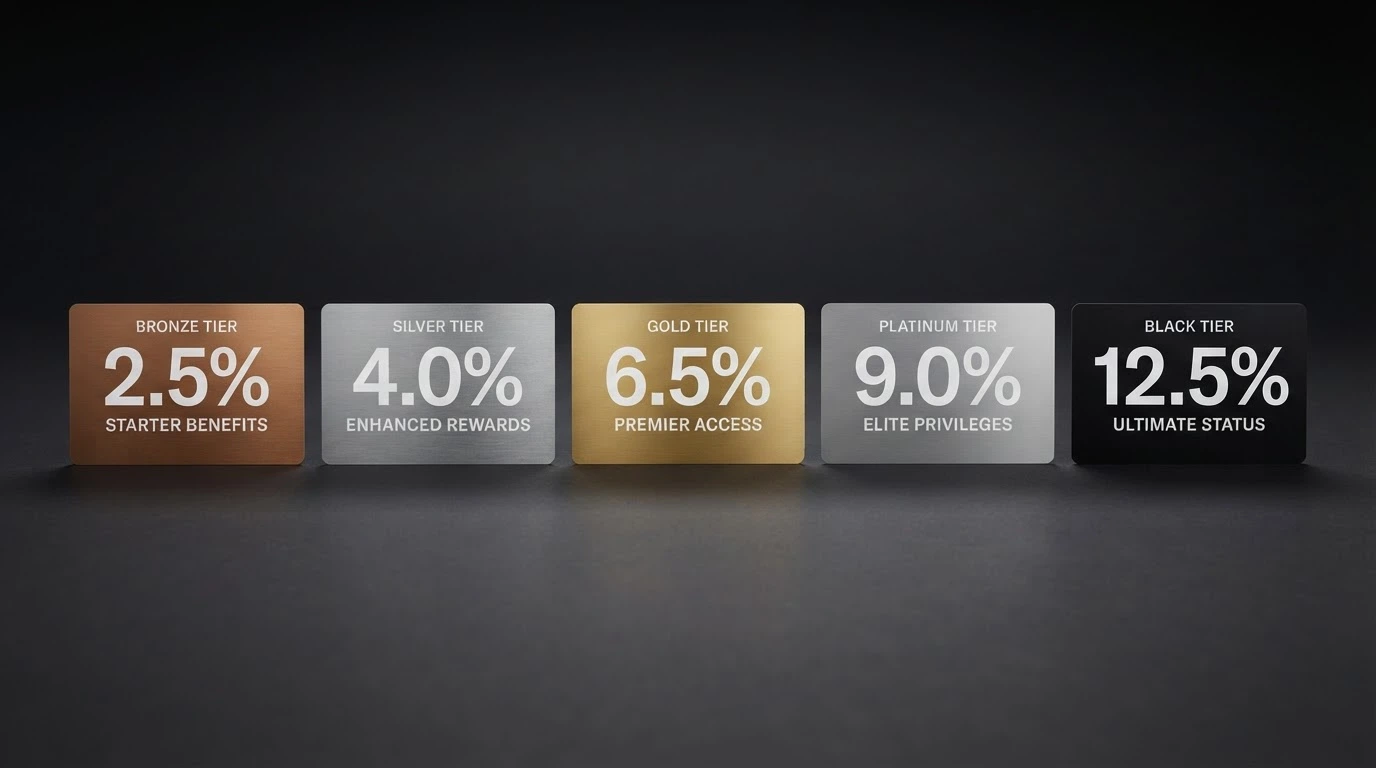
For a player comparing programs, the practical question is which perks carry a real dollar value and which are packaging. Cashback with no wagering is the clearest dollar value: Skycrown’s 10% weekly cashback up to A$500 is paid in cash, withdrawable immediately, and ties the player’s loss to a guaranteed return. A personal VIP manager is harder to value but real: it means faster dispute resolution, bespoke bonus offers calibrated to the player’s pattern, and a single point of contact for withdrawal issues. Faster withdrawals — Jackpot Jill’s 5-minute PayID at Diamond — have a hard value when a player needs funds at short notice.
The rest is largely packaging. Higher table limits matter to a high-roller and to nobody else. Exclusive tournaments are a perk for the few players who would attend them. Custom bonuses at the top tier are usually reload offers with wagering attached, and the value depends on the terms.
How Loyalty Tiers Move You Up (and How Fast You Fall)
Tier progression is fast on the way up because the casino wants the player to feel rewarded early. Bronze is automatic. Silver is reachable inside a week of steady play. Gold arrives within a month for a player staking a few hundred dollars per session. The pace is engineered to make the climb feel achievable, because every wager between the tiers is house-edge profit the casino would not otherwise have.
Tier maintenance is slower to penalise but relentless in application. The monthly points floor at most programs sits well below the threshold needed to reach the tier in the first place, but above what a casual player will generate by accident. A player who stops playing for two weeks does not lose the tier immediately; a player who takes a month off usually does. The grace period varies by operator and is rarely published in plain language.
What this means in practice is that the tier is rented, not owned. A player who has spent A$25,000 reaching Platinum is paying ongoing rent in the form of monthly wagering minimums, and the rent is set just low enough that keeping the tier feels reasonable and just high enough that losing it feels like wasting the climb. Players are better served by viewing the tier table as a recurring cost sheet rather than a reward chart.
The Benefits That Actually Save You Money
Three perks in the typical offshore VIP program have a direct dollar value, and only three.
Cashback. The 5%–25% range quoted across the offshore market is the headline; the specifics matter more. Skycrown’s 10% weekly cashback up to A$500 with no wagering is the cleanest example in the set reviewed: a player who loses A$1,000 in a week receives A$100 back, withdrawable, with no playthrough. Jackpot Jill’s tiered cashback multiplier — 1x at Bronze, 1.2x at Silver, 1.5x at Gold, 2x at Platinum, 2.5x at Diamond — is paid in bonus funds at the lower tiers and increasingly in cash at the upper tiers, and that distinction is where the value sits. A 1.5x cashback paid in bonus funds with 40x wagering is worth less than a 1x cashback paid in cash.
Reduced wagering on reloads. Several programs offer lower wagering multipliers on bonuses claimed at higher tiers. The reduction is usually modest — from 40x to 30x on the bonus, or 35x on deposit-plus-bonus instead of 40x — but at VIP volumes it shifts the arithmetic noticeably. A A$1,000 reload at 30x instead of 40x is A$10,000 less turnover required, and A$10,000 of turnover at a 96% RTP pokie is roughly A$400 less expected loss.
Higher withdrawal limits. The dollar value is conditional on the player actually needing to withdraw more than the standard ceiling. For a high-roller clearing tens of thousands in winnings, the standard A$5,000–A$10,000 weekly cap is a real friction, and a VIP-tier lift to A$20,000 or unlimited withdrawals resolves it. For a player withdrawing a few hundred per week, the cap is irrelevant.
Everything else — exclusive tournaments, birthday bonuses, higher table limits, faster withdrawal processing (as opposed to higher withdrawal limits) — is real but secondary. The reader comparing programs should weight cashback first, reload wagering second, withdrawal limits third, and treat the rest as nice-to-have.
How to Join a VIP Program Without Chasing Losses
- Treat the lowest tier as the goal for the first three months, not the highest. Bronze and Silver are reached through normal play within a deposit-controlled budget; reaching for Gold by doubling stakes is how players cross from VIP-curious to problem-gambling.
- Decline the offer to accelerate progression. Some programs sell “VIP fast-track” point packages or deposit bonuses that compress the climb in exchange for higher wagering. The arithmetic rarely favours the player.
- Keep a record of deposits and withdrawals by month, not by session. A player who can read their own monthly net position will recognise when the VIP climb is costing more than the perks are returning.
- Read the monthly minimum before claiming any welcome offer. A program that requires A$5,000 monthly wagering to keep a tier is a different commitment from a program that requires A$500.
- Use the personal manager as a service channel, not a relationship. The manager’s job is retention; the player’s job is to keep the manager honest about what was promised.
What Happens to Your VIP Status When You Switch Casinos
VIP status does not transfer. No offshore casino in the set reviewed honours another operator’s tier, and the published terms make no claim of portability. A player who reaches Platinum at Jackpot Jill and signs up at Skycrown starts at the bottom of Skycrown’s loyalty ladder and has to repeat the climb.
What is lost in the switch is not just the tier. It is the wagering already spent to reach it. A Platinum player who has put A$25,000 through Jackpot Jill’s pokies to reach the tier has paid the house edge on that turnover and received, in return, the right to keep paying it at the same rate to maintain the tier. Walking away forfeits the perks but, more importantly, the wagering is not recovered at the new casino; it is simply gone.
The practical advice is to evaluate a VIP program before committing significant volume, not after. A player who plans to spend A$20,000 a year on online pokies should pick one operator, read the tier table, and stay there long enough for the climb to make sense. A player who hops between three operators chasing welcome bonuses will reach the top tier at none of them.
The Top VIP Casino Programs Available to Australian Players in 2026
| Casino | AU Licence | Welcome Offer (1st Deposit) | Wagering | VIP Highlight |
|---|---|---|---|---|
| Jackpot Jill | None (offshore) | 100% up to A$1,500 (1st of 5-deposit package) + 100 wager-free FS on Dragon Pearls | Varies by deposit; 0x on wager-free FS | 6-tier ladder with published thresholds; Diamond 2.5x cashback, 5-min PayID |
| Skycrown | None (offshore) | 100% up to A$500 + 100 FS on Book of Dead | 40x bonus / 30x FS | 10% weekly cashback up to A$500, no wagering; invite-based VIP manager |
| Crownplay | None (offshore) | 250% up to $4,500 + 350 FS | 35x (deposit+bonus) / 40x FS winnings | 5-level loyalty with personal management at advanced tiers |
| Rocket Play | None (offshore) | 100% up to A$1,000 + 100 FS | 40x (bonus+deposit) | VIP manager contact within 24h via email; higher limits for crypto |
| Stake | None (offshore) | 200% up to $2,000 (USD) | 40x within 30 days | Rakeback, reloads, leaderboard races, rain giveaways |
| Rainbet | None (offshore) | 100% up to $700 + 20 FS on Sweet Bonanza | 40x (deposit+bonus); max bet 2% of deposit | VIP progression + rakeback + daily recurring bonuses |
| Rocket Casino | None (offshore) | 150% up to €1,050 + 150 FS on Big Bass Splash | 45x | VIP specifics not confirmed this run |
| WinSpirit | None (offshore) | 100% up to A$300 + 100 FS | 40x; max bet A$7.50 | VIP specifics not confirmed this run |
| Royal Reels | None (offshore) | Not confirmed | Not confirmed | Not confirmed |
| FairGO | None (offshore) | Not confirmed | Not confirmed | Not confirmed |
The “AU Licence” column reads the same way down every row: None. That is the structural fact of the market, and it is the reason this page exists as a comparison of offshore operators rather than a list of licensed Australian casinos. The wagering column is where the headline bonus meets the actual cost, and the gap is what this page keeps coming back to. Crownplay’s 250% match to $4,500 looks large until the 35x deposit-plus-bonus multiplier is applied to the full deposit-and-bonus amount; the required turnover for a A$1,000 deposit at 250% match is A$122,500 before any winnings are withdrawable.

For a player who is choosing between these programs on the VIP dimension specifically — and not on the welcome offer — the ranking that follows the table is the practical guide. The welcome offer is a one-time event; the VIP program is the long-term cost.
Jackpot Jill: The Most Detailed VIP Tier System We Found
Jackpot Jill publishes what most offshore programs keep vague: a six-tier ladder with named thresholds, a cashback multiplier at each level, and a clear list of benefits that arrive at each promotion. Bronze is automatic on first deposit and pays 1x cashback. Silver, reached after roughly A$1,000 in wagering, lifts the multiplier to 1.2x and adds faster withdrawals and a birthday bonus. Gold, at A$5,000 wagered, unlocks a personal account manager and a 1.5x cashback multiplier. Platinum, at A$25,000 wagered, doubles the cashback to 2x and grants access to exclusive pokie tournaments. Diamond and Royal sit behind invitation; Diamond offers 2.5x cashback and 5-minute PayID withdrawals; Royal offers custom bonuses and a direct line to the head of VIP.
The welcome package is A$7,500 across five deposits with 100 wager-free free spins on Dragon Pearls and a A$200 maximum win cap on the free spin winnings. The cap is worth noting: it means even the “wager-free” component caps the upside at A$200, and any free spin winnings above that are forfeit. The deposit bonus wagering varies by tier and is not as transparent as the VIP thresholds.
The honest read: Jackpot Jill is the operator to choose if the VIP program is the primary reason for signing up. The published thresholds mean a player knows the climb cost, and the cashback multipliers at Diamond and Royal are the highest in the set. The trade-off is a smaller and less generous welcome offer than Skycrown or Crownplay, and a free spin win cap that limits the upside of the no-wagering component.
Skycrown: Weekly Cashback With No Wagering Requirement
Skycrown’s headline perk is the 10% weekly cashback up to A$500 with no wagering requirement. For a player who wagers steadily and accepts the loss, that is a guaranteed return: lose A$1,000 in a week, receive A$100 back in cash, withdraw immediately. Few operators in the set reviewed match that offer, and none beat it.
The welcome package is A$8,000 plus 400 free spins across four deposits, with the first deposit offering 100% up to A$500 and 100 free spins on Book of Dead. Wagering is 40x on the bonus, 30x on free spin winnings, with a 14-day validity per tier and a A$5 maximum bet during bonus play. The bonus structure is generous on paper; the wagering is the standard 40x that the offshore market uses to monetise the headline.
The VIP manager access is invite-based after KYC and steady play, with an indicative deposit from A$500. That is more accessible than most programs’ top tiers but still gated behind verification and a spending pattern the operator chooses to define. Skycrown is the clear choice for a player who prioritises predictable returns over tier prestige; the 10% weekly cashback offer provides a level of certainty that few other offshore programs match.
Crownplay: Five Loyalty Levels With Personal Management
Crownplay’s welcome offer is the largest by headline number in the set: 250% up to $4,500 plus 350 free spins. Wagering is 35x on the deposit-and-bonus combined and 40x on free spin winnings, with a 10-day validity. The short validity window is the trade-off — 10 days is tight for a bonus of this size, and a player who cannot complete A$150,000+ of turnover in that window will forfeit the bonus and any winnings.
The loyalty program is five levels with cashback, higher limits, and personal management at advanced tiers. The specifics of the tiers and thresholds are not published in the same detail as Jackpot Jill’s, which makes direct comparison harder. What the welcome offer implies is that the operator is willing to spend heavily on player acquisition and to enforce tight terms in return; whether the loyalty program carries the same generosity at the upper tiers is not something this run could confirm. Crownplay will appeal most to players primarily driven by the scale of the welcome offer, though they should weigh that upfront value against the comparative lack of transparency in the loyalty program.
Rocket Play: Points-Based Loyalty With Crypto Perks
RocketPlay’s first deposit is 100% up to A$1,000 with a minimum deposit of A$30 and 100 free spins released at 20 per day for five days. Wagering is 40x on the deposit-and-bonus combined, with a 5-day validity and a A$7.50 maximum bet during bonus play. The 5-day validity is the shortest in the set and is the constraint that decides whether this offer is worth taking: a player who cannot complete roughly A$80,000 in turnover over five days from a A$1,000 deposit at 100% match will not see a withdrawal from the bonus.
The loyalty program is points-based and tiered, with higher withdrawal limits and faster processing for crypto players. The VIP manager is reachable within 24 hours by email after either a large first deposit or four-plus weeks of regular crypto play. RocketPlay is the operator to choose if crypto is the primary funding method and if the player values the 24-hour manager response over a published tier ladder.
Stake: Rakeback and Reload Bonuses for Regular Players
Stake runs a different model from the tiered loyalty programs at the other operators. Instead of a Bronze-to-Diamond ladder, the player earns rakeback on play, claims daily and weekly reload bonuses, and competes in leaderboard races and rain giveaways. The welcome offer is a 200% match up to $2,000 (USD) with a $50 minimum deposit, 40x wagering, and 30-day validity.
The rakeback model suits a player who wagers consistently and at high volume, because the rakeback compounds: every wager returns a fraction regardless of whether the spin wins or loses. For a casual player staking A$50 per session, the rakeback will be small; for a high-volume player, it can exceed the value of a fixed-percentage weekly cashback. Stake’s model suits a consistent, high-volume player; those who prefer a reliable weekly return on their losses will likely find a traditional cashback structure more rewarding.
Rainbet: VIP Progression With Daily Recurring Bonuses
Rainbet’s welcome package totals $2,100 (USD) plus 60 free spins across three deposits, with the first deposit offering 100% up to $700 plus 20 free spins on Sweet Bonanza. Wagering is 40x on the deposit-and-bonus combined, the maximum bet is 2% of the deposit, and slots with RTP over 97.4% are excluded from bonus play. The exclusion list is a real constraint: a player who would prefer to clear wagering on a high-RTP pokie cannot, and the operator has effectively removed the games with the lowest house edge from the bonus playthrough.
The VIP program layers a progression system on top of daily recurring bonuses and leaderboard races. The structure rewards daily play more than occasional large sessions, which suits a player who logs in regularly. Rainbet is best suited to players with a daily play pattern, as its system of recurring bonuses and leaderboard races offers a different form of engagement than a single, one-time welcome bonus.
WinSpirit: What We Could Confirm About Its VIP Program
WinSpirit’s welcome offer is up to A$600 plus 100 free spins across two deposits, with the first deposit at 100% up to A$300 plus 100 free spins released at 20 per day for five days. Wagering is 40x, the maximum bet during bonus play is A$7.50, and the free spin games are Royal Piggy Hold the Spin and Diamonds Power. The bonus is modest by the standards of the set reviewed.
The VIP program specifics for WinSpirit could not be confirmed this run. The welcome offer structure implies a smaller-scale operator than the ones with A$4,500 or A$8,000 headline packages, and a player evaluating WinSpirit for its VIP program should treat the absence of confirmed tier details as a signal to ask the operator directly before depositing. The published welcome offer is a reasonable starting point; the VIP program is the open question.
Rocket Casino: What We Could Confirm About Its VIP Program
Rocket Casino’s welcome offer is 150% up to €1,050 plus 150 free spins on Big Bass Splash with 45x wagering. The 45x multiplier is the highest in the set reviewed, and combined with the 150 free spins it means a player must clear a substantial turnover before any winnings are withdrawable. The free spin winnings are subject to the same 45x unless stated otherwise.
The VIP program specifics for Rocket Casino could not be confirmed this run, which is the central risk for a player considering the operator on its VIP merits. A 45x wagering multiplier is steep even before the absence of confirmed tier details, and a player who cannot verify the loyalty program should weigh that gap against the welcome offer. Players should only consider Rocket Casino if the welcome bonus is their sole objective, given the absence of confirmed details regarding the VIP program.
Royal Reels: Offshore Operator With Unconfirmed VIP Details
Royal Reels is an offshore operator that appears in Australian-facing rankings, but this run could not confirm specific VIP program details, bonus terms, or game providers. The operator has no Australian licence, which means no recourse under Australian law if a withdrawal is withheld or an account is closed.
For a player evaluating Royal Reels, the absence of confirmed details is the entire signal. A program that does not publish tier thresholds, cashback percentages, or withdrawal limits is asking the player to trust the operator’s word on the program’s value. That trust is the position the player is in across all ten operators, but the others at least publish their headline terms. Royal Reels does not, and the data gap is the reason this write-up does not assign it a VIP ranking.
FairGO: Offshore Operator With Unconfirmed VIP Details
FairGO is an offshore operator that appears in Australian-facing rankings, and the situation mirrors Royal Reels: this run could not confirm specific VIP program details, bonus terms, or game providers. The operator has no Australian licence.
The same advice applies. A player who can verify the VIP program directly with FairGO’s support team, read the published terms in full, and accept the offshore status can choose to play; a player who cannot verify those terms is choosing on the operator’s marketing alone. The gap in confirmed data is the gap the player would be filling themselves, with no Australian consumer protection if the program does not deliver what is promised.
Why No Online Casino VIP Program Is Licensed in Australia
The Interactive Gambling Act and the ACMA: What the Law Actually Says
Online casino games, including pokies, are prohibited under the Interactive Gambling Act 2001 in Australia. There is no licence for them anywhere in the country — not federally, not in any state or territory. The Australian Communications and Media Authority (ACMA) enforces the prohibition, and its tools are site blocking, civil penalties, and the pursuit of offshore operators that target Australian customers. The penalty ceiling for a corporation providing a prohibited interactive gambling service is A$12,375,000 per day.
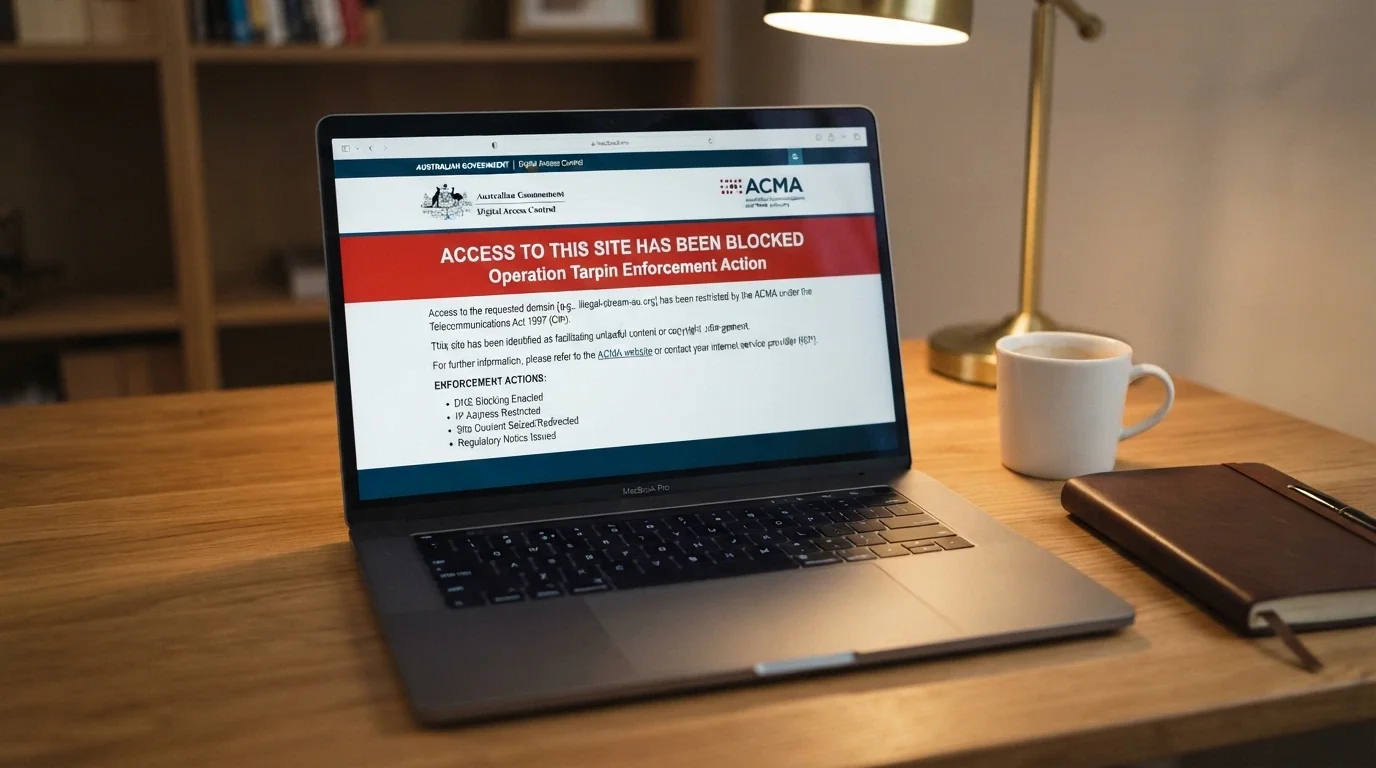
The ACMA has blocked 1,369 illegal gambling and affiliate websites since its first blocking request in November 2019, and around 220 illegal services have withdrawn from the Australian market since enforcement began in 2017. The blocking is ongoing; the withdrawals are not voluntary concessions, they are operators deciding that continuing to serve Australian customers is not worth the enforcement cost. The reader should understand that an offshore casino accepting an Australian deposit today can be blocked tomorrow, and the player’s account balance does not survive the block.
The 2026 reform package tightens further. The Interactive Gambling Amendment (Gambling Reform) Bill 2026 passed Parliament on 19 August 2026, with measures commencing 1 January 2027. The reforms include advertising caps (a maximum of three gambling ads per hour between 6am and 8:30pm), inducement bans (no sign-up offers within 14 days of registration, no offers within three months of BetStop deregistration, and no offers indefinitely to at-risk customers), live-sport broadcast blackouts, and — most directly relevant to offshore VIP programs — express authority for banks and payment providers to block transactions to illegal gambling operators. From 1 January 2027, a deposit to an offshore casino can be refused at the payment rail rather than at the site block.
The individual player is not prosecuted for playing at an offshore casino. The penalty falls on the operator. But the lack of prosecution is not the same as legality, and the absence of Australian consumer protection means a player whose withdrawal is withheld has no Australian dispute resolution, no ACMA complaint route, and no state or territory regulator to appeal to.
What Player Protection You Lose When You Play Offshore
The licensed Australian wagering market offers player protection infrastructure that the offshore casino market does not. BetStop, the National Self-Exclusion Register, launched on 21 August 2023 and recorded 44,841 registrations by the end of Q4 FY 2024–2025, with 30,032 active exclusions as of 30 June 2025. A player who registers with BetStop cannot be served by any Australian-licensed wagering operator; the operator is bound to close the account and refund the balance. Unibet paid a A$1,014,120 penalty for failing to close 954 accounts of customers registered with BetStop, which is the precedent that gives the register its weight.
BetStop binds Australian-licensed wagering services. An offshore casino is not licensed here, is not connected to the register, and will keep taking a self-excluded person’s money. The ACMA states this plainly: the register is a tool for the licensed market, and the offshore market operates outside it. A player who has registered with BetStop and then deposits at an offshore casino has not self-excluded from that casino; the casino has no way to check, no obligation to check, and every incentive not to.
The credit card and digital currency ban for online wagering, in force since 11 June 2024, is the other piece of the licensed-market protection. Companies failing to enforce the ban face fines of up to A$247,500. The ban exists because credit and crypto were the easiest routes for problem gamblers to deposit beyond their means; the licensed market is now closed to both, while offshore casinos continue to accept them. The reform package from 1 January 2027 gives banks express authority to block transactions to illegal operators, which is the licensed-market response to the offshore gap.
The responsible gambling support infrastructure remains available regardless of where a player plays. The National Gambling Helpline is 1800 858 858, free, confidential, and staffed 24/7. Gambling Help Online offers chat and counselling at gamblinghelponline.org.au. Approximately 2.1% of Australian adults — roughly 430,000 people — experience problem gambling, and the support services are designed for that population whether the gambling occurs at a licensed TAB, a Crown casino, or an offshore site the ACMA has not yet blocked.
What You Lose When an Offshore Casino Freezes Your Account
When an offshore casino blocks a withdrawal or closes an account, the player has three options and none of them are Australian. The first is the casino’s own dispute resolution process, which is internal and decides in favour of the operator more often than not. The second is the regulator in the jurisdiction where the casino is licensed — Curaçao, Malta, the Kahnawake Gaming Commission, the Philippines — and the third is the payment provider that processed the deposit, which may or may not offer a chargeback route depending on the method used.
None of these routes is fast, none is free, and none is guaranteed. A player who has been paid in crypto and then has the account closed has very limited recourse, because the crypto transaction is final once confirmed. A player who paid by card has the strongest chargeback position but must file within the card network’s dispute window and prove the operator breached its terms. The legal cost of pursuing a Curaçao or Malta-licensed operator from Australia usually exceeds the value of the disputed withdrawal.
The practical advice is to do the due diligence before depositing, not after. Read the terms page in full. Check the licence number on the regulator’s register. Search the operator’s name with “withdrawal” and “scam” and read what other players have reported. Make a small test withdrawal before committing volume. The offshore market is not uniformly bad, but it is uniformly outside Australian consumer protection, and the player is the only person checking.
VIP Casino Bonuses: Why the Biggest Number Rarely Pays the Most
Welcome Bonuses That Look Bigger Than They Are
A welcome package totaling thousands of dollars in bonus funds plus hundreds of free spins is the headline every offshore casino leads with. Skycrown’s A$8,000 plus 400 free spins across four deposits is the most generous in the set reviewed. Jackpot Jill’s A$7,500 across five deposits plus 100 wager-free free spins is close behind. Crownplay’s 250% match up to $4,500 plus 350 free spins has the highest single-deposit match.

The reader should know that most of these packages are designed so the first deposit is the largest and each subsequent deposit is smaller, and that the player who claims only the first deposit — the most common pattern — captures a fraction of the headline total. Skycrown’s first deposit is 100% up to A$500 plus 100 free spins; the remaining A$7,500 of bonus funds is split across three further deposits. Rainbet’s $2,100 headline is split into three deposits of $700 each. A player who claims the first deposit and walks away is leaving most of the package on the table.
This is not a criticism. It is a structural feature of the offshore welcome offer. The packages are large because the casino expects most players to claim one or two of the four or five deposit bonuses, and the headline number is calibrated to the upper bound of player behaviour rather than the average. The honest read is to evaluate the first deposit offer on its own terms and treat the rest as a bonus for players who intend to stay.
The expected loss calculation that follows in the next section uses the first-deposit number, because that is the offer most players actually claim and the one the wagering arithmetic applies to.
Deposit-Match Offers: The Wagering Multiplier Is the Real Price
A deposit-match offer of 100% up to A$500 at 40x wagering on the bonus looks like a free A$500. It is not. The 40x multiplier applies to the bonus amount, so the required turnover before any bonus winnings are withdrawable is A$20,000. At a 96.21% RTP pokie — Skycrown’s chosen Book of Dead, for example — the expected house edge on A$20,000 in turnover is A$758. The expected loss is the real price of the bonus, and the “A$500 free” framing is the marketing layer over that arithmetic.
The variance in wagering terms across the set is the source of the real difference between offers. Skycrown’s 40x on the bonus alone is the standard. RocketPlay’s 40x on the deposit-plus-bonus combined, for a A$1,000 deposit at 100% match, requires A$80,000 in turnover. Rainbet’s 40x on the deposit-plus-bonus combined applies to a $700 deposit at 100% match, which is A$56,000 in turnover at the worst-case interpretation. Crownplay’s 35x on the deposit-plus-bonus combined, for a $1,000 deposit at 250% match, requires A$87,500 in turnover before any winnings are withdrawable. Each of these numbers is the cost of the bonus in expected loss at the standard offshore RTP range, and the player who skips the wagering comparison is comparing the marketing number rather than the offer.
The maximum bet during bonus play is the other constraint that decides whether the wagering is achievable. Skycrown’s A$5 maximum, RocketPlay’s A$7.50, and Rainbet’s 2% of deposit are the published caps. A player who exceeds the cap during wagering risks having the bonus and any winnings voided, which is a real risk for high-volume players used to staking A$20+ per spin.
The validity window is the third constraint. Skycrown’s 14 days per tier, RocketPlay’s 5 days, and Crownplay’s 10 days are the published windows. A 5-day window for a bonus that requires A$80,000 in turnover is not a window for a casual player; it is a window for someone wagering A$16,000 per day, which is a different play pattern again.
The calculation for Skycrown’s first deposit is illustrative. At A$500 bonus, 40x wagering on bonus, and Book of Dead’s 96.21% RTP, the required turnover is A$20,000, the expected house edge is A$758, and the bonus value after the expected loss is approximately negative A$258 before any free spin or cashback adjustment. The “free A$500” is, on average, a A$258 cost to claim. The full arithmetic is laid out in the next section.
Crypto VIP Programs: Faster Withdrawals, Fewer Questions
Bitcoin and Crypto Deposits: What Changes for VIP Players
The licensed Australian wagering market has banned credit cards and digital currency for online wagering since 11 June 2024. The ban applies to operators licensed under the IGA, and the fine for non-enforcement is up to A$247,500 per company. The offshore casinos reviewed here are not subject to that ban, and most accept Bitcoin, Ethereum, USDT, and other cryptocurrencies for deposits.
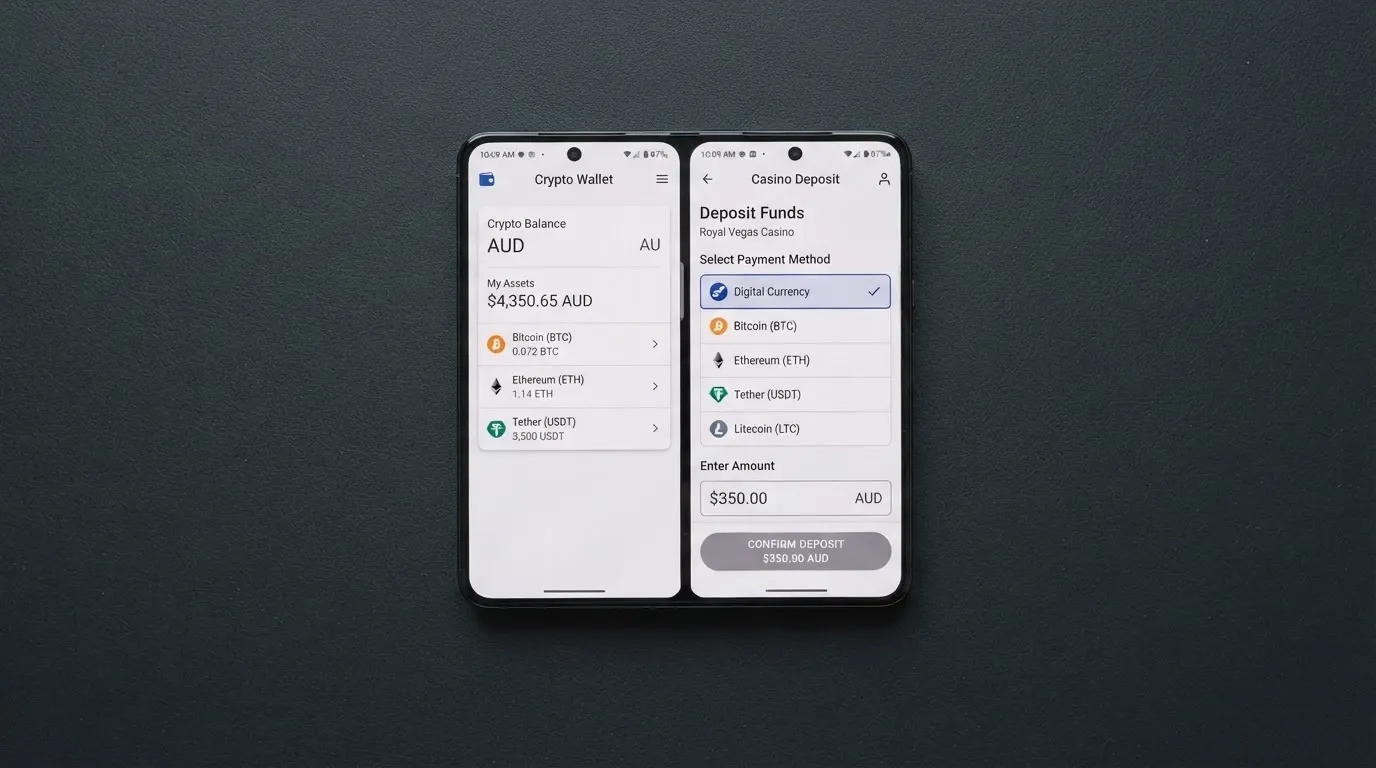
The crypto route changes three things for a VIP player. First, the withdrawal processing time: crypto withdrawals at most offshore operators are processed within hours rather than the 1-5 business days typical for bank transfers or card withdrawals. For a high-roller moving tens of thousands in winnings, the difference in processing time is the difference between waiting a week and waiting an afternoon. Second, the withdrawal limits: RocketPlay offers higher limits for crypto players, and Stake’s crypto-first model means there is effectively no withdrawal ceiling for verified accounts. Third, the deposit ceiling: crypto deposits usually have no per-transaction cap, which removes the friction of splitting large deposits across multiple card transactions.
The credit card ban on the licensed side is the reason the crypto route exists on the offshore side. The licensed market closed the credit card route to limit problem gambling; the offshore market kept it open via crypto, and the result is that the players who most need the licensed market’s protections are the ones most likely to seek the offshore alternatives.
The reform package from 1 January 2027 gives Australian banks express authority to block transactions to illegal gambling operators, which is the licensed-market response. A crypto deposit to an offshore casino routed through a centralised exchange may be blocked at the exchange; a deposit routed through a self-custody wallet will not be. The reader should understand that the route of the funds, not the destination, is where the new block sits.
The Anonymity Trade-Off: What You Gain and What You Risk
Crypto is often sold as anonymous. For a VIP player at an offshore casino, it is not. The casino still requires KYC — know-your-customer verification — for any withdrawal above a small threshold, and a player who has climbed to a VIP tier where the manager contact is invite-based has already passed KYC to reach the tier. Skycrown’s VIP manager access is gated behind KYC. RocketPlay’s VIP manager contact is triggered by either a large first deposit or four-plus weeks of regular crypto play, which is a behavioural trigger rather than a KYC trigger — but the withdrawal of any meaningful amount still requires verification.
What crypto actually provides is unlinkability at the payment rail. The deposit is not tied to a bank account or a card, the casino does not see a cardholder name, and the blockchain transaction does not include personal information. The casino’s KYC process ties the wallet address to the verified identity at the time of withdrawal, but the deposit itself is private.
The risk is the operator. An offshore casino that is not subject to Australian anti-money-laundering requirements may handle the KYC process casually, may not verify at all, or may verify and then use the verified information in ways the player has not authorised. The licensed Australian wagering market is subject to AUSTRAC requirements and to state-level AML obligations; the offshore market is not, and the difference is the regulatory floor under the operator’s behaviour.
The honest read: crypto at an offshore casino is more private than a card deposit, but the privacy is at the payment rail rather than at the casino. The casino still knows who the player is at withdrawal time, and the player has no Australian regulator to complain to if the verification process is mishandled. The privacy gain is real; the protection gain is not.
Inside the VIP Room: What Changes When You Leave the Main Lobby
VIP Rooms: Higher Limits and a Different Game
A VIP room at an offshore casino is not a separate building — it is a separate lobby, usually accessed from the main account page once a player has reached the relevant tier. What changes is the game selection and the stake range. The pokies in the VIP room are the same titles as in the main lobby, but the betting range is higher, with maximum bets that exceed the standard A$5–A$10 cap. The live dealer tables in the VIP room are the same Evolution and Pragmatic Play Live tables, but the table limits are higher, often starting at A$50–A$100 rather than the A$5–A$10 minimums in the standard lobby.

The practical effect is that a VIP player is not playing a different game — the RTP is the same — but is playing the same game at a stake level that makes the VIP tier economically meaningful. A A$5 maximum bet in the main lobby is not relevant to a player clearing A$20,000 in turnover; a A$50 maximum bet in the VIP room is. The room is the casino’s way of giving the high-volume player a stake ceiling that does not constrain the wagering.
For a player evaluating a VIP program, the question to ask is what the VIP room actually offers beyond the stake ceiling. Some operators open exclusive table variants, early access to new game releases, or higher RTPs on selected titles. Most do not, and the VIP room is a higher-stakes version of the same game library. The reader should expect the latter and be pleasantly surprised by the former.
VIP Clubs: Tiered Access and Exclusive Tournaments
A VIP club is the community layer over the tier ladder. The club gates access by tier — Platinum and above at Jackpot Jill, the upper levels at Crownplay’s five-level program — and offers events the lower tiers cannot attend. The events are usually tournaments: leaderboard races on selected pokies, with prize pools paid in cash or bonus funds, and the entry is by tier status rather than by buy-in.
The value of a VIP tournament depends on the prize pool relative to the entry pool. A Platinum tournament with a A$50,000 prize pool and 100 entrants is worth A$500 in expected value per entrant before considering the house edge on the wagering required to play; the same tournament with 1,000 entrants is worth A$50. The reader cannot evaluate a VIP tournament without knowing the expected field size, and most operators do not publish it.
Jackpot Jill’s Platinum tier offers exclusive pokie tournaments as a published benefit, and the Royal tier offers custom bonuses and a direct line to the head of VIP. The Royal tier is invitation-only and the specifics of the custom bonuses are not published, which is normal — the entire point of the top tier is that the terms are negotiated rather than standardised.
The VIP Lounge: Dedicated Support and Bespoke Offers
The VIP lounge is the support layer. A personal account manager replaces the standard support queue, and the manager’s job is to handle withdrawals, payment issues, bespoke bonus offers, and the day-to-day friction of running a high-volume account. The best VIP managers respond within hours, know the player’s history without being told, and proactively offer bonuses calibrated to the player’s pattern. The worst respond within the standard 24-48 hours, read from a script, and treat bespoke offers as a retention tool to be used sparingly.
Skycrown’s VIP manager contact is invite-based after KYC and steady play, with an indicative deposit from A$500. RocketPlay’s VIP manager contact is within 24 hours by email after either a large first deposit or four-plus weeks of regular crypto play. Jackpot Jill’s Gold tier is the published entry point for personal account manager access, and the Royal tier offers a direct line to the head of VIP. Each of these is a real channel, and each requires the player to have established the wagering pattern the operator is looking for.
The honest read on the VIP lounge: the personal manager is the clearest distinguishing feature of top-tier membership, and the offer is worth more in practice than the cashback percentage difference between tiers. A manager who resolves a withdrawal in 24 hours is worth more than a 0.5x cashback increase. The reader comparing VIP programs should weight the manager access channel — invite-based, automatic at a tier, email-only, 24/7 chat — as heavily as the cashback rate.
The Games VIP Players Actually Play — and the Ones That Return the Most
| Slot Title | Provider | RTP | Volatility | Max Win |
|---|---|---|---|---|
| Big Bass Bonanza | Pragmatic Play | 96.71% | High | 2,100x |
| Sweet Bonanza 1000 | Pragmatic Play | 96.53% | — | 25,000x |
| Gates of Olympus 1000 | Pragmatic Play | 96.50% | — | 15,000x |
| Book of Dead | Play’n GO | 96.21% | — | — |
| Wolf Gold | Pragmatic Play | 96.01% | Medium | 2,500x |
The RTP spread across the five confirmed titles is 0.70 percentage points, from Wolf Gold at 96.01% to Big Bass Bonanza at 96.71%. That spread is the difference between losing A$798 and losing A$658 on A$20,000 in turnover — a A$140 gap from choosing a different pokie at the same stake. At the volumes a VIP player is clearing, the gap compounds.

The volatility column tells a different story. Big Bass Bonanza and Wolf Gold are the two titles with confirmed volatility classifications, and the contrast is the standard high-volatility-versus-medium-volatility trade-off. A high-volatility pokie returns less frequently but in larger amounts; a medium-volatility pokie returns more frequently in smaller amounts. For a player clearing a wagering requirement, the higher frequency of medium volatility is usually preferable, because the wagering is met faster and the variance is lower. For a player playing with cash rather than bonus funds, the high-volatility upside is the attraction.
The max win column is the marketing layer. Big Bass Bonanza’s 2,100x and Wolf Gold’s 2,500x are large numbers; Sweet Bonanza 1000’s 25,000x and Gates of Olympus 1000’s 15,000x are the new-generation high-volatility figures. The max win is the upper bound of a single spin’s payout, and the probability of hitting it is the inverse of the figure — Sweet Bonanza 1000’s 25,000x pays out roughly once in many millions of spins. The reader should treat the max win as a marketing number and the RTP as the economic number.
Rainbet’s exclusion of slots with RTP over 97.4% from bonus play is the constraint that connects the game choice to the bonus arithmetic. A player who would prefer to clear wagering on a 97.5% or 98% RTP pokie cannot do so at Rainbet, and the operator has removed the games with the lowest house edge from the playthrough. The implication is that the wagering cost at Rainbet is higher than at operators without the exclusion, because the excluded games are exactly the ones a sharp player would choose.
Pokies That Reward High-Rollers With Better RTP
A VIP player clearing A$20,000 in turnover needs the highest RTP pokies in the eligible set, because every decimal point of RTP is a measurable amount of house edge avoided. The 0.70 percentage point spread between Wolf Gold and Big Bass Bonanza is A$140 per A$20,000 of turnover; the spread between Big Bass Bonanza and a hypothetical 98% RTP pokie would be A$258 over the same volume. The arithmetic is straightforward, and the player who is clearing wagering at a 96% pokie when a 97% pokie is available is paying for the choice.
The provider mix at the featured operators is concentrated on Pragmatic Play, with Play’n GO and Evolution at the larger operators. Pragmatic Play’s pokies are the most common bonus-eligible games across the set, and the RTP figures for the Pragmatic Play titles above are the published rates. A player who wants to verify the RTP for a specific pokie at a specific operator should check the game’s information page at the casino, because some operators run lower-RTP versions of the same title.
The Rainbet exclusion of RTP-over-97.4% pokies is the case where the operator’s terms directly contradict the player’s interest. A player who would prefer to clear wagering on a 98% pokie is forced to clear on a 97.4% or lower, and the difference is real money. The same exclusion is not present in the published terms of the other operators reviewed, and a player who values the high-RTP route should choose an operator without the exclusion.
Live Casino: The Real VIP Arena
Live dealer tables are where VIP status translates into a genuinely different experience. The main-lobby tables at Evolution and Pragmatic Play Live run from A$1–A$10 minimums, with maximums in the A$5,000–A$10,000 range. The VIP tables run from A$50–A$100 minimums, with maximums that scale into the A$50,000–A$100,000 range, and the table environment is private — the player is at a single table with a single dealer rather than one of many at a shared table.
Skycrown and Stake both carry Evolution in their provider lists, which is the clearest signal of live-casino depth at those operators. A player who intends to play live rather than pokies should choose an operator with Evolution and Pragmatic Play Live, and should verify the VIP table availability before depositing. Live casino is the only segment where the VIP program materially changes the product rather than the wagering, and a player who treats live as the primary game is the one for whom the VIP tier matters most.
The RTP at live casino is structurally different from pokies. Blackjack pays 99.5% with optimal strategy, baccarat pays 98.9% on the banker bet, and roulette pays 97.3% on the European single-zero wheel. A live-casino player clearing wagering is losing less per unit of turnover than a pokie player clearing the same amount, and the VIP live arena is where the maths most favours a disciplined player. The counterweight is the table minimum, which makes the live arena uneconomical for low-stakes players.
Demo Mode: Try Before You Commit (When It Is Available)
Demo mode lets a player test a pokie’s volatility, hit frequency, and bonus structure without risking real money. For a VIP player evaluating a new pokie before committing the volume the tier requires, demo mode is the only risk-free way to assess whether the game’s variance suits the player’s bankroll.
Demo mode availability at the featured offshore operators is not uniform. Some operators offer demo play on most pokies; others restrict demo mode to logged-in players, or to players who have made a deposit, or to specific game providers. A player who intends to test a pokie before committing should verify the demo mode is available for the specific title at the specific operator, and should not assume the title’s RTP in demo mode matches the real-money version. Some operators run the same RTP; some run a lower RTP in demo to preserve the marketing of the real-money figure.
The honest read: demo mode is more useful at the pokie evaluation stage than at the VIP program evaluation stage. A player who has already chosen the operator and the tier does not need demo mode; a player who is choosing between Big Bass Bonanza and Wolf Gold for the next A$20,000 of wagering should run both in demo for 200–500 spins to assess the volatility before committing.
How We Evaluated These VIP Casino Programs
The ten operators reviewed here were selected because they appear in Australian-facing rankings and because they accept Australian players in 2026. The list is not exhaustive of the offshore market, and the rankings on VIP program depth are based on what each operator publishes, not on what the operator claims when prompted.
The evaluation framework had four pillars. First, the published VIP program: tier structure, threshold transparency, cashback or rakeback percentages, and personal manager access. Jackpot Jill ranks highest on this pillar because the six-tier structure and the cashback multiplier at each level are published in detail. Skycrown ranks next on the strength of the 10% weekly cashback and the no-wagering condition. The remaining operators either publish less detail or, in two cases, could not be confirmed at all this run.
Second, the welcome offer terms: bonus size, free spin count, wagering multiplier, validity window, and maximum bet during bonus play. Crownplay has the largest headline offer; RocketPlay has the shortest validity window; Skycrown has the standard 40x on the bonus alone. The terms are compared on a like-for-like basis where possible, and on a first-deposit basis where the welcome package is multi-deposit.
Third, the offshore status and the player protection gap. All ten operators are offshore and unlicensed in Australia, and the ACMA can block any of them at any time. The evaluation flags this as a uniform risk rather than a per-operator differentiator.
Fourth, the verification state. Royal Reels and FairGO appear in Australian-facing rankings but this run could not confirm their VIP program details, bonus terms, or game providers. The data gap is the result, and the reader is asked to interpret the absence of confirmed information as a signal to verify directly with the operator before depositing.
The sources used in the evaluation are the operators’ own terms pages, the ACMA’s published enforcement and BetStop data, game-provider RTP disclosures, and two third-party review sources — BetSquare and Top10 Casino Australia — for VIP manager access data that the operators’ own pages do not publish. The research notes several gaps in the data the third-party sources cover, and the write-ups for the two unverified operators flag the gap rather than filling it with speculation.
What Your 2026 VIP Casino Decision Actually Rests On
The arithmetic on a VIP program reduces to three numbers and one risk. The first number is the monthly wagering required to reach the tier the player is aiming for. The second is the cashback or rakeback percentage the tier pays, and whether the cashback is paid in cash or bonus funds. The third is the wagering multiplier on any bonus the player claims at that tier, because the multiplier compounds with the cashback to determine the net return. The risk is the offshore status: the casino can be blocked, the withdrawal can be withheld, and the player has no Australian recourse.
For a player who is choosing between the ten operators reviewed, the practical ranking is Jackpot Jill first on the strength of the published six-tier program, Skycrown second on the no-wagering cashback, and the remaining operators in the order their published terms justify. A player who values crypto should look at RocketPlay for the higher crypto limits and Stake for the rakeback model. A player who values the welcome offer should look at Crownplay, with the awareness that the 35x deposit-plus-bonus wagering and 10-day validity are the constraint.
The decision the player should not make is the one the marketing invites: chasing the largest headline bonus and assuming the VIP program will return the difference. A A$8,000 welcome package at 40x wagering on the bonus is not worth more than a A$2,100 package at the same wagering, because the expected loss is proportional to the turnover required, not to the bonus size. The player who recognises that the wagering multiplier is the real price, and who reads the validity window and the maximum bet before claiming, is the player who will end the year ahead of the player who did not.
The offshore status is the constant under all of it. Every VIP program reviewed here is offered by an operator outside Australian law, and every benefit the program delivers is delivered by an operator that the ACMA can block tomorrow. The player who accepts that trade — and some will, because the licensed Australian market does not offer online casino at all — should choose the operator with the most transparent terms, the lowest wagering multiplier, and the clearest path to withdrawing winnings. The rest is marketing.
Frequently Asked Questions
How do I become a VIP member at an online casino?
Entry is either automatic on first deposit — the lowest loyalty tier counts as “VIP” at some operators — or invite-only after the operator’s VIP team has reviewed the player’s KYC, deposit history, and play pattern. At Jackpot Jill, Bronze is automatic and Diamond is invitation-only after roughly A$25,000 in wagering. Most operators publish the auto-enrolment tier; few publish the invitation threshold.
Do VIP programs offer better cashback than regular players?
Yes, and the gap is material. Standard loyalty cashback at the operators reviewed runs from 5% to 10% of losses with no wagering. VIP-tier cashback runs from 10% to 25% of losses, with the upper tiers at Jackpot Jill and similar programs paying multipliers of 1.5x to 2.5x on the base rate, and Skycrown offering 10% weekly cashback up to A$500 with no wagering requirement.
Can I get a personal account manager as a VIP casino player?
Yes, but only at the upper tiers and usually by invitation. Jackpot Jill publishes the Gold-tier threshold (roughly A$5,000 wagered) for personal account manager access. Skycrown and RocketPlay offer manager contact by invitation after KYC and either a large first deposit or several weeks of steady play. The manager is the clearest distinguishing feature of top-tier membership.
What happens to my VIP status if the casino is blocked in Australia?
The status is frozen in place at the casino, and the player’s account balance is held by the operator. The ACMA blocking does not return funds, and the player has no Australian dispute resolution. The licensed Australian market is not connected to the offshore casino’s program, so a blocked casino means a player loses both access and the tier, and the only recourse is the operator’s own dispute process or the regulator in the operator’s licensed jurisdiction.
Are crypto casinos better for VIP programs in Australia?
Crypto casinos offer faster withdrawal processing and higher withdrawal limits, which matters at VIP volume. RocketPlay explicitly offers higher limits for crypto players, and Stake operates as a crypto-first platform. The licensed Australian wagering market has banned credit cards and crypto for online wagering since 11 June 2024, so the crypto route is an offshore-only option. From 1 January 2027, Australian banks gain express authority to block transactions to illegal gambling operators, which will affect crypto deposits routed through Australian exchanges.
No-Deposit Bonuses: Do Any VIP Casinos Still Offer Them?
None of the ten featured operators in this review currently offers a no-deposit VIP bonus. The minimum deposit across the set ranges from A$20 to A$30 for the Australian-dollar operators, $30 to $50 (USD) for the USD-denominated operators, and €20 for the euro-denominated operators. The no-deposit bonus — a small cash or free spin credit issued on signup with no deposit required — is rare in the current offshore market for Australian players, and rarer still at VIP level.
The reason is structural. A no-deposit bonus attracts players who have not committed any money, and the casino’s expected loss on those players is the entire bonus amount. The wagering multiplier, maximum cashout cap, and game restrictions on no-deposit bonuses are calibrated to claw that loss back, and the player experience is almost always negative. The casinos that have moved away from no-deposit offers have done so because the bonus does not retain players — it attracts one-time claimers who leave after the wagering is cleared or the cap is hit.
If a player encounters a no-deposit bonus at an offshore VIP program, the checklist before claiming is short. What is the wagering multiplier, and does it apply to the bonus alone or the bonus plus any winnings? What is the maximum cashout, and is the cashout a withdrawal ceiling or a winnings-cap that forfeits the excess? Which games contribute to the wagering, and which are excluded? Is there a validity window, and is the window long enough to clear the wagering at the maximum bet the bonus allows? A no-deposit offer that fails any of those checks is one to decline.