
100 Free Spins No Deposit in Australia: What the Offer Is Worth After the Terms Are Read
A “100 free spins no deposit” offer is the loudest banner in Australian online casino marketing, and almost every line of fine print beneath it is the part that actually decides whether the player walks away with anything. The spin count is the headline; the wagering, the cashout ceiling and the slot the spins are locked to are the bill.

This page is built around the maths and the regulation, not the banner. Every operator reviewed here is an offshore casino serving Australian players from outside the country, because no online casino licence exists in Australia. The Interactive Gambling Act 2001 prohibits the supply; the player is not the target of the Act, but the player is the one who absorbs the cost of the terms once the spins land. Reading the page before claiming the offer is the cheapest thing a reader can do.
Data current as of 16 October 2026 and verified against the ACMA register, BetStop statistics and the operators’ publicly stated bonus terms.
Table of Contents
- The 100 Free Spins No-Deposit Offer, Unpacked — What It Is and What It Isn’t
- The Fine Print Nobody Reads — Wagering, Caps and the Spins That Vanish
- Where to Find 100 Free Spins No Deposit Offers in Australia (2026)
- The Pokies Behind the Promo — Games, Providers and What Actually Loads
- Claiming Free Spins on Mobile — Apps, Browsers and the Sign-Up Sprint
- Crypto Casino Free Spins — Bitcoin, No-Deposit Offers and the AU Payment Knot
- Free-Play vs Real-Money Spins — What the Demo Mode Won’t Tell You
- Is It Legal? The Offshore Reality Every Australian Player Faces in 2026
- Staying Safe — Gambling Harm, Self-Exclusion and Where to Get Help
- How We Picked and Ranked These Operators
- What You Should Actually Do With a 100 Free Spins Offer
- Frequently Asked Questions
The 100 Free Spins No-Deposit Offer, Unpacked — What It Is and What It Isn’t
A 100 free spins no-deposit offer is a sign-up promotion that credits a new account with one hundred rounds on a named pokie without requiring the player to deposit first. The “no deposit” part is the hook: nothing leaves the player’s bank account before the spins are played. The “free” part is the part that needs reading, because the spins are free to play but the winnings almost always come with strings.
The mechanics are simple. A new account is registered, the spins are credited (sometimes immediately, sometimes after a phone or email verification), the player runs the one hundred rounds on the named pokie at a fixed stake — typically A$0.10 to A$0.20 per spin — and whatever balance remains once the spins finish is the “winnings” the bonus terms apply to. That balance is not real money until the wagering requirement is cleared and the cashout cap is respected.
What the offer is not, in spite of how it is marketed:
- It is not a deposit-match bonus. A deposit-match offer requires a real-money deposit to unlock, usually doubles the deposit, and applies its own wagering to the matched amount. A no-deposit offer credits the spins before any money moves.
- It is not a no-wager bonus. Almost every 100 free spins offer reviewed on this page carries a wagering multiplier of 30x to 60x on winnings. A small number of zero-wager offers exist in the wider market, but the 100-spin headline in Australia almost always means 30x or worse.
- It is not a 100-spin reality. The honest Australian no-deposit market sits at 10 to 50 free spins for new sign-ups, not 100. The 100-spin headline is the marketing figure most commonly attached to offshore brands; the actual credited amount is often lower and may require a deposit to unlock in full.
The dollar value of one hundred spins at standard rates is small. At A$0.10 per spin, the total play value is A$10. At A$0.20, it is A$20. The player is not receiving A$100 of bonus value; they are receiving one hundred rounds on a single pokie at a fixed stake, and the upside is whatever the wagering and cashout cap leave on the table.
No-Deposit vs Deposit-Match — Why the Distinction Matters
The two offer types are built for different jobs. A no-deposit offer is an acquisition funnel — the casino’s cost of putting a new account on file. The player has not paid anything, has not entered a payment method in many cases, and has not committed to anything beyond an email and a phone number. The operator’s bet is that a small percentage of those accounts convert into depositing players who lose more than the cost of the free spins.
A deposit-match offer is a retention and upsell mechanism. The player has already paid in, the casino has a payment method on file, and the matched bonus is designed to keep the player at the tables and the pokies for longer than they would otherwise stay. The wagering applies to the matched amount, not to the deposit, and the terms are usually tighter than a no-deposit offer because the player is already monetised.
The honest description of the market: every “100 free spins no deposit Australia” landing page is an offshore acquisition funnel with Australian payment polish, not a state-endorsed product. The pages look local; the operator is not. The distinction matters because the no-deposit path leads to a smaller, more transparent bonus with a clearer upside, while the deposit-match path leads to a larger bonus with a steeper cost in turnover and time.
What You Actually Get — Spin Value, Play Time and the Real Cost
One hundred spins at A$0.10 each is a A$10 session; at A$0.20 each it is A$20. Across 100 spins the player will see a few small wins, possibly a bonus feature on the pokie, and a final balance that depends entirely on the hit rate and volatility of the title the spins are locked to. Starburst pays out small, frequent wins; Book of Dead has longer dry stretches punctuated by bigger hits. The pokie shapes the experience before any of the bonus terms do.
The realistic outcome of a no-deposit claim is unglamorous. About one in five claims results in a successful withdrawal, and the successful withdrawals land in the A$10 to A$50 range. The other four claims either burn through the balance before the wagering is cleared, hit the cashout cap on a larger win, or expire before the player can finish the wagering. The promotion is built to fail four out of five times, and the house edge baked into the pokie does most of the work.
The real cost of the offer is not the A$10 or A$20 in spin value; it is the wagering obligation on whatever the player wins. A A$20 win at 40x wagering means A$800 of turnover before a withdrawal is possible, and at 96% RTP the expected loss on that turnover is A$32 — more than the entire face value of the spins. The spins are a free trial. The terms are the price.
The Fine Print Nobody Reads — Wagering, Caps and the Spins That Vanish
Four numbers decide whether a 100 free spins offer is worth claiming, and three of them live in the bonus terms the player does not open until the spins are already played. Wagering requirement, max cashout cap, bonus expiry and max bet limit are the four. The first two eat most of the upside. The second two forfeit the rest.

Wagering requirements on Australian no-deposit free spin offers range from 25x at generous operators to 60x at tight ones, with a typical band of 30x to 50x. The multiplier applies to the winnings, not the spin face value — a A$30 win at 40x means A$1,200 of required turnover, not A$1,500. The lower the multiplier, the smaller the grind before the balance is withdrawable. Below 30x is favourable; 30x to 40x is marginal; above 40x is structurally disadvantaged, because the expected loss during the wagering grind begins to exceed the size of the original win.
Max cashout caps sit at A$50 to A$100 for most offers, with a handful of operators pushing to A$150 or A$180. The cap is independent of the wagering — the player must clear both hurdles to withdraw. A A$200 win reduced by a A$50 cap, then by a 50x wagering requirement on the reduced balance, is a different outcome than the raw win figure suggests.
Bonus expiry is the third trap. Most offers expire within seven days of claiming. Some operators set a 24 to 48 hour window. A player who wins on day one and returns on day eight finds the balance gone, the wagering obligation voided, and the spins counted as cleared with no payout.
Max bet limits are the fourth. While wagering, players typically cannot bet more than A$5 to A$7 per spin. Exceeding the limit voids the bonus and all winnings. A single A$10 spin during the wagering period is enough to forfeit the entire balance at most operators.
Wagering Requirements — 30x, 40x, 60x and What Each Tier Costs You
The wagering multiplier is the single most expensive term in the offer, and the one the marketing copy works hardest to bury. A 30x multiplier on a A$20 win requires A$600 of turnover before withdrawal. A 40x multiplier on the same win requires A$800. A 60x multiplier requires A$1,200. The arithmetic gets worse the larger the win, because the multiplier is applied to the winnings and the winnings grow with each lucky hit before the wagering begins.
The game contribution rules make the picture sharper. Pokies contribute 100% of every dollar wagered toward clearing the requirement. Table games contribute 10% or nothing. Live casino and jackpot games are off-limits in 99% of cases. The player who tries to clear a 40x wagering requirement by sitting at a blackjack table for an hour is doing the equivalent of ten hours of slot play, because every A$10 blackjack hand counts as A$1 toward the requirement. The pokie is the only realistic vehicle to clear the bonus, and the house edge on the pokie is the real cost.
The tier breakdown matters operationally. Below 30x is the only band where the expected loss during wagering is smaller than the original win, and even there the maths is close. 30x to 40x is a marginal zone where the bonus is technically clearable but the expected loss approaches the value of the win. Above 40x, the expected loss during wagering exceeds the value of the win more often than not, which means the player is paying to play. The 60x offers reviewed on this page are not worth the time the wagering takes.
Max Cashout Caps — Why Your A$200 Win Shrinks to A$50
A max cashout cap is a ceiling on the amount the player can withdraw from a no-deposit bonus, regardless of how much the spins produce. The cap is applied after the wagering is cleared, not before. A player who wins A$200, clears 40x wagering on the full amount, and reaches the withdrawal screen is paid A$50, not A$200, if the cap is A$50.
The cap is the operator’s hedge against a lucky sign-up. No-deposit offers are acquisition funnels, and the operator does not want a new account to walk away with a four-figure payout from a A$10 spin bundle. The cap limits the damage. The standard cap in the Australian market is A$50 to A$100; a smaller set of operators offer A$150 or A$180 caps that double the ceiling but do not remove it.
The player who reads the cap only after the wagering is done has lost the time invested in the wagering. The cap should be checked before the spins are played, because it changes whether a large win during the free spins is worth the grind. A 60x offer with a A$180 cap is a different proposition from a 60x offer with a A$50 cap, and the difference is the cap.
Bonus Expiry and Max Bet Limits — Two Traps That Void Your Winnings
Bonus expiry is the silent killer. Seven days is the standard window; some operators set 24 to 48 hours. A player who claims a 100-spin offer on a Monday and returns on the following Monday finds the balance at zero and the wagering obligation dissolved. The spins counted; the winnings did not.
The expiry applies to the wagering, not the spins. The spins usually need to be used within 24 hours of being credited; the wagering then runs on a separate clock. Both clocks start when the spins are credited, not when the spins are used. Missing either one voids the bonus.
Max bet limits are the second silent killer. While clearing wagering, the player cannot bet more than A$5 to A$7 per spin without voiding the bonus. The cap is per spin, not per round, and a single A$10 spin during the wagering period is enough to forfeit the entire balance. Some operators push the cap to A$10 — Fair Go’s God of Wealth promo allows A$10 per spin during wagering, which is the most generous in the set — but the rule is the same: exceed the cap, lose the bonus.
The max bet rule is enforced through the software, not the player. The casino tracks the average bet across the wagering period and flags accounts that exceed the cap. A player who bets A$5 for ninety rounds and A$20 for the ninety-first round will not see the A$20 spin paid out; they will see the entire bonus voided and the balance reset to zero. The rule has no grace period.
Where to Find 100 Free Spins No Deposit Offers in Australia (2026)
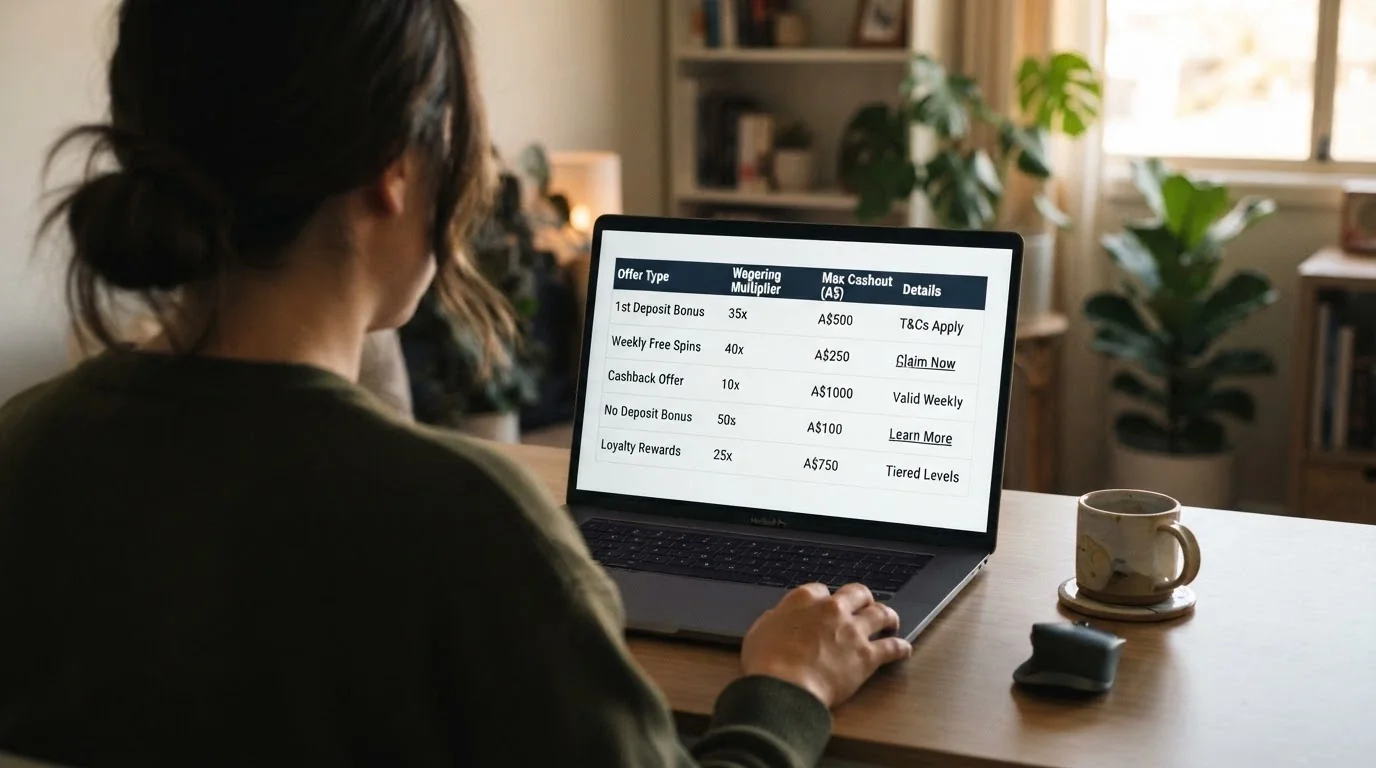
Ten operators appear in the featured set. Every one of them is licensed offshore (Curacao is the dominant jurisdiction) and serves Australian players from outside the country. No operator in the table holds an Australian online casino licence, because no such licence exists. The table ranks the operators by wagering burden, from the lowest multiplier in the set to the highest, with two operators flagged where the offer could not be confirmed this round.
| Operator | Licence | Free Spins | Wagering | Max Cashout | Bonus Slot |
|---|---|---|---|---|---|
| King Billy | Curacao (offshore) | 100 | 30x | A$120 | Starburst / Book of Dead |
| Skycrown | Curacao (offshore) | 100 | 35x | — | Not specified |
| PlayAmo | Curacao (offshore) | 100 | 35x | A$100 | Gonzo’s Quest |
| BitStarz | Curacao (offshore) | 100 | 40x | A$150 | Alien Fruits |
| Fair Go | Curacao (offshore) | 100 | 60x | A$180 | God of Wealth |
| Ozwin Casino | Curacao (offshore) | 100 | 60x | A$180 | Oz Golden Trail / Cash Bandits 3 |
| Play Croco | Curacao (offshore) | 100 | 60x | A$180 | Coyote Cash 2 |
| Ripper Casino | Curacao (offshore) | 100 | 60x | A$180 | Various |
| Rocket Play | Curacao (offshore) | — | — | — | Not confirmed |
| Bizzo Casino | Curacao (offshore) | 100 | — | — | Not confirmed |
The 30x offer at King Billy is the most player-friendly in the set, the 60x offers at Fair Go, Ozwin, Play Croco and Ripper are the least, and the two flagged operators sit outside the ranking because their terms could not be verified. The spread of A$100 to A$180 on the cashout cap matters less than the spread of 30x to 60x on the wagering: a 30x offer with a A$120 cap clears faster and pays more in expected value than a 60x offer with a A$180 cap, because the expected loss during wagering compounds with every additional multiple.
A reader who picks by the table alone is missing the part the table cannot show. The licence row is the same on every line, and the slot row is where the experience actually changes. Starburst, Book of Dead and Gonzo’s Quest are NetEnt and Play’n GO titles with verified RTPs in the 95 to 96% range. God of Wealth, Oz Golden Trail, Cash Bandits 3 and Coyote Cash 2 are RTG titles without publicly stated RTPs in the research that supports this page. A player who knows the pokie will trust the offer; a player who does not should pick the offer that locks to a pokie they have tried in demo mode first.
BitStarz — 100 No-Deposit Spins With Crypto Support and a 40x Wagering Hurdle
BitStarz is the longest-running brand in the set, operating since 2014, and the only operator in the table confirmed to accept both Australian dollars and six cryptocurrencies for deposits and withdrawals. The 100 no-deposit free spins are credited on Alien Fruits, a slot from a provider in BitStarz’s 79-studio lobby, and the wagering requirement on winnings is 40x. The max cashout is A$150, which is the second-highest in the table.
The 40x wagering is the mid-band of the set, and at a typical win it produces a grind of A$600 to A$800 of required turnover before withdrawal. The cryptocurrency support is a real differentiator for players who already hold BTC, ETH, LTC, DOGE, BCH or USDT, but it is worth noting that the Australian payment ban on digital currency applies to licensed wagering only — BitStarz is offshore and outside the ban’s reach. The withdrawal path is fast for crypto, slower for fiat.
The offer suits a player who already has cryptocurrency, is comfortable with 40x wagering, and wants a brand with a long operating history. The A$150 cashout ceiling is generous; the 40x multiplier is the price of that ceiling. For a player who values crypto payouts and a known brand, BitStarz is the most complete offer in the table.
Skycrown — Phone-Verified 100 Free Spins at 35x Wagering
Skycrown’s 100 free spins no-deposit offer is activated through phone verification, which adds a friction step most competitors skip. The wagering is 35x — below the 40x mid-band — and the lobby lists over 10,400 games, which is the largest in the table. The max cashout is not publicly stated in the terms research pulled for this page, which is itself a signal: a player who cannot find the cashout cap in the bonus terms should ask support before the spins are used.
The phone verification is a one-time step, not a recurring one, and it usually takes under a minute. The 35x wagering is the most favourable band the player can clear without it being trivially easy, and the game’s library depth means the operator is not relying on the bonus alone to keep the player around. The offer suits a player who is comfortable sharing a phone number with an offshore operator and who wants below-average wagering without committing to the lowest 30x in the set.
The missing cashout figure is the reason to read the terms before claiming. If Skycrown’s cap is in the A$50 to A$100 range, the offer sits in the middle of the table. If the cap is higher, the offer moves up. Until that number is confirmed, the offer is “35x wagering on a pokie you have not chosen yet, with a cap you have not been told.” The 35x is the floor of what the offer is worth; the cap is the ceiling.
Fair Go — RTG Pokies and 100 Free Spins With a 60x Reality Check
Fair Go’s 100 free spins no-deposit offer is locked to God of Wealth, an RTG pokie with medium volatility and 25 paylines. The wagering is 60x on winnings, the max cashout is A$180, and the max bet during wagering is A$10 — the most generous per-spin cap in the set. The 60x wagering is the most expensive in the set, and the A$180 cap is the joint-highest.
The combination tells the operator’s story. A 60x wagering requirement on winnings means the player is expected to grind A$1,200 of turnover for every A$20 of winnings before the cashout becomes available. At 96% RTP the expected loss during that grind is A$48, more than double the face value of the win. The generous A$180 cap and the A$10 max bet are the operator’s way of making the grind feel less restrictive, but the maths is the maths.
Fair Go suits a player who likes RTG pokies specifically, wants the highest cashout ceiling in the set, and is willing to accept that the wagering is the price of that ceiling. The God of Wealth pokie is a medium-volatility title, so the dry stretches are shorter than a high-volatility book like Dead or Alive but longer than a low-volatility title like Starburst. For most players, the 60x wagering is a hard “no.” For an RTG loyalist who knows the pokie, the offer has shape.
Rocket Play — A Curacao-Registered Platform With No Confirmed 100-Spin No-Deposit Offer
Rocket Play appears in the operator set because it shows up in the Australian-facing search results for 100 free spins no deposit, but research did not confirm a 100-spin no-deposit offer this round. The licence is Curacao, offshore and outside the Australian regulatory perimeter, and the operator is not on the ACMA whitelist because no online casino operator is — the whitelist does not exist for that product category.
A player who lands on Rocket Play’s promotions page should treat the absence of a confirmed 100-spin offer as the signal it is. Offshore casinos rotate their bonuses, and an offer that was live last month may be gone this month. The right move is to check the current promotions page before registering, read the wagering and cashout terms in full, and confirm that the offer is actually credited without a deposit before sharing payment details.
Rocket Play is in this list as a flag, not a recommendation. The absence of confirmed terms is the editorial position: a reader who sees Rocket Play ranked alongside operators with verified terms should know the verification is missing here, and act on that knowledge.
King Billy — The Lowest Wagering in the Set at 30x, With A$120 Max Cashout
King Billy’s 100 free spins no-deposit offer splits across Starburst (NetEnt, RTP ~96.09%) and Book of Dead (Play’n GO, RTP ~96.21%) — the two most popular pokies in the Australian-facing no-deposit market. The wagering is 30x on winnings, the lowest in the set, and the max cashout is A$120. The 30x wagering is the only offer in the table that sits in the “favourable” band identified in the terms analysis, where the expected loss during wagering is smaller than the original win.
A 30x wagering on a A$30 win requires A$900 of turnover, and at 96% RTP the expected loss during that turnover is A$36. The original win covers the loss, the A$120 cap leaves room above the expected outcome, and the slot titles are the two most widely-known games in the market. This is the cleanest offer in the set on the terms that matter most.
The verdict is the easiest one to write on this page. King Billy is the offer to claim if the player is choosing one. The 30x wagering is the reason. The Starburst and Book of Dead allocation means the player picks the pokie they want to play rather than the one the operator has chosen, which is rare in this market. For a player who wants the highest expected value and the most transparency, King Billy is it.
Ozwin Casino — 100 Free Spins on RTG Titles, 60x Wagering and A$180 Cap
Ozwin’s 100 free spins no-deposit offer is split across two RTG pokies — Oz Golden Trail and Cash Bandits 3 — at 60x wagering on winnings and a A$180 max cashout. RTG (RealTime Gaming) is the dominant provider in the Australian-facing offshore market, and the two titles are RTG-specific games that do not appear in the NetEnt or Play’n GO lineups. The 60x wagering matches Fair Go, Play Croco and Ripper at the top of the table; the A$180 cap matches them too.
The 60x wagering is the expensive term, and the RTG-specific titles limit the appeal to players who already know the games. A player who has never played Oz Golden Trail or Cash Bandits 3 is signing up for a 60x grind on an unknown pokie, which is the worst of both worlds. The A$180 cap is generous, but the grind to reach it is the most expensive in the set.
Ozwin is the offer for an RTG loyalist who knows the two pokies and has decided that the A$180 cap is worth the 60x grind. For everyone else, the offer is too expensive for the upside. The 60x is the reason; the unknown pokie is the second reason.
PlayAmo — 100 Free Spins on Gonzo’s Quest With 35x Wagering
PlayAmo’s 100 free spins no-deposit offer is locked to Gonzo’s Quest, a NetEnt pokie with a 95.97% RTP and medium-to-high volatility. The wagering is 35x, the max cashout is A$100, and the licence is Curacao offshore. The 35x wagering matches Skycrown at the favourable end of the mid-band, and the A$100 cap is the lowest ceiling in the set for operators with confirmed terms.
Gonzo’s Quest is a known title with a known RTP, which is an advantage over the RTG-locked offers with no published RTP. The 95.97% is below the Starburst 96.09% and the Book of Dead 96.21%, which means a small additional house edge per spin. The A$100 cap is the tightest ceiling in the set, which limits the upside of a lucky hit during the wagering period.
PlayAmo is the offer for a player who wants Gonzo’s Quest specifically and is comfortable with 35x wagering and a A$100 cap. The combination is balanced: the pokie is known, the wagering is manageable, the cap is the lowest. A player who values the cap over the wagering should look at King Billy’s A$120 cap with 30x wagering; a player who values the pokie over both will find this offer fits.
Play Croco — 100 Free Spins, 60x Wagering and a A$180 Max Cashout
Play Croco’s 100 free spins no-deposit offer is locked to Coyote Cash 2, an RTG pokie without a published RTP in the research that supports this page. The wagering is 60x on winnings, the max cashout is A$180, and the licence is Curacao offshore. The 60x wagering is the most expensive in the set; the A$180 cap matches Fair Go, Ozwin and Ripper at the joint-highest.
The unknown RTP on Coyote Cash 2 is the gap. An RTG pokie without a published RTP is a black box on the house edge, and a player claiming 100 spins on it is gambling on the pokie’s long-term payout as well as on the spin outcomes. The 60x wagering on top of an unknown RTP is the most uncertain offer in the set on the dimension the player cannot check.
Play Croco is the offer for a player who already knows Coyote Cash 2 and has decided the A$180 cap is worth the 60x grind. For everyone else, the offer is too expensive and too opaque. The 60x is the reason; the unknown RTP is the second reason.
Ripper Casino — 100 Free Spins With 60x Wagering and A$180 Max Cashout
Ripper’s 100 free spins no-deposit offer is the least specific in the set. The spins are credited on “various pokies” — the operator does not name a single bonus title — and the wagering is 60x on winnings with a A$180 max cashout. The licence is Curacao offshore. The 60x wagering matches the four operators at the top of the table; the A$180 cap matches them too.
The “various pokies” specification is the gap. A player who claims 100 spins on Ripper does not know which pokie the spins are locked to until the offer is credited, which means the player cannot check the RTP, the volatility or the bonus frequency of the title before committing. The 60x wagering is expensive on a known pokie; it is more expensive on an unknown one.
Ripper is the offer for a player who is comfortable with whatever pokie the operator assigns and has decided the A$180 cap is worth the 60x grind. The bonus terms should be read in full before the claim, and the eligible games should be confirmed with support if the terms page is silent. For everyone else, the offer is too expensive and too underspecified.
Bizzo Casino — 100 Free Spins on Sign-Up, Terms Not Publicly Verified
Bizzo’s 100 free spins are credited on sign-up, and that is the most that can be said about them with confidence. The wagering multiplier is not publicly confirmed, the max cashout is not publicly confirmed, and the bonus slot title is not publicly confirmed. The licence is Curacao offshore, and the operator is in the table because the offer appears in Australian-facing search results.
An offer with unconfirmed terms is the least transparent in the set, and the transparency gap is the editorial position. A player who claims 100 spins on Bizzo without knowing the wagering is gambling on the bonus terms as well as the pokie, and the player who wins during the spins may find a 50x or 60x requirement on withdrawal that was not visible at the claim stage. The unconfirmed cashout cap compounds the uncertainty.
Bizzo is the offer to skip unless the player is willing to open a live chat and ask, in writing, for the wagering multiplier, the cashout cap and the bonus slot title before claiming. The offer may be competitive; the offer may be expensive. Until the terms are visible, the player does not know which one it is, and the player should not find out by accident.
The Pokies Behind the Promo — Games, Providers and What Actually Loads
The pokie is the part of the offer the player actually experiences, and it is the part the headline does not describe. Most no-deposit free spin offers in the Australian market lock the spins to one or two named titles, not the full lobby. Starburst, Book of Dead, Big Bass Bonanza and Gonzo’s Quest are the most common bonus slot titles in the featured set; God of Wealth, Oz Golden Trail, Cash Bandits 3 and Coyote Cash 2 are the RTG titles that dominate the AU-facing offshore market.

The provider shapes the experience more than the title does. NetEnt and Play’n GO pokies have published RTPs in the 95% to 96% range and moderate volatility; they are the player-friendly end of the market. RTG pokies are less standardised on the RTP disclosure, and the volatility varies title by title. The RTG-heavy offers in the table are the ones with the least transparency on long-term payout.
RTP and volatility are the two numbers a player can actually use. Return to Player (RTP) is the percentage of wagered money the pokie returns to players over a large number of spins — 96% RTP means the pokie keeps 4% over the long run. Volatility is the spread of outcomes: low volatility pays out small, frequent wins; high volatility pays out larger wins less often. A 100-spin session on a low-volatility pokie produces a more predictable balance; a 100-spin session on a high-volatility pokie produces a wider range of outcomes and more sessions that end at zero.
The Slot Titles and Providers That Carry the Spins
The titles named in the featured offers split across three providers. NetEnt contributes Starburst and Gonzo’s Quest; Play’n GO contributes Book of Dead; RTG contributes God of Wealth, Oz Golden Trail, Cash Bandits 3, Coyote Cash 2 and Alien Fruits (the BitStarz title, where the provider was not confirmed in the research that supports this page). The published RTPs for the NetEnt and Play’n GO titles are 95.97% to 96.21%; the RTG RTPs are not publicly stated in the research.
| Slot Title | RTP | Provider | Volatility |
|---|---|---|---|
| Starburst | ~96.09% | NetEnt | Low |
| Book of Dead | ~96.21% | Play’n GO | High |
| Gonzo’s Quest | ~95.97% | NetEnt | Medium–High |
| God of Wealth | — | RTG | Medium |
| Alien Fruits | — | — | — |
| Oz Golden Trail | — | RTG | — |
| Cash Bandits 3 | — | RTG | — |
| Coyote Cash 2 | — | RTG | — |
The NetEnt and Play’n GO titles sit at the top of the table because their RTPs are verifiable. A player who picks an offer on one of these pokies is choosing a pokie with a known long-term payout. The RTG titles sit at the bottom because the RTP is not stated, and the player is choosing the pokie blind on the dimension that matters most.
The 95% to 96% RTP range across the published titles is the band the offer maths is built around. A A$10 spin bundle at 96% RTP is expected to return A$9.60 in winnings over the long run, before wagering. A A$10 spin bundle at 94% RTP is expected to return A$9.40. The 2% spread between the best and worst published RTPs in the table is a A$0.20 difference on a A$10 spin bundle, which compounds across the wagering obligation. A player who knows the pokie has the edge over a player who does not.
Claiming Free Spins on Mobile — Apps, Browsers and the Sign-Up Sprint
Mobile is the default path for most Australian players, and offshore casinos know it. Almost every operator in the featured set is mobile-first, with a browser-based site that adjusts to phone and tablet screens, a sign-up flow that runs in two or three screens, and a verification step that uses the phone’s camera for ID upload where required. Native iOS and Android apps are rare in the Australian-facing offshore market, and the operators that publish apps usually route Australian players to the browser version because the App Store and Google Play policies prohibit real-money casino apps in the Australian market.
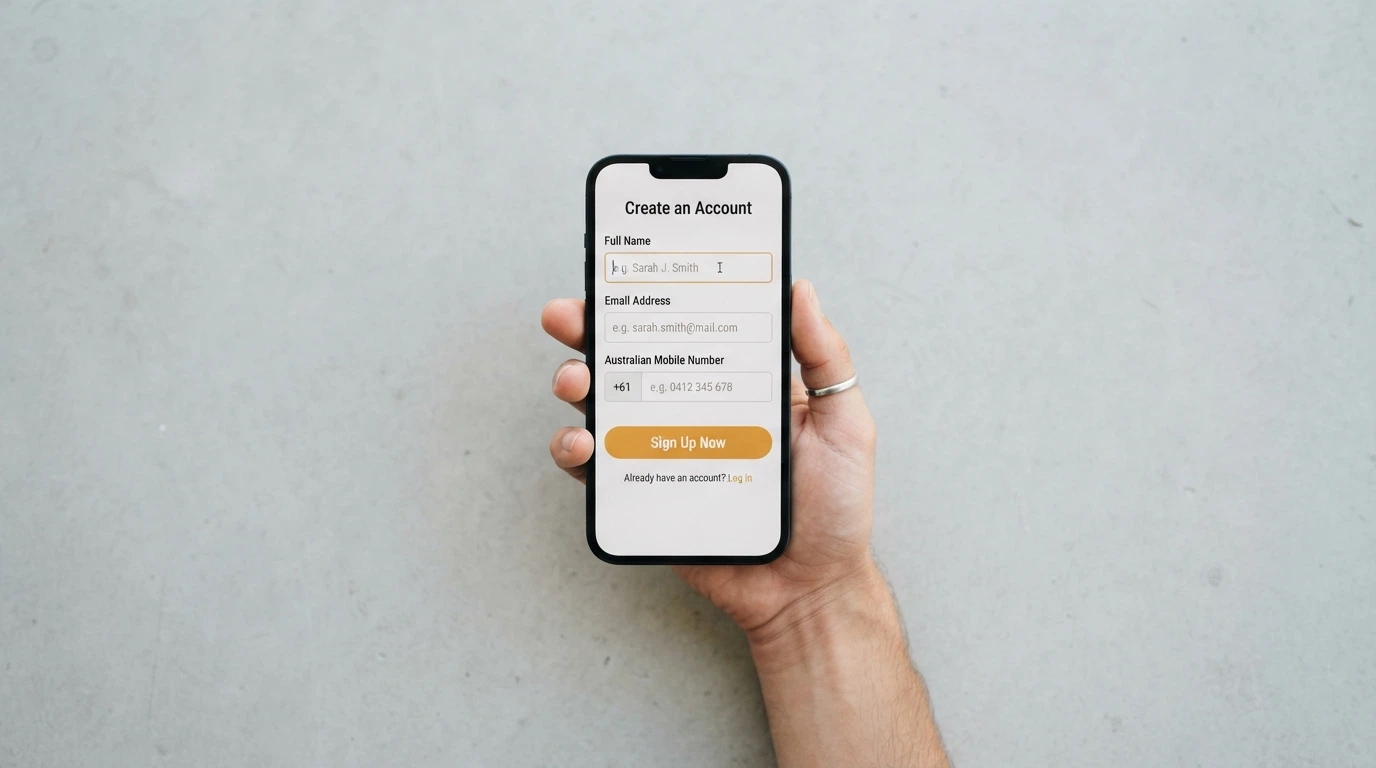
The sign-up sprint is the part that varies most. A typical no-deposit claim on mobile runs: open the operator’s URL in the browser, tap the sign-up button, enter email and password, confirm the email, and either receive the spins immediately or trigger the verification step. Skycrown requires phone verification before the spins are credited, which is a one-time code sent by SMS and entered on the site. Most other operators in the set require email verification only.
The phone verification step is the friction that catches players out. A player who enters a landline number, a work number, or a number they cannot receive SMS on at the moment of sign-up will not get the code and will not get the spins. The fix is straightforward — use a mobile number the player can receive SMS on at the moment of sign-up — but the fix is only obvious after the first failed attempt.
Mobile Browser vs Casino App — What Works for No-Deposit Spins
The mobile browser is the only path most Australian players have, and it is the path that works. The browser version of a modern offshore casino is a single-page application that loads the lobby, the cashier, the bonus terms and the live chat in one frame, with the game library rendered in HTML5 for instant play. No download is required, no app store approval is needed, and the player is playing within a minute of opening the URL.
Native apps exist in the wider market but are not the standard for the Australian-facing offshore operators in this set. The App Store and Google Play policies in Australia prohibit real-money casino apps from being published to Australian users, which means a native app would have to be sideloaded or installed through a third-party store. The friction of that install path is the reason most operators do not bother; the browser is good enough.
The browser experience has trade-offs. The game library loads in HTML5, which is fast on a modern phone and slow on an older one. Live dealer games run in the browser with a higher data cost than slot games. Push notifications are not available, so the player does not get a reminder when the bonus is about to expire. For a player claiming a 100-spin offer with a 7-day expiry, the absence of a notification is a real risk, and the player should set their own calendar reminder when the spins are credited.
Crypto Casino Free Spins — Bitcoin, No-Deposit Offers and the AU Payment Knot
Crypto casinos are a sub-niche of the offshore market, and the Australian regulatory environment makes them more complicated than the marketing suggests. BitStarz is the only operator in the featured set confirmed to accept cryptocurrencies for deposits and withdrawals — Bitcoin, Ethereum, Litecoin, Dogecoin, Bitcoin Cash and Tether are all supported. The 100-spin no-deposit offer at BitStarz is credited regardless of the deposit method, but the crypto support is the reason the brand is in this section.
The Australian position on crypto and online wagering is set by the Interactive Gambling Amendment (Credit and Other Measures) Act 2023, which banned credit cards, credit-related products and digital currency as payment for online wagering from 11 June 2024. The ban applies to licensed operators — the ones authorised by a state or territory to take sports and racing bets. The ban does not apply to offshore casinos, which sit outside the Australian regulatory perimeter and process payments through the crypto networks directly.
The gap between the licensed and offshore markets is the part the marketing tends to skip. A licensed Australian bookmaker cannot accept Bitcoin; an offshore casino can. The licensed bookmaker offers consumer protections and BetStop coverage; the offshore casino does not. The licensed bookmaker is required to verify identity and enforce deposit limits; the offshore casino is not. The payment route is a feature of the offshore product, and the offshore product is the only place a player can use crypto for online casino games in Australia.
Bitcoin Free Spins and the AU Payment Reality
A Bitcoin casino 100 free spins offer at an offshore operator works like this: the player registers, claims the spins, plays through the wagering, and withdraws the balance in BTC (or the cryptocurrency of choice) to a personal wallet. The withdrawal is processed on the blockchain, usually within a few hours, and the player receives the funds without going through a bank. The transaction is pseudonymous, the operator does not require identity verification for small withdrawals, and the player has full control of the funds once they land in the wallet.
The risk is the part the marketing does not lead with. An offshore casino is not connected to BetStop, has no Australian complaints body, and can disappear with the balance overnight. The ACMA has blocked 1,788 illegal gambling and affiliate websites since November 2019, and a blocked site is a site the player can no longer reach to withdraw funds. The crypto wallet is a real protection against payment-processor blocks (the casino cannot reverse a Bitcoin transaction), but it is not a protection against the operator closing the account or the site being blocked.
The Bitcoin free spins path suits a player who already holds cryptocurrency, is comfortable with self-custody of the wallet, and has accepted that the operator is outside every Australian safeguard. The 40x wagering at BitStarz and the A$150 cashout cap are the terms; the offshore status and the absence of recourse are the trade-off. A player who values the speed and pseudonymity of crypto will find the offer competitive. A player who values Australian consumer protection will not.
Free-Play vs Real-Money Spins — What the Demo Mode Won’t Tell You
Demo mode and no-deposit free spins look similar at a glance, and the difference between them is the entire point of the offer. Demo spins are play-money rounds on a pokie with no real-money balance at risk and no path to a real withdrawal. No-deposit free spins are real-money rounds on a pokie with a real balance at risk and a real withdrawal path gated by wagering and cashout terms. The two experiences feel the same in the first hundred rounds; they diverge completely at the withdrawal screen.
Demo mode is a tool, and a useful one. A player who has never played Book of Dead can run the pokie in demo mode for an hour and learn the bonus frequency, the volatility feel and the payline structure before committing a no-deposit claim. The cost of demo mode is zero; the time is real. The information is real too: a player who has played Book of Dead for an hour in demo mode knows the pokie better than a player who has never seen it.
What demo mode hides is the part that matters at withdrawal. A demo session tells the player what the pokie does; it does not tell the player what the wagering costs. A A$30 win on Book of Dead feels like a win in demo mode, where the wagering is a number on a screen. In a real-money claim, the same A$30 win triggers 30x to 60x of required turnover, and the cost of clearing that turnover is the expected loss on the pokie. Demo mode is silent on that cost because demo mode does not have a cost.
What Demo Mode Shows and What It Hides
Demo mode shows the game mechanics. The paylines, the bonus features, the scatter symbols, the wild substitutions and the volatility feel are all visible in the first hundred demo spins. A player who has run the demo can read the paytable and recognise the symbols, can predict roughly when a bonus feature is likely, and can decide whether the pokie is one they want to play for real.
Demo mode hides the bonus grind. The 100-spin offer is not 100 spins in isolation; it is 100 spins plus the wagering obligation on the winnings plus the cashout cap on the withdrawal. The cost of clearing the wagering on a A$30 win is a separate decision from the value of the pokie, and demo mode does not surface it. A pokie that feels generous in demo mode may feel very different when every win triggers a multiplier of 30x to 60x of additional turnover before the money is real.
The right use of demo mode is to choose which pokie to claim the spins on, not to decide whether to claim at all. A player who has played Starburst in demo mode for an hour knows the pokie and can claim a Starburst-locked offer with confidence. A player who has never played Starburst is claiming a 100-spin offer on an unknown pokie, which is a different risk profile. Demo mode is the cheapest research tool in the page, and the 30 minutes it costs saves the 30x wagering it would otherwise be spent on.
Is It Legal? The Offshore Reality Every Australian Player Faces in 2026
The first sentence of the legal position is also the last: online casino is prohibited in Australia. The Interactive Gambling Act 2001 makes it an offence to provide an online casino game — including online pokies — to a person in Australia. There is no licence for online casino anywhere in the country, not federally and not in any state or territory. A page about “licensed Australian online casinos” is describing something that does not exist.
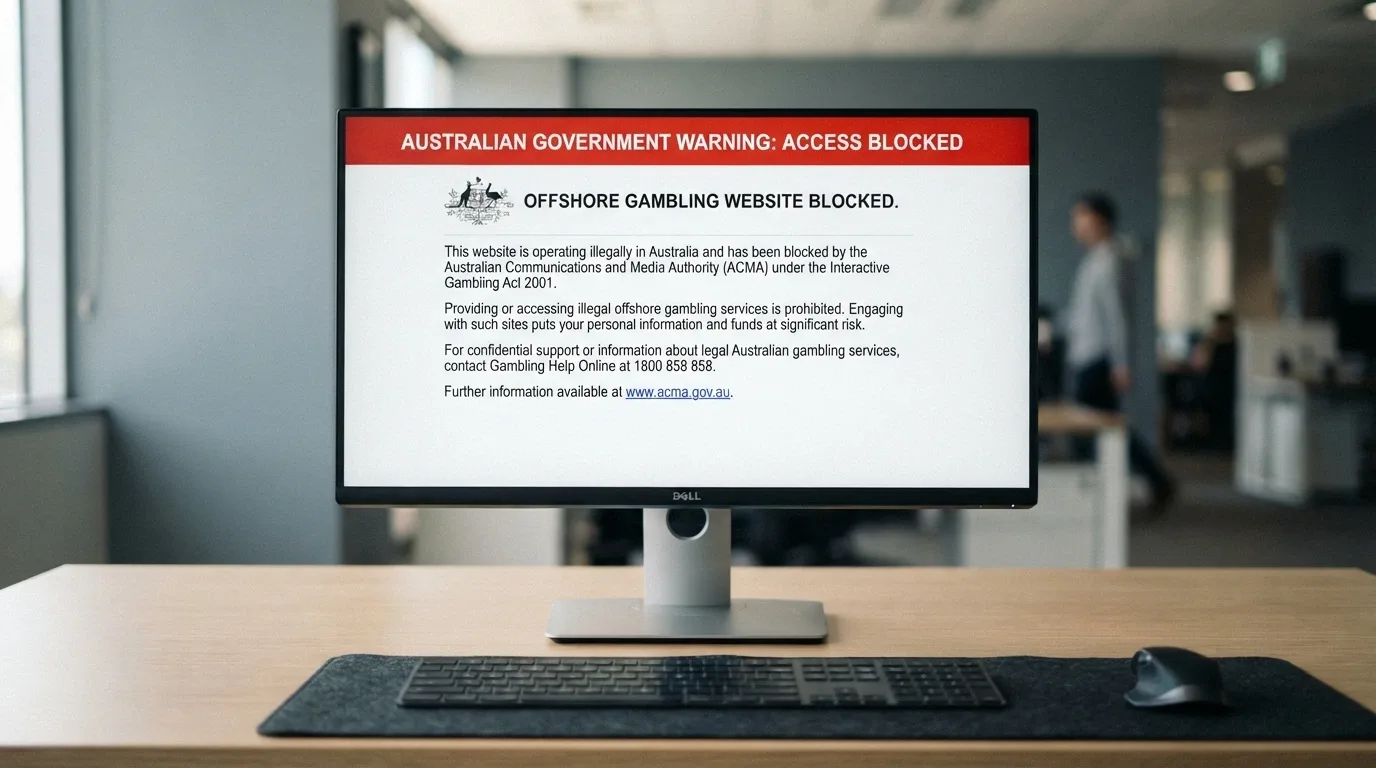
The Act targets the provider, not the player. An Australian who registers with an offshore casino and plays online pokies is not committing an offence under the IGA. The Act is enforced against the offshore operator, through ACMA blocking requests, ISP cooperation and international pressure. Over 230 illegal services have withdrawn from the Australian market since enforcement strengthened in 2017, and 1,788 websites have been blocked since November 2019. The player is downstream of the enforcement; the operator is upstream of it.
The 2026 Gambling Reform Bill, which passed Parliament on 19 August 2026, adds further measures that commence on 1 January 2027. The changes affect advertising, inducement marketing and the authority of banks to block transactions to illegal operators. The changes do not legalise online casino; they tighten the perimeter around the product that is already prohibited.
The honest summary is that the player is not prosecuted, but the player is unprotected. An offshore casino owes the player nothing under Australian law. The ACMA cannot recover a balance. BetStop does not reach the site. The site can be blocked at any time. The player is the one who chose to play, and the player is the one who absorbs the consequences if the operator does not pay out.
The Interactive Gambling Act 2001 — Why No Online Casino Holds an Australian Licence
The IGA is the foundation of the Australian online gambling position, and it is also the reason no online casino is licensed here. The Act, in force since 2001 and amended several times since, prohibits the supply of online casino games, online pokies and in-play sports betting to people in Australia. “Supply” is the operative word: the offence is providing the service, not using it. An offshore operator that accepts an Australian registration is committing an offence under the Act; the player who registers is not.
The enforcement is run by the Australian Communications and Media Authority (ACMA), which can request ISPs to block illegal sites, issue formal warnings, refer services for investigation and coordinate with international regulators. In Q4 2025 alone, the ACMA looked into 483 enquiries and complaints, completed 23 investigations into 45 gambling sites, found 69 breaches of the IGA, issued 10 formal warnings, and referred 133 websites to ISPs for blocking. The enforcement is real and ongoing.
The absence of an Australian online casino licence is not a gap in the market waiting to be filled. It is the design. The IGA was passed to prohibit the product, and the prohibition has been maintained through three federal amendments. The 2026 reform bill is the latest in that line. A player searching for a “licensed Australian online casino” is searching for a product the Australian Parliament has decided not to allow.
The 2026 Gambling Reform Bill — What Changes From 1 January 2027
The Interactive Gambling Amendment (Gambling Reform) Bill 2026 passed Parliament on 19 August 2026, and its measures commence on 1 January 2027. The bill does not legalise online casino. It tightens the perimeter around the product that is already prohibited, with a focus on advertising, inducement marketing and the payment infrastructure that supports illegal operators.
The advertising restrictions are the most visible change. From 1 January 2027, no more than three wagering ads per hour may air between 6:00 am and 8:30 pm. Wagering advertising is banned from 15 minutes before a live sporting event until 5 minutes after it ends. Broadcasting sporting odds is prohibited. Radio ads are barred during school times. Online wagering ads may only target logged-in, age-verified users. Athletes, celebrities and influencers are barred from promoting wagering.
The inducement marketing rules are the second major change. Direct marketing of inducements is prohibited for 14 days after a customer signs up, for three months after a person deregisters from BetStop, and indefinitely for customers identified as at risk of gambling-related harm. The rule is targeted at the kind of aggressive bonus marketing that brings players back to a site during the highest-risk window of a new account.
The bank blocking authority is the third. From 1 January 2027, banks and payment providers gain express authority to block transactions to illegal gambling operators. The rule gives the financial sector a clear legal basis to refuse or delay payments identified as flowing to offshore casinos. The effect on the player is that a deposit to an offshore casino may be refused at the bank, and a withdrawal from an offshore casino may be delayed or returned.
Payment Restrictions — Credit Cards, Crypto and the PayID Route
The Interactive Gambling Amendment (Credit and Other Measures) Act 2023 banned credit cards, credit-related products and digital currency (crypto) as payment for online wagering in Australia, with the ban commencing on 11 June 2024. The ban applies to licensed wagering operators — the sports and racing bookmakers authorised by a state or territory. The ban does not apply to offshore casinos, which process payments through the crypto networks and through international payment processors outside the Australian perimeter.
The legal deposit routes for licensed wagering are debit card, bank transfer, PayID/Osko and BPAY. A player who opens an account with a licensed Australian bookmaker can deposit through any of these methods, with identity verification required at account opening. The verification is the licensed operator’s KYC obligation; it is the same kind of check a bank performs when opening an account, and it is one of the consumer protections that offshore casinos do not provide.
The offshore casino path is different. A deposit to an offshore casino is made through a payment processor, a cryptocurrency transfer or an international card transaction. The processor may accept the deposit, may refuse it, or may hold it for review. A withdrawal is the same path in reverse. The risk is that the processor or the operator changes the terms at any time, and the player has no Australian body to appeal to.
Staying Safe — Gambling Harm, Self-Exclusion and Where to Get Help
The gambling-harm data in Australia is rising, and the offshore free-spins market sits outside every safeguard designed to address it. In 2024, 65.1% of Australian adults reported participating in at least one form of gambling, and 15% were at some risk of harm — 7.6% low risk, 4.8% moderate risk and 2.6% high risk. In 2025, the at-risk figure rose to 19.4% of adults, almost double the 13.7% recorded in 2024. Problem gambling among adults rose to 2.9% in the year to June 2025, up from 1.9% two years earlier.
The infrastructure for help is real, and it is the part of the page a reader who is struggling should not scroll past. The National Gambling Helpline (1800 858 858) is free, confidential and staffed 24 hours a day. Gambling Help Online (Gamblinghelponline.org.au) provides online chat and counselling. BetStop — the National Self-Exclusion Register — lets a player exclude themselves from every Australian-licensed wagering service in one registration. None of this infrastructure reaches an offshore casino.
The hard truth is that self-exclusion through BetStop binds Australian-licensed operators only. An offshore casino is not connected to the register. A player who has registered with BetStop can still open an account with an offshore casino, claim a 100-spin offer, and play. The exclusion does not follow the player outside the licensed market. The only exclusion that reaches every site is the player’s own decision to stop.
How Many Australians Are at Risk — The Numbers Behind the Headlines
The prevalence data is the background to every other number on this page. 65.1% of Australian adults gambled in 2024 — nearly two in three — and 15% of adults were at some level of risk. The at-risk figure rose to 19.4% in 2025, almost doubling the 2024 figure within a single year. Problem gambling among adults rose to 2.9% in the year to June 2025, the highest figure in the Roy Morgan series.
The risk gradient is also sharper than the headline. Low-risk gambling (7.6% of adults) is the largest at-risk group; moderate-risk (4.8%) is the second; high-risk (2.6%) is the third. The high-risk group is the smallest by count but the largest by individual harm, and it is the group the offshore market is most likely to capture. A high-risk player who lands on a 100-spin offer is exactly the player the bonus is designed to convert, and exactly the player who will not be protected by any of the offshore operator’s terms.
The minimum age for commercial gambling in Australia is 18. Every licensed operator verifies age at account opening. Offshore casinos verify age inconsistently, and the verification is the operator’s, not the regulator’s. A player under 18 should not be playing, and the offshore market is not the place to test that boundary.
Self-Exclusion, Helplines and the Tools That Actually Work
BetStop — the National Self-Exclusion Register — launched on 21 August 2023, and to the end of Q2 FY2025–2026, 54,859 people had registered. As of 31 December 2025, 35,135 people held active exclusions. The register binds Australian-licensed wagering services only; the registration excludes the player from every licensed online and phone bookmaker in the country in one step. The minimum exclusion period is three months, with options extending to a lifetime exclusion. 78% of registrants were under 40, and 38% chose lifetime exclusion.
The National Gambling Helpline is 1800 858 858, free, confidential and available 24 hours a day. Online chat and counselling are available through Gambling Help Online at Gamblinghelponline.org.au. The service is staffed by counsellors trained in gambling harm, and the first conversation is the one that decides whether the player calls back. The number is the one to save, even if the player never expects to use it.
The offshore casino gap is the part no tool closes. An offshore casino does not check BetStop, does not honour an Australian self-exclusion, and does not notify the player of the helpline number. A player who has registered with BetStop and then opens an offshore account has not breached the BetStop terms; the offshore account is outside the register’s reach. The exclusion is the player’s own commitment, and the offshore market is the place that commitment does not travel to.
The tax position is one footnote worth knowing. Gambling winnings are not assessable income under section 6-5 of the ITAA 1997, and gambling losses are not deductible under section 8-1 — unless the person is carrying on a business of betting or gambling. A casual player who wins A$200 on a no-deposit bonus does not declare it; a casual player who loses A$200 cannot claim it. The ATO’s IT 2655 sets out the criteria for the business-of-betting exception, and the threshold is high.
How We Picked and Ranked These Operators
The operators in the table were selected from the most popular online casinos currently offering 100 free spins no deposit to Australian players in 2026. The selection is descriptive, not exhaustive: many of the same brands appear repeatedly across the market, and the table captures the ones with the clearest published terms. Operators that appeared in the rankings but had no current offer (Rocket Play) or no publicly verifiable terms (Bizzo) are included for transparency, with the gaps flagged rather than filled in.
Every operator’s licence was checked against the ACMA regulatory framework. The check returned the same result for all ten: no Australian online casino licence, because no such licence exists. The featured operators are licensed in Curacao, which is an offshore jurisdiction and outside the Australian regulatory perimeter. The licence row in the table says “Curacao (offshore)” for that reason, and the absence of an AU licence is the consistent position across the set, not a per-operator failure.
The ranking is ordered by wagering burden, from the lowest multiplier in the set to the highest. The 30x at King Billy is the most player-friendly; the 60x at Fair Go, Ozwin, Play Croco and Ripper is the least. The two operators with unconfirmed terms (Rocket Play, Bizzo) are placed at the bottom of the table because the absence of a confirmed wagering figure leaves the ranking incomplete. The ranking reflects term transparency and wagering fairness; it is not a safety endorsement. Every operator in the set is offshore, and every operator carries the same offshore status caveat.
The reader should treat the table as a starting point, not a verdict. The operator review sections beneath the table add the per-brand detail the table cannot show — the bonus slot title, the game providers, the crypto support, the verification steps and the gaps the research did not fill. The two together are the picture; either alone is a summary.
What You Should Actually Do With a 100 Free Spins Offer
The verdict is the same regardless of which operator the player chooses, and it is the same regardless of which offer looks most generous. The first move is to read the bonus terms before claiming, not after. Wagering, max cashout, expiry and max bet are the four numbers that decide whether the offer is worth the time. A 60x offer with a 7-day expiry is a different proposition from a 30x offer with a 48-hour expiry, and the difference is in the terms, not the spin count.

The second move is to treat the spins as a trial, not a profit opportunity. The realistic outcome of a no-deposit claim is a small balance that may or may not clear the wagering within the expiry window. About one in five claims results in a successful withdrawal, and the successful withdrawals land in the A$10 to A$50 range. The player who expects a four-figure payout from a 100-spin no-deposit offer is going to be disappointed; the player who treats the offer as a way to test the casino’s pokies and withdrawal process is going to be informed.
The third move is to accept the offshore status and what it costs. Every operator on this page is offshore and unregulated in Australia. The ACMA cannot recover a balance if the operator refuses to pay. BetStop does not reach the site. Self-exclusion through BetStop does not stop an offshore account. The player who claims an offer at an offshore casino has chosen to play outside the Australian consumer protection framework, and that choice is the trade for the bonus. The trade is real, and it should be made knowingly.
The fourth move is to set a hard stop. The spins run, the wagering is cleared or it is not, the cashout cap is reached or it is not, and the player walks away. The offer is a one-time event, not a reason to keep playing, and the player who treats it as the latter is the player the marketing is designed for. Set a calendar reminder for the expiry, set a hard stop at the cashout cap, and leave the rest of the bonus in the casino’s pocket if the maths does not work. The house always has an edge, and this page is not the place to forget it.
Frequently Asked Questions
What are the typical wagering requirements for 100 free spins no deposit offers in Australia?
Wagering requirements on 100 free spins no deposit offers in Australia typically run from 30x to 50x on winnings, with the range stretching from 25x at the most generous operators to 60x at the tightest. Below 30x is favourable; 30x to 40x is marginal; above 40x is structurally disadvantaged. The multiplier applies to the winnings after the spins are played, not to the spin face value.
Can I win real money from 100 free spins no deposit bonuses in Australia?
Yes, but the realistic outcomes are small. About one in five no-deposit free spin claims results in a successful withdrawal, and the successful withdrawals typically land in the A$10 to A$50 range. The wagering requirement, the max cashout cap and the bonus expiry all gate the withdrawal, and any one of them can void a win.
How do max cashout limits work on no deposit free spins bonuses?
A max cashout cap is a ceiling on the amount the player can withdraw from a no-deposit bonus, applied after the wagering is cleared. Most Australian no-deposit offers cap withdrawals at A$50 to A$100, with a smaller set of operators offering A$150 or A$180. The cap is independent of the wagering requirement, and the player must clear both hurdles to withdraw.
What payment methods can Australian players use to withdraw winnings from free spins?
Withdrawals from offshore casinos offering 100 free spins no deposit to Australian players are typically processed through bank transfer, e-wallet or cryptocurrency, depending on the operator. The Australian ban on credit cards and crypto for licensed online wagering does not apply to offshore casinos. Identity verification is required for most withdrawals, and the processing time varies by method.
Do I need to verify my identity to claim 100 free spins no deposit in Australia?
Most offshore casinos require some form of identity verification before processing a withdrawal, even when the offer itself is no-deposit. The verification can include email confirmation, phone verification (Skycrown requires this before the spins are credited) and document upload for larger withdrawals. The verification is the operator’s, not the regulator’s, and the standard varies by brand.